













Hugo is the cheapest AI support agent published in 2026. Drag includes AI in the seat. Both undercut Fin, from opposite ends. The honest comparison.
Key takeaways
- Hugo (Crisp's AI agent) and Drag are 2026's two budget answers to per-outcome AI pricing: Hugo meters the category's cheapest published rate ($0.05 to $0.10 per conversation, token-based), while Drag includes AI in the seat from $18, with monthly AI credits and top-ups that never expire.
- The real difference is architecture: Hugo is a customer-facing agent born in Crisp's chat widget that escalates into Crisp's inbox; Drag is the inbox itself, inside Gmail, with AI working alongside the team.
- Hugo's mechanics to know before signing: credits expire monthly (reset on the 4th), testing and training consume them, Hugo stops answering when they run out unless Pay-As-You-Go is on, and it only exists inside a Crisp workspace.
- Both companies bet on MCP from opposite ends: Hugo consumes MCP to reach your tools; Drag ships its own MCP server so AI assistants can operate the inbox. If you believe support runs through AI, that shared bet matters more than the rivalry.
Table of contents
Hugo is Crisp's AI agent and, at $0.05 to $0.10 per handled conversation, the cheapest published rate in customer-facing AI support. Drag is a Gmail shared inbox with Varley, its AI, included in the seat from $18. Both exist because per-outcome pricing (Fin's $0.99) broke budgets, and both bet on MCP. The honest split: Hugo automates your chat widget inside Crisp; Drag puts AI inside the inbox where email-first teams already work. Here is the full comparison, including where Hugo genuinely wins.
What we agree on (and it is most of it)
Strip the branding and the two products share a worldview. Per-outcome AI pricing punishes exactly the teams AI should help most, so both price radically cheaper, just differently. Autonomous resolution claims are inflated across the industry, and to its credit Hugo's own case studies say 40 to 60 percent automation, not the 80-plus in most vendor decks; that matches what we tell readers to plan for. The winning pattern is hybrid, AI on routine volume with clean human handoff carrying full context, and both products are built around that handoff rather than pretending it away. And both companies made the same infrastructure bet: support runs through MCP. Hugo consumes MCP to reach your CRM, billing, and helpdesk so it can act rather than answer. Drag ships its own MCP server (47 tools) so assistants like Claude can operate the inbox itself. Same protocol, opposite ends of the pipe. If you are choosing between us, you have already decided AI is doing real support work; the question left is where it should live and how it should be billed.
Where the AI lives: the widget or the inbox
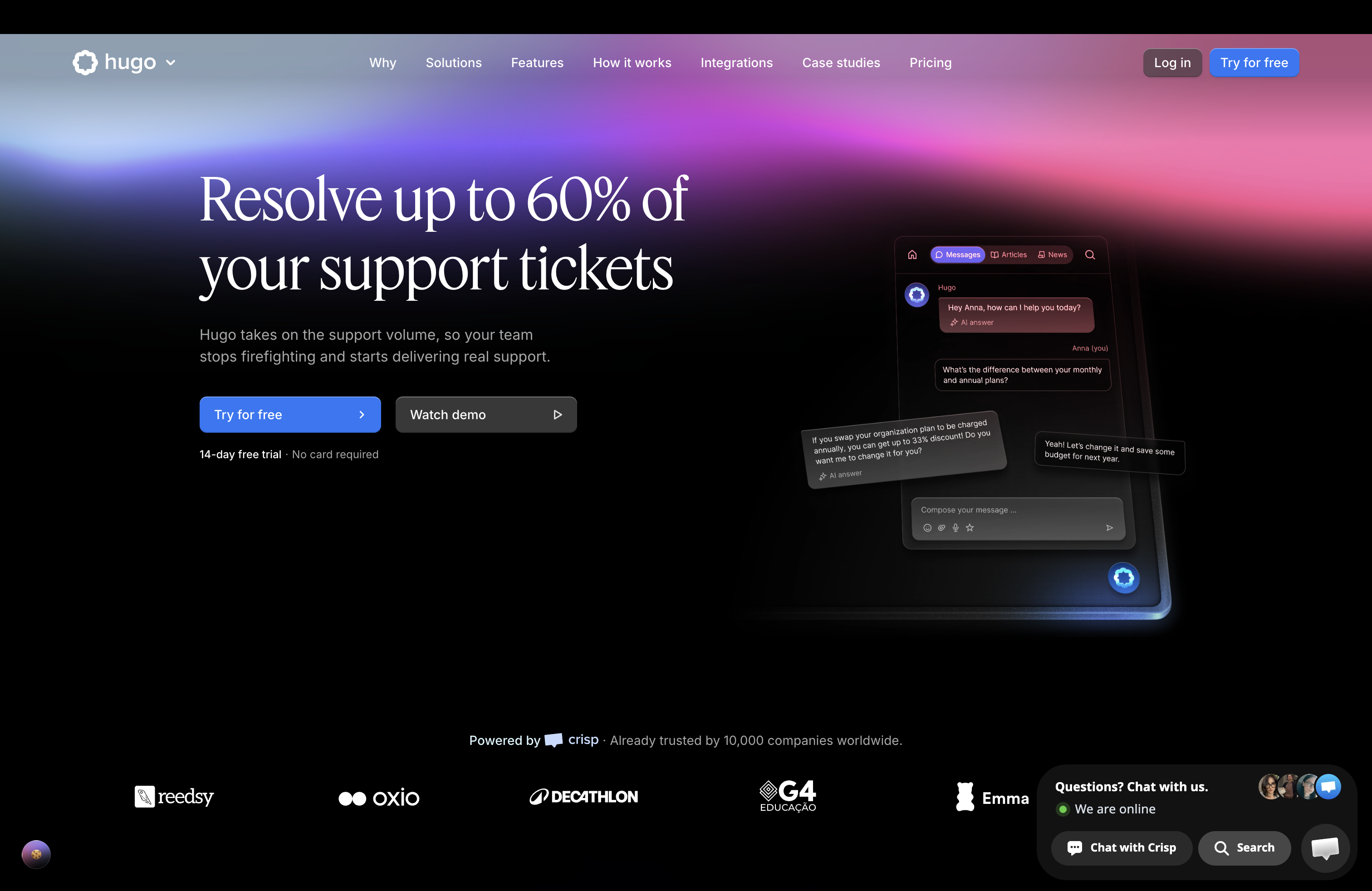
Hugo is customer-facing first. It was born in Crisp's chat widget, answers your customers directly across Crisp's channels, and escalates to humans inside Crisp's inbox. It is genuinely capable there: MCP tool access means it looks up orders and updates records instead of paraphrasing your FAQ, it is model-agnostic (Claude, ChatGPT, Llama, or your own), and setup is no-code. Drag starts from the opposite end: the inbox itself. The AI works alongside the team on the real support queue, drafting replies, classifying and tagging, summarising threads, reading sentiment, included in the seat with monthly AI credits. The customer-facing layer (help center, live chat, WhatsApp) is included, and on Pro, Varley’s Agent resolves conversations on its own. So the architectural question is honest and simple: do you want to automate the conversation your customers have with a widget, or equip the inbox your team already answers email from? Chat-led businesses will feel Hugo's pull; email-first Gmail teams are Drag's home ground.
The pricing mechanics, honestly
Hugo's headline rate is real and it is the cheapest published in the category, but the mechanics deserve plain statement, and all of this is from Crisp's own billing docs. Billing is token-based; $0.05 to $0.10 per conversation is Crisp's own average, and it moves with your model choice (Claude costs more, OpenAI less) and setup. A conversation means the full exchange until resolution or escalation, which is fair. Credits come bundled with Crisp plans ($5 on Mini, $25 on Essentials, $75 on Plus), expire every billing cycle on the 4th, and are consumed by testing, training, and Playground use, not just live conversations. When they run out, Hugo stops answering and escalates everything to your team, unless you enable Pay-As-You-Go, which, credit where due, supports spend caps. And Hugo exists only inside a Crisp workspace, so the real floor is Crisp's plan price, and multi-brand teams need a workspace each. Drag's model is simple: AI is included in the seat from $18, with monthly AI credits; heavy users top up, and credits they buy never expire. Run the honest numbers. A 4-person team handling 300 AI conversations a month: Crisp Mini at $45 plus Hugo usage of roughly $15 to $30 (minus the $5 included) lands at $55 to $70 total; Drag Plus is 4 x $18 = $72. At 10 seats: Crisp Essentials at $95, whose $25 of included credits covers that volume almost entirely, comes to $95 to $100 against Drag's $180. On raw dollars, Crisp plus Hugo is cheaper at both sizes, and we have said as much on our own Crisp comparison. The catch is that the two AIs are doing different jobs for that money: Hugo's spend buys customer-facing deflection on 300 widget conversations, while Drag's included AI works on every email the team touches, drafting, tagging, and summarising across the whole queue, plus the MCP server. Which job you need is the real question. And beyond the totals, the difference is not always the number itself. It is the meter's behavior: Hugo stops answering when its expiring credits run out, while at zero Drag keeps tagging, pauses only AI drafts, and never touches your email. Model both at your volume in the cost calculator.
Drag · with Varley
The inbox your team and Varley work in together
Shared inbox and live chat for Gmail teams, with Varley, Drag’s AI, included from $18. Plus an MCP server your own AI tools can drive.
Where Hugo genuinely wins
Straight up: if your support is chat-led, you are on Crisp (or happy to adopt it), and you want a customer-facing agent that acts on live data at the lowest published price anywhere, Hugo is the pick, and probably the category's best value. The MCP tool access is real capability, not marketing. Model choice is a genuine flexibility no rival at this price offers. EU hosting and GDPR posture matter for European teams. The spend caps show respect for budget control. And the honest 40-to-60-percent automation claims earn trust that inflated competitors squander. The watch-outs, equally sourced: G2 reviewers describe Hugo as feeling "like a guest" in Crisp's UI with lingering bugs, the Crisp mobile app has no AI at all, testing consumes paid credits, and everything you build lives and dies inside Crisp, the AI is not portable if you ever leave.
When Drag is the answer instead
If your support arrives mostly by email and your team lives in Gmail, the widget-first architecture is the wrong grain, and a metered customer-facing agent solves a problem you may not have. Drag equips the queue you already work: assignment, boards, collision detection, plus Varley, Drag’s AI, in the seat, and its MCP server means you can run the inbox from Claude or ChatGPT (search, draft, assign, reply) today. Most teams never reach the end of their included AI credits, bought credits never expire, and at zero your email keeps working. No platform migration: it installs into Gmail. And Varley’s Agent now resolves conversations on its own. (How MCP changes support covers the deeper shift both products are betting on.)
Frequently asked questions
What is Hugo?
Hugo is Crisp's AI customer support agent, launched in 2026. It answers customers autonomously across Crisp's channels, connects to your tools via MCP so it can act on live data, is model-agnostic, and escalates to humans with full context. It exists only inside the Crisp platform.
How much does Hugo really cost?
$0.05 to $0.10 per handled conversation on average, per Crisp's own billing docs, token-based underneath, so it varies with model and setup. Credits are bundled with Crisp plans ($5 Mini, $25 Essentials, $75 Plus), expire monthly on the 4th, and are also consumed by testing and training. When they run out, Hugo stops unless Pay-As-You-Go is enabled. The floor is a Crisp plan from $45.
Does Hugo require Crisp?
Yes. There is no standalone Hugo: it runs only inside a Crisp workspace, each brand needs its own workspace, and the AI configuration is not portable if you leave the platform.
How does Hugo compare with Fin?
Hugo is roughly ten to twenty times cheaper per conversation ($0.05-0.10 vs $0.99 per outcome) and includes MCP tool access and model choice, while Fin is the more proven agent at enterprise scale with the larger ecosystem. Fin also carries a 50-outcome monthly minimum. See the full Fin AI alternatives guide.
Drag vs Hugo: which should my team pick?
Chat-led team on (or open to) Crisp wanting the cheapest customer-facing agent: Hugo. Email-first team in Gmail wanting AI in the seat, plus an MCP server to run the inbox from AI assistants: Drag. The architectures barely overlap; pick where your support actually arrives.
Is Hugo's $0.05 per conversation real?
Broadly yes, with caveats from Crisp's own docs: it is a token-based average quoted as $0.05 to $0.10, model choice moves it, testing and training consume the same credits, and unused credits expire monthly. It remains the cheapest published rate in the category.

Co-founder
Building Drag for nearly ten years: shared inboxes, boards, and now the AI and agent layer, all on Gmail, plus HeyHelp for the personal inbox. Writes the honest versions of the comparisons.
