












Agentic customer support, defined properly: how AI agents resolve cases end to end, the chatbot difference, the tool-access layer, and the honest limits in 2026.
Key takeaways
- Agentic customer support means AI agents that resolve cases end to end, reasoning through them, using your real tools, and taking action, where chatbots only reply.
- The defining capability is tool access: an agent that cannot touch the inbox, CRM, or billing system cannot actually do support work.
- Humans stay in the loop by design: agents handle routine volume and escalate judgment calls, with an audit trail on every action.
- Adoption works in stages rather than as a big-bang replacement: AI assists first, then works with approval, then runs autonomously on narrow case types it has earned.
Table of contents
- What this guide covers
- What "agentic" actually means (and the three ways vendors use it)
- Agentic support vs chatbots: the actual difference
- How the loop works
- The connection layer: why tool access decides everything
- What agentic support can and cannot do in 2026
- Adopting agentic support without betting the queue
- What this looks like in a real inbox
- Frequently asked questions

Founder’s Take
A personal note from Nick, co-founder of Drag
The honest thing nobody in this market says out loud: we don't yet know where agentic ends. The current finish line is clear enough, a customer writes in, and an AI interprets the problem, takes the actions, and resolves it, start to finish, no human in the loop. Very few products genuinely do this today; Fin is one of a small handful, and it's what we built Drag's agent to do for teams running support on Gmail.
But I keep asking what's after that finish line, because I don't think resolution is the end state. The next frontier is agents that don't wait for the ticket: they watch usage, predict the problem, and reach the customer before the complaint exists. Support stops being a queue you answer and becomes something closer to a system that prevents its own volume. Whether that's two years away or five, I don't know, which is rather the point.
Definition last reviewed: July 2026.
Agentic customer support, sometimes called agentic AI customer service, is a way of running customer service in which AI agents handle requests end to end. They read each case, reason about what it needs, pull context from your systems, and take real actions through connected tools, replying to customers, updating records, issuing refunds. Each case is either resolved outright or handed to a human with the work already done. The word that matters is agentic, from agency: these systems act, where chatbots only respond. A chatbot answers "where is my order?" with a tracking link template; an agentic system looks up the order, sees it stalled, files the carrier claim, emails the customer the resolution, and logs the whole trail for review. This guide defines the term properly, since vendors currently use it three different ways, shows how the loop actually works, what connects agents to your tools, where humans stay essential, and how teams adopt it without betting the support queue on day one.
What this guide covers
- Agentic support vs chatbots
- How the loop works
- The connection layer: why tool access decides everything
- What agentic support can and cannot do in 2026
- Adopting agentic support without betting the queue
- What this looks like in a real inbox
- Frequently asked questions
What "agentic" actually means (and the three ways vendors use it)
Read ten vendor pages and you will find three competing definitions. Some mean full autonomy, an AI resolving tickets with no human involved. Some mean tool use, an AI that can act across your systems rather than just talk. Some mean multi-step reasoning, an AI that plans before it answers. All three are real properties, but they are not equally fundamental. Reasoning without tools is a smarter chatbot; autonomy without tools is impossible, there is nothing to be autonomous with. Tool access is the load-bearing property: an agent becomes agentic the moment it can touch the systems where support work actually happens, the inbox, the help desk, the CRM, billing. Autonomy is then a dial you turn per case type, and reasoning is the quality that decides how far you can turn it. That is the definition this page uses: agentic customer support is support work performed by AI agents with real tool access, at whatever level of autonomy each case type has earned. For the email-specific version, including the risks of letting an agent send, see what agentic email is.
Agentic support vs chatbots: the actual difference
| Chatbot | Agentic support | |
|---|---|---|
| Core action | Responds with answers | Performs the work |
| Knowledge | Scripted flows or a KB | Your live systems, in context |
| "Where's my order?" | Sends a tracking link | Checks the order, fixes the stall, confirms the fix |
| Scope | The conversation window | The inbox, CRM, billing, and beyond |
| When it fails | Loops or dead-ends | Escalates with the case pre-worked |
| Human role | Takes over from scratch | Reviews, approves, handles judgment calls |
The one-line version every comparison converges on: chatbots respond, agents act. The rows above are what "act" means in practice.
Drag · with Varley
The inbox your team and Varley work in together
Shared inbox and live chat for Gmail teams, with Varley, Drag’s AI, included from $18. Plus an MCP server your own AI tools can drive.
How the loop works
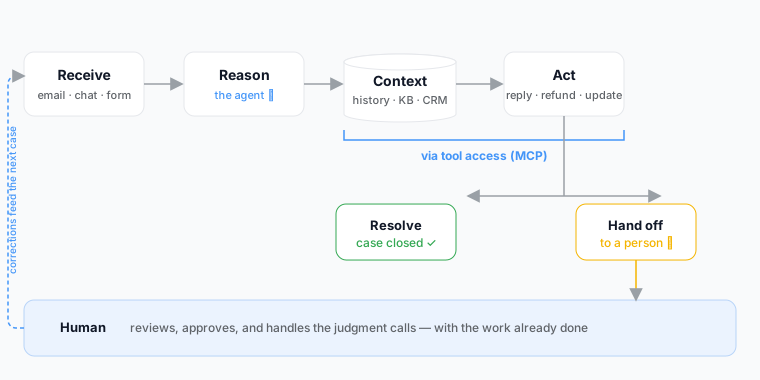
Every agentic system, whatever the vendor, runs some version of a five-step loop. Receive: a case arrives, an email, a chat, a form. Reason: the agent classifies it and decides what resolving it requires. Gather context: it pulls what it needs, the customer's history, the order, the knowledge base, your policies. Act: it does the work through connected tools, drafts and sends the reply, updates the record, processes the refund within its limits. Resolve or hand off: it closes the case, or it escalates to a human with everything it found and did attached, which is the difference between an escalation and a cold start. The loop then feeds back: every resolution and every correction a human makes becomes signal for the next case.
The connection layer: why tool access decides everything
The loop lives or dies on step four, and step four is a plumbing question. An agent can only act on systems it is connected to, which is why the emerging standard here matters more than any model benchmark: MCP, the Model Context Protocol, gives AI agents a common way to see and operate real tools, the same way a standard port replaced a drawer of proprietary cables. A support stack whose inbox, help desk and data speak MCP can be worked by whichever agent you choose, Claude, ChatGPT, or a purpose-built one, without custom integration for each. This is also the honest test to put to any vendor using the word agentic: what can your agent actually touch, and through what? Our guide to MCP for customer support covers the protocol side in depth, and the practical how-to shows a real queue being worked from Claude. The same walled-versus-open question is reshaping the sales side too, which our agentic CRM guide takes on.
What agentic support can and cannot do in 2026
Where it is genuinely good today: high-volume routine cases with clear policies, order status, returns within rules, password and account basics, appointment changes, first-response triage and routing, and drafting for human review on everything else. Where it is not: judgment calls, angry or vulnerable customers, policy exceptions, anything legal or safety-adjacent, and edge cases with no precedent, which is precisely where your best humans earn their keep. The market is honest about this in private and less so in public: Gartner predicts more than 40% of agentic AI projects will be canceled by the end of 2027, on escalating cost, unclear value, or weak controls. The pattern behind failed projects is consistent, too much autonomy too fast, on case types that had not earned it. The teams succeeding run the dial in stages, which is the next section.
Adopting agentic support without betting the queue
- Assist. The agent drafts, summarizes and triages; humans send everything. You learn where it is reliably right, at zero customer risk.
- Approve. For the case types it handled well, the agent acts, behind a one-click human approval. Volume drops for the team; the audit trail builds.
- Autonomous, narrowly. Case types with proven accuracy graduate to end-to-end handling with spot-check review; everything else stays at assist or approve. Autonomy is earned per case type, never granted wholesale.
The readiness checklist before stage one: written policies an agent can follow (refund limits, escalation rules); a knowledge base that is actually current; clean tool access to the systems support touches; a named human owner for the agent's performance; and an escalation path that preserves context. Teams missing two or more of these should fix the operation first, agentic support amplifies the operation you have, including its gaps.
What this looks like in a real inbox
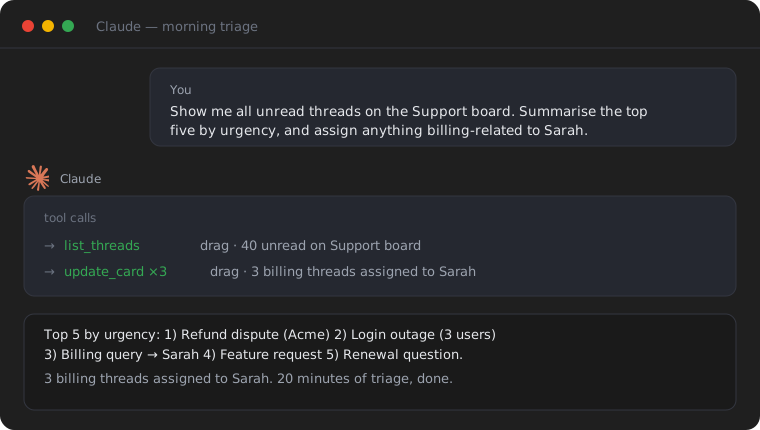
Concretely, here is what it looks like in a shared inbox. The morning queue arrives and the agent has already triaged it: routine cases are resolved or drafted, each with its reasoning attached as internal notes, and the rest are assigned to the right person with context summarized.
A human reviews the drafts over coffee, approves most, rewrites two, and the corrections teach the system. Rules still handle the deterministic work, routing by keyword, SLA timers, because rules are cheaper than reasoning where reasoning adds nothing; the agent handles the cases where judgment within policy is the job.
That division, rules for the predictable, agents for the reasonable, humans for the judgment, is what a working agentic operation actually looks like, and it is the model Varley’s Agent implements for teams running support on Gmail, with every agent action visible, assignable and reversible by the team.
Frequently asked questions
What is agentic customer support in simple terms?
It is customer service where AI agents do the work, not just the talking: they read cases, use your real systems, take actions like replying or processing refunds, and resolve issues end to end, escalating to humans when judgment is needed.
How is agentic AI different from a chatbot?
A chatbot responds from scripts or a knowledge base; an agentic system acts across your tools. The difference shows at "where's my order?": the chatbot sends a tracking link, the agent checks the order, fixes the problem, and confirms the resolution.
Does agentic support replace human agents?
No, it redistributes the work. Agents absorb routine volume and pre-work escalations; humans handle judgment, exceptions and relationships. Teams typically redeploy people toward harder cases rather than cutting them, the queue's easy half simply stops consuming them.
What is MCP and why does it matter for agentic support?
MCP, the Model Context Protocol, is the open standard that lets AI agents see and operate real tools, inboxes, help desks, data, through one common connection. It matters because tool access is what makes an agent agentic; MCP is how that access happens without custom integration per tool.
Can AI agents really resolve tickets end to end?
Yes, for the right case types. Routine, policy-clear, high-volume work resolves reliably today, and the harder judgment calls still route to people.
How do you measure whether agentic support is working?
The same numbers as before, first response time, resolution time, reopen rate, satisfaction, plus two new ones: the share of volume resolved autonomously, and the correction rate on agent actions. Rising autonomy with a flat-or-falling correction rate is the health signal.
What does agentic customer support cost?
The cost usually has two layers. The first is the agent capability itself, which on some tools is a plan tier, Drag includes it in the $18 per user plan, and the second, on some platforms, is a per-resolution or usage fee on top. The honest comparison is cost per resolved case against your loaded human cost on the same case types.
Is agentic customer support safe for regulated industries?
With the dial set correctly, yes: assist and approve modes keep a human on every send while still capturing most of the efficiency. Full autonomy in regulated contexts should be limited to case types with zero policy ambiguity, if used at all.
How long does it take to adopt?
The assist stage delivers value in days, it is drafting and triage, not surgery. Earning autonomy takes weeks per case type, because it should: the audit trail has to prove accuracy before the approval step comes off.
What is the best way to try agentic support on a real queue?
Start where your volume is: connect the inbox your team already works. Drag turns a Gmail shared inbox into an agentic operation, with drafting, triage, and agent actions running under human approval, and its MCP server means Claude or ChatGPT can work the same queue. The 7-day trial needs no card.
Co-founder
Building Drag for nearly ten years: shared inboxes, boards, and now the AI and agent layer, all on Gmail, plus HeyHelp for the personal inbox. Writes the honest versions of the comparisons.
