







Fin (formerly Intercom) is built around a customer-facing AI agent billed at $0.99 for every outcome it produces, where an “outcome” can be as little as a customer who stops replying. Salesforce signed to acquire Fin for approximately $3.6B in June 2026 (closing expected in Salesforce’s fiscal Q4 2027). It is a powerful platform, but many teams evaluating it do not actually need a customer-facing AI chatbot; they need a shared inbox where their team collaborates and AI is included. This is an honest comparison of the two approaches, and where each one genuinely fits.

Table of contents

Founder’s Take
A personal note from Nick, co-founder of Drag
It always sounds impressive when a SaaS product gets a billion-dollar exit. In Fin's case (the company formerly known as Intercom), it's $3.6 billion. But what does that really mean for the teams using it, when the product is being absorbed into Salesforce? Fin becomes a product for Salesforce customers: that's the stated plan, folding it into Agentforce.
The page below is a little about Drag, and how it may work for the many Fin users who aren't Salesforce customers, and don't plan to be.
The verdict
Drag and Intercom solve different problems. Intercom (now Fin) is an AI-first platform built around a customer-facing AI agent billed at $0.99 per outcome; it is excellent if you want autonomous AI resolution at scale and can absorb usage-based pricing. Drag is a Gmail-native shared inbox with AI included in the seat ($12 to $24), best for teams whose support is email and collaboration and who want predictable pricing. If you want a customer-facing AI chatbot, choose Intercom; if you want a shared inbox where AI helps your team and costs are flat, choose Drag.
Choose Drag if you…
- Your support is email and team collaboration, not a customer-facing AI chatbot.
- You want AI included in the seat, with predictable per-seat pricing.
- You want to stay in Gmail rather than adopt a separate platform.
- You want to run your inbox from Claude or ChatGPT (Drag has its own MCP server).
- You want an independent product, not one mid-acquisition.
Choose Intercom if you…
- You specifically want a best-in-class customer-facing AI agent (Fin) that autonomously resolves tickets.
- You want an AI-first platform where human and AI agents share one inbox at scale.
- You can absorb usage-based pricing that scales with AI resolutions.
Looking at more options? See our best Intercom alternatives for 2026 for a broader comparison.
Do you need a customer-facing AI agent, or a shared inbox?
Before comparing prices, ask what you are actually buying. Intercom’s Fin is a customer-facing AI agent: it talks to your customers and tries to resolve issues autonomously, and you pay for each outcome. That is genuinely valuable if you have high volumes of repetitive questions and want to deflect them. But a lot of teams evaluating Intercom do not really need an autonomous chatbot answering customers. They need a shared inbox where their team handles email together, faster, with AI helping draft, summarise, and triage, and included in the price.
Those are different products. If you want the autonomous customer-facing agent, Intercom is one of the best. If what you actually need is a collaborative inbox with AI built in, you are likely overpaying per outcome for something you do not need. This page compares Drag (the shared-inbox-with-AI-included answer) to Intercom (the AI-agent answer), honestly, so you can tell which one your team needs.
Drag vs Intercom at a glance
| Feature | Drag | Intercom |
|---|---|---|
| What it is | ||
| Core model | Gmail shared inbox, AI included | AI-first platform, customer-facing agent (Fin) |
| Best-fit need | Team email + collaboration | Autonomous customer-facing AI resolution |
| Works inside Gmail | check_circle | cancel |
| Standalone app too | Yes (web/desktop/mobile) | check_circle |
| Pricing | ||
| Seat price (per seat/mo, annual) | $12 to $24 | $29 to $132 |
| AI cost | Included from $18 | $0.99 per outcome, every plan |
| Cost predictability | Flat, predictable | Usage-based, scales with volume |
| "Assumed resolution" billing | None | Billed when a customer just stops replying |
| AI | ||
| AI included in seat | check_circle | No (per-outcome) |
| Customer-facing autonomous agent | cancel | Yes (Fin) |
| AI works on your real inbox | check_circle | Knowledge base + trained sources |
| MCP server (connect Claude/ChatGPT) | check_circle | cancel |
| Company | ||
| Independent | check_circle | Acquisition by Salesforce agreed (June 2026) |
Pricing and features verified June 2026; confirm current details on each vendor’s site.
Why Gmail teams pick Drag
Pricing
Predictable pricing, AI included.
Drag is $12 to $24 a seat, with AI included from $18. One predictable bill, no usage surprises. Intercom runs $29 to $132 a seat, and then Fin adds $0.99 for every outcome on top, including “assumed resolutions” where the customer simply stops replying. The difference grows with volume.
- Drag: $12 to $24 a seat, AI included from $18, flat and predictable.
- Intercom: $29 to $132 a seat, plus $0.99 per Fin outcome (usage-based, hard to forecast).
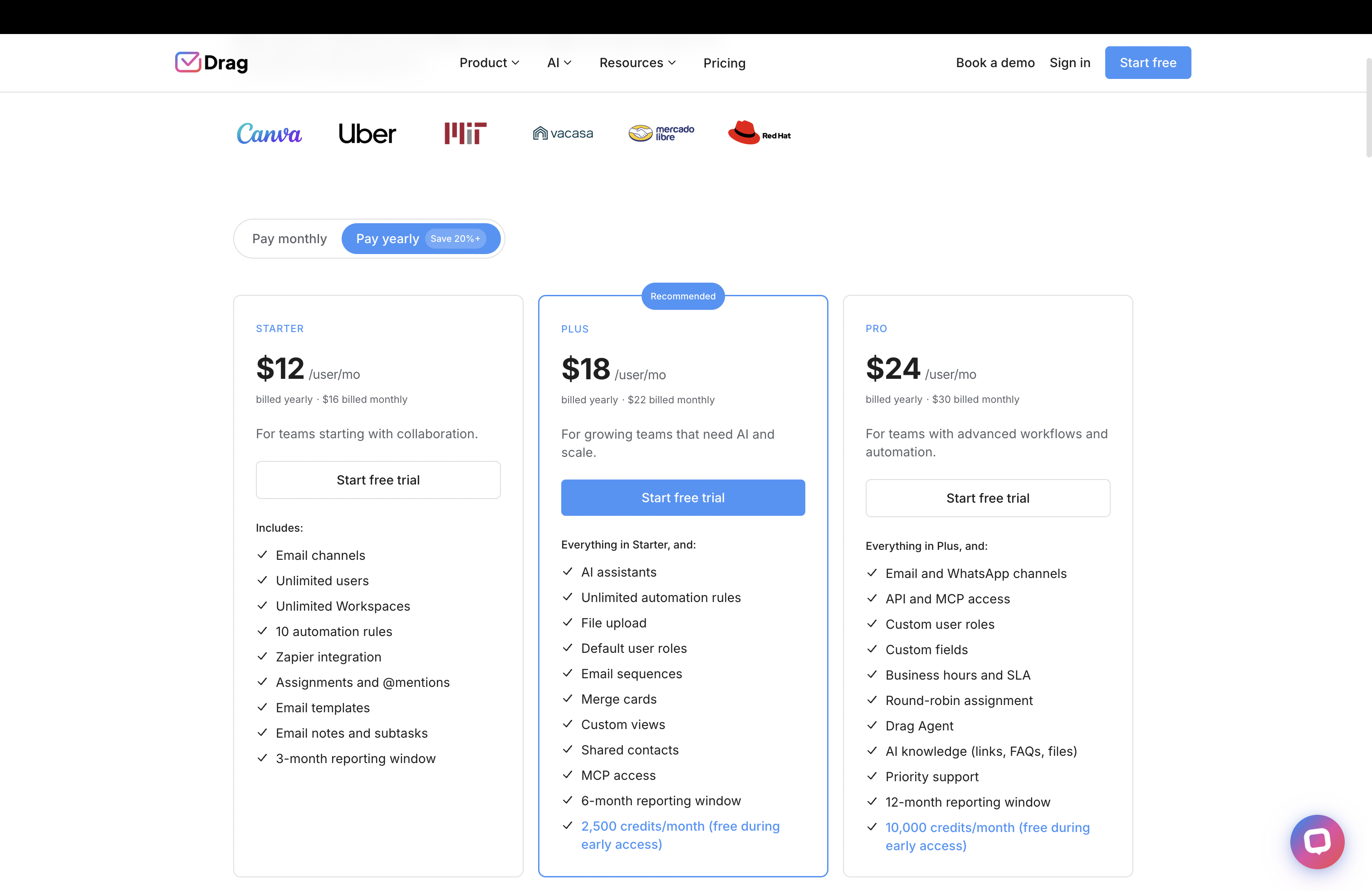
Source: Drag and Intercom pricing pages, June 2026.
AI
AI that helps your team, included.
Drag includes Varley, its AI, in the seat from $18. It drafts and tags every email, answers from everything your team knows, acts in your tools and, on Pro, resolves conversations on its own. It works on your real inbox, not just a knowledge base. Intercom’s Fin is a customer-facing autonomous agent billed per outcome. Different job: Fin talks to your customers; Drag’s AI helps your team.
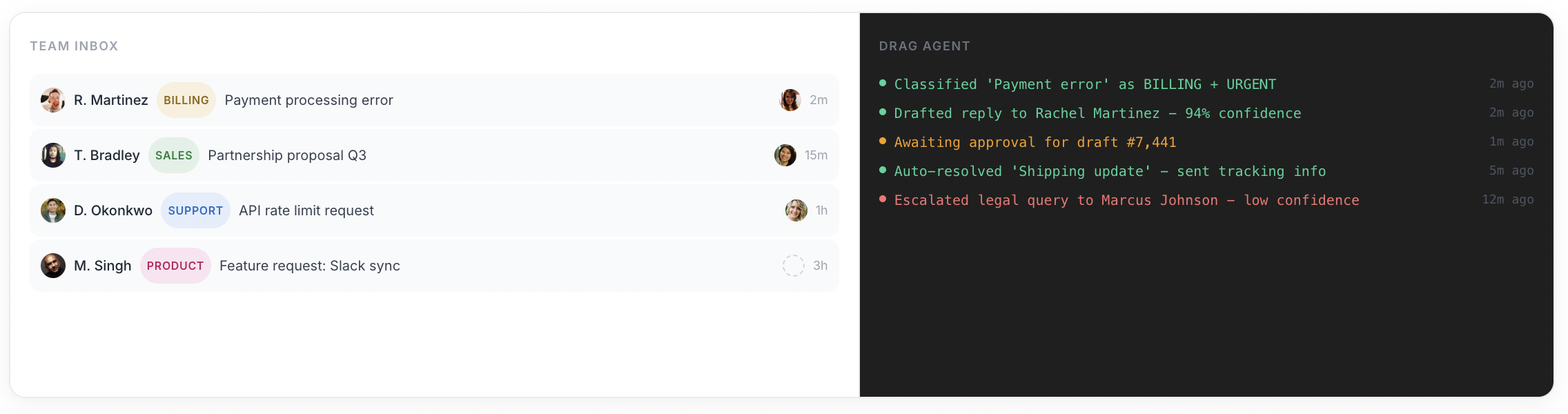
- Drag: Varley included in the seat, working on your real inbox.
- Intercom: Fin is a customer-facing agent billed at $0.99 per outcome, plus Copilot at roughly $29 a seat extra.
Varley · Drag’s AI
One AI, four ways it works.
Varley, Drag’s AI, knows your help center, docs and past conversations. It drafts and tags every email, answers your team in Copilot, acts in Stripe, Slack and HubSpot when you approve, and on Pro resolves conversations on its own. Monthly AI credits come with every Plus and Pro seat, with no per-seat AI add-on.
Intercom bills Fin at $0.99 per outcome on top of the seat, with a 50 outcome per month minimum.
- CopilotAsk Varley, then let it act
- AgentsVarley resolves conversations on its own
- IntelligenceWhat Varley knows, and the tools it acts in
- AssistsVarley in every email: drafts, tags, summaries
Included in Plus. Pro gets 2x the usage. Power users top up any time.
Varley resolves the routine ones on its own.
On Pro, Varley’s Agent reads the email, checks your policy, acts in tools like Stripe, replies in your team’s voice and closes the conversation. Anything it isn’t sure of goes to your team, with everything it found. Included in Pro.
Intercom has Fin for customer-facing resolution; Varley’s Agent works inside the inbox your team already uses.

I was charged twice this month
Daniel Okonkwo · Customer
- 9:38:13
Read Daniel’s email
Billing · Urgent
- 9:38:15
Checked your refund policy
Duplicate charges: refund in full
- 9:38:18
Found both charges in Stripe
$49 on 12 April, twice
- 9:38:22
Refunded the duplicate
$49 back to Daniel’s card
- 9:38:30
Replied to Daniel
Policy cited, in your team’s voice
- 9:38:35
Closed the conversation
Logged, with its sources
Connect Claude to your inbox in about two minutes.
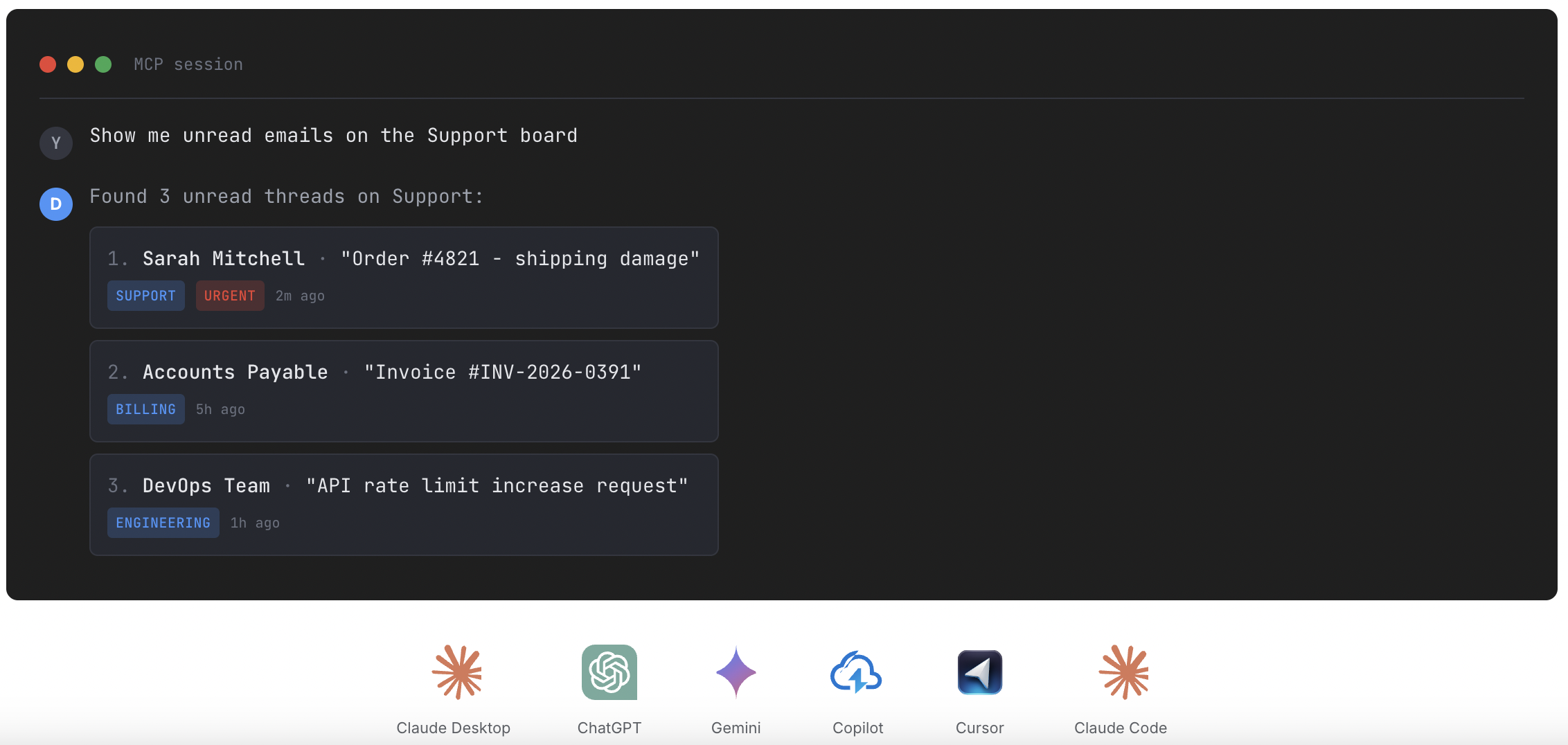
Paste one URL into Claude’s settings, enter your API key once, and your inbox becomes 47 tools with full read and write, WhatsApp included, on the Pro plan. ChatGPT, Gemini, Copilot and Cursor connect the same way. Then just ask:

Summarise unread Support threads and assign billing to Sarah.

Label everything mentioning refunds and move it to In Progress.

What was our first-reply time this week vs last?
Fin’s official MCP server is read-focused: 13 tools, with writes limited to help-center articles, on US and EU hosted workspaces.
Explore the MCP serverMCP server
@dragapp/mcp-server
47
tools · 12 categories · read + write
https://app.dragapp.com/mcp
paste into Claude › Settings › Connectors

 + any MCP client
Gmail-native
Stay in Gmail, not a separate platform.
Intercom is a standalone platform your team logs into. Drag is a Gmail shared inbox: your team works where they already work, in Gmail, with shared boards, assignment, and AI built in. No new platform to learn, no migration project.
- Drag: works natively inside Gmail and Google Workspace. No new platform.
- Intercom: standalone platform your team logs into separately.
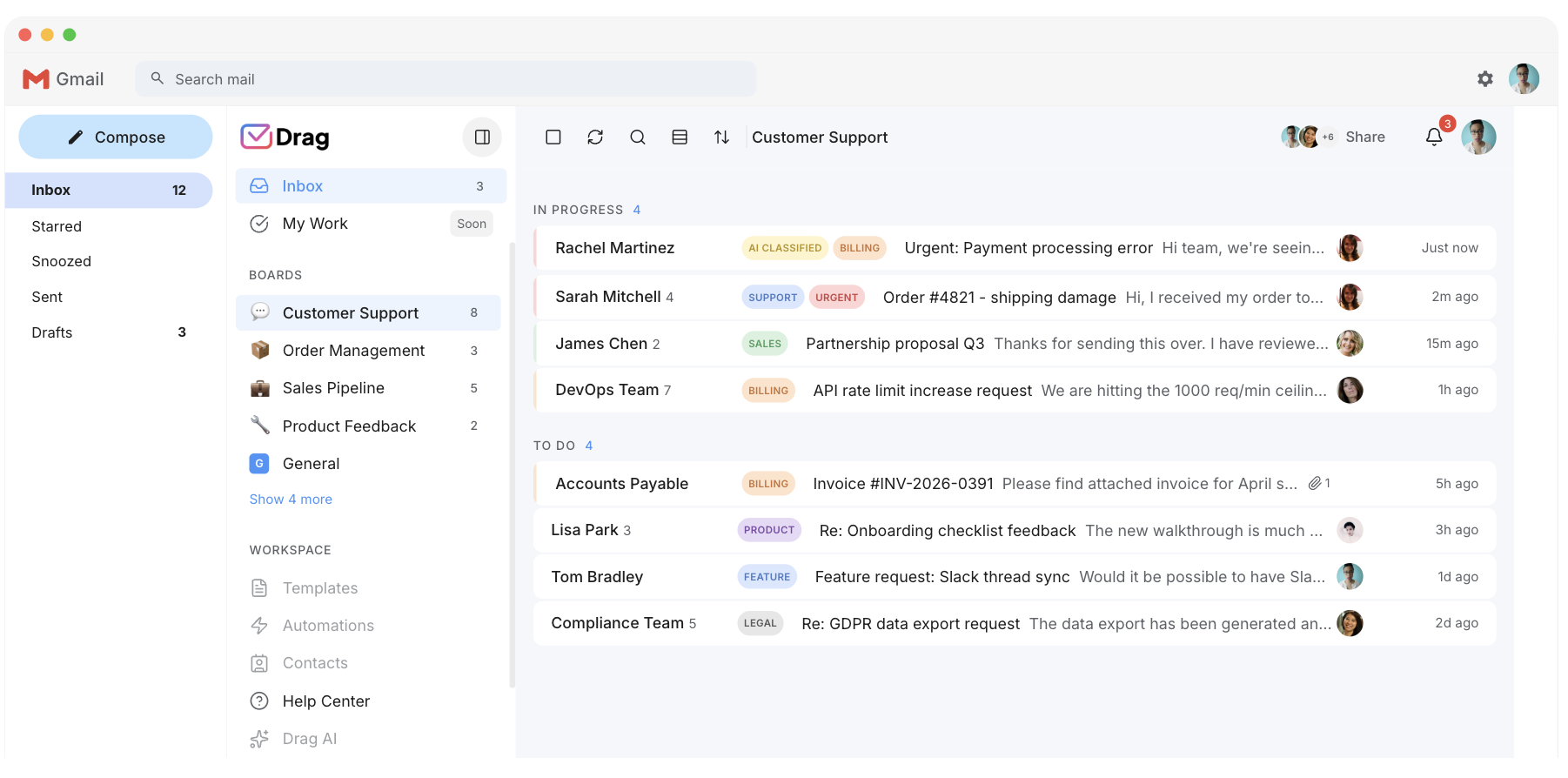
Dual experience
Gmail-native, with a full standalone app when you want one.
Drag gives you both: a native in-Gmail experience and a full standalone web, desktop, and mobile app, on the same shared data and boards. Your power users get an app; your Gmail loyalists stay in Gmail; everyone shares the same inbox.
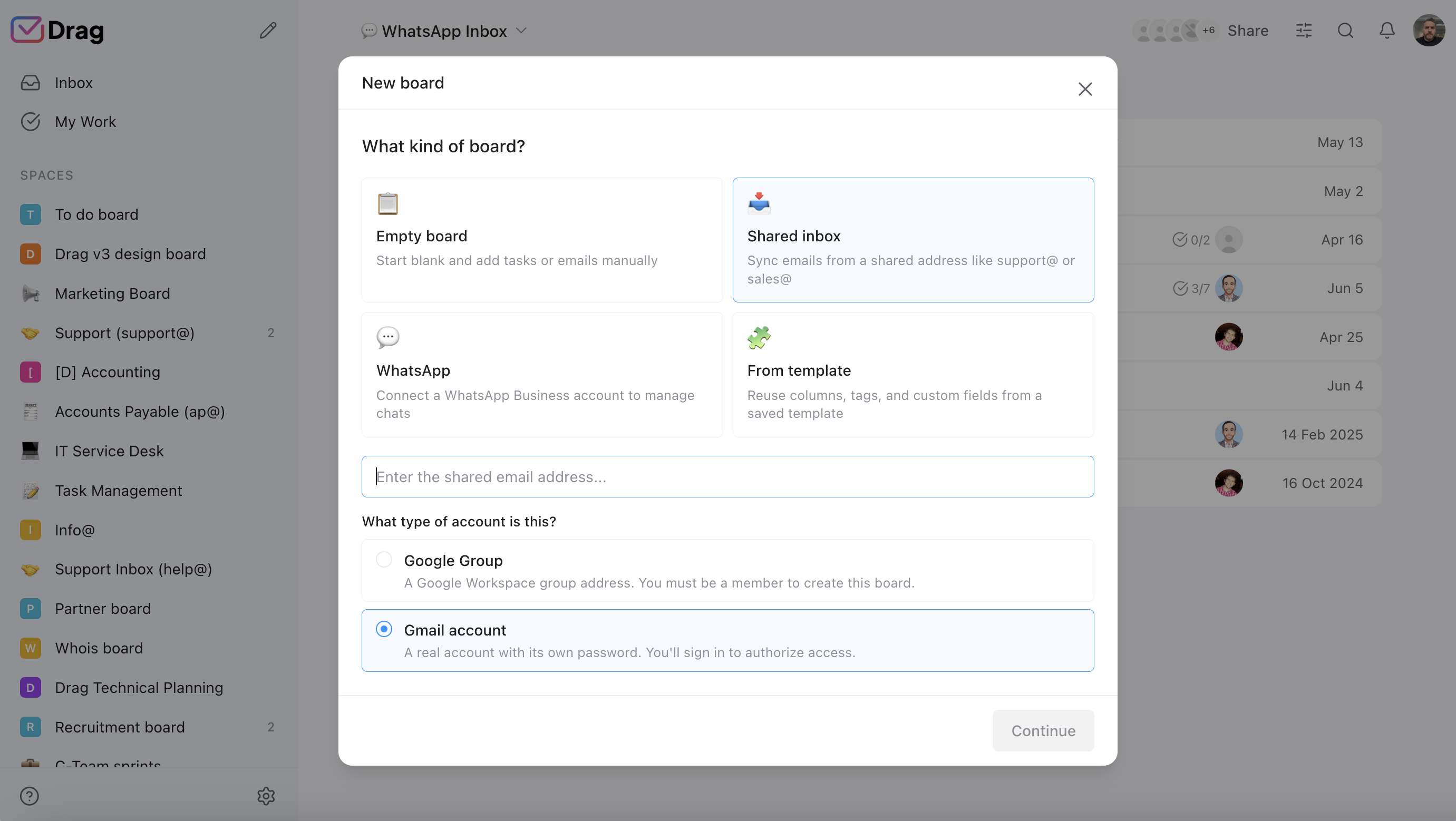
- Drag: native Gmail or full standalone app, same data, your team’s choice.
- Intercom: standalone platform only.
Stability
Predictable, and independent.
Drag is an independent product with flat, predictable pricing and permission-based security. Intercom (now Fin) is mid-acquisition by Salesforce (signed June 2026, not yet closed), with usage-based pricing that scales with AI volume. If you are signing a multi-year contract, independence and pricing stability matter.
- Drag: independent, predictable per-seat pricing with AI credits included.
- Permission-based access, CASA Tier 2, GDPR, no email duplication.
- Intercom: Salesforce acquisition agreed (June 2026), not yet closed. Pricing unchanged for now.
Pricing: Drag vs Intercom
Intercom’s real cost is the seat plus Fin outcomes. Drag’s cost is the seat, AI included. Put your own numbers in.
AI features
 Drag Plus (AI included)
$2,160/yr
$18/user/mo × 10 seats · AI included
 Intercom Advanced
from $10,200/yr+
$85/user/mo × 10 seats · Intercom seats are $29 to $132. Fin AI is billed SEPARATELY at $0.99 per outcome on every plan (50/mo minimum), and an 'outcome' can include a customer who simply stops replying, so real AI cost is usage-based and grows with volume beyond what this calculator shows. Copilot (~$29/seat) and channels are extra.
Your team saves at least $8,040/yr with Drag.
Estimate based on annual per-seat pricing, June 2026. Intercom shown at Essential ($29) and Advanced ($85); Expert is $132. Fin outcomes ($0.99 each) are additional and not included in the calculator. Confirm current pricing on each vendor's site.
A worked example: a 10-agent support team
Put real numbers on it. A 10-agent team on Intercom Advanced with moderate Fin usage:
- Intercom: Advanced at $85 per seat. 10 seats × $85 × 12 months = $10,200 a year in seats alone. At 1,000 Fin outcomes per month, add 1,000 × $0.99 × 12 = roughly $11,880 a year in Fin fees. Total: roughly $22,000 a year or more, before Copilot or channel add-ons.
- Drag: Plus at $18 per seat, with Varley drafting for your team already included. 10 seats × $18 × 12 months = $2,160 a year, flat.
- Difference: roughly $20,000 a year, for a team that needs a collaborative inbox with AI, not a customer-facing AI chatbot.
Put your own numbers in the interactive calculator above. (Figures use published per-seat annual pricing, June 2026; confirm current numbers on each vendor’s site.)
Drag vs Intercom, feature by feature
The detail layer for evaluators. Each claim is backed by a Drag product screenshot and, where we state an Intercom limitation, a cited source.
Pricing model
Drag is flat and included. Intercom is seat plus per-outcome, with “assumed resolution” billing where a customer who stops replying still counts as an outcome.
- Drag: $12 Starter, $18 Plus (AI included), $24 Pro. Flat, predictable.
- Intercom: $29 Essential, $85 Advanced, $132 Expert, plus $0.99 per Fin outcome, 50/mo minimum. Assumed resolutions are billed.
Source: Drag pricing, Intercom pricing page, Intercom Fin documentation.
AI approach
Different models. Drag includes Varley, which works with your team inside the inbox and, on Pro, resolves conversations itself. Intercom’s Fin is a customer-facing autonomous agent billed per outcome.
- Drag Plus $18: Varley drafts, tags, answers from your docs and acts in your tools, on your real inbox.
- Intercom Fin: customer-facing autonomous agent, $0.99 per outcome. Copilot roughly $29 per seat extra.
Gmail-native vs standalone platform
Drag works inside Gmail. Intercom is a separate platform.
- Drag: native Gmail experience or standalone web, desktop, and mobile app, same data.
- Intercom: standalone platform. Your team leaves Gmail.
MCP server
Drag publishes its own MCP server (47 tools across 12 categories). Intercom's MCP server is read-focused with limited write (13 tools); Drag's is read and write (47 tools).
- 47 tools, full read and write from Claude, ChatGPT, Gemini, Copilot, Cursor, or Claude Code.
- Intercom: read-focused MCP server (13 tools).
Source: MCP for customer support; what is an AI support agent
Collaboration and boards in Gmail
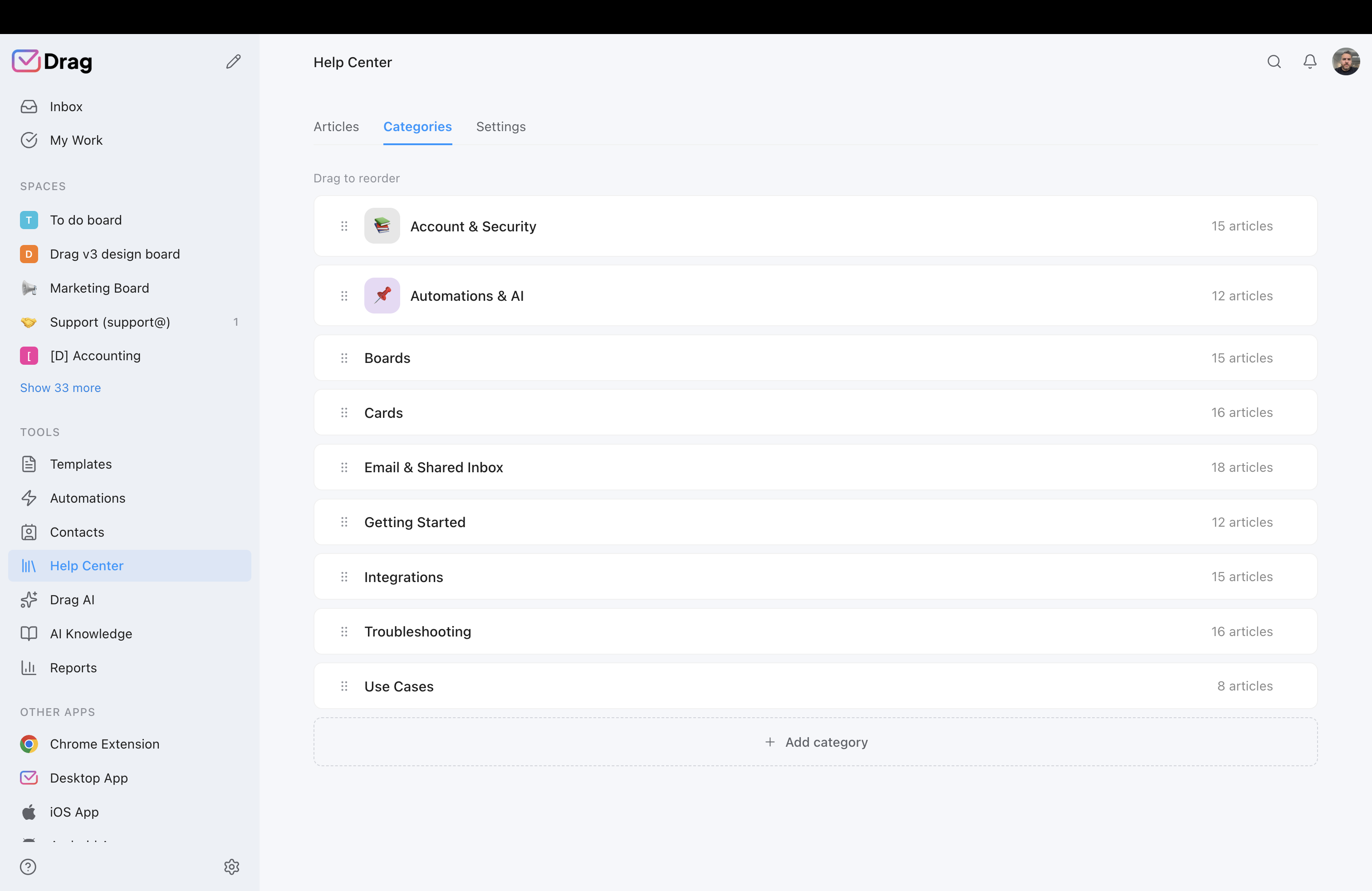
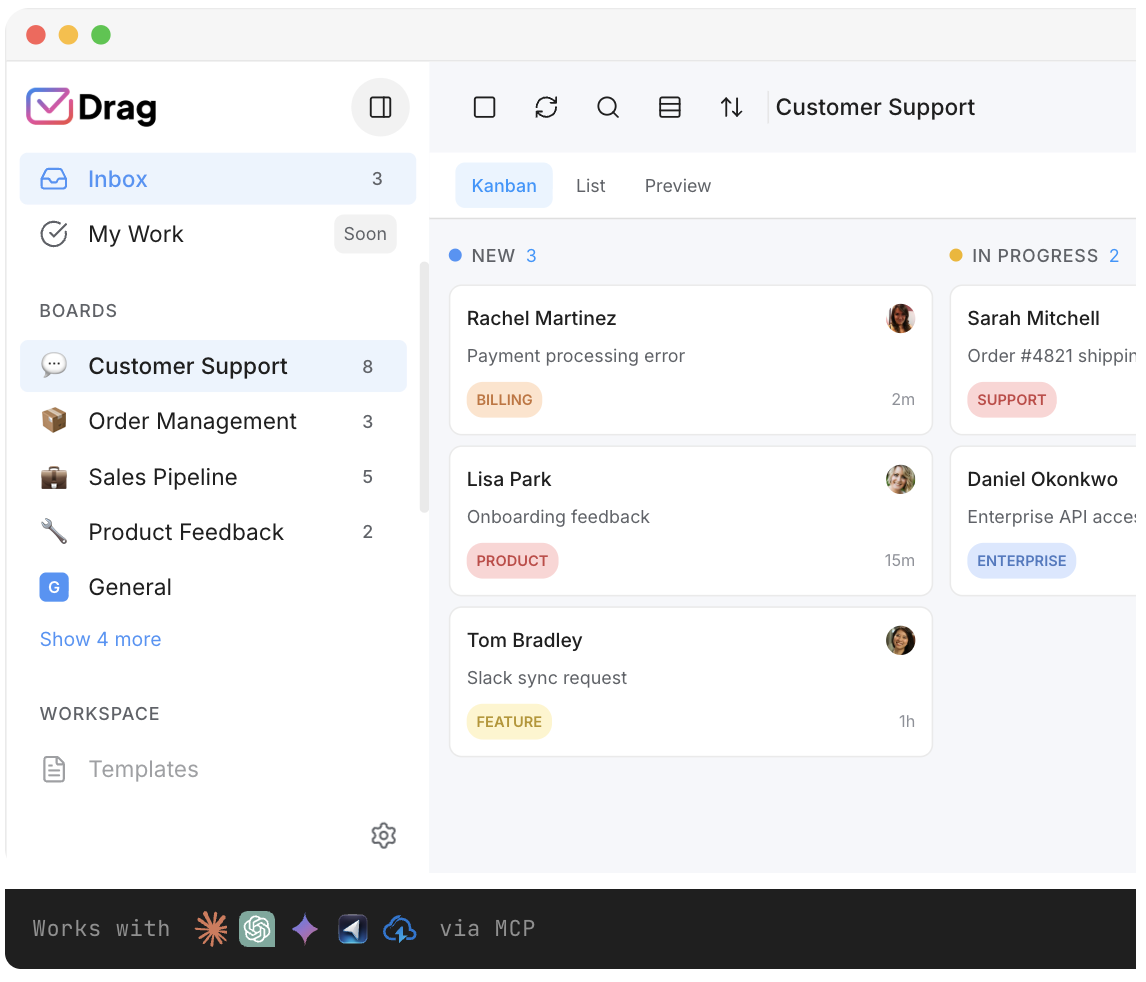
Drag organises shared inboxes into boards with columns, assignments, and a Kanban view, directly in Gmail.
- Drag: boards, Kanban views, assignments, comments, and collision detection, inside Gmail.
- Intercom: inbox, ticketing, and team assignment in its standalone platform.
Predictability and company stability
Drag is independent with flat pricing. Intercom is mid-acquisition with usage-based pricing.
- Drag: independent, flat pricing, permission-based security, CASA Tier 2, GDPR, no email duplication.
- Intercom: Salesforce acquisition agreed (June 2026, not closed), usage-based pricing that scales with Fin volume.
Source: public reporting on the Salesforce acquisition; Drag security/trust center.
Where Intercom is the better choice
Straight up: Intercom’s Fin is one of the best customer-facing AI agents available, and the platform is excellent. Choose Intercom if:
- You specifically want an autonomous AI agent that talks to your customers and resolves issues on its own. Fin is genuinely excellent at this, and Drag does not do it.
- You want an AI-first platform where human and AI agents share one inbox at scale. Intercom is purpose-built for this model.
- You want a best-in-class messenger. Intercom’s messenger and chat product is best-in-class for customer engagement.
- You can absorb usage-based pricing that scales with automation. For high-volume teams getting real deflection from Fin, the per-outcome model can pay for itself.
Drag is not trying to be a customer-facing AI chatbot. It is for teams who want a shared inbox where AI is included and predictable, and who want to stay in Gmail.
Moving from Intercom to Drag is quick
Drag installs in Gmail in minutes, with no platform migration and no usage-based bill to forecast. Your team works in Gmail (or the standalone app), and AI is included from day one.
What customers say
“What we like the most about Drag is the ability to see at a glance where a client is during their Onboarding process, through the use of columns, tasks, and tags. It has been crucial for us because Waste Logics is a growing business and this transparency allows us to work faster and smarter.”
“There really is no comparison when it comes to Drag. We have a great relationship with their team, it’s incredibly easy to use, addresses all of our needs, and the price is right!”
“Drag provided a lot of transparency and unified our team. It allowed us to bring the entire team together to manage emails and tasks collaboratively, as opposed to working in silos, across different tools.”
Frequently asked questions
Is Drag a good Intercom alternative?
For Gmail teams wanting AI included and predictable pricing, yes. It is not a customer-facing AI chatbot like Fin, so if that is what you need, Intercom fits better.
How much cheaper is Drag than Intercom?
Drag is $12 to $24 a seat, AI included. Intercom is $29 to $132 a seat plus $0.99 per Fin outcome. A 10-agent team can run roughly $2,160 a year on Drag versus $22,000 a year or more on Intercom with moderate Fin usage.
What is Intercom’s Fin AI pricing?
$0.99 per outcome on every plan, 50 a month minimum. An outcome can be a resolution, procedure handoff, or disqualification; a lead qualification is $9.99. On top of $29 to $132 seats.
What counts as a Fin “outcome”?
A resolution (confirmed or assumed), a procedure handoff, or a disqualification. "Assumed resolution" means you can be billed when a customer simply stops replying, which makes the bill hard to forecast.
Is Fin (formerly Intercom) being acquired by Salesforce?
Yes. Intercom renamed to Fin in May 2026, and on June 15, 2026 Salesforce signed a definitive agreement to acquire Fin for approximately $3.6B (closing expected in Salesforce’s fiscal Q4 2027, pending approvals). The deal is not yet closed and pricing is unchanged for now. Worth weighing for multi-year contracts.
Does Drag have a customer-facing AI agent like Fin?
No. Drag’s AI assists your team inside the inbox (draft, summarise, triage) and is included in the seat. Fin is a customer-facing autonomous agent billed per outcome. Different models.
Can my team keep working in Gmail?
Yes, natively, plus a standalone app on the same data. Intercom is a separate platform.
Does Drag have an MCP server and Intercom does not?
Correct. Drag publishes its own MCP server (connect Claude, ChatGPT, Cursor). Intercom's MCP server is read-focused with limited write (13 tools); Drag's is read and write (47 tools).
Is my data secure with Drag?
Permission-based access, no email duplication, emails not stored on Drag’s servers; Google Cloud Partner, CASA Tier 2, GDPR.
How long does it take to switch?
Minutes in Gmail; no migration, no usage bill to model.
Is Drag a full help desk?
No, it is a Gmail-native shared inbox with boards, AI, help center, and chat. For a full customer-facing AI platform, Intercom or Freshdesk are closer.
Does Drag include a help center and live chat?
Yes, both included.
What are the best Intercom alternatives besides Drag?
Depends on need: Freshdesk or Zendesk for a fuller help desk, Help Scout for simple email, Crisp for chat-first on a budget, or cheaper AI agents if you want the Fin model for less.
Is Intercom worth it?
For teams that want a best-in-class customer-facing AI agent and can absorb usage-based cost, yes. For teams wanting AI included in a shared inbox with predictable pricing, an alternative like Drag fits better.


