








Kayako is a capable support platform, and its 2026 Kay agent resolves tickets end to end. But its new model bills $1 for every ticket the AI resolves, with no seat fee, so the bill scales with your automation and needs forecasting. Drag turns the Gmail your support already runs through into the helpdesk: AI drafting, tagging, sentiment, and summaries included in the seat from $18, a flat bill whatever the volume, with boards, help centre, live chat, and its own MCP server. Here is the honest, side-by-side comparison.

Table of contents
The verdict
The best Kayako alternative for Gmail teams is Drag: it turns the Google Workspace your support address already runs through into the helpdesk, with AI drafting, tagging, sentiment, and summaries included in the seat from $18 on a flat, predictable bill, where Kayako's 2026 model charges $1 for every ticket its AI resolves. Drag keeps a human approving what goes out, and support lives inside the Gmail you already use, so nothing migrates. Kayako remains the better choice for teams that want autonomous end-to-end resolution today, and social and voice queues in one view.
Choose Drag if you…
- your support runs on email in Google Workspace
- you want a predictable flat bill, with AI drafting, tagging, sentiment, and summaries included in the seat from $18
- you want humans approving what goes out, with no per-ticket meter
Choose Kayako if you…
- you want an autonomous AI agent resolving tickets end to end at usage pricing
- you want multi-channel coverage including social and voice in one view. We say so plainly below.
Comparing more helpdesks? See our best help desk software guide for a broader comparison.
Drag vs Kayako at a glance
| Feature | Drag | Kayako |
|---|---|---|
| Pricing & plans | ||
| Pricing model | Flat per-seat, $12 to $24, AI included from $18 | Usage-based: $1 per AI-resolved ticket, no seat fees (Kayako One, 2026 model) |
| Predictability | Same bill every month | Bill scales with resolution volume |
| Free plan | 7-day trial, no card | No (trial on request) |
| Platform & access | ||
| Where you work | Inside Gmail + standalone apps | Standalone platform |
| Kanban workflow | check_circle | cancel |
| AI & automation | ||
| AI approach | Varley in the seat; drafts for approval, Agent resolves on Pro | Kay agent: drafts first, then autonomous resolution end to end |
| MCP server (run inbox from AI clients) | Yes, 47 tools | No |
| Channels & support | ||
| Channels | Email + live chat + WhatsApp | Email, chat, social, voice in one view |
| Help centre | Yes, AI-grounded | Yes, multi-brand |
| Reporting | Built-in, exportable | Built-in |
Verified July 2026; confirm current details on each vendor’s site.
Why Gmail teams pick Drag
Pricing
A bill that does not scale with your success.
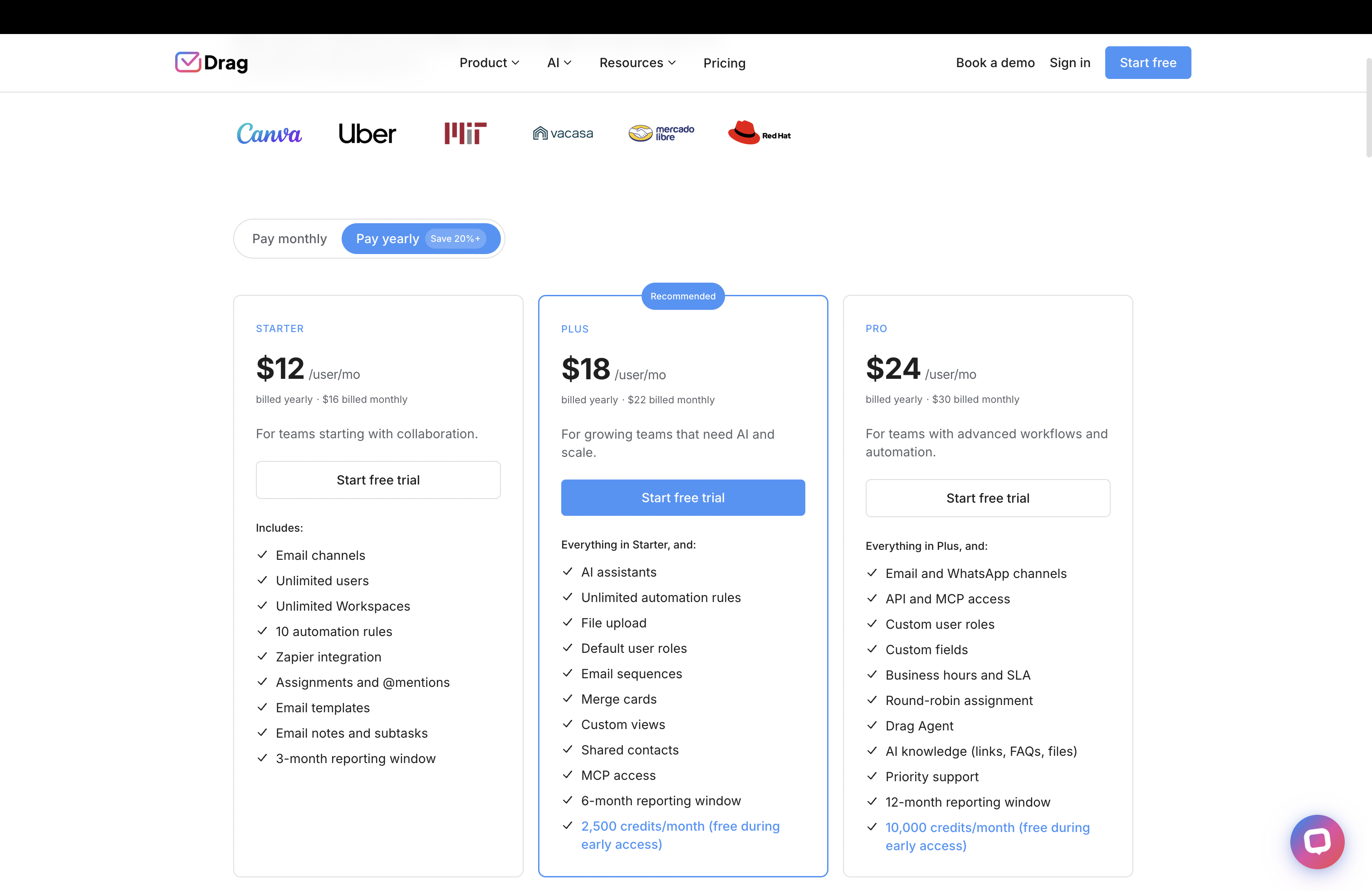
Kayako’s 2026 model charges $1 for every ticket its AI resolves: automate more, pay more, and reviewers describe the volume forecasting as the hard part. Varley, Drag’s AI, is included in the seat from $18, with monthly AI credits: the bill follows your team size, not your ticket count.
- Drag: $12 to $24 a seat, AI included from $18, a flat bill whatever the volume.
- Kayako: $1 per AI-resolved ticket, so the bill grows with every resolution.
AI
AI your team approves, included in the seat.
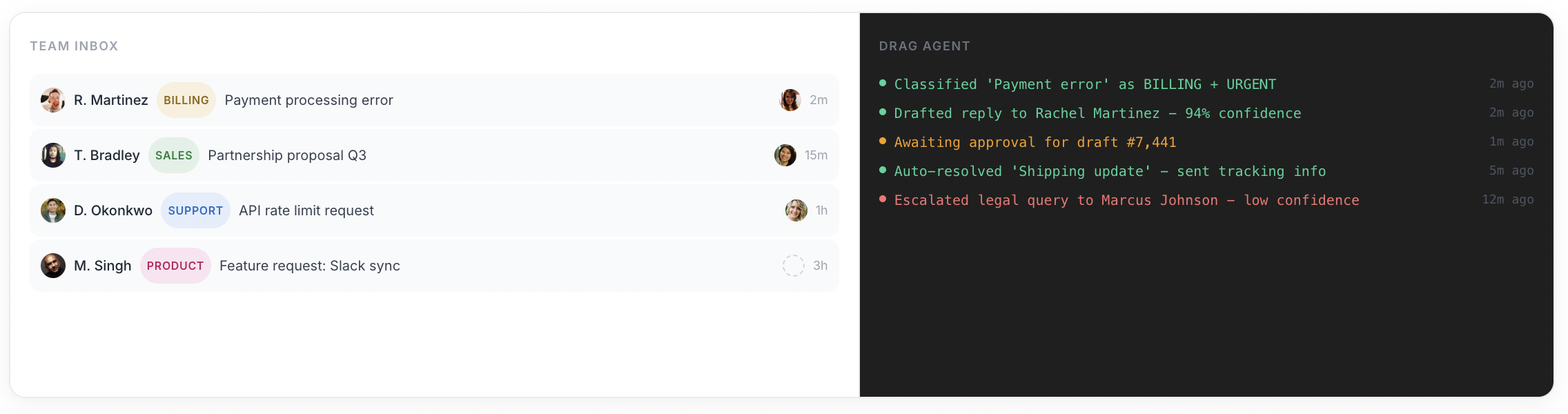
Varley, Drag’s AI, is in the seat: grounded reply drafts, automatic tagging, thread summaries and answers from your docs, for your team to approve. When you are ready, on Pro, Varley resolves conversations on its own, included in the seat rather than billed at Kayako’s $1 a ticket.
- Drag: Varley in the seat (drafts, tagging, summaries, answers from your docs), human-approved, plus Agents on Pro.
- Kayako: Kay drafts first, then resolves end to end autonomously, billed per ticket.
Varley · Drag’s AI
One AI, four ways it works.
Varley, Drag’s AI, knows your help center, docs and past conversations. It drafts and tags every email, answers your team in Copilot, acts in Stripe, Slack and HubSpot when you approve, and on Pro resolves conversations on its own. Monthly AI credits come with every Plus and Pro seat, with no per-seat AI add-on.
Kayako meters its AI at $1 per resolved ticket, a bill that grows with volume.
- CopilotAsk Varley, then let it act
- AgentsVarley resolves conversations on its own
- IntelligenceWhat Varley knows, and the tools it acts in
- AssistsVarley in every email: drafts, tags, summaries
Included in Plus. Pro gets 2x the usage. Power users top up any time.
Varley resolves the routine ones on its own.
On Pro, Varley’s Agent reads the email, checks your policy, acts in tools like Stripe, replies in your team’s voice and closes the conversation. Anything it isn’t sure of goes to your team, with everything it found. Included in Pro.
Kayako’s Kay already resolves autonomously, billed at $1 per ticket.

I was charged twice this month
Daniel Okonkwo · Customer
- 9:38:13
Read Daniel’s email
Billing · Urgent
- 9:38:15
Checked your refund policy
Duplicate charges: refund in full
- 9:38:18
Found both charges in Stripe
$49 on 12 April, twice
- 9:38:22
Refunded the duplicate
$49 back to Daniel’s card
- 9:38:30
Replied to Daniel
Policy cited, in your team’s voice
- 9:38:35
Closed the conversation
Logged, with its sources
Connect Claude to your inbox in about two minutes.
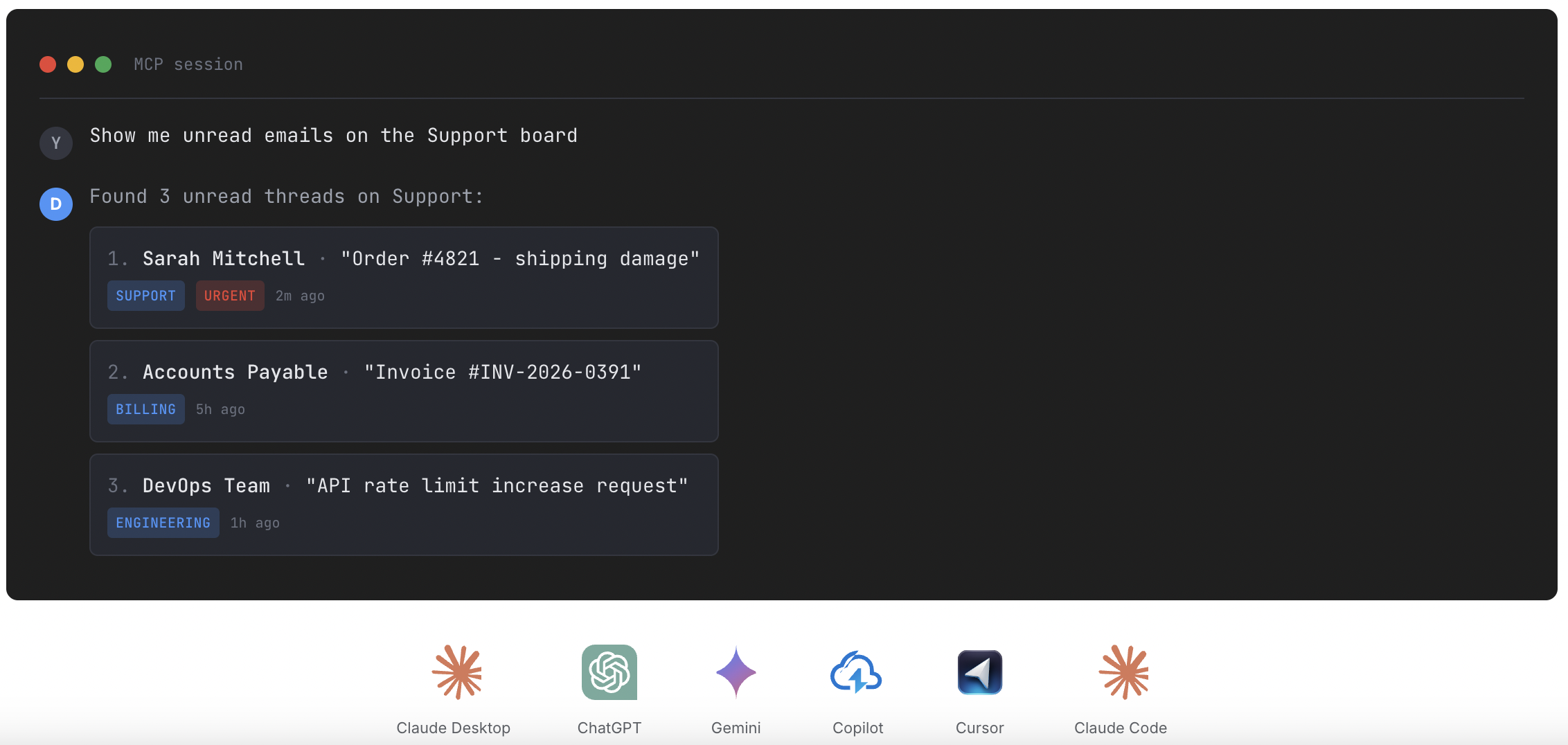
Paste one URL into Claude’s settings, enter your API key once, and your inbox becomes 47 tools with full read and write, WhatsApp included, on the Pro plan. ChatGPT, Gemini, Copilot and Cursor connect the same way. Then just ask:

Summarise unread Support threads and assign billing to Sarah.

Label everything mentioning refunds and move it to In Progress.

What was our first-reply time this week vs last?
Kayako has no official MCP server; its AI works inside Kayako rather than exposing the inbox to your AI tools.
Explore the MCP serverMCP server
@dragapp/mcp-server
47
tools · 12 categories · read + write
https://app.dragapp.com/mcp
paste into Claude › Settings › Connectors

 + any MCP client
Gmail-native
Support where your email already lives.
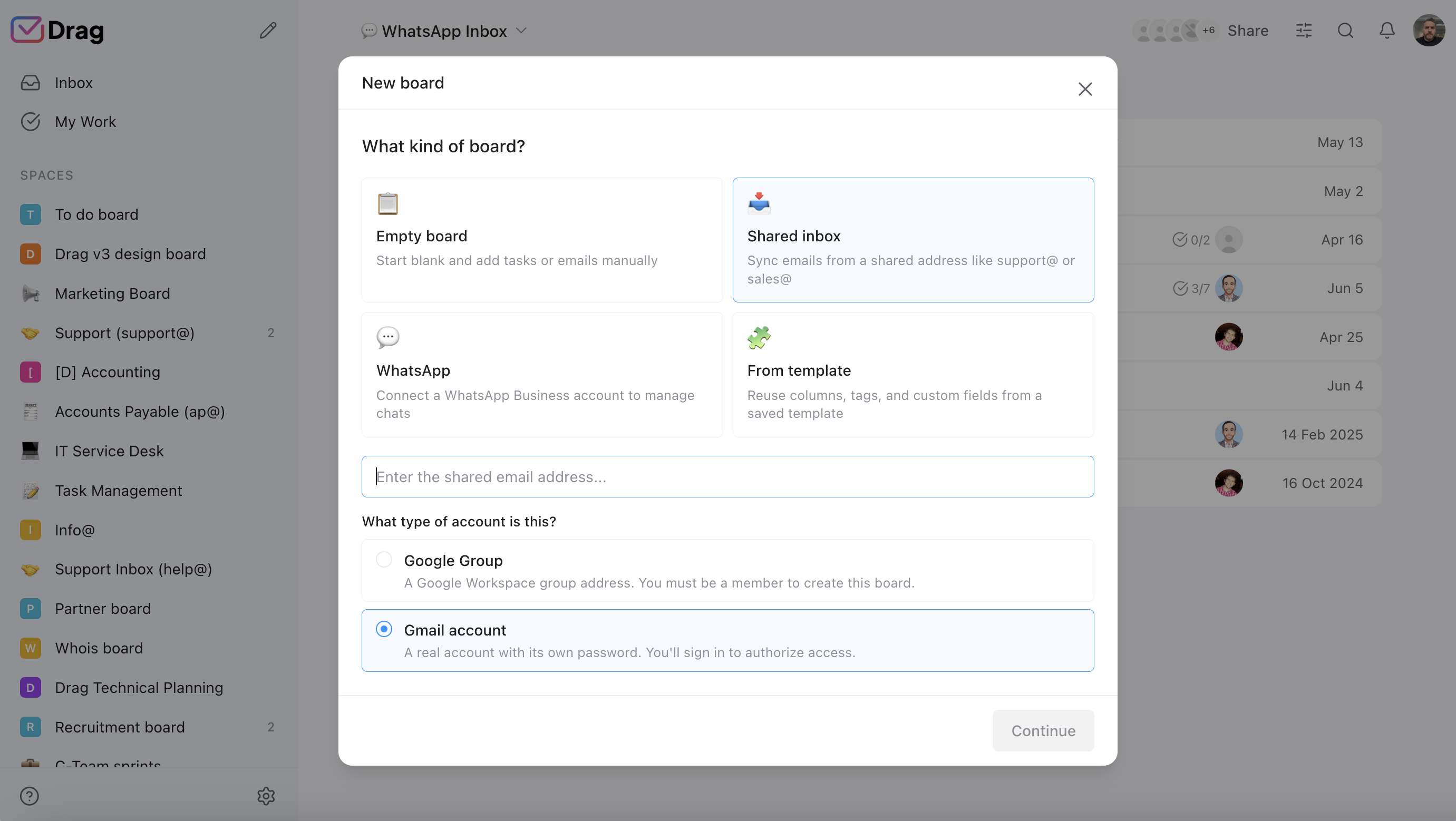
Kayako is a platform you move to; Drag installs into the Google Workspace your support address already uses: boards, assignment, collision detection, automations, standalone apps when you want them. No migration, no new system of record.
- Drag: installs into the Gmail your support already uses. No migration, no new system of record.
- Kayako: a separate platform you move your support onto.
Workflow
Workflow you can see.
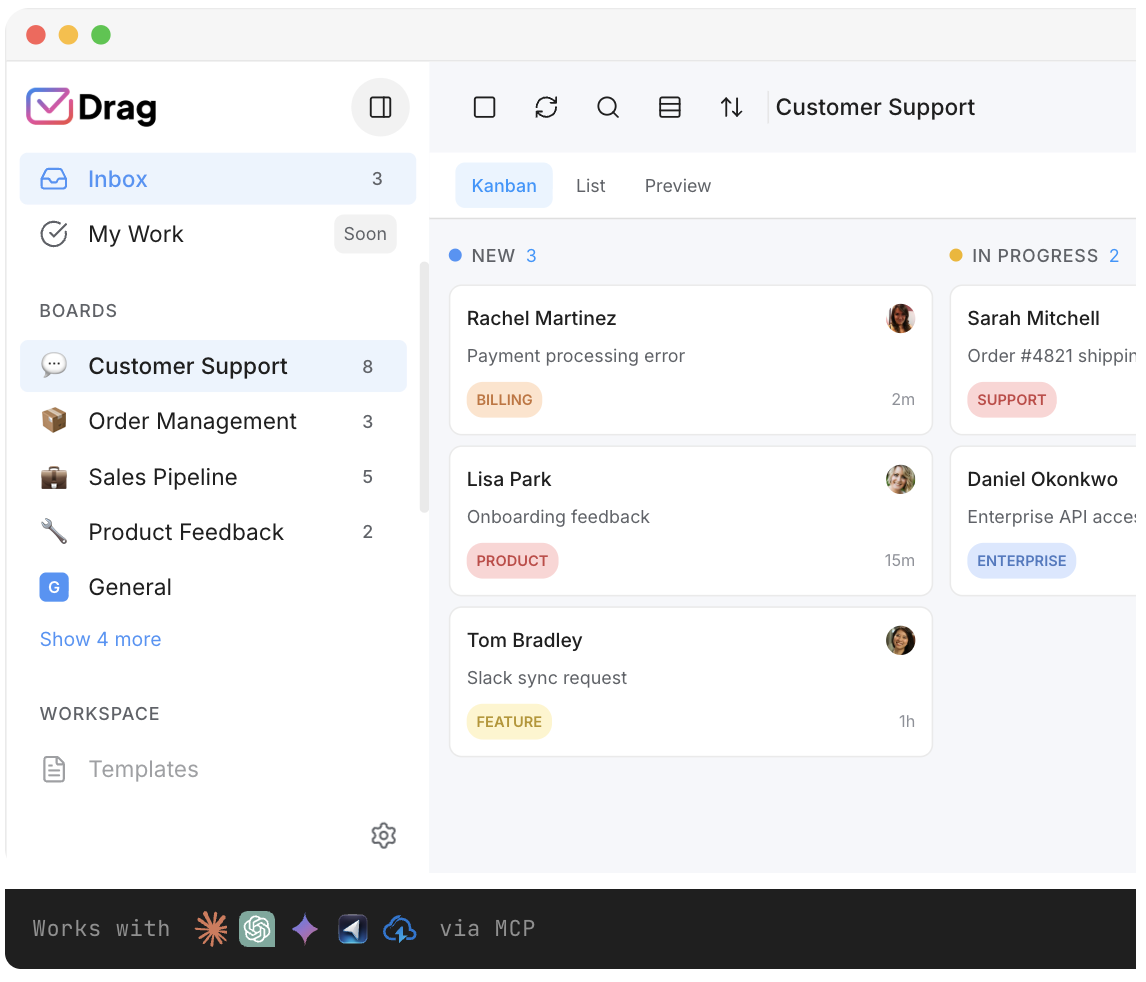
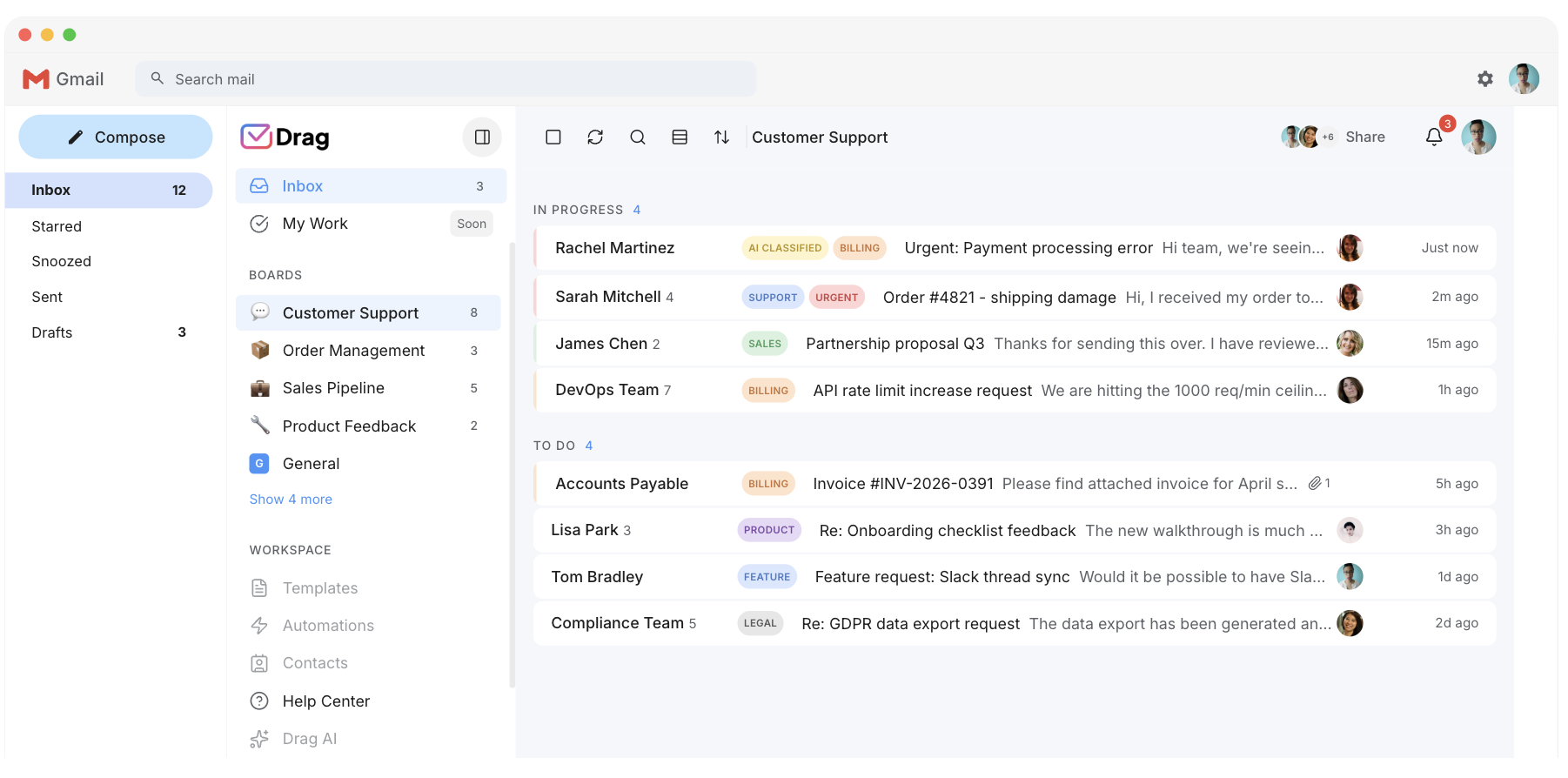
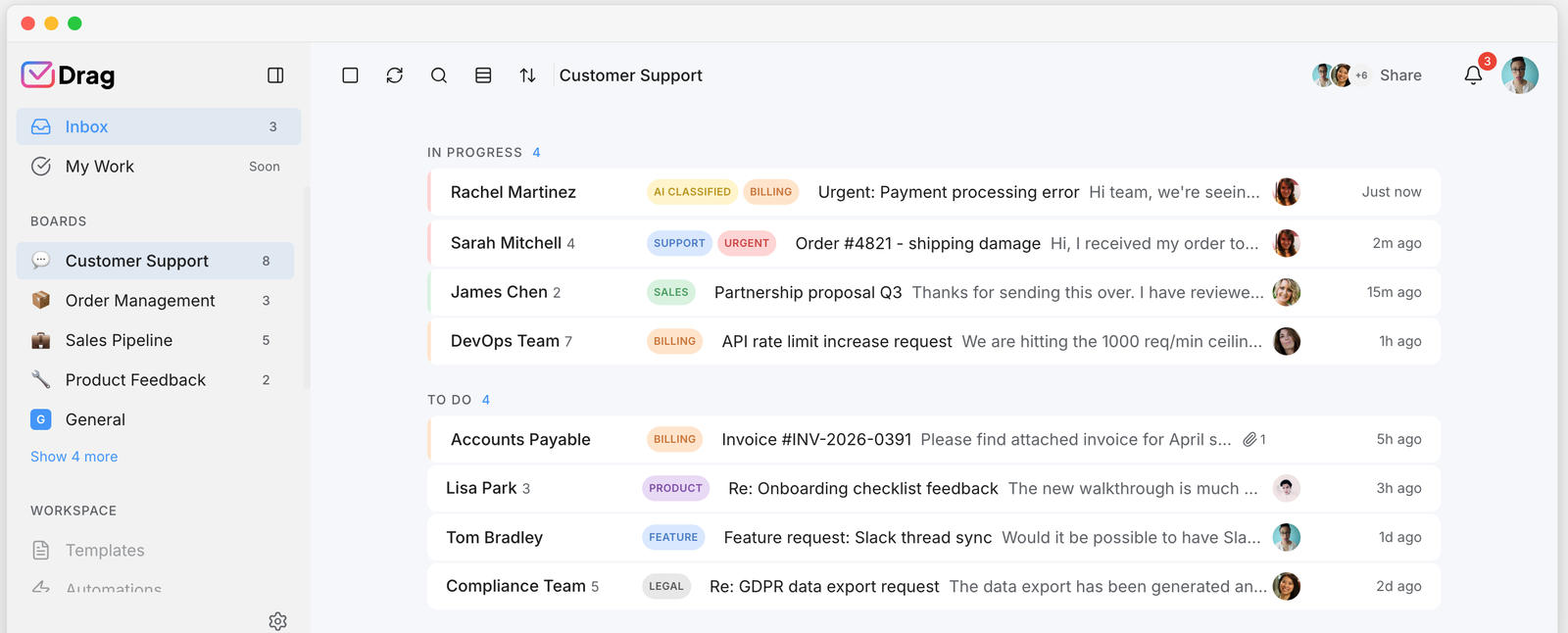
Kanban boards turn the queue into cards moving through stages the whole team reads at a glance, with round-robin assignment and collision detection built in.
- Drag: Kanban boards, round-robin assignment, and collision detection, inside Gmail.
- Kayako: queue and ticket views, without a Kanban board workflow.
Pricing: Drag vs Kayako
Kayako’s 2026 model has no seat fee: you pay $1 for every ticket its AI resolves, so 1,000 AI-handled conversations is $1,000 that month. Drag for five Pro seats is $120, with Varley included; teams resolving at that volume top up as they go. Model your team in the cost calculator.
Drag vs Kayako, feature by feature
The detail layer for evaluators, with Drag product screenshots where they clarify the claim.
Shared inbox
Both centralise a team’s conversations with assignment and history. Kayako’s Single View unifies more channels; Drag adds Kanban boards and lives inside Gmail. Check both, different shapes.
- Drag: one shared queue with assignment and history, plus Kanban boards, inside Gmail.
- Kayako: a Single View that unifies more channels in one place.
AI on the ticket
Genuinely strong on both sides, differently priced and differently governed. Kay drafts first, then graduates to autonomous end-to-end resolution, billed per resolution. Varley drafts for approval in the seat, and on Pro resolves on its own, AI included. Check both: Kay has a longer track record of full autonomy; Varley does the job inside Gmail, priced by seat.
- Drag: six seat-included assists, human-approved, at a flat price.
- Kayako: Kay drafts first, then resolves end to end autonomously, billed per resolution.
Automation rules
Both do condition-and-action routing; Drag’s rules extend to board moves and Gmail-native triggers. Parity, honestly marked.
- Drag: condition-and-action routing, extending to board moves and Gmail-native triggers.
- Kayako: condition-and-action routing across its channels.
Reporting
Both ship response-time and activity reporting; Drag’s exports on every paid plan. Parity with a note.
- Drag: response-time and activity reporting, exportable on every paid plan and queryable via MCP.
- Kayako: response-time and activity reporting built in.
Help centre and live chat
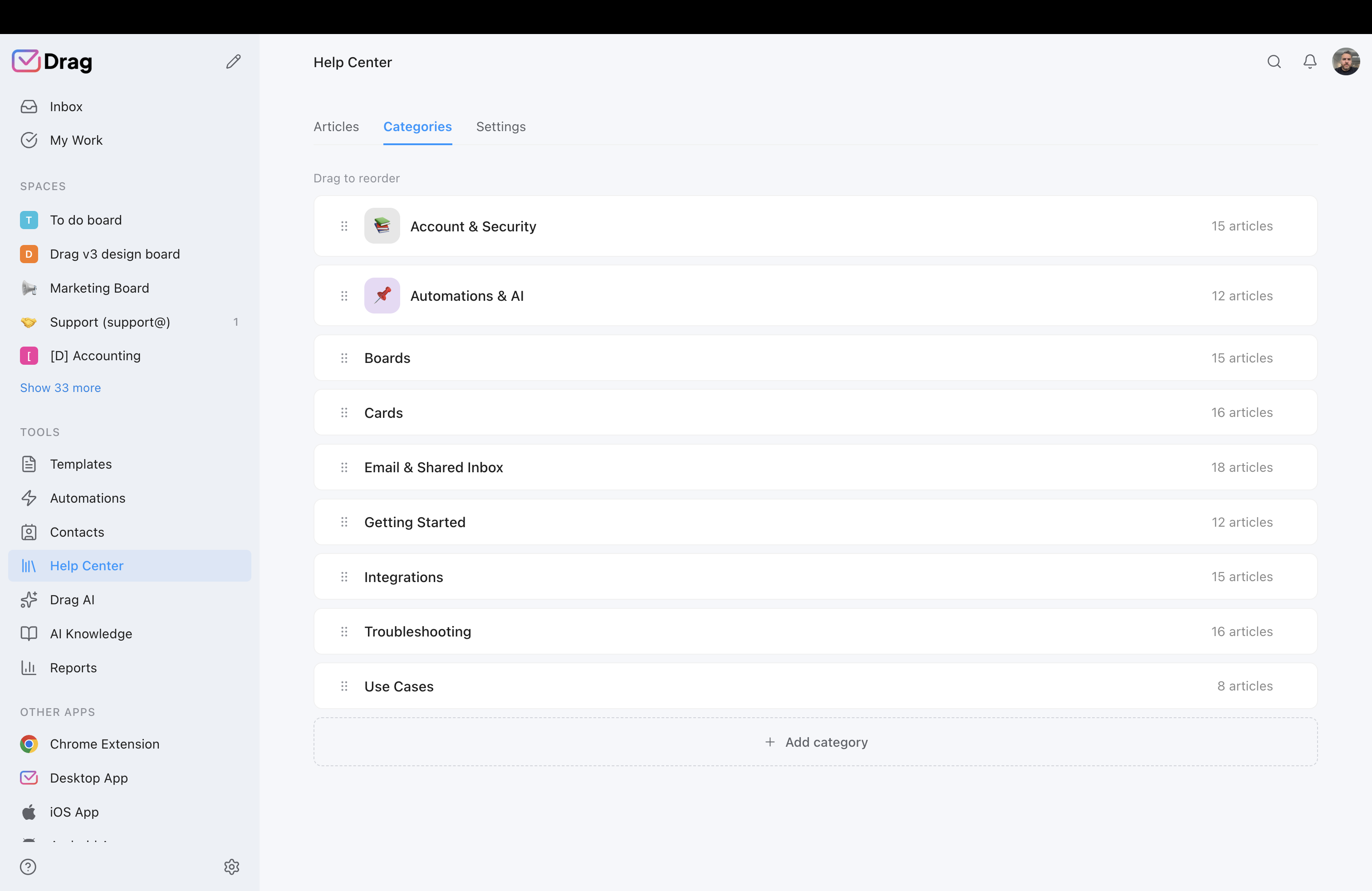
Both offer help centres (Kayako’s multi-brand support is real; Drag’s is AI-grounded) and chat widgets. Drag’s chat lands in the same Gmail queue as email. Check both.
- Drag: AI-grounded help centre and a chat widget that lands in the same Gmail queue as email.
- Kayako: multi-brand help centre and chat widgets.
Channels
Kayako wins: social and voice as first-class queues in one view. Drag covers email, live chat, and WhatsApp. Honest cancel for Drag.
- Kayako: social and voice as first-class queues in one view.
- Drag: email, live chat, and WhatsApp. No social or voice queues.
Cost model
The section the 2026 pivot makes decisive: usage billing versus flat seats. Check Drag for predictability; check Kayako only if your resolution volume is low and stable.
- Drag: $120 a month for five Pro seats, AI included.
- Kayako: $1 per AI-resolved ticket, so 1,000 resolutions is $1,000; comfortable only at low, stable volume.
If you switch: what you keep, what changes
The honest question a Kayako team asks is not “is Drag cheaper”, it is “what happens to the way we work today?” Here is the straight answer.
You keep
Your email address and history (Gmail becomes the system of record, nothing migrates in), your templates and macros (recreated in an hour), your help-centre content (imported or rebuilt AI-grounded), and your team’s email muscle memory.
What changes
The multi-channel Single View becomes a Gmail-centred queue (social and voice queues would need other homes, stated plainly); autonomous resolution becomes human-approved assists unless and until you add an agent layer; and the bill stops moving: no more forecasting resolution volume, which long-term Kayako users describe as the recurring budgeting headache, alongside reported price increases through the platform’s transitions.
Where Kayako fits better
Three real cases.
- Full autonomy today: Kay resolving tickets end to end without human review is genuinely ahead of Drag's human-in-the-loop assists.
- True multichannel: social and voice as first-class queues in one view.
- Low, stable volume: at a few hundred AI resolutions a month with no seats to pay for, the usage model can genuinely undercut seat pricing; run your own numbers before deciding.
If those describe you, stay with our blessing; this page is for the Gmail-first team that wants the AI layer at a flat, predictable price.
Switching from Kayako to Drag is quick
No migration project: Drag installs into the Gmail your support address already flows through. Connect the shared inboxes, set up boards, recreate templates, invite the team. Most teams are working the queue the same afternoon. The 7-day trial answers the fit question faster than any comparison page.
What customers say
“What we like the most about Drag is the ability to see at a glance where a client is during their Onboarding process, through the use of columns, tasks, and tags. It has been crucial for us because Waste Logics is a growing business and this transparency allows us to work faster and smarter.”
“There really is no comparison when it comes to Drag. We have a great relationship with their team, it’s incredibly easy to use, addresses all of our needs, and the price is right!”
“Drag provided a lot of transparency and unified our team. It allowed us to bring the entire team together to manage emails and tasks collaboratively, as opposed to working in silos, across different tools.”
Frequently asked questions
Is Drag a good Kayako alternative?
For Gmail and Google Workspace teams, yes: AI drafting, tagging, sentiment, and summaries included from $18 per user on a flat bill, with boards, help centre, live chat, and WhatsApp, inside the inbox you already run. It is not the fit if you need social and voice queues or fully autonomous resolution today.
What is the main difference between Drag and Kayako?
The pricing model and the AI governance. Kayako's 2026 model charges $1 per AI-resolved ticket with no seat fees; Drag charges flat seats with AI included. Kayako's Kay resolves autonomously; Drag's assists keep a human approving what goes out.
How much does Kayako cost in 2026?
Kayako consolidated into Kayako One: $1 per ticket its AI resolves, no seat or setup fees, no free plan. A month of 1,000 AI resolutions bills $1,000; costs scale directly with automation volume.
Is Drag cheaper than Kayako?
It depends on volume, and we show the maths: five Drag Pro seats are $120 a month with Varley, Drag’s AI, included. Kayako is cheaper under roughly 120 AI resolutions a month; beyond that, its $1 per ticket keeps climbing, while Drag’s price stays per seat and only very high volumes top up.
Does Kayako still charge per agent?
No. Long-time users knew seat plans (and later a $79 seat model); the 2026 Kayako One pivot removed seat fees entirely in favour of $1 per AI resolution. If you are on a legacy plan, the migration maths deserves attention before renewal.
Does Drag have AI like Kayako's Kay?
Both resolve on their own now. Drag includes Varley, its AI, in the seat: it drafts for your team to approve, tags, summarises and answers from your docs, and on Pro Varley’s Agent resolves conversations end to end. Kay resolves at $1 per ticket.
Can I run my inbox from Claude or ChatGPT with Drag?
Yes: Drag exposes an MCP server with 47 tools, so Claude, ChatGPT, Gemini, Copilot, or Cursor can read, draft, assign, label, and report on your shared inbox by prompt. Kayako offers no MCP server.
Does Drag have a help centre and live chat like Kayako?
Yes, both: an AI-grounded help centre and a chat widget whose conversations land in the same Gmail queue as email, one owner per thread.
Does Drag have a free plan?
Drag offers a 7-day trial with no card required; paid plans are $12, $18 (AI included from here), and $24 per user billed annually. Kayako has no free plan.
What channels does Drag support?
Email (Gmail and Google Workspace), a website live-chat widget, and WhatsApp. Social and voice queues are Kayako territory, and we say so plainly.
Is Kayako's usage pricing good value?
At low, stable volume it can be: no seats, pay only for resolutions. The risk reviewers describe is forecast drift: automation succeeding faster than budgeted, with the bill following. Flat-seat models trade that ceiling for predictability.
Does Drag work outside Gmail?
No: Drag is Gmail and Google Workspace only, inside Gmail and as standalone web, desktop, and mobile apps on the same account. Kayako is provider-independent.
How does reporting compare?
Both ship response-time and activity reporting; Drag's is exportable on every paid plan and, via MCP, queryable from an AI assistant in a sentence.
What do Kayako reviewers complain about?
The recurring themes in public reviews: pricing changes and billing surprises through the platform's transitions, an interface some describe as dated, and support quality varying since the ownership change. We cite these as reviewer reports, not our claims.
Who is Kayako best for?
Teams that want autonomous AI resolution today across email, chat, social, and voice, with volume low or predictable enough that per-resolution billing stays comfortable.
How do I switch from Kayako to Drag?
Install Drag into the Google Workspace your support address already uses, connect the shared inboxes, recreate templates and macros, import or rebuild help-centre content, invite the team. Gmail becomes the system of record; most teams switch in an afternoon.


