








Keeping is a clean, deliberately simple ticket layer on Gmail, and Drag matches its $12 starting price to the dollar. The difference is the ceiling: Keeping has no AI at any tier, no boards, no channels beyond email, and no API, while Drag’s $18 tier adds Varley, its AI, Kanban boards, live chat, WhatsApp and a help centre, and Pro adds its own MCP server. Here is the honest, side-by-side comparison.

Table of contents
The verdict
The best Keeping alternative for Gmail teams is Drag: it matches Keeping's $12 entry price and keeps the same gentle in-Gmail workflow, then adds what Keeping has at no tier: AI drafting, tagging, sentiment, and summaries from $18, Kanban boards, live chat, WhatsApp, a help centre, an API, and an MCP server. Keeping remains the better choice for teams that want the simplest possible ticket layer on Gmail, with built-in CSAT surveys and Shopify order context, and are sure they will not need AI or channels beyond email.
Choose Drag if you…
- you want Gmail-native support that grows with you, at the same $12 starting price
- you want AI drafting, tagging, sentiment, and summaries included from $18
- you want Kanban boards, live chat, WhatsApp, and an AI-grounded help centre
- you want an MCP server to run the inbox from Claude, ChatGPT, or Cursor
Choose Keeping if you…
- you want the simplest possible ticket layer on Gmail, with built-in CSAT surveys and Shopify order context
- you are sure you will not need AI, an API, or channels beyond email. We say so plainly below.
Setting up support in Gmail? See our Gmail shared inbox guide for the full walkthrough.
Drag vs Keeping at a glance
| Feature | Drag | Keeping |
|---|---|---|
| Pricing & plans | ||
| Entry price (annual) | $12 per user | $12 per user ($14 monthly) |
| AI drafting and assists | Included from $18 (Varley) | No AI features at any tier |
| Automations | Included | 2 workflows on entry tier; unlimited on top tier |
| Workflow & views | ||
| Workflow view | Kanban boards + list | Ticket list (Open, Pending, Closed) |
| Beyond support | Sales, ops, HR boards on the same seats | Support-ticket focus |
| Channels & self-serve | ||
| Channels | Email + live chat + WhatsApp | Email only |
| Help centre | Yes, AI-grounded | No |
| CSAT surveys | Not built in (we say so) | Yes, built in on higher tiers |
| Platform & access | ||
| Mobile | Standalone web, desktop, and mobile apps | Mobile web portal; no native app |
| API | Yes | No public API |
| MCP server (run inbox from AI clients) | Yes, 47 tools | No |
Verified July 2026; confirm current details on each vendor’s site.
Why Gmail teams pick Drag
Pricing
Same $12, different ceiling.
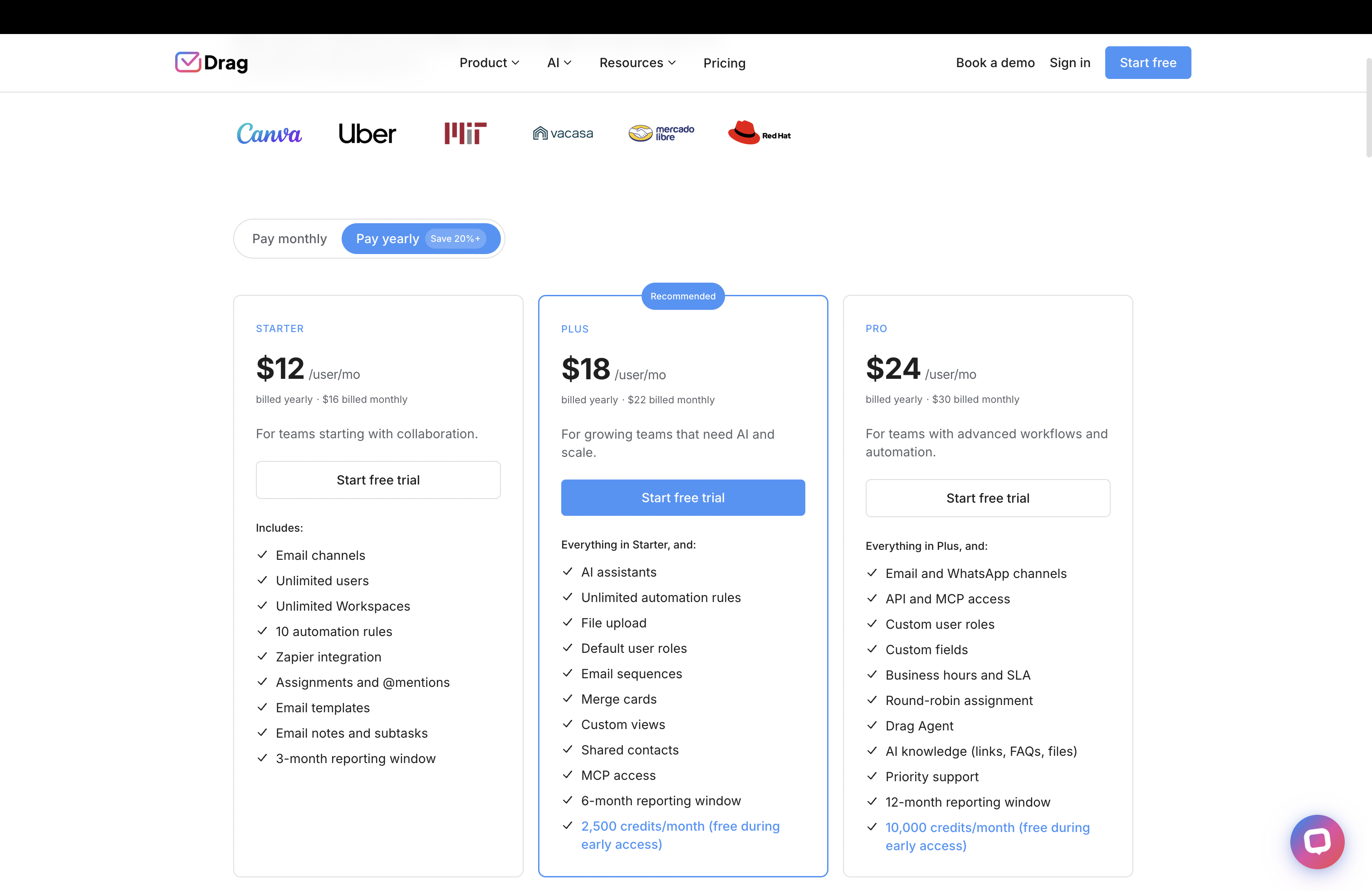
Drag and Keeping start at the same $12 a seat, and that is where the paths split: Keeping has no AI at any price, while Drag’s $18 tier adds Varley, its AI: grounded reply drafts, automatic tagging, thread summaries and answers from your docs. Five seats with Varley is $90 a month, and the upgrade is a toggle, not a migration.
- Drag: same $12 start, and a $18 tier that adds Varley, its AI. Five seats with Varley is $90 a month.
- Keeping: $12 start, with no AI at any price to upgrade to.
Workflow
Boards you can read at a glance.
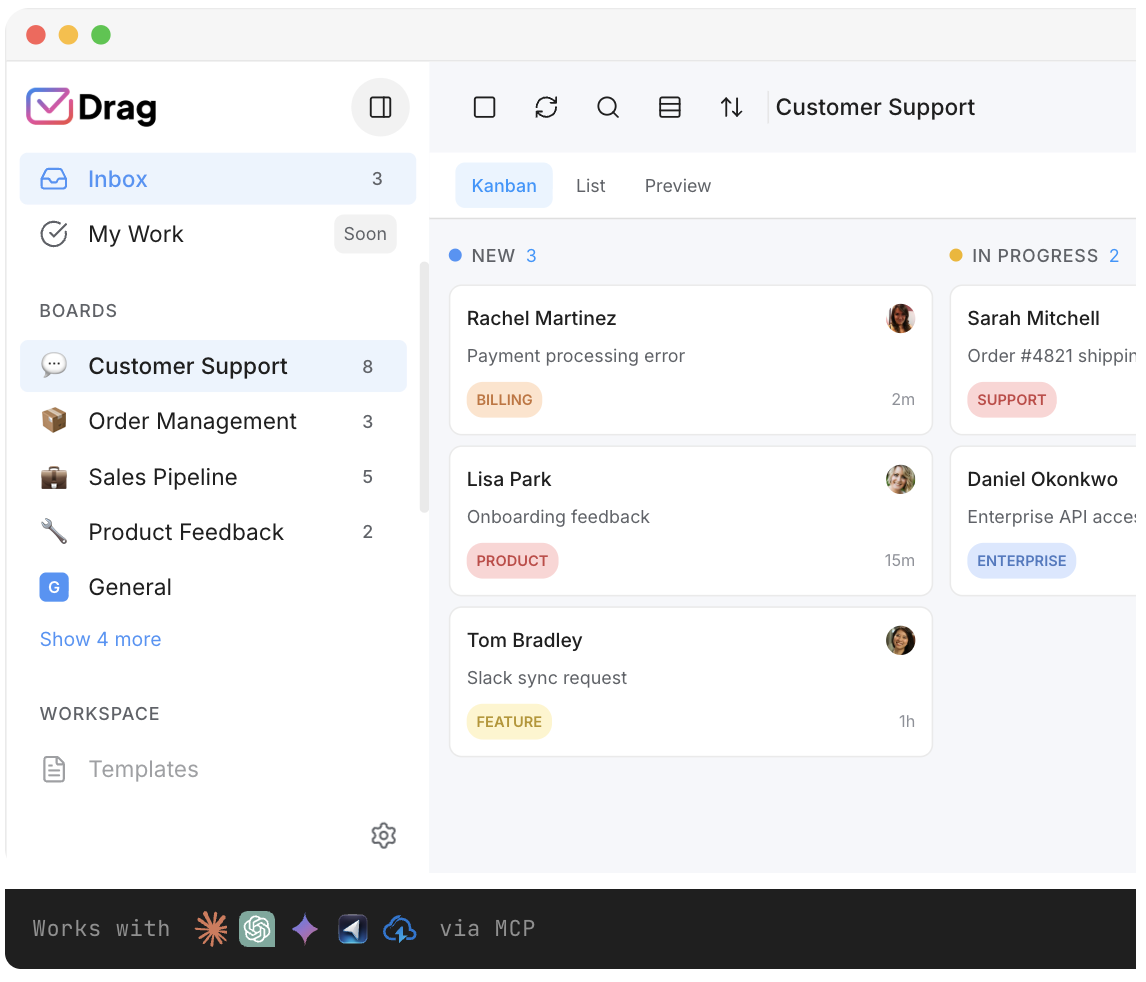
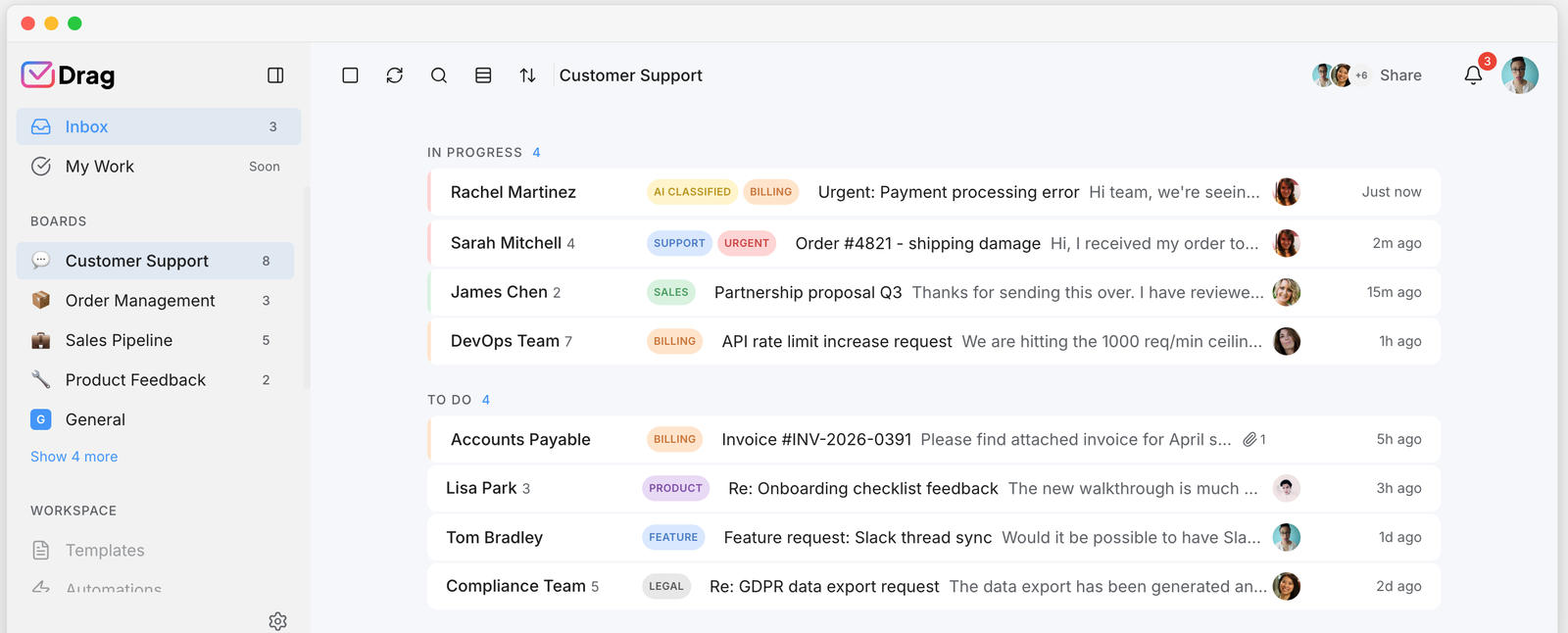
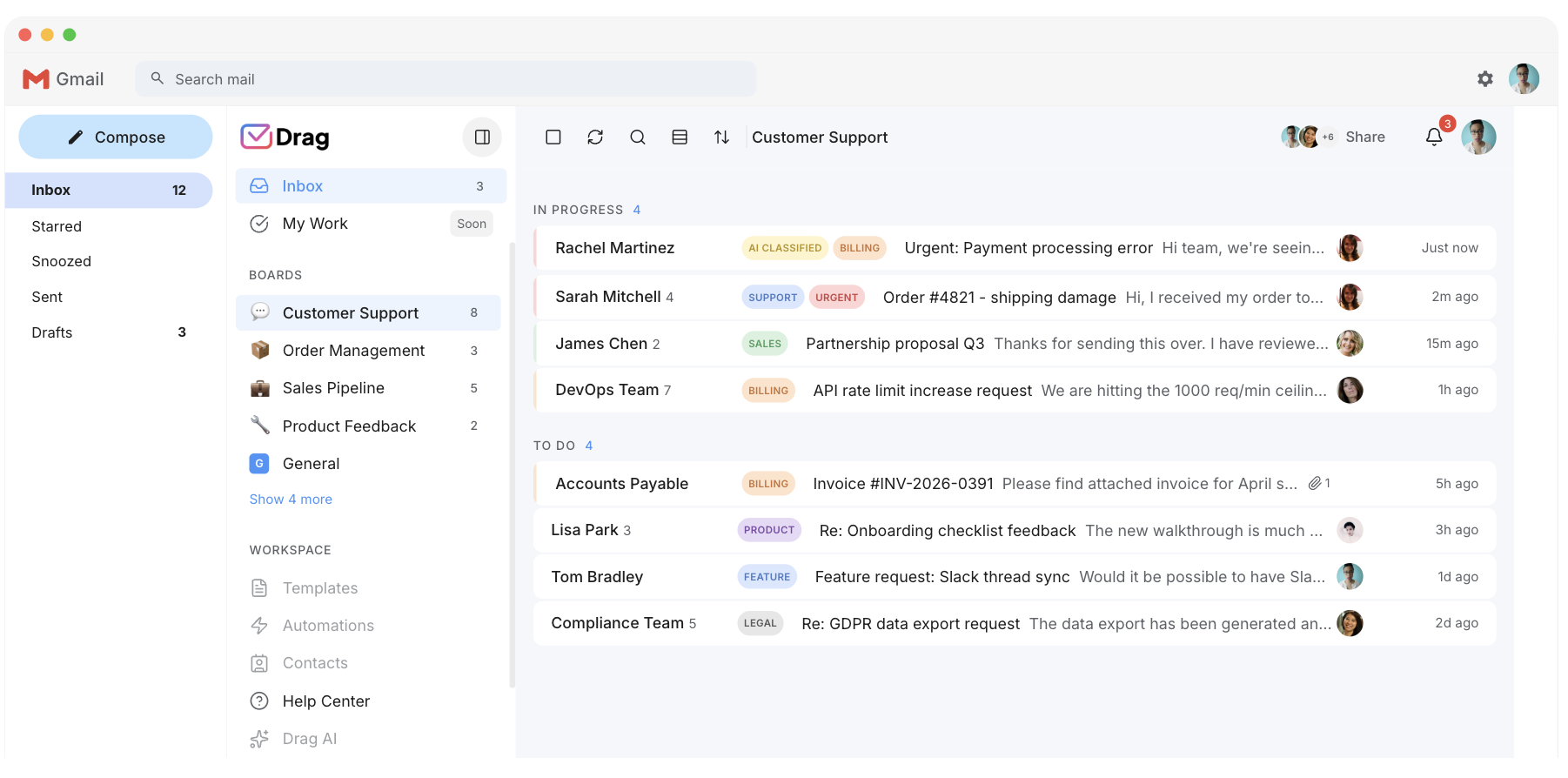
Keeping tracks tickets as a list of statuses. Drag turns the queue into Kanban boards: every conversation is a card moving through stages the whole team sees, with round-robin assignment and collision detection built in. For queues past a handful a day, the difference is whether the workload is visible or discovered.
- Drag: Kanban boards, cards through stages, round-robin assignment, collision detection.
- Keeping: a ticket list of statuses (Open, Pending, Closed).
Varley · Drag’s AI
One AI, four ways it works.
Varley, Drag’s AI, knows your help center, docs and past conversations. It drafts and tags every email, answers your team in Copilot, acts in Stripe, Slack and HubSpot when you approve, and on Pro resolves conversations on its own. Monthly AI credits come with every Plus and Pro seat, with no per-seat AI add-on.
Keeping has no AI features at any tier to turn on.
- CopilotAsk Varley, then let it act
- AgentsVarley resolves conversations on its own
- IntelligenceWhat Varley knows, and the tools it acts in
- AssistsVarley in every email: drafts, tags, summaries
Included in Plus. Pro gets 2x the usage. Power users top up any time.
Varley resolves the routine ones on its own.
On Pro, Varley’s Agent reads the email, checks your policy, acts in tools like Stripe, replies in your team’s voice and closes the conversation. Anything it isn’t sure of goes to your team, with everything it found. Included in Pro.
With no AI at any tier, Keeping has no autonomous agent to compare against.

I was charged twice this month
Daniel Okonkwo · Customer
- 9:38:13
Read Daniel’s email
Billing · Urgent
- 9:38:15
Checked your refund policy
Duplicate charges: refund in full
- 9:38:18
Found both charges in Stripe
$49 on 12 April, twice
- 9:38:22
Refunded the duplicate
$49 back to Daniel’s card
- 9:38:30
Replied to Daniel
Policy cited, in your team’s voice
- 9:38:35
Closed the conversation
Logged, with its sources
Connect Claude to your inbox in about two minutes.
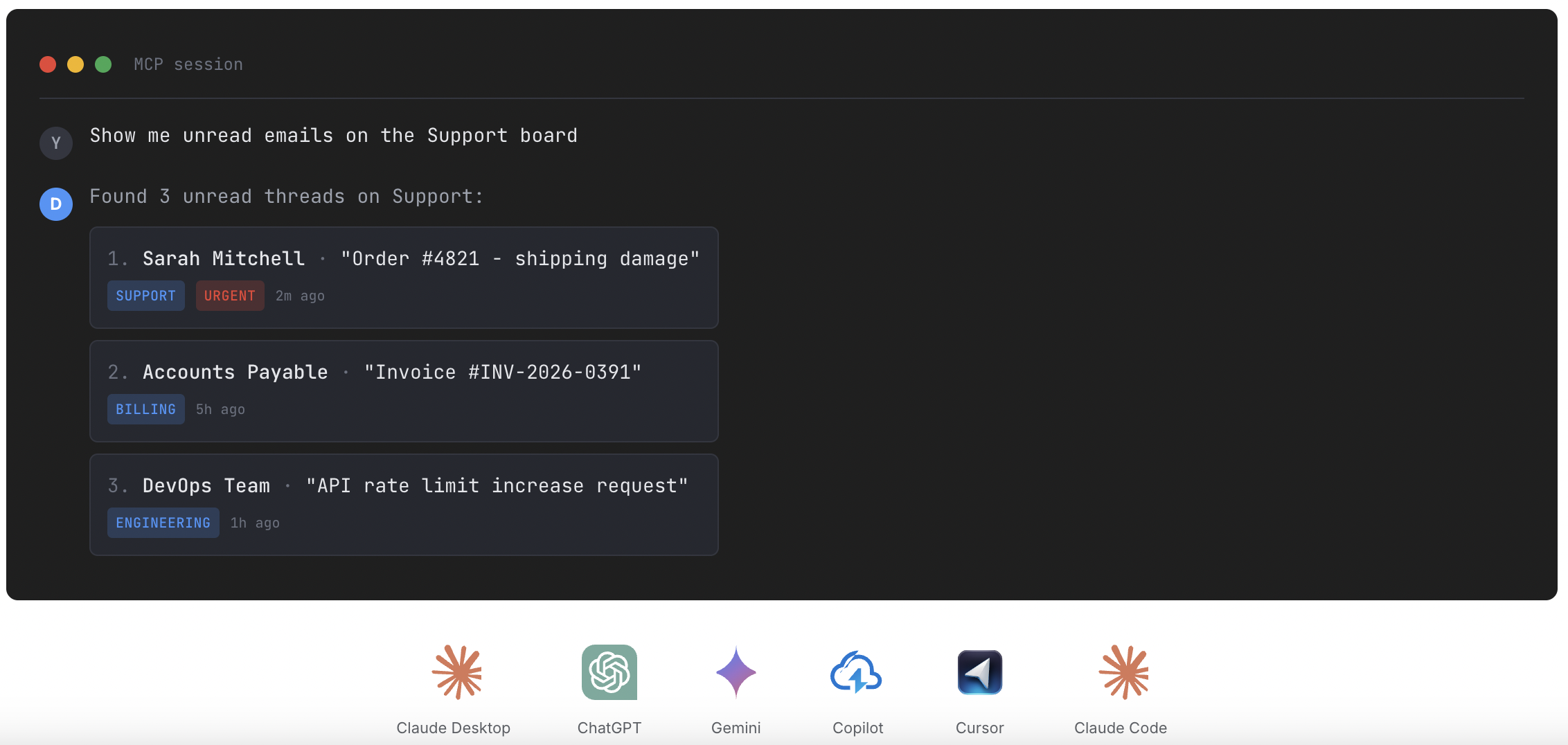
Paste one URL into Claude’s settings, enter your API key once, and your inbox becomes 47 tools with full read and write, WhatsApp included, on the Pro plan. ChatGPT, Gemini, Copilot and Cursor connect the same way. Then just ask:

Summarise unread Support threads and assign billing to Sarah.

Label everything mentioning refunds and move it to In Progress.

What was our first-reply time this week vs last?
Keeping has no MCP server and no public API; integrations run through Zapier and native connectors only.
Explore the MCP serverMCP server
@dragapp/mcp-server
47
tools · 12 categories · read + write
https://app.dragapp.com/mcp
paste into Claude › Settings › Connectors

 + any MCP client
Beyond support
More than a support ticket layer.
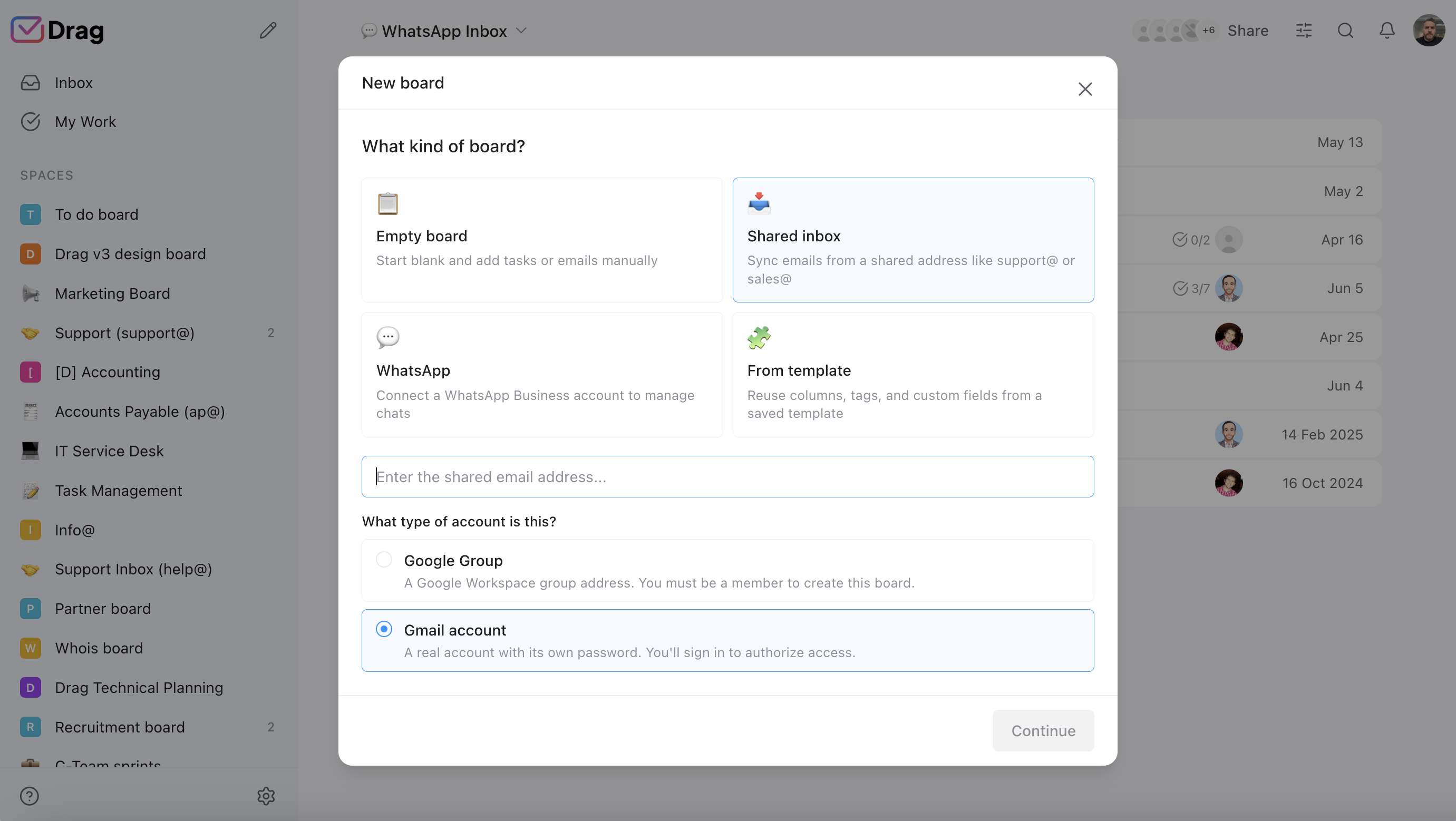
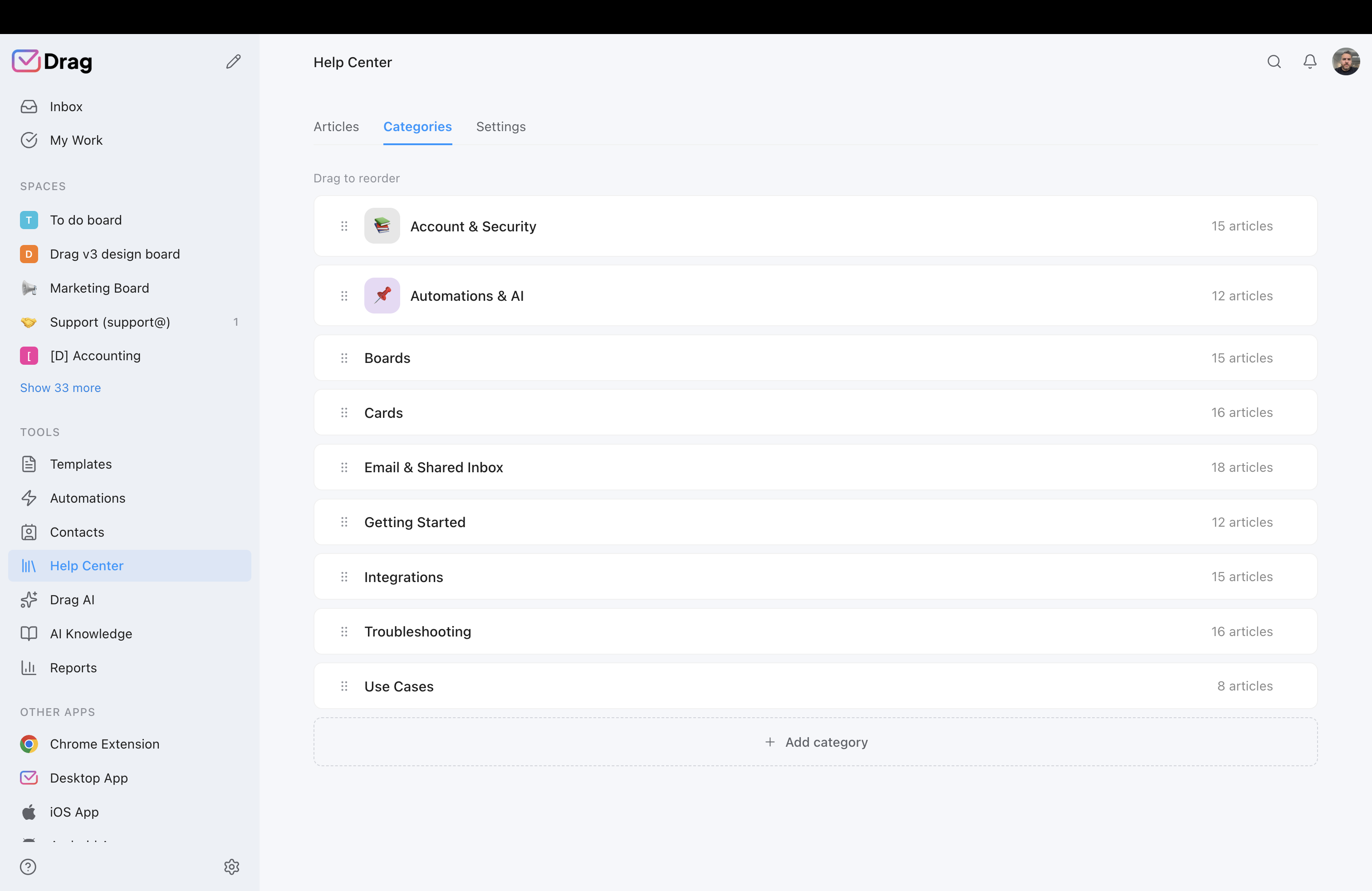
Keeping is built for support tickets. Drag runs the support queue and the rest of the company’s shared email on the same seats: sales pipelines, ops, HR, finance, each on its own board, plus a live-chat widget and WhatsApp landing in the same Gmail queue, and an AI-grounded help centre for self-serve.
- Drag: support plus sales, ops, HR, and finance boards on the same seats, with live chat, WhatsApp, and a help centre.
- Keeping: built around the support-ticket use case.
Automation
Room to automate.
Keeping’s entry tier caps automation at 2 workflows, with unlimited reserved for its top plan. Drag’s automation rules are included, and they extend to board moves, assignment, and labels, the operations a growing queue actually repeats.
- Drag: automation rules included, extending to board moves, assignment, and labels.
- Keeping: 2 workflows on the entry tier; unlimited only on the top plan.
Pricing: Drag vs Keeping
Drag and Keeping both start at $12 a seat billed annually. The difference is what the next dollar buys: Drag’s $18 tier includes Varley, its AI; Keeping has no AI tier to upgrade to. Model your team in the cost calculator.
AI features
 Drag Plus (AI included)
$2,160/yr
$18/user/mo × 10 seats · AI included
 Keeping Essentials (no AI tier)
from $1,440/yr+
$12/user/mo × 10 seats · Keeping offers no AI features at any tier; its plans differ on workflow counts, reporting depth, and CSAT, not AI. Drag's $18 tier is being compared against Keeping's closest plan by price.
Estimate based on annual per-seat pricing, July 2026. Keeping has no AI tier, so both comparator columns use its $12 Essentials rate. Confirm current pricing on each vendor's site.
Same start, different upgrade path
Put real numbers on it. A five-person team on the entry plan pays the same either way; the split is what an upgrade adds:
- At entry, identical: 5 seats × $12 × 12 months = $720 a year, on Drag Starter or Keeping Essentials alike.
- Drag with Varley: 5 seats × $18 = $90 a month ($1,080 a year) with Varley. Keeping has no AI tier at any price, so there is no equivalent upgrade to buy.
The entry prices match to the dollar; the difference is capability, not cost. Figures use published annual per-seat pricing, July 2026; confirm current numbers on each vendor’s site.
Drag vs Keeping, feature by feature
The detail layer for evaluators, with product screenshots where they clarify the claim.
Shared inbox inside Gmail
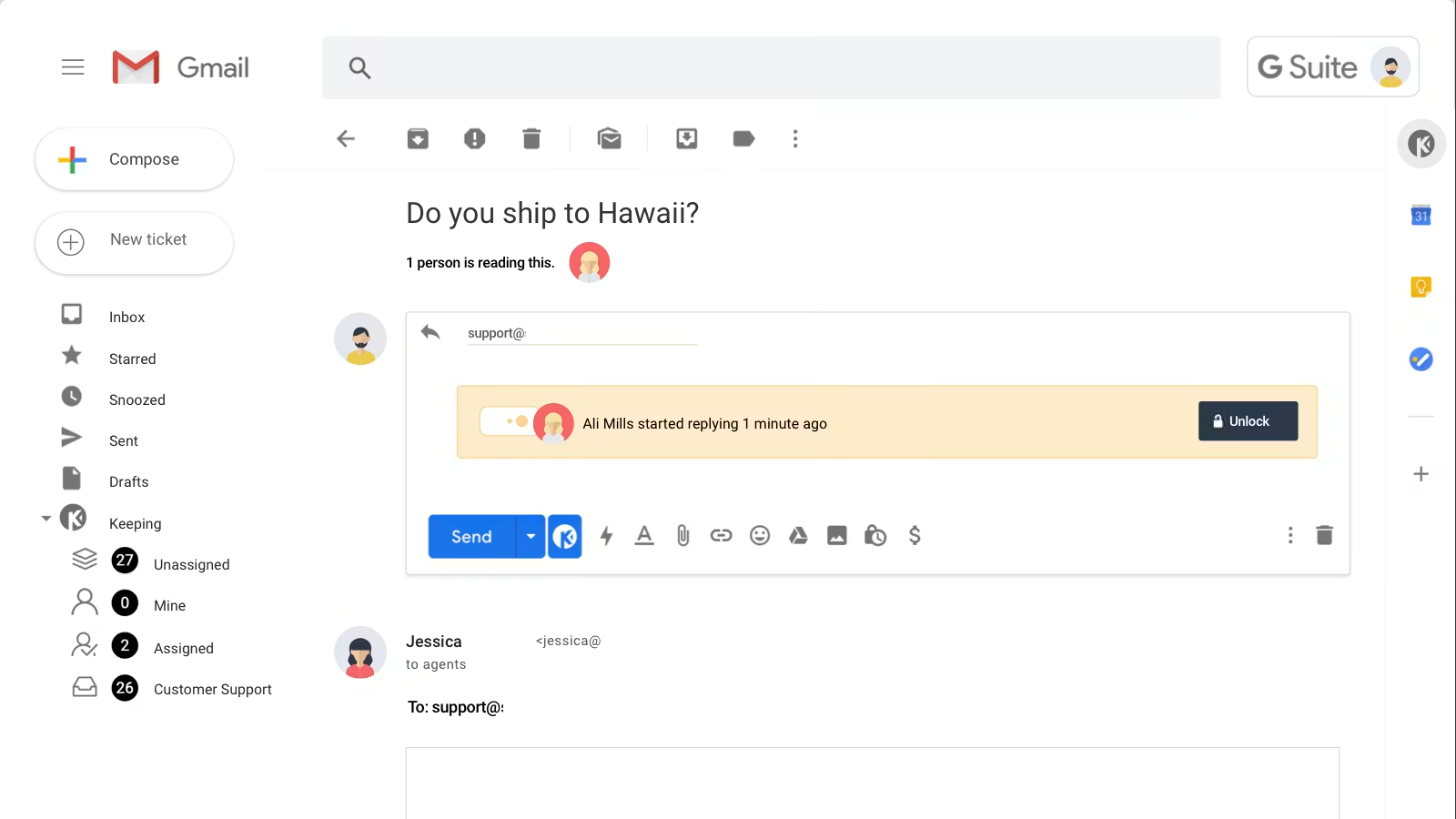
Genuine parity in the core: both live in Gmail, both assign, note, and detect collisions, both set up in minutes. Check both; this is the category’s shared DNA, and Keeping does it credibly.
- Drag: shared inbox in Gmail with assignment, notes, and collision detection, set up in minutes.
- Keeping: the same in-Gmail core (statuses, assignment, notes, collisions), done credibly.
AI on the ticket
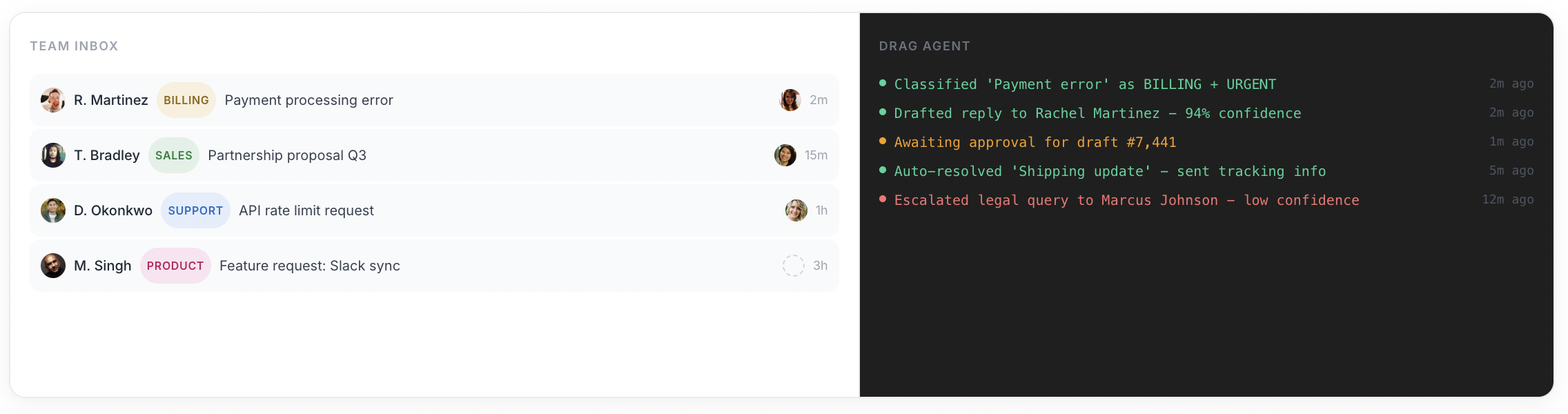
The decisive gap: Drag’s six seat-included assists versus none at any Keeping tier (its reply suggestions are template-matching from past answers, not generative drafting). Check Drag, cancel Keeping, stated plainly.
- Drag Plus $18: Varley drafts, tags, answers from your docs and acts in your tools.
- Keeping: no AI at any tier; reply suggestions are template-matching, not generative.
Workflow visibility
Boards versus statuses. Check Drag; Keeping partial, its statuses work but visibility is the limit.
- Drag: Kanban boards, cards through stages, the whole queue visible at a glance.
- Keeping: statuses work, but visibility is the limit.
Automation
Both do assign, tag, and status rules; the difference is the entry-tier cap (2 workflows) versus included. Check Drag; Keeping partial.
- Drag: assign, tag, and status rules included, extending to board moves and labels.
- Keeping: assign/tag/status rules, but the entry tier caps at 2 workflows.
Reporting and CSAT
Both report response and resolution times. Keeping wins a real point here: built-in CSAT surveys on higher tiers, which Drag does not ship. Check both, with the concession explicit.
- Drag: response and resolution reporting, exportable and queryable from an AI client via MCP.
- Keeping: response and resolution reporting, plus built-in CSAT surveys on higher tiers (Drag does not ship CSAT).
Channels and self-serve
Drag adds live chat, WhatsApp, and an AI-grounded help centre in the same queue; Keeping is email-only with no help centre. Check Drag, cancel Keeping.
- Drag: email plus live chat, WhatsApp, and an AI-grounded help centre, all in the same Gmail queue.
- Keeping: email only, with no help centre.
Platform access
Drag ships standalone apps and an MCP server alongside the Gmail extension; Keeping is a Gmail extension plus a mobile web portal, with no native app and no public API. Check Drag.
- Drag: Gmail plus standalone web, desktop, and mobile apps, and an MCP server.
- Keeping: Gmail extension plus a mobile web portal; no native app, no public API.
If you switch: what you keep, what changes
The honest question a Keeping team asks is not whether Drag does more (it does), it is “what happens to the way we work today?” Here is the straight answer.
You keep
Gmail as the system of record (both tools’ architecture honours it: your history stays in your accounts either way, a point Keeping itself makes fairly), your templates (recreated in an hour), and the in-Gmail muscle memory: Drag’s learning curve from Keeping is near-zero because the home is the same.
What changes
Tickets become cards on boards; statuses become columns; the AI layer appears at the $18 tier; and two Keeping features need honest replacement plans: CSAT surveys (Drag does not ship them; teams typically run a lightweight reply-based measure or a form) and in-Gmail Shopify order context (Drag has no store integration; the store admin is a tab away).
Where Keeping fits better
Three real cases.
- Radical simplicity: if the whole requirement is 'tickets in Gmail, nothing else to learn,' Keeping's focus is genuinely its feature; there is less product to configure because there is less product.
- Built-in CSAT: satisfaction surveys ship in the box on its higher tiers; Drag does not have them.
- Shopify context in the inbox: Keeping shows order information beside the conversation; Drag does not integrate with stores.
If those three outweigh AI, boards, channels, and an API for you, stay with our blessing; this page is for teams that expect to grow past a ticket list.
Switching from Keeping to Drag is quick
The gentlest switch on this site: both tools live in Gmail, so there is no platform migration in either direction. Install Drag into the same Google Workspace, connect the shared addresses, set up boards, recreate templates, invite the team. Most teams are working the queue the same afternoon; the 7-day trial answers the fit question directly.
What customers say
“What we like the most about Drag is the ability to see at a glance where a client is during their Onboarding process, through the use of columns, tasks, and tags. It has been crucial for us because Waste Logics is a growing business and this transparency allows us to work faster and smarter.”
“There really is no comparison when it comes to Drag. We have a great relationship with their team, it’s incredibly easy to use, addresses all of our needs, and the price is right!”
“Drag provided a lot of transparency and unified our team. It allowed us to bring the entire team together to manage emails and tasks collaboratively, as opposed to working in silos, across different tools.”
Frequently asked questions
Is Drag a good Keeping alternative?
For Gmail teams, yes, and the switch is unusually gentle since both live in Gmail. Drag matches Keeping's $12 entry price and adds what Keeping does not offer at any tier: AI assists from $18, Kanban boards, live chat, WhatsApp, a help centre, an API, and an MCP server.
What is the main difference between Drag and Keeping?
Ceiling. Keeping is a deliberately simple ticket layer on Gmail: statuses, assignment, notes, CSAT. Drag is a Gmail-native platform: the same core plus AI, boards, more channels, automation without tier caps, and programmatic access.
How much does Keeping cost?
Three plans from $12 per user per month billed annually ($14 monthly), with a 14-day free trial and no permanent free plan. Higher tiers add unlimited mailboxes and workflows, advanced reporting, CSAT, and SLA alerts.
Is Drag cheaper than Keeping?
They start identical at $12. The comparison is what upgrades buy: Drag’s $18 tier adds Varley, its AI; Keeping’s upgrades add workflow counts and reporting depth, never AI. Five Drag seats with Varley: $90 a month.
Does Keeping have AI?
No AI features at any tier. Its reply suggestions match templates from past answers; there is no generative drafting, tagging, sentiment, or summarisation. Drag includes all four from $18.
Does Keeping have an API or MCP server?
Neither: no public API and no MCP server. Drag has both; via MCP (47 tools), Claude, ChatGPT, or Cursor can read, draft, assign, label, and report on your inbox by prompt.
Does Drag have CSAT surveys like Keeping?
No, and we say it plainly: built-in CSAT is a genuine Keeping advantage on its higher tiers. Drag teams typically measure satisfaction with a lightweight reply-based method or a form; if boxed CSAT is a hard requirement, weigh that honestly.
Does Drag work with Shopify like Keeping?
No. Keeping shows order information inside Gmail; Drag has no store integration. Email-led stores handle order lookups in a store-admin tab; if in-inbox order context is central to your workflow, that is a real Keeping point.
Does Drag have a free plan?
Drag offers a 7-day trial with no card required; paid plans are $12, $18 (AI included from here), and $24 per user billed annually. Keeping offers a 14-day trial but no permanent free plan.
Which is easier to learn?
Honestly, both: each lives inside Gmail, which is the shared point of the category. Keeping has less surface to learn because it has less product; Drag's boards take an hour to feel native.
Can Drag handle more than customer support?
Yes: sales, ops, HR, and finance shared inboxes run as separate boards on the same seats. Keeping is built around the support-ticket use case.
Does Keeping have a mobile app?
A mobile web portal, not a native app. Drag ships standalone web, desktop, and mobile apps alongside the Gmail extension.
What channels does each support?
Keeping: email. Drag: email, a website live-chat widget, and WhatsApp, all landing in the same Gmail queue with the same owners and boards.
How does automation compare?
Keeping's entry tier includes 2 workflows, with unlimited on its top plan. Drag's automation rules are included and extend to board moves, assignment, and labels.
Who is Keeping best for?
Teams that want the simplest credible ticket layer on Gmail, value built-in CSAT and Shopify order context, and are confident they will not need AI, an API, boards, or channels beyond email.
How do I switch from Keeping to Drag?
Install Drag into the same Google Workspace, connect the shared addresses, set up boards, recreate templates, invite the team. Both tools keep Gmail as the system of record, so nothing migrates and nothing is lost. Start free.


