








Trengo is a capable multichannel platform, strongest when Instagram, Facebook, voice, and SMS are first-class queues. But its bill stacks three meters: a 10-seat bundle from €299 a month, a conversation allowance counted in 7-day windows, and a per-conversation AI surcharge. Drag bills seats, with Varley, its AI, drafting, tagging and summarising included from $18, unlimited conversations, and WhatsApp and live chat in the Gmail queue. Here is the honest, side-by-side comparison.

Table of contents
The verdict
The best Trengo alternative for Gmail teams is Drag: it swaps Trengo's three meters (a 10-seat bundle from €299, a conversation allowance counted in 7-day windows, and a per-conversation AI surcharge) for one flat seat price with Varley, its AI, drafting, tagging and summarising included from $18, unlimited conversations, and WhatsApp and live chat in the Gmail queue. Trengo remains the better choice for teams running Instagram, Facebook, voice, and SMS as first-class queues, or WhatsApp broadcasts and marketing campaigns.
Choose Drag if you…
- your customer conversations are mostly email and WhatsApp, and your team lives in Google Workspace
- you want one meter, seats: a flat price with AI drafting, tagging, sentiment, and summaries included from $18
- you want no conversation counting and no per-conversation AI surcharge
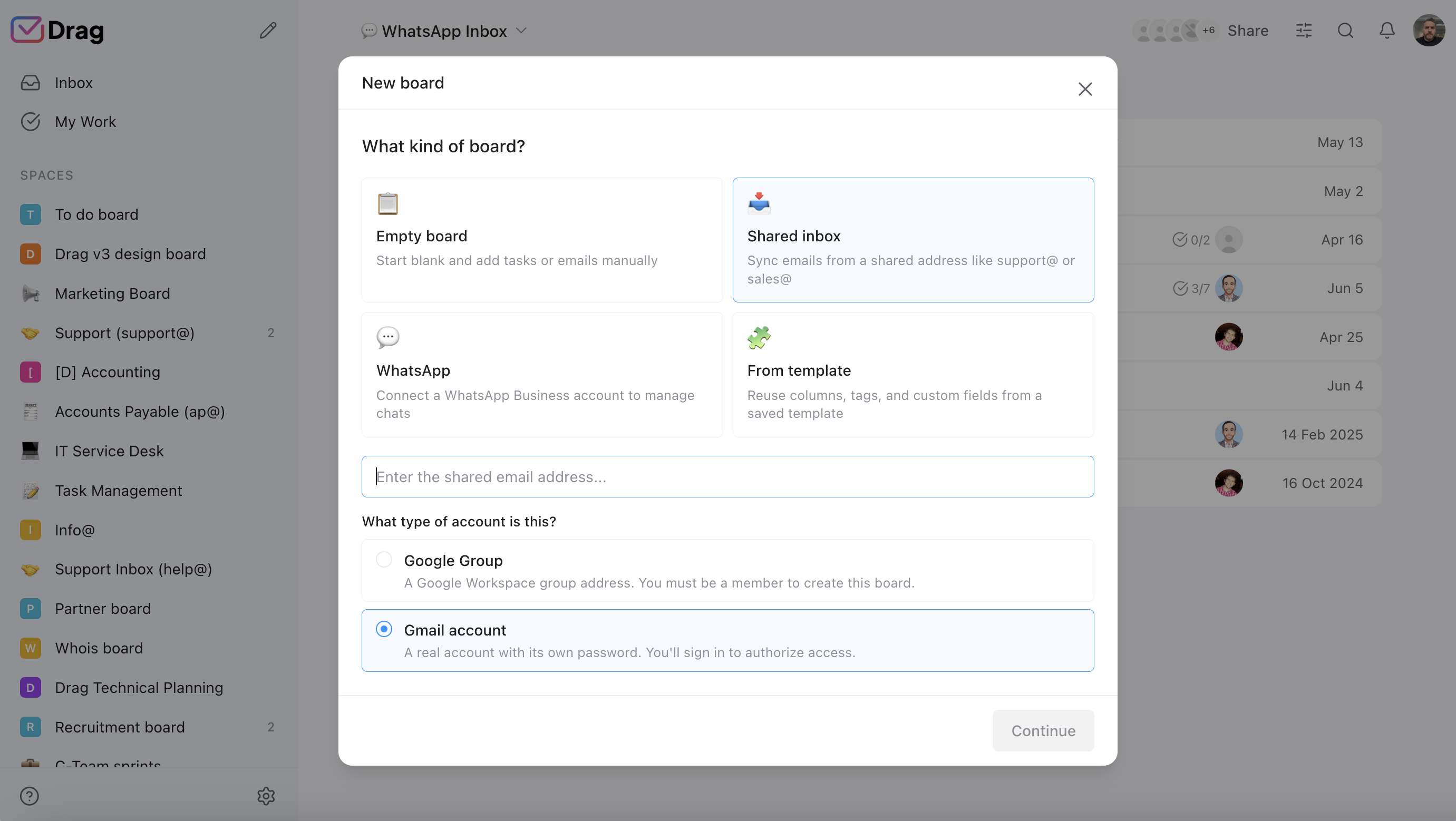
- you want WhatsApp and live chat landing in the same Gmail queue, plus an MCP server
Choose Trengo if you…
- you genuinely run support across Instagram, Facebook, voice, and SMS as first-class queues
- WhatsApp broadcasts and marketing campaigns are core to your operation. We say so plainly below.
Running WhatsApp support too? See our WhatsApp shared inbox guide for the setup.
Drag vs Trengo at a glance
| Feature | Drag | Trengo |
|---|---|---|
| Pricing & plans | ||
| Pricing model | Flat per-seat, $12 to $24 | Seat bundles + conversation allowance + usage wallet (Boost €299/mo annual, 10 seats, 6,000 conversations/year) |
| Smallest team fit | Any size from 1 seat; 7-day trial | No small tier: a 3-person team pays the full 10-seat Boost bundle |
| AI cost | Included from $18, with monthly AI credits | €0.25 to €0.30 per AI-handled conversation on top of the plan (50 included monthly on Boost) |
| Conversation limits | None | Counted in 7-day windows against an annual allowance |
| Channels & WhatsApp | ||
| Channels | Email + live chat + WhatsApp | 10+ channels incl. Instagram, Facebook, voice, SMS (its genuine strength) |
| Shared inbox in Gmail | Official partner; Meta rates passed through at cost; broadcasts and campaigns | |
| Platform & workflow | ||
| Where you work | Inside Gmail + standalone apps | Standalone platform |
| Kanban workflow | check_circle | cancel |
| Help centre | Yes, AI-grounded | Yes |
| Access | ||
| Free plan | 7-day trial, no card | No (trial only) |
| MCP server (run inbox from AI clients) | Yes, 47 tools | No |
Verified July 2026; Trengo prices in EUR as published, Drag in USD; confirm current details on each vendor’s site.
Why Gmail teams pick Drag
Pricing
One meter, not three.
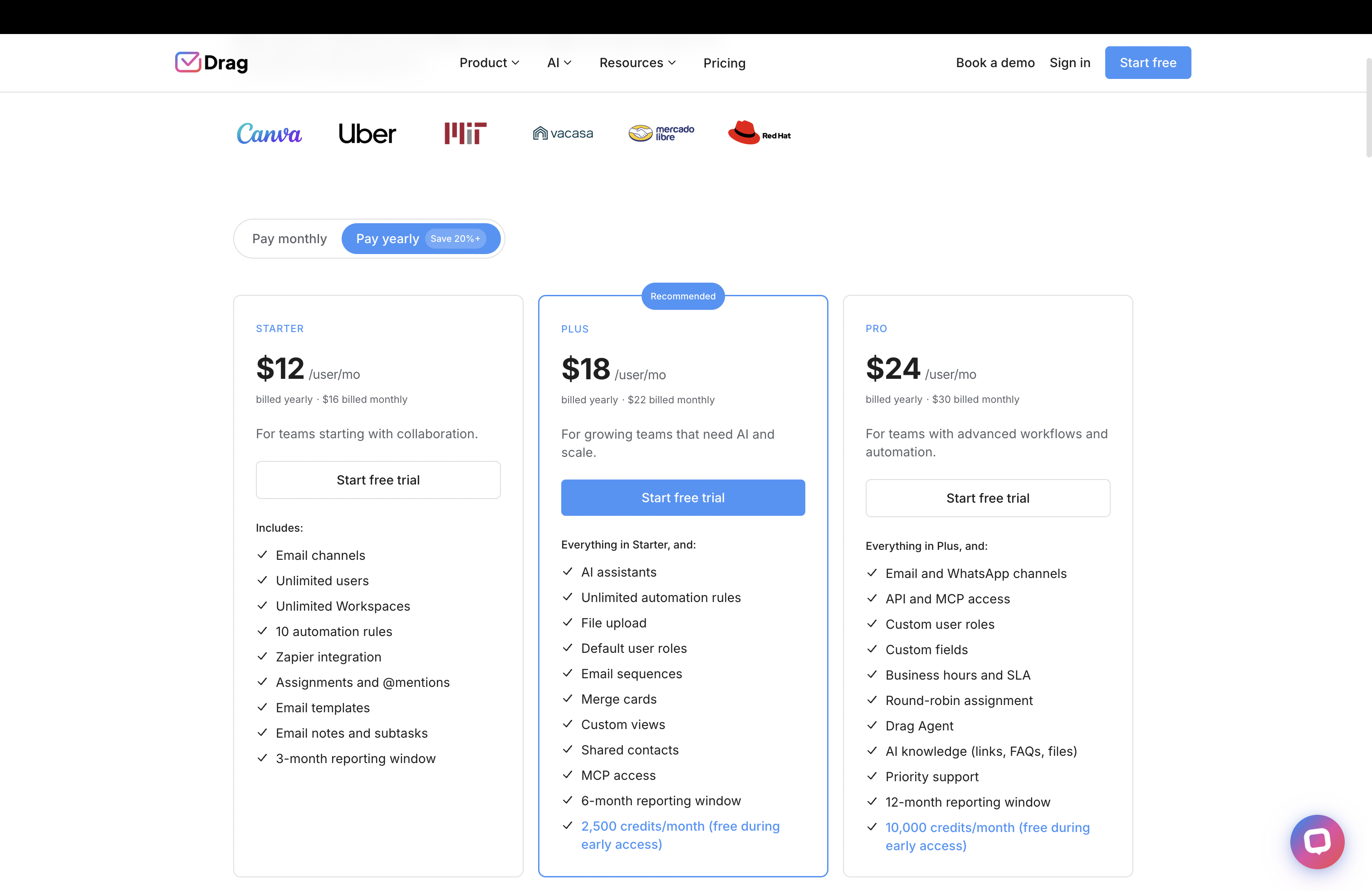
A Trengo bill stacks three counters: the seat bundle, the conversation allowance (counted in 7-day windows, so one slow-moving issue can bill twice), and the AI wallet. Drag has one: seats. Five seats with Varley is $90 a month, and it is the same number in a busy month as a quiet one.
- Drag: priced by seat. Five with Varley is $90 a month, busy month or quiet.
- Trengo: three counters, the seat bundle, the conversation allowance, and the AI wallet.
No minimums
No ten-seat minimum.
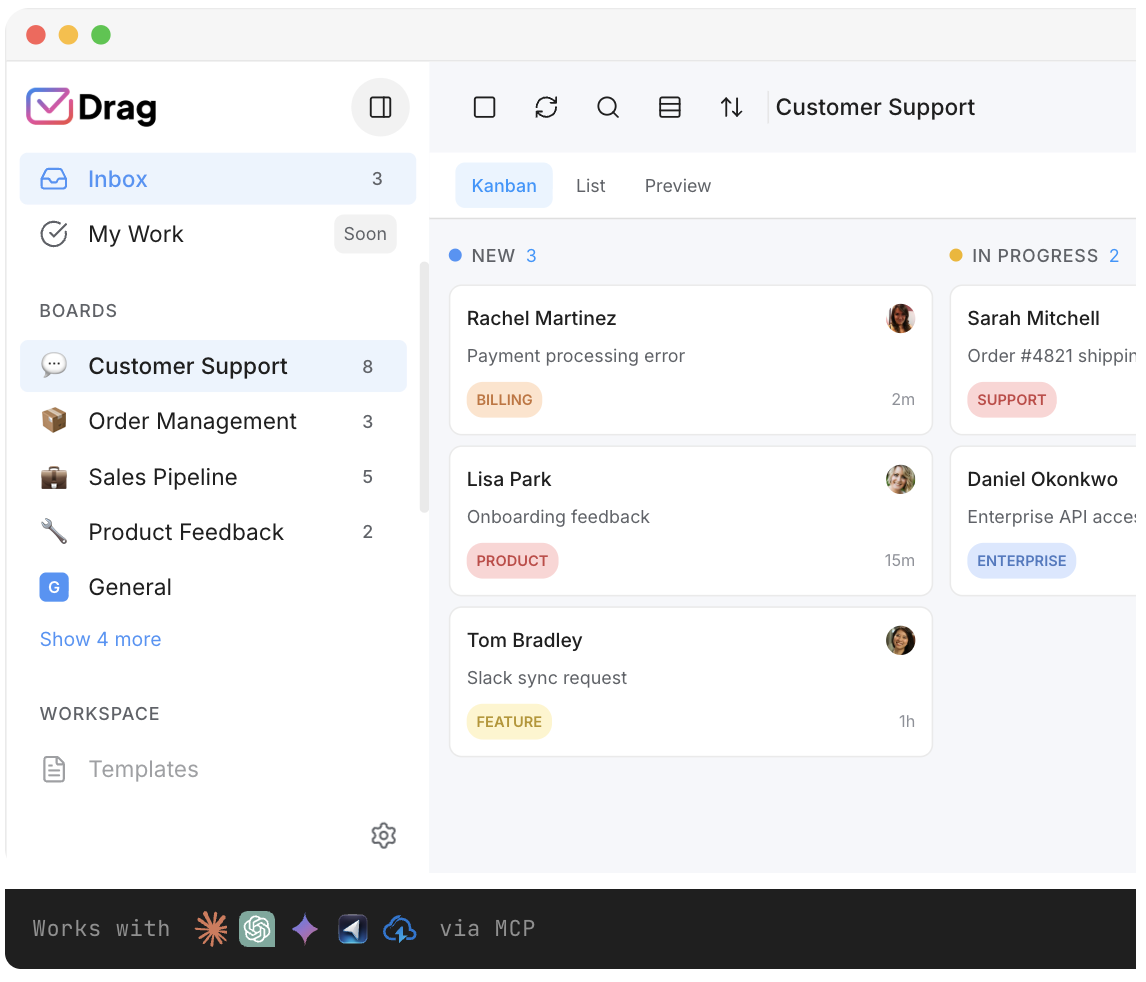
Trengo’s smallest plan is a 10-seat bundle at €299 a month, so a three-person team pays for seven empty chairs. Drag prices the team you actually have: three seats with full AI is $54 a month, and there is a 7-day trial to start on, no card required.
- Drag: pay for the team you have. Three seats with Varley is $54 a month, after a 7-day trial.
- Trengo: a 10-seat bundle at €299/mo, so a three-person team pays for seven empty chairs.
Varley · Drag’s AI
One AI, four ways it works.
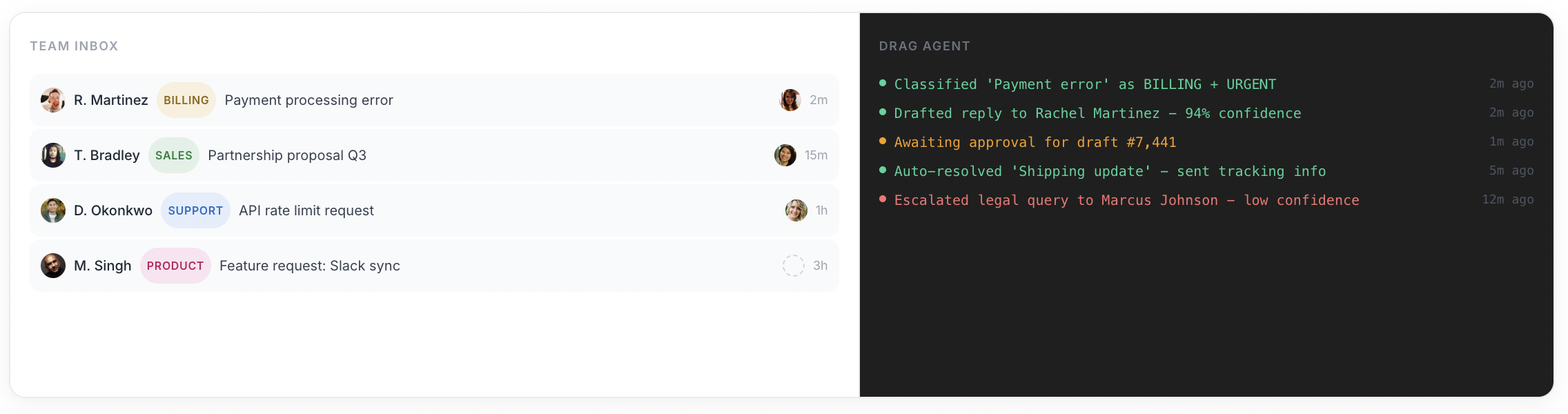
Varley, Drag’s AI, knows your help center, docs and past conversations. It drafts and tags every email, answers your team in Copilot, acts in Stripe, Slack and HubSpot when you approve, and on Pro resolves conversations on its own. Monthly AI credits come with every Plus and Pro seat, with no per-seat AI add-on.
Trengo adds €0.25 to €0.30 for every AI-handled conversation.
- CopilotAsk Varley, then let it act
- AgentsVarley resolves conversations on its own
- IntelligenceWhat Varley knows, and the tools it acts in
- AssistsVarley in every email: drafts, tags, summaries
Included in Plus. Pro gets 2x the usage. Power users top up any time.
Varley resolves the routine ones on its own.
On Pro, Varley’s Agent reads the email, checks your policy, acts in tools like Stripe, replies in your team’s voice and closes the conversation. Anything it isn’t sure of goes to your team, with everything it found. Included in Pro.
Trengo’s HelpMate answers and takes actions today, billed per handled conversation.

I was charged twice this month
Daniel Okonkwo · Customer
- 9:38:13
Read Daniel’s email
Billing · Urgent
- 9:38:15
Checked your refund policy
Duplicate charges: refund in full
- 9:38:18
Found both charges in Stripe
$49 on 12 April, twice
- 9:38:22
Refunded the duplicate
$49 back to Daniel’s card
- 9:38:30
Replied to Daniel
Policy cited, in your team’s voice
- 9:38:35
Closed the conversation
Logged, with its sources
Connect Claude to your inbox in about two minutes.
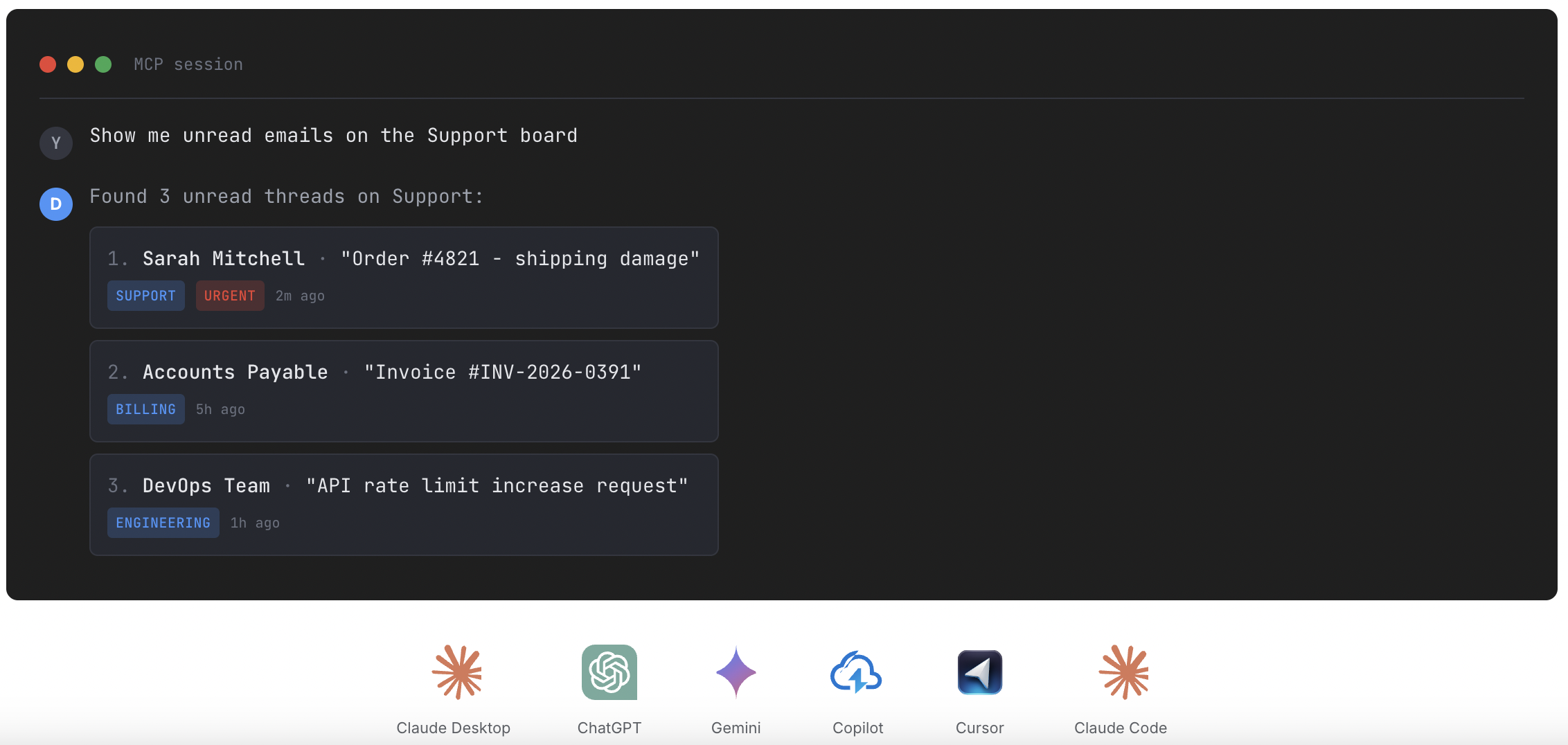
Paste one URL into Claude’s settings, enter your API key once, and your inbox becomes 47 tools with full read and write, WhatsApp included, on the Pro plan. ChatGPT, Gemini, Copilot and Cursor connect the same way. Then just ask:

Summarise unread Support threads and assign billing to Sarah.

Label everything mentioning refunds and move it to In Progress.

What was our first-reply time this week vs last?
Trengo has no official MCP server; only third-party API bridges exist.
Explore the MCP serverMCP server
@dragapp/mcp-server
47
tools · 12 categories · read + write
https://app.dragapp.com/mcp
paste into Claude › Settings › Connectors

 + any MCP client
AI
AI included, not surcharged.
Trengo’s AI adds €0.25 to €0.30 for every conversation it handles beyond a small allowance, so automating 500 conversations a month adds roughly €125 to €150 to the bill: the cost rises exactly as the AI succeeds. Varley, Drag’s AI, is in the seat from $18: grounded drafts, tagging, summaries and answers from your docs, with monthly AI credits included.
- Drag: Varley in the seat from $18, with monthly AI credits.
- Trengo: €0.25 to €0.30 per AI-handled conversation, so 500 a month adds ~€125 to €150.
Predictable
A bill you can budget a year out.
The most consistent theme in Trengo’s public reviews is pricing instability: repeated increases, including for existing customers, and the 2024 shift to conversation-based billing that capped previously uncapped usage. We cite that as reviewer reports, not our claim, and offer the structural fix: a flat seat price has nothing to re-meter.
- Drag: a flat seat price with nothing to re-meter, the same number a year from now.
- Trengo: reviewers report repeated increases and a 2024 shift to conversation-based billing.
Pricing: Drag vs Trengo
Trengo’s Boost plan is €299 a month billed annually: a 10-seat bundle with 6,000 conversations a year, before AI. Add the AI surcharge and moderate automation (500 AI-handled conversations a month at €0.25 to €0.30) and the real bill runs roughly €425 to €450 a month, more if conversations exceed the allowance. Drag for five seats with Varley drafting every reply, unlimited conversations and no surcharges is $90 a month, and very high resolution volumes top up. Model your own team in the cost calculator.
Drag vs Trengo, feature by feature
The detail layer for evaluators, with Drag product screenshots where they clarify the claim.
Shared inbox
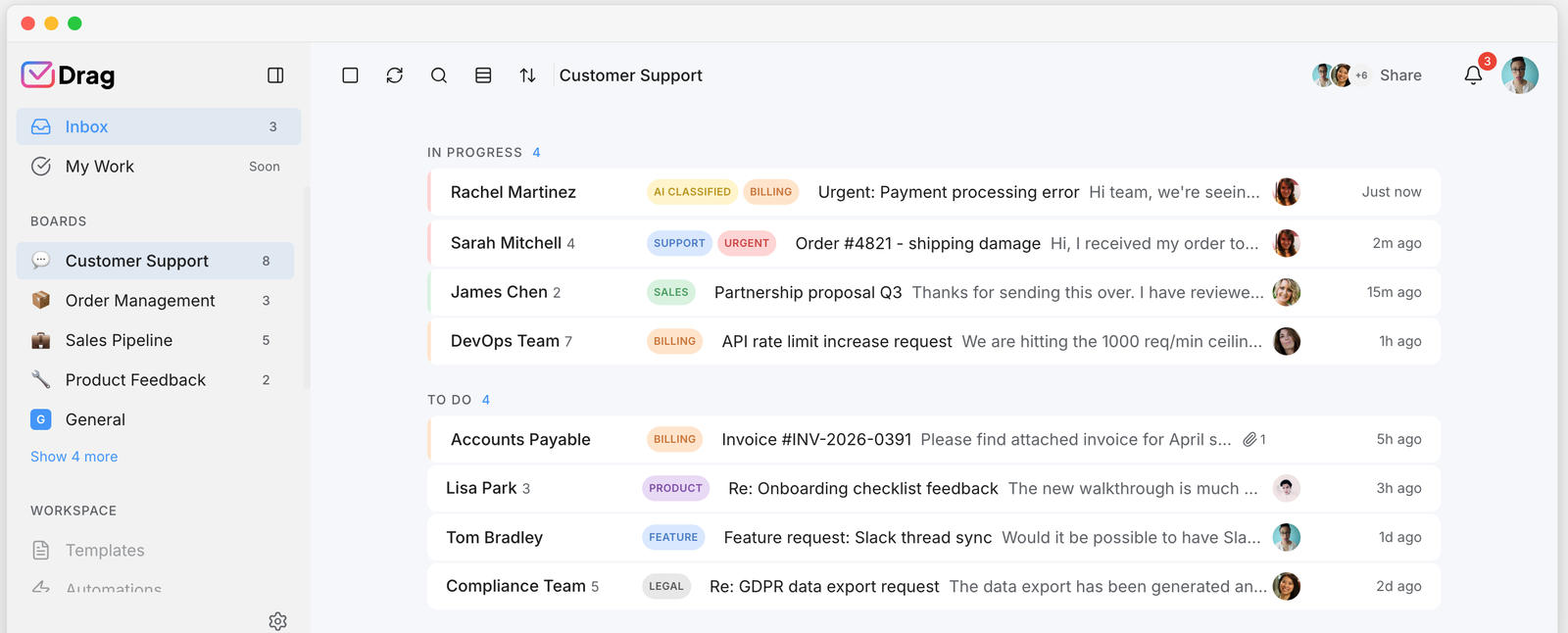
Both centralise team conversations with assignment, notes, and collision handling; Trengo consolidates more channels into its view, Drag adds Kanban boards and lives in Gmail. Check both, different shapes.
- Drag: one shared queue with assignment, notes, and collision handling, plus Kanban boards, in Gmail.
- Trengo: consolidates more channels into one view.
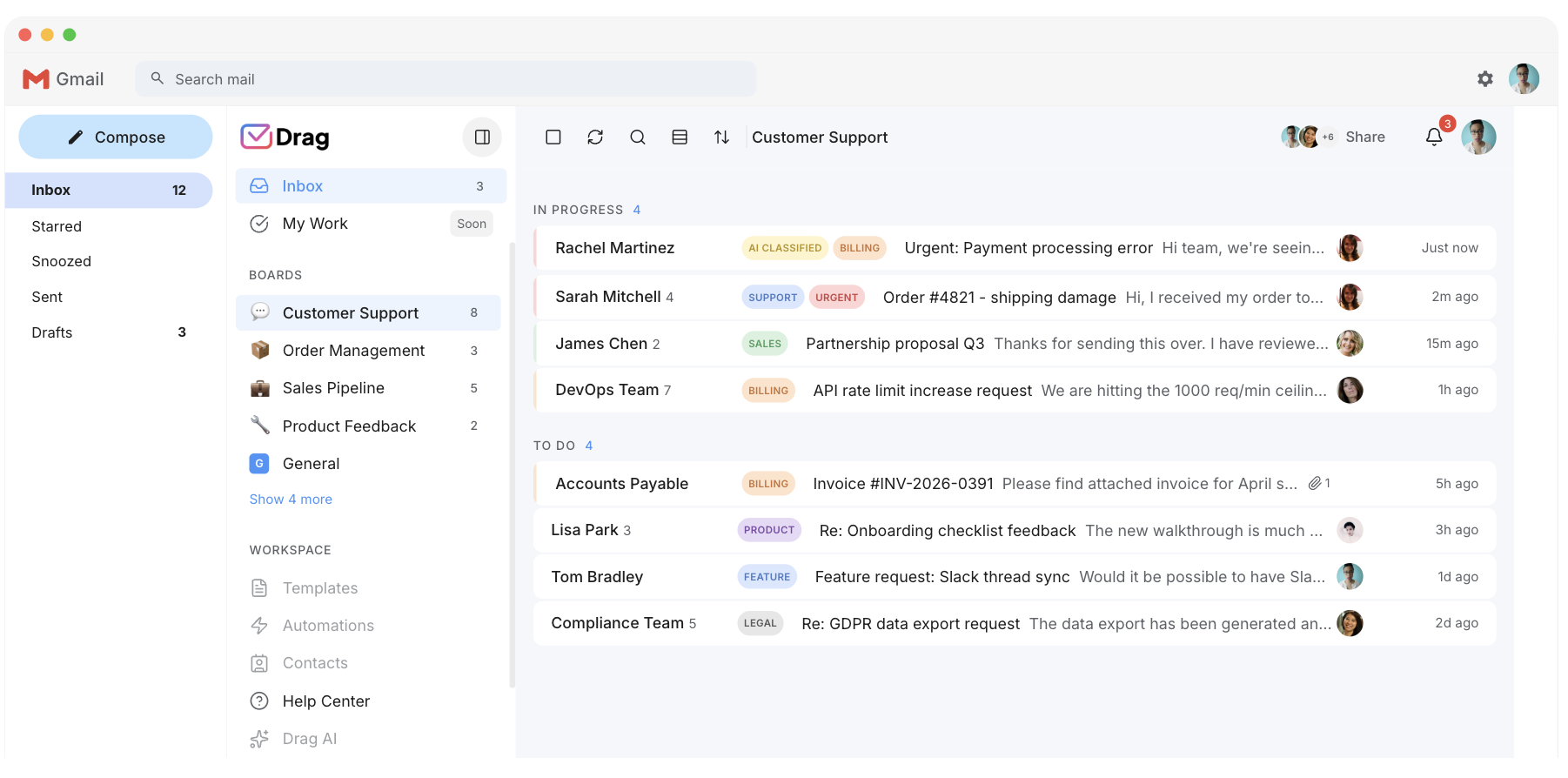
The head-on collision, honestly split: for WhatsApp as a support channel beside email, Drag lands it in the same Gmail queue with the same owners, boards, and AI. For WhatsApp as a marketing channel (broadcasts, campaigns, official-partner depth, Meta rates at cost), Trengo is genuinely ahead. Check both with the split stated.
- Drag: WhatsApp as a support channel in the same Gmail queue, same owners, boards, and AI.
- Trengo: WhatsApp as a marketing channel, broadcasts, campaigns, official-partner depth, Meta rates at cost.
AI on the conversation
Both real, differently billed: Trengo’s HelpMate answers grounded in your help centre and takes actions, at €0.25 to €0.30 per handled conversation; Varley is included in the seat, with monthly AI credits. Reviewers also note Trengo’s flow-builder is basic and its AI Journeys is still beta per its own pricing page. Check Drag on cost model; check Trengo on autonomous breadth.
- Drag: Varley in the seat (drafts, tagging, summaries, answers from your docs, Copilot).
- Trengo: HelpMate answers and takes actions at €0.25 to €0.30 per handled conversation; Journeys still beta.
Automation
Trengo’s rules and flowbots route across channels; reviewer complaints centre on missing conditional logic. Drag’s rules are included and extend to board moves and assignment. Check Drag; Trengo partial.
- Drag: automation rules included, extending to board moves and assignment.
- Trengo: rules and flowbots across channels, but reviewers note missing conditional logic.
Reporting
Both report response times and volumes; Trengo’s multichannel analytics go wider, Drag’s are included with export on every paid plan. Honest split.
- Drag: response-time and volume reporting, exportable on every paid plan and queryable via MCP.
- Trengo: response times and volumes, with wider multichannel analytics.
Channels beyond email and chat
Trengo wins outright: Instagram, Facebook, voice, SMS, Telegram as first-class queues. Drag covers email, live chat, and WhatsApp. Honest cancel for Drag.
- Trengo: Instagram, Facebook, voice, SMS, and Telegram as first-class queues.
- Drag: email, live chat, and WhatsApp; no social, voice, or SMS.
Data and exit
Stated fairly from public reviews: Trengo data export runs through its API, which reviewers describe as painful; Drag’s architecture keeps Gmail as the system of record, so your email history is yours whether you stay or go. Check Drag.
- Drag: Gmail stays the system of record, so your email history is yours whether you stay or go.
- Trengo: data export runs through its API, which reviewers describe as painful.
If you switch: what you keep, what changes
The honest question a Trengo team asks is not “is Drag cheaper” (it is), it is “what happens to the way we work today?” Here is the straight answer.
You keep
Your email (Gmail is the system of record, nothing migrates), your WhatsApp number (porting is standard Meta process, coordinate before disconnecting), your templates, and your help-centre content.
What changes
The ten-channel view becomes a Gmail-centred queue, and that is the honest fork: Instagram, Facebook, voice, and SMS queues need other homes if they are real channels for you. The bill changes shape completely: from bundle-plus-meters to one flat line, and the conversation-counting anxiety (7-day windows, allowances, wallets) simply stops existing.
Where Trengo fits better
Three real cases.
- True multichannel operations: if Instagram DMs, Facebook, voice, and SMS are genuine first-class queues, Trengo’s consolidation is its real product and Drag does not compete there.
- WhatsApp marketing: broadcasts, campaigns, and official-partner depth with Meta rates passed through at cost; Drag does WhatsApp support, not WhatsApp marketing.
- EU-hosted preference: Trengo is Netherlands-based and EU-hosted, which some European teams weight heavily.
If those describe you, stay with our blessing; this page is for the email-and-WhatsApp team paying three meters for two channels.
Switching from Trengo to Drag is quick
No migration project: Drag installs into the Gmail your support address already flows through. Connect the shared inboxes and WhatsApp, set up boards, recreate templates, invite the team. Most teams are working the queue the same afternoon; the 7-day trial answers the fit question directly.
What customers say
“What we like the most about Drag is the ability to see at a glance where a client is during their Onboarding process, through the use of columns, tasks, and tags. It has been crucial for us because Waste Logics is a growing business and this transparency allows us to work faster and smarter.”
“There really is no comparison when it comes to Drag. We have a great relationship with their team, it’s incredibly easy to use, addresses all of our needs, and the price is right!”
“Drag provided a lot of transparency and unified our team. It allowed us to bring the entire team together to manage emails and tasks collaboratively, as opposed to working in silos, across different tools.”
Frequently asked questions
Is Drag a good Trengo alternative?
For teams whose customer conversations are mostly email and WhatsApp on Google Workspace, yes: one flat seat price with Varley, Drag’s AI, included from $18, no conversation counting, no per-conversation AI surcharge, no ten-seat minimum. It is not the fit if Instagram, Facebook, voice, and SMS are first-class queues for you.
What is the main difference between Drag and Trengo?
The meter. Trengo bills a seat bundle plus a conversation allowance plus a per-conversation AI surcharge; Drag bills flat seats with AI and unlimited conversations included. Trengo consolidates more channels; Drag lives inside Gmail.
How much does Trengo cost in 2026?
Boost is €299 a month billed annually (€349 monthly) for a 10-seat bundle and 6,000 conversations a year; Pro is €499 (€599 monthly) for 20 seats and 18,000 conversations; Enterprise is custom. Extra users run €25 to €30, and AI-handled conversations add €0.25 to €0.30 each beyond a small allowance. There is no free plan.
What is Trengo's AI surcharge?
Per Trengo's help centre: every AI-handled conversation costs €0.30 (monthly billing) or €0.25 (annual) beyond the included allowance, which on Boost is 50 Suggested-Replies conversations a month; all Autopilot conversations bill from first use. Automating 500 conversations a month adds roughly €125 to €150.
Is Drag cheaper than Trengo?
For most small teams, substantially: five Drag seats with Varley is $90 a month flat, versus Boost’s €299 bundle before AI surcharges and overages. A three-person team pays $54 on Drag versus the full 10-seat €299 on Trengo.
Does Trengo count conversations?
Yes: a conversation is any reply exchange within a 7-day window, counted against your plan's annual allowance; a customer issue that spans more than a week counts as multiple conversations. Drag has no conversation limits on any plan.
Can I run my inbox from Claude or ChatGPT with Drag?
Yes: Drag exposes an MCP server with 47 tools, so Claude, ChatGPT, Gemini, Copilot, or Cursor can read, draft, assign, label, and report on your shared inbox by prompt. Trengo has no MCP server.
Does Drag support WhatsApp like Trengo?
For support, yes: WhatsApp conversations land in the same Gmail queue as email with the same owners, boards, and AI. For WhatsApp marketing (broadcasts, campaigns), no: that is Trengo territory, and we say so plainly.
Does Drag have a free plan?
Drag offers a 7-day trial with no card required; paid plans are $12, $18 (AI included from here), and $24 per user billed annually. Trengo has no free plan and no tier below its 10-seat bundle.
Why do teams leave Trengo?
The most consistent themes in public reviews: repeated price increases including for existing customers, the 2024 shift to conversation-based billing that capped usage, features gated behind higher tiers or add-ons, and data export requiring the API. We cite these as reviewer reports.
What channels does each support?
Trengo: email, WhatsApp, Instagram, Facebook Messenger, live chat, voice, SMS, Telegram, and more. Drag: email, a website live-chat widget, and WhatsApp, all in one Gmail queue.
Does Drag work outside Gmail?
No: Drag is Gmail and Google Workspace only, inside Gmail and as standalone web, desktop, and mobile apps. Trengo is provider-independent.
How does the AI compare?
Trengo's HelpMate answers from your help centre with citations and takes actions, billed per handled conversation; its Journeys builder is in beta. Drag's Varley drafts for your team to approve, tags and summarises, included in the seat with monthly AI credits; on Pro it also resolves conversations on its own.
Can I move my WhatsApp number from Trengo to Drag?
Yes: WhatsApp number porting is a standard Meta process; coordinate the transfer with the new setup before disconnecting Trengo so the number never lapses.
Who is Trengo best for?
Teams running genuine multichannel support (social, voice, SMS as first-class queues), WhatsApp-marketing operations wanting official-partner depth, and EU teams preferring Netherlands hosting, with volume predictable enough to budget the meters.
How do I switch from Trengo to Drag?
Install Drag into the Google Workspace your support address already uses, connect the shared inboxes and WhatsApp, set up boards, recreate templates, invite the team. Gmail becomes the system of record; most teams switch in an afternoon.


