













How to create, send, share, and automate Gmail email templates. Plus 10 ready-to-use examples. Updated 2026 guide with mobile workarounds and team-sharing.
Key takeaways
- Gmail templates (formerly canned responses) are pre-written emails you insert in a few clicks. They are free, built in, and disabled by default, so you turn them on once in Settings.
- Most repeat emails are the same few answers retyped. Saving them as templates once is one of the simplest ways to reclaim hours each week.
- Native Gmail templates are limited: no team sharing, no mobile access, no folders, no variables, and a cap on how many you can save.
- Gmail cannot share templates across a team. The honest workarounds are clumsy, which is the main reason teams move to a tool like Drag.
- Drag adds shared templates for Gmail that work on desktop and mobile, with categories, keyboard shortcuts, and merge variables.
- This guide includes 10 copy-paste template examples you can adapt today.
Table of contents
- What this guide covers
- How to enable Gmail templates
- How to create a template
- How to send a saved template
- How to manage and edit templates
- The limitations of native Gmail templates
- How to share Gmail templates with your team
- 10 ready-to-use Gmail template examples
- How to auto-send templates with filters
- Gmail templates on mobile
- Frequently asked questions
Gmail templates (previously called canned responses) save you from typing the same email twice. Whether you are sending the same follow-up to leads, answering common support questions, or onboarding new customers, templates take you from minutes to seconds. This 2026 guide covers everything: how to enable Gmail's built-in templates, how to create and send them, how to share them across your team (Gmail can't, but Drag can), 10 ready-to-use template examples you can copy today, advanced auto-send filters, and the mobile workaround nobody explains.
The short version: Gmail's built-in templates live behind one setting: Settings, See all settings, Advanced, enable Templates, then compose, type the email once, and save it via the three-dot menu, Templates, Save draft as template. Reusing one is two clicks in any compose window. The native feature covers personal reuse well; its limits, no sharing, no variables, a cap on saved templates, are where teams graduate to shared tools. Setup, the workflow, and the honest limits below.
What this guide covers
- How to enable Gmail templates
- How to create a template
- How to send a saved template
- How to manage and edit templates
- The limitations of native Gmail templates
- How to share templates with your team
- 10 ready-to-use Gmail template examples
- How to auto-send templates with filters
- Gmail templates on mobile
- FAQ
How to enable Gmail templates
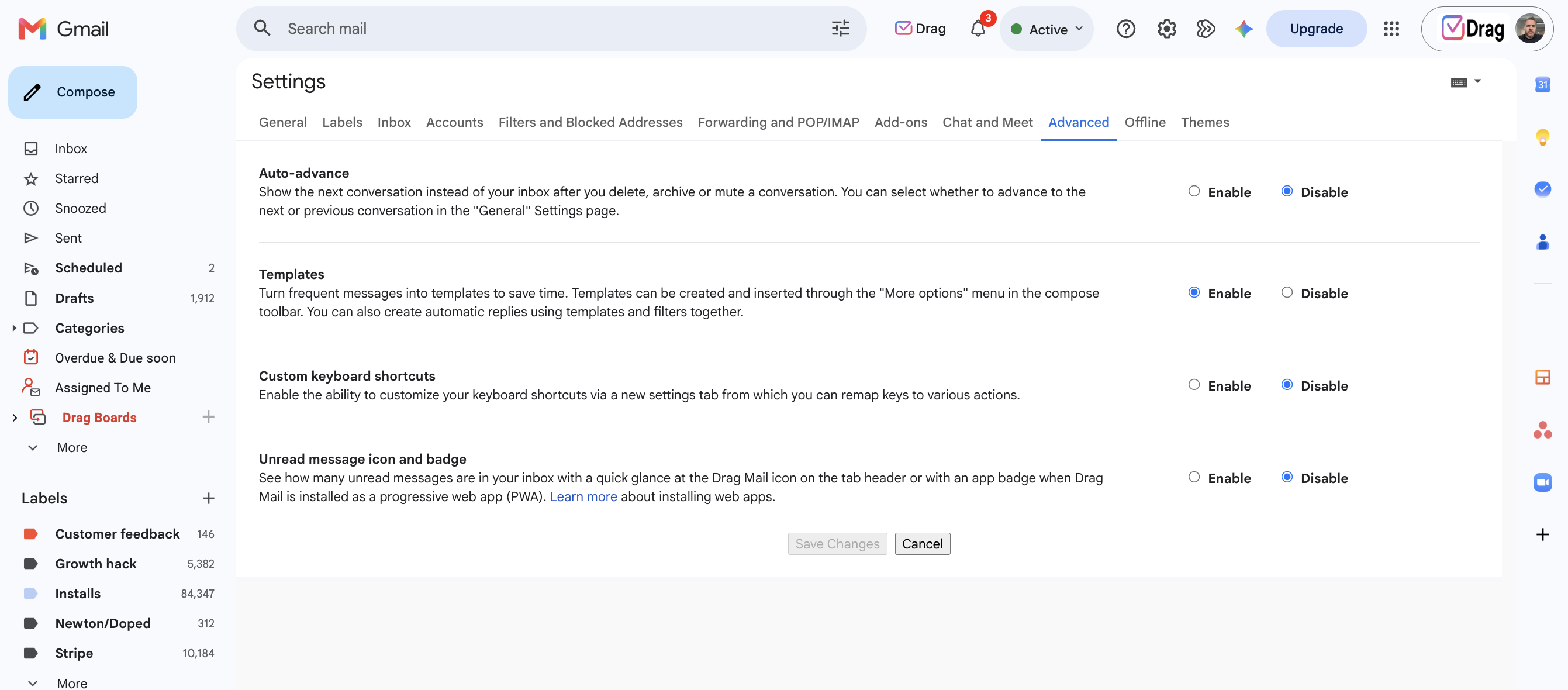
Gmail templates are turned off by default. To switch them on, open Gmail on a computer, go to Settings, See all settings, the Advanced tab, and click Enable next to Templates, then Save Changes. You only do this once, and it takes under a minute.
The full steps:
- Open Gmail on your computer. Templates are a desktop-only feature, so this will not work in the mobile app.
- Click the gear icon in the top right, then click See all settings.
- Click the Advanced tab at the top of the settings page.
- Find Templates in the list and click Enable.
- Scroll to the bottom and click Save Changes. Gmail reloads and templates are now available.
How to create a template
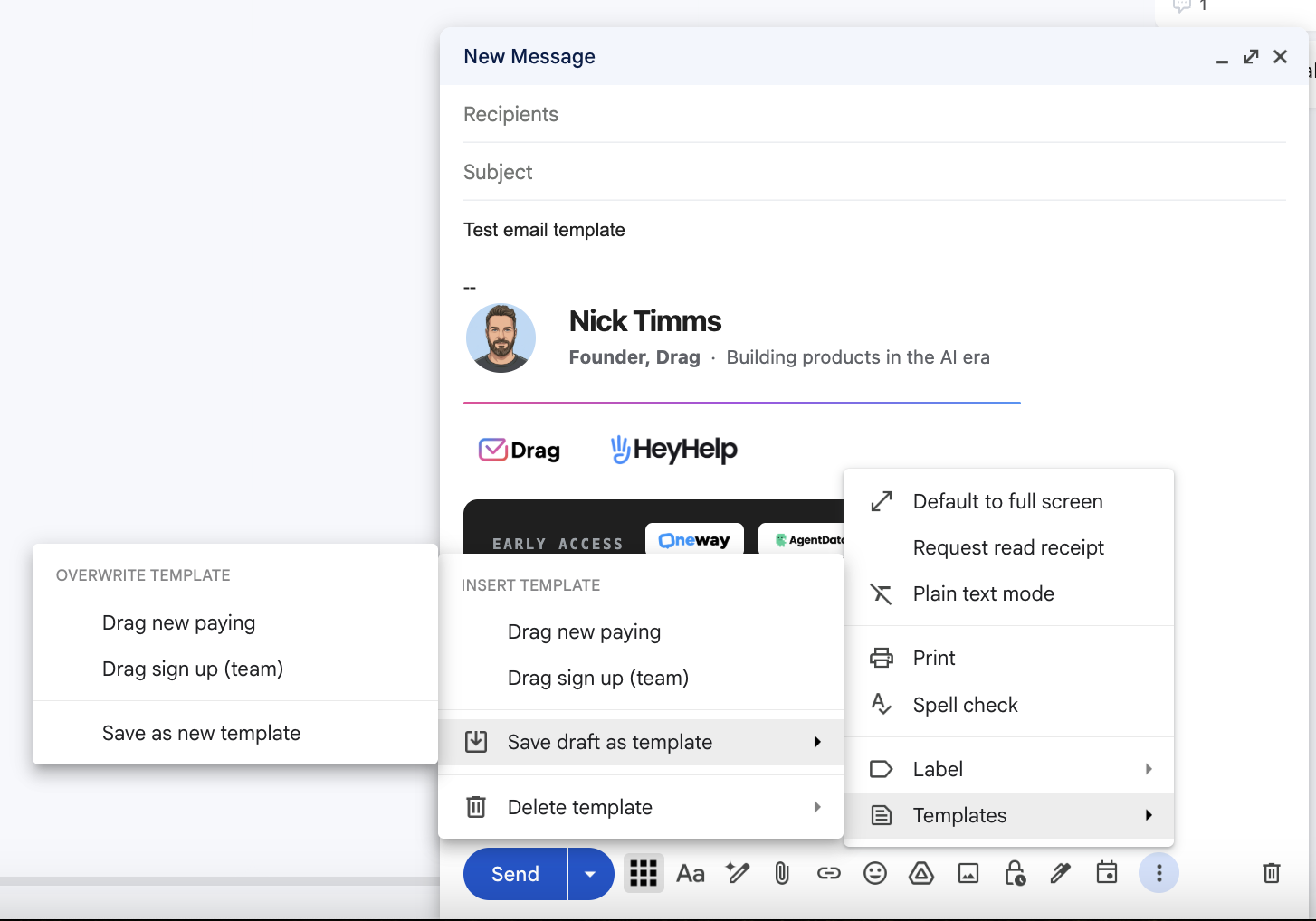
To create a Gmail template, click Compose, type the content you want to reuse, click the three-dot menu in the compose window, hover over Templates, and choose Save draft as template, then Save as new template. Name it clearly, because the template name becomes the subject line when you insert it.
The full steps:
- Click Compose in the top left to start a new email.
- Type the content you want to save. Tip: delete your email signature from the draft first, otherwise it duplicates every time you insert the template later.
- Click the three-dot menu (More options) in the bottom-right of the compose window.
- Hover over Templates, then click Save draft as template.
- Click Save as new template, give it a clear name, and click Save.
Drag · with Varley
The inbox your team and Varley work in together
Shared inbox and live chat for Gmail teams, with Varley, Drag’s AI, included from $18. Plus an MCP server your own AI tools can drive.
How to send a saved template
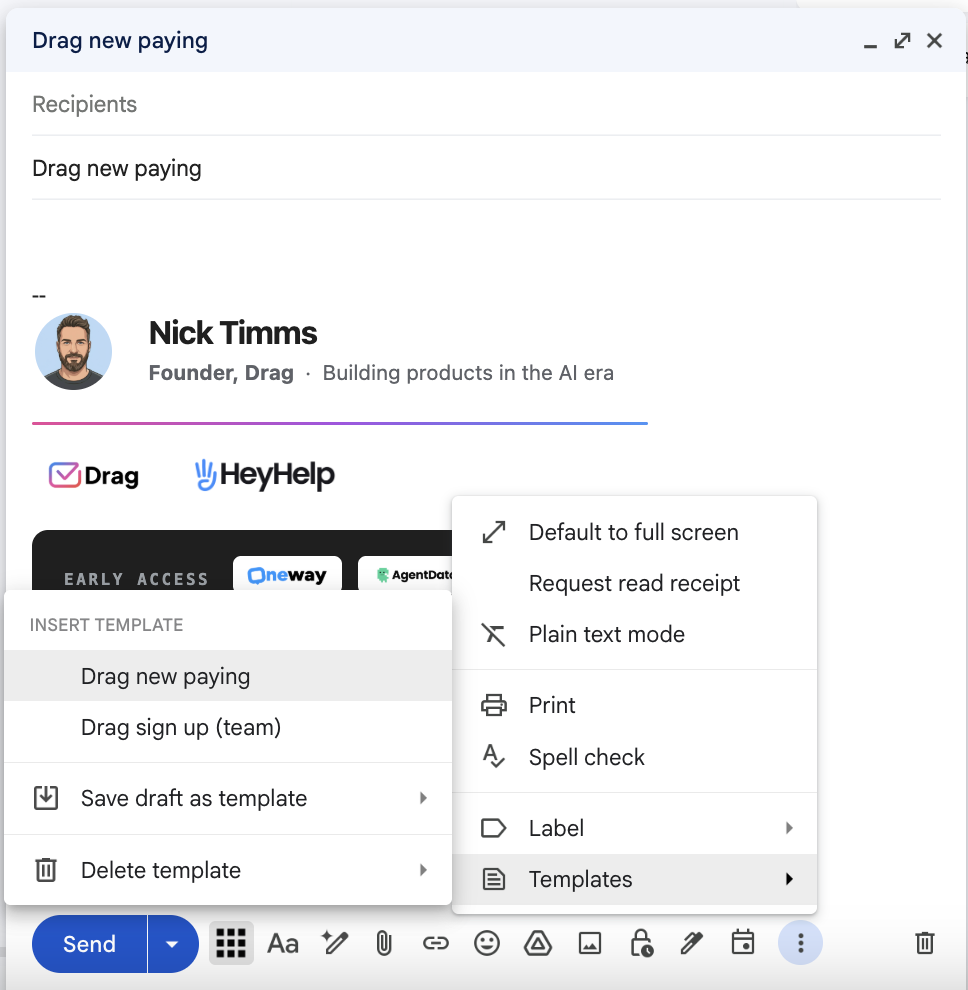
To send a saved template, click Compose, open the three-dot menu, hover over Templates, and click the template you want under Insert template. It drops into the message body ready to edit and send. The whole action takes three clicks.
- Click Compose (or open a reply).
- Click the three-dot menu, then hover over Templates.
- Under Insert template, click the template you want. It drops into the message body, ready to edit and send.
Add your recipient, make any edits, and click Send. Recipients are never saved inside a template, so you add those fresh each time.
How to manage and edit templates
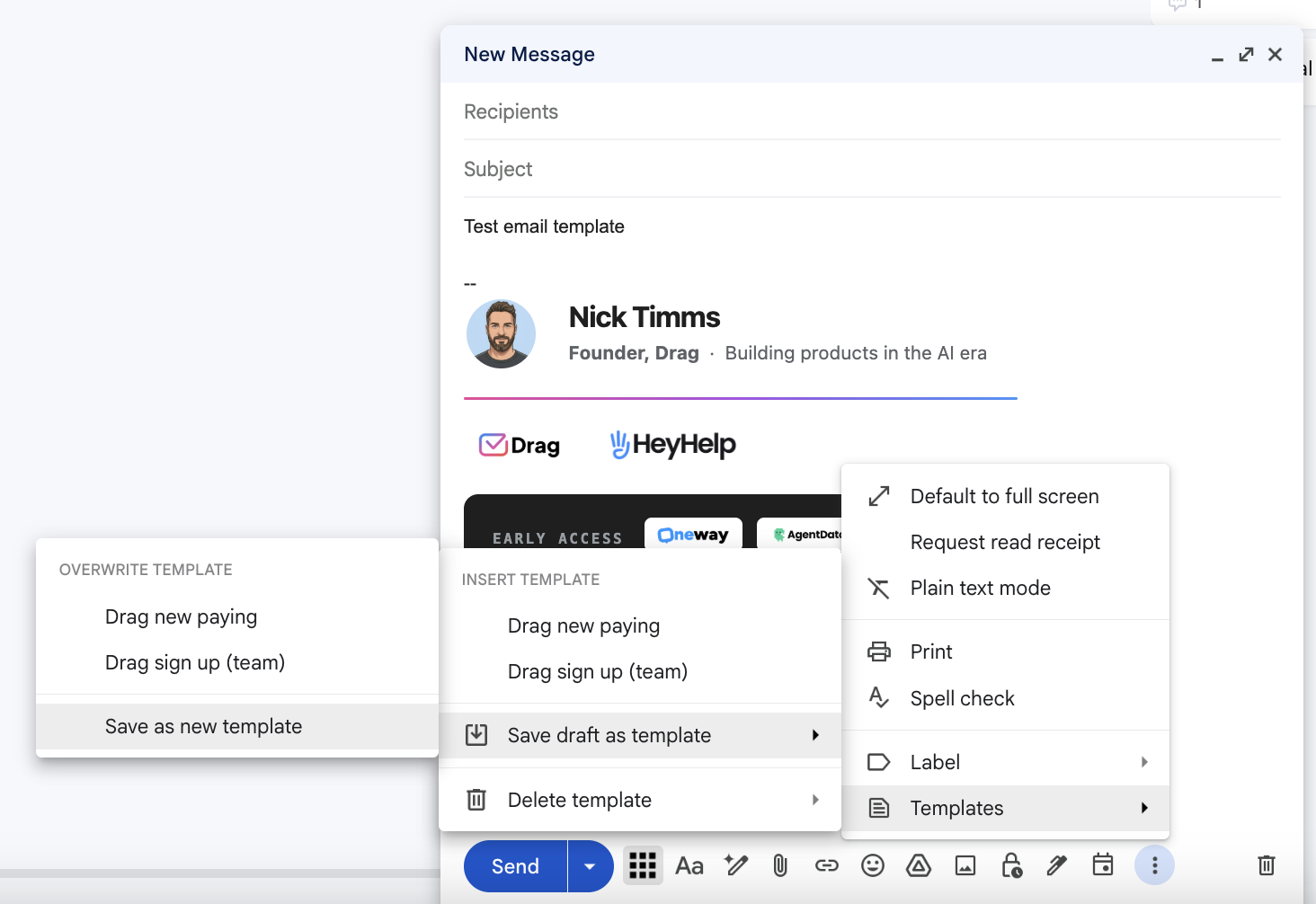
Gmail has no edit button for templates. To change one you overwrite it: insert the template, edit the text, then Save draft as template and choose the existing name under Overwrite Template. To remove one, use Delete template from the same menu. Note that Gmail cannot rename templates and deleted templates cannot be recovered.
To overwrite an existing template: insert the template, edit it, then go to the three-dot menu, Templates, Save draft as template, and under Overwrite Template choose the one to replace. Click Save.
To delete a template: open the three-dot menu, Templates, Delete template, choose the one to remove, and confirm. Deleted templates cannot be recovered.
The rename gotcha: Gmail gives you no way to rename a template. If you want a new name, you have to create a fresh template from the old one and delete the original. Small thing, but it trips people up.
The limitations of native Gmail templates
Gmail's built-in templates work well for one person sending occasional repeat emails, but they break down for teams and power users. The main gaps are no team sharing, no mobile access, no folders or variables, and a ceiling on how many templates you can save. Here is the full picture:
- No team sharing. Templates are tied to your individual account. Your teammates cannot see or use them, so everyone rebuilds the same templates separately.
- No mobile access. Templates only work in Gmail's desktop web interface, not the iOS or Android apps.
- No keyboard shortcuts. Every insert means digging through the three-dot menu. There is no way to trigger a template by typing a shortcut.
- No folders or categories. Every template lives in one flat list. Once you pass a couple of dozen, finding the right one is slow.
- No variables or merge fields. There is no built-in way to auto-fill a recipient's first name or company. Every personalized send is a manual edit.
- No usage analytics. You cannot see which templates get used, or which ones actually lead to replies.
- No HTML editor. Templates are essentially plain text. Formatted or branded HTML emails need a manual workaround.
- A template ceiling. Gmail caps how many templates you can save, and behavior gets unreliable as you approach it.
- No version history. Edit a template and the previous version is gone. There is no way to roll back.
None of these are dealbreakers for a solo user. All of them become daily friction for a team trying to keep messaging consistent.
How to share Gmail templates with your team
Gmail cannot share templates. They are stored against your individual account, so teammates cannot see or use them. The two ways around this are a shared document everyone copies from, or a Gmail tool like Drag that adds genuinely shared templates inside the inbox.
The workaround: keep your templates in a shared Google Doc or a team Google Group and have everyone copy-paste them into their own Gmail. It works, barely. There is no version control, no single source of truth, and the moment someone edits their copy your "standard" reply quietly drifts across the team.
Gmail delegation lets a teammate send from your address, but even delegated accounts maintain their own separate template libraries.
The Drag way: Drag adds shared templates directly for Gmail. Create a template once and the whole team can use it, on desktop and mobile, with keyboard shortcuts to insert it, categories to organize it, and variables to auto-fill names and details. Update a shared template and everyone gets the new version instantly, so your team's replies stay consistent without anyone managing copies.

 Sarah Chen
If your team sends the same emails over and over, shared templates are the difference between everyone improvising and everyone sounding like one company. Shared templates are included in every Drag plan.
10 ready-to-use Gmail template examples
Below are 10 templates you can copy, paste, and adapt. Each one is plain text, so it works as a native Gmail template straight away. Replace the bracketed placeholders with your own details.
1. Sales follow-up
When to use it: A few days after a meeting or demo with no reply.
Subject: Following up on [topic]

Hi [First name],

Thanks for taking the time to chat about [topic] last week. I wanted to follow up and see if you had any questions I can help with.

If it is useful, I am happy to set up a quick call to walk through the details. Just let me know a time that works.

Best,
[Your name]
2. Meeting request
When to use it: To propose times without a back-and-forth.
Subject: Quick call about [topic]?

Hi [First name],

I would love to find 20 minutes to discuss [topic]. Would any of these times suit you?

- [Option 1]
- [Option 2]
- [Option 3]

If none of those work, send me a couple of windows that do and I will make one fit.

Thanks,
[Your name]
3. Out-of-office reply
When to use it: Any time you are away and want urgent items routed.
Subject: Out of office until [date]

Hello,

Thank you for your email. I am out of the office until [date] with limited access to email.

For anything urgent, please contact [colleague name] at [email]. Otherwise I will reply when I am back.

Best,
[Your name]
4. Customer support acknowledgment
When to use it: The first reply to any new support email, to set response-time expectations.
Subject: We are on it [ticket #]

Hi [First name],

Thanks for reaching out. I have received your message about [issue] and our team is looking into it now.

I will get back to you with an update by [timeframe]. If anything changes in the meantime, just reply to this email.

Best,
[Your name]
5. Refund request acknowledgment
When to use it: When a customer asks for a refund and you need to confirm receipt before processing.
Subject: Your refund request

Hi [First name],

Thanks for getting in touch. I can confirm we have received your refund request for [item or order number].

I am reviewing it now and will confirm the outcome within [timeframe]. You do not need to do anything else for now.

Best,
[Your name]
6. Cold outreach
When to use it: A first-touch email to a prospect who does not know you yet.
Subject: [Specific result] for [their company]?

Hi [First name],

I came across [their company] while looking into [relevant context] and thought I would reach out.

We help [type of company] with [specific outcome]. For teams like yours that usually means [concrete benefit].

Worth a short call to see if it is a fit? No pressure either way.

Best,
[Your name]
7. Networking thank-you
When to use it: Within a day of meeting someone at an event.
Subject: Great to meet you at [event]

Hi [First name],

It was a pleasure meeting you at [event]. I really enjoyed our conversation about [topic].

I would love to stay in touch. If you are ever up for a coffee or a quick call, I am around.

Best,
[Your name]
8. Project kickoff
When to use it: To align a team at the start of a new project.
Subject: [Project name] kickoff

Hi team,

Excited to get [project name] underway. Here is where we are starting:

- Goal: [goal]
- Timeline: [start] to [end]
- Owner: [name]
- First milestone: [milestone] by [date]

I will follow up with a calendar invite for our kickoff call. Reply with any questions before then.

Thanks,
[Your name]
9. Invoice reminder
When to use it: A few days before or after an invoice due date.
Subject: Reminder: invoice [number] due [date]

Hi [First name],

A friendly reminder that invoice [number] for [amount] is due on [date].

You can find the invoice attached. If you have already sent payment, please ignore this note and thank you.

Best,
[Your name]
For a fuller version with payment terms and escalation wording, see our invoice email template guide.
10. Onboarding welcome
When to use it: The first email a new customer or hire receives.
Subject: Welcome to [company]

Hi [First name],

Welcome aboard, we are glad to have you. Here is everything you need to get started:

- [Getting-started link or step 1]
- [Step 2]
- [Where to ask for help]

If anything is unclear, just reply to this email and we will help you out.

Welcome again,
[Your name]
How to auto-send templates with filters
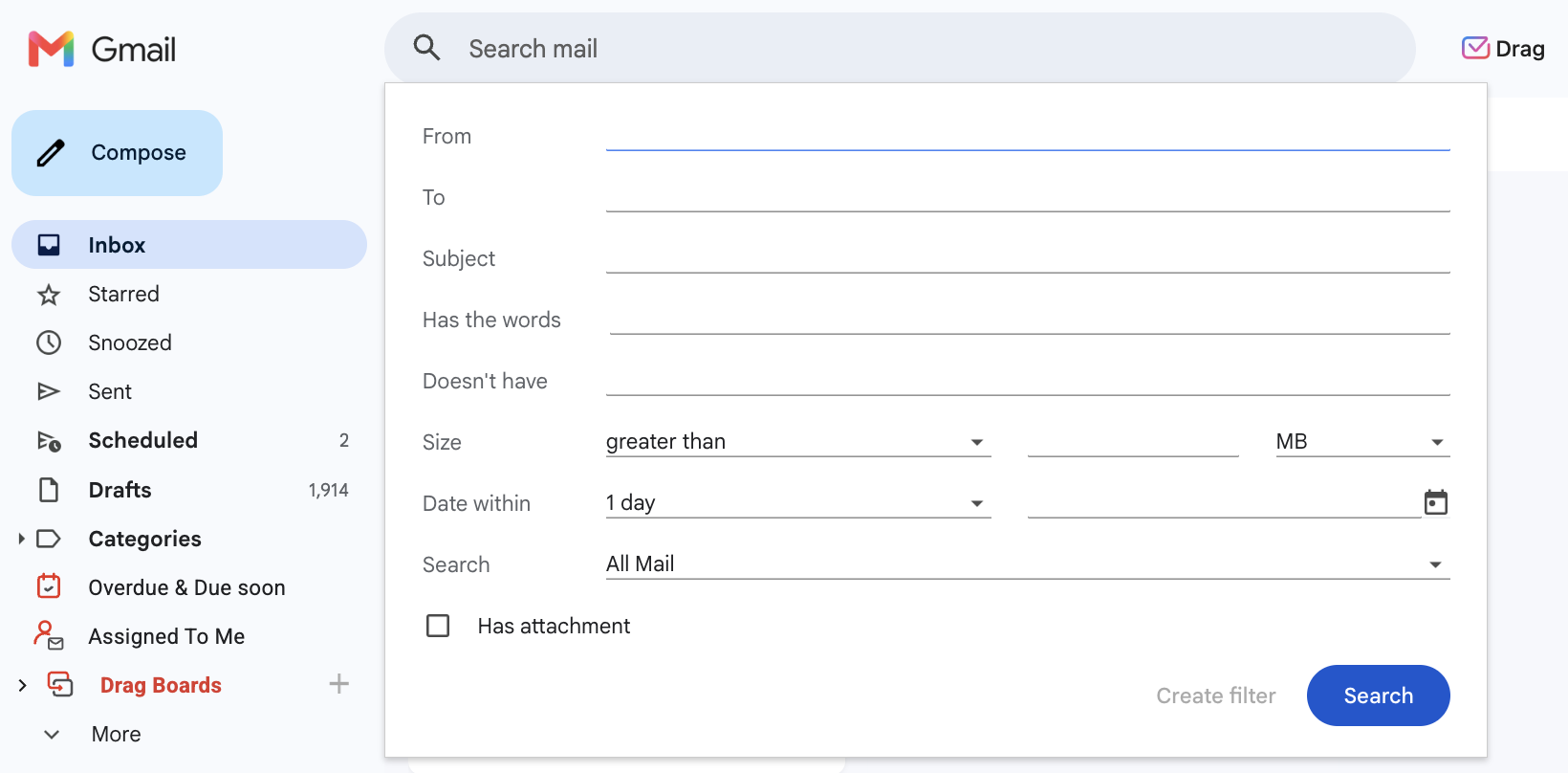
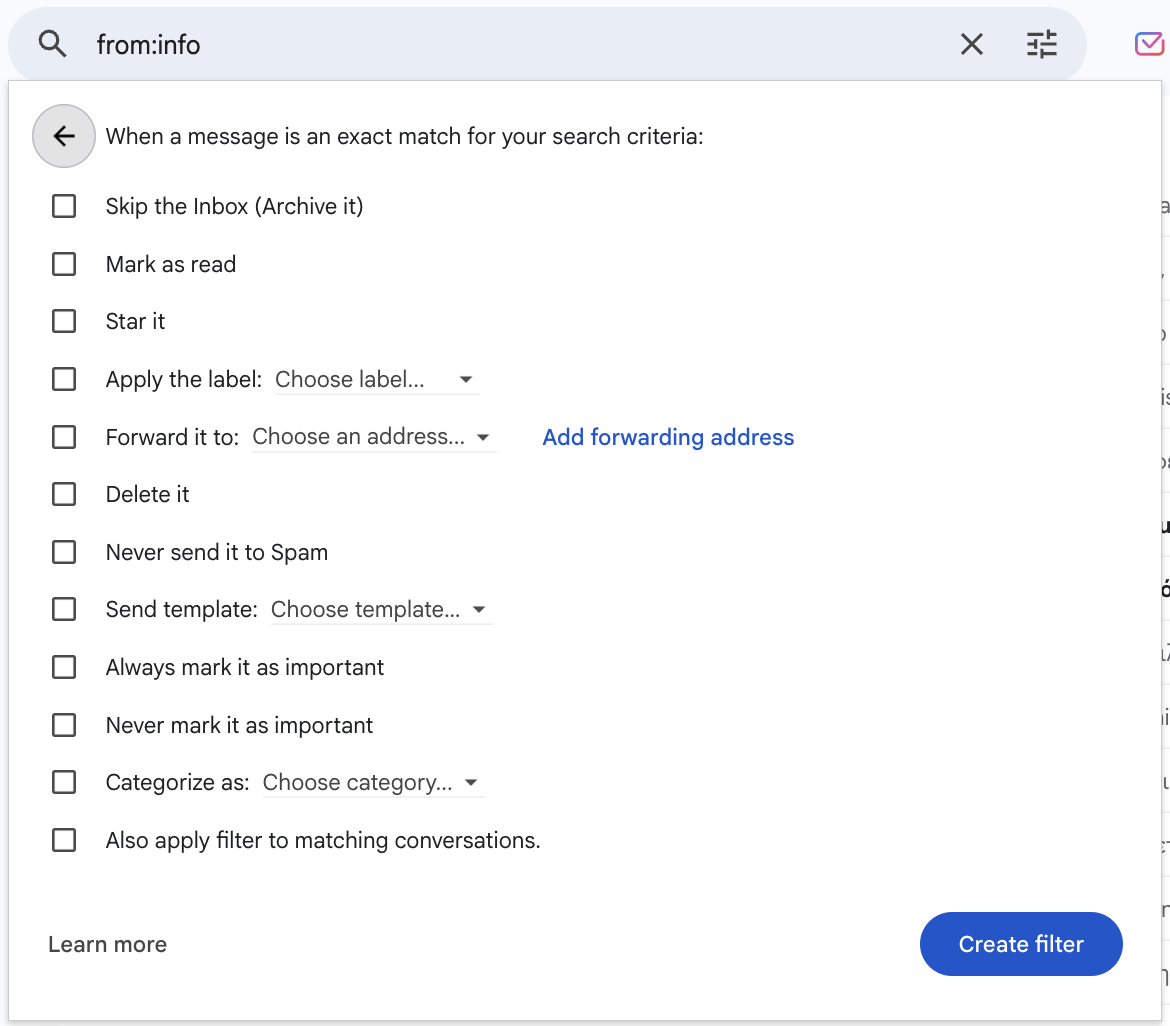
Gmail can send a template automatically when an incoming email matches rules you set. Open the search options in the Gmail search bar, enter your criteria, click Create filter, tick Send template, and choose the template. This is useful for form-submission confirmations and routing common requests.
- In the Gmail search bar, click Show search options (the sliders icon).
- Enter your criteria, for example a subject line like "New form response" or a sender address.
- Click Create filter.
- Check the box next to Send template and choose the template you want to send.
- Click Create filter to save.
Every matching email now gets your template as an automatic reply. Use specific criteria so you do not auto-reply to the wrong messages.
Gmail templates on mobile
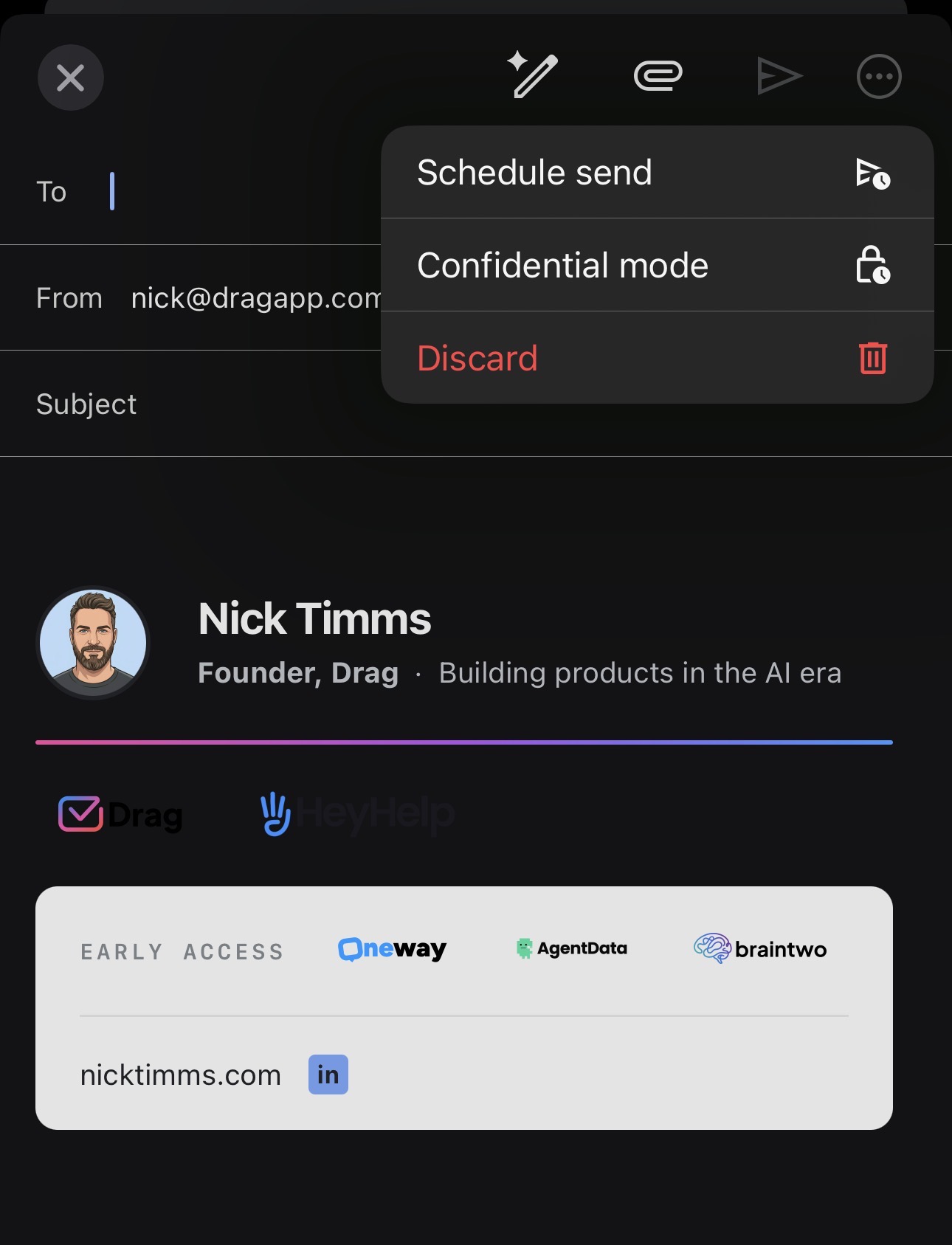
Native Gmail templates do not work on mobile. They are a desktop web feature only, so a template you saved on your computer cannot be inserted from the Gmail iOS or Android app. The common workarounds (storing text in a note, or in Google Drive, and pasting it) are slow and do not keep a team aligned.
If mobile templates matter to you, this is one of the clearest reasons to use Drag, where templates work the same on mobile and desktop, so you can send a saved reply from your phone in seconds.
Frequently asked questions
What are Gmail templates?
Gmail templates are pre-written, reusable emails you can insert into a new message with a few clicks. They were previously called canned responses. You enable them in Settings, save any draft as a template, then insert it whenever you need it.
How many email templates can I save in Gmail?
Google does not publish a maximum. The feature stays reliable for a modest library and gets flaky as it grows, so heavy users often turn to a dedicated tool with no practical limit.
Can I share Gmail templates with my team?
Not natively. Gmail templates are tied to your individual account and cannot be shared. Teams either copy-paste from a shared document or use a tool like Drag, which adds genuinely shared templates for Gmail.
Do Gmail templates work on mobile?
No. Native Gmail templates only work in the desktop web version of Gmail, not the iOS or Android apps. Tools like Drag provide templates that work on mobile too.
What is the difference between Gmail templates and canned responses?
They are the same feature. Canned responses was the original name, and Google later renamed it Templates. Some older menus and guides still use the old term.
Can I use HTML in Gmail templates?
Not directly. Gmail templates are essentially plain text. To save a formatted HTML email as a template, you paste the rendered HTML (not the raw code) into the compose window first, then save that as a template.
How do I auto-send a Gmail template?
Create a Gmail filter, set your matching criteria, then tick Send template and choose your template. Every email matching the filter receives that template automatically. Use precise criteria to avoid false matches.
What is the best alternative to Gmail templates for teams?
For teams that live in Gmail, Drag is the natural step up: shared templates across the whole team, mobile and desktop access, keyboard shortcuts, categories, and variables, all on Gmail. It solves the team-sharing and mobile gaps that native templates cannot.

Co-founder
Co-founder at Drag, writing about Google Workspace, shared inboxes, and how teams actually run email.
