




How to turn Gmail into a help desk four ways, from free labels, filters and Collaborative Inbox to add-ons, with a copy-ready kit and October 2026 prices.
Key takeaways
- Google does not sell a help desk. Gmail becomes one when the team answers from one support address and every email has one owner, a status and a response target.
- Free options cover part of that: labels, filters and templates give you statuses and an automatic acknowledgment, and a Google Groups Collaborative Inbox adds assign, take and mark complete.
- Gmail delegation lets up to 1,000 people (10 on a personal Gmail account) answer from one address without sharing a password, and Google says about 40 can use the account at the same time.
- Gmail cannot time a reply. Its older_than search counts in days, months and years only, so hour-level response targets, collision alerts and response-time reports need a help desk add-on.
- Help desk add-ons that work in Gmail start at $12 a seat a month for Drag, $14 for Keeping and $25 for Hiver, billed annually (checked October 9, 2026).
Table of contents
- How to turn Gmail into a help desk: the four ways at a glance
- What a help desk does, and how much of it Gmail does natively
- How an email becomes a ticket in Gmail
- How to set up a help desk in Gmail, step by step
- Google Groups Collaborative Inbox: free assignment in Google Workspace
- Google's native shared inbox: what it adds and what it doesn't
- When Gmail is not enough: the signs it's time for a help desk add-on
- Which help desk tools work best with Gmail
- Can you track SLAs and resolution time with just Gmail?
- Common mistakes when using Gmail as a help desk
- Gmail help desk FAQs
- Related guides: Gmail support, ticketing and shared inboxes
The short version: Gmail works as a help desk once every customer email has one owner, a status and a response target, and the team answers from one shared address. You can get most of the way for free with a delegated support account, four status labels, a few filters and a template auto-reply; a Google Groups Collaborative Inbox adds real assignment. What Gmail cannot do on its own is warn you when two people reply to the same email, time a reply in hours, or report on response times. That is the point at which teams add a help desk add-on that runs in Gmail.
This guide is the build: the four ways to do it, a copy-ready label and filter kit, what each Google feature does and does not do, and when to add a tool. Every Google limit on this page was checked against Google's help pages on October 9, 2026, and every price against the vendor's own pricing page the same day. If you are still deciding whether Gmail should run your support at all, start with our guide to Gmail for customer support.
How to turn Gmail into a help desk: the four ways at a glance
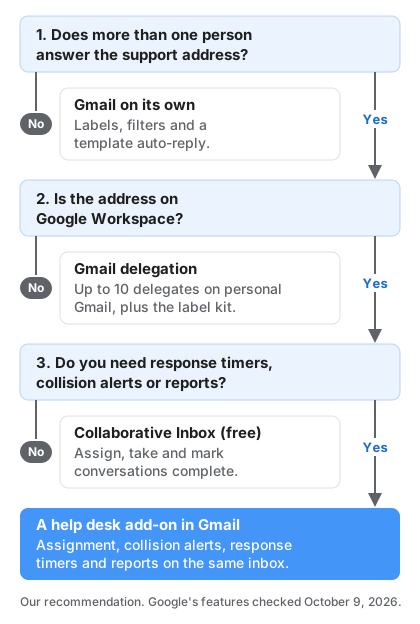
There are four ways to turn Gmail into a help desk: a shared support account with labels and filters, a Google Groups Collaborative Inbox, a help desk add-on that runs in Gmail, or a form and spreadsheet you build yourself. They differ in what they track for you and what stays a team habit:
| Way | Cost | What you still do by hand |
|---|---|---|
 1. Shared support account with labels, filters and templates | Free | Ownership, response times, reporting |
 2. Google Groups Collaborative Inbox | Included with Google Workspace | Response times, reporting, notes |
 3. Help desk add-on in Gmail (Drag, Keeping, Hiver) | From $12 a seat a month | Little: assignment, timers and reports are built in |
| 4. Google Forms, Sheets and Apps Script | Free, plus build time | Email replies, which the sheet does not track |
As a rule of thumb, the first way fits one to three people answering, the second a small Workspace team that needs assignment, and the third any team with a response target or duplicate replies every week. The fourth suits internal IT and request forms more than customer email, and we cover it in our Google ticketing system guide. The rest of this page is about the first three.
What a help desk does, and how much of it Gmail does natively
A help desk does seven jobs: it gives the team one address, gives each email one owner, tracks its status, stops two people answering at once, keeps notes off the customer thread, holds a response target and reports on the work. This is how much of each one Gmail and Google Workspace do on their own, from Google's help pages (checked October 9, 2026):
| Job | Gmail and labels | Groups inbox | Drag add-on |
|---|---|---|---|
| One address | Delegation | Yes* | Yes |
| One owner | Label habit | Yes | Yes |
| Status | Labels | Yes | Yes |
| Collision warning | No | Not listed | Yes |
| Internal notes | No | Not listed | Yes |
| Auto-reply | Yes | Yes | Yes |
| Response target | Days only | No | Yes |
| Reports | By hand | Search | Yes |
The Gmail and labels column covers a delegated account or Google's native shared inbox, where each person answers with their own login and replies show who sent them; without either, the only way to share one address is to share its password. *In the Groups inbox column (a Google Groups Collaborative Inbox), members reply as the group address once a group owner or manager gives them the "Who can post as group" permission, statuses are complete, duplicate and no action needed, auto-replies are a group setting, and "Not listed" means Google's Collaborative Inbox page does not mention it. The Drag add-on column describes our product, where status is a board column, assignment can be round-robin, notes take @mentions, response targets are SLA rules and reports cover response times and workload. "Days only" is explained next.
Two of those cells catch most teams out. First, a status label in Gmail is a team habit, not a rule: nothing stops someone replying to an email that a colleague has already labeled as theirs. Second, Gmail has no clock. Its search can find email older than a number of days, but not hours, so a "reply within four hours" target cannot be checked in Gmail at all.
How an email becomes a ticket in Gmail
An email becomes a ticket when it gets a status and an owner, and it stops being one when it is marked done and archived. In a help desk that cycle is automatic; in Gmail you run it with labels. Here is the cycle with the labels from our kit below:
| Stage | In Gmail alone | In a help desk add-on |
|---|---|---|
| New: the email reaches support@ and the customer gets an acknowledgment | A filter adds Support-New and sends the template | Lands on the shared board; an auto-reply rule answers |
| Open: one person takes it | They swap Support-New for Support-Open and add their Owner label | Assigned to one person; teammates see it is taken |
| Waiting: on the customer | Support-Waiting, still with the owner's label | A Waiting column, still assigned |
| Done: answered and closed | Support-Done, then archive (never delete) | Moved to Done |
When a customer writes back to an email that is already open or done, Gmail puts the conversation back in the inbox and the filter adds Support-New to the new message. The triage person then hands it straight to the owner named on its label, so the customer keeps talking to the same person.
How to set up a help desk in Gmail, step by step
You can set up a working help desk in Gmail with free Google features: one support address, delegated access, a set of labels, three filters, a template auto-reply and four saved searches. Here are the steps.
- Create one support address. On Google Workspace, create support@ as a user, or as a native shared inbox in the Admin console if your account has it (more on that below). On personal Gmail, create a new account for support.
- Give each person access without sharing a password. Add each teammate as a delegate of the support account. Google allows up to 1,000 delegates on a Workspace account and up to 10 on personal Gmail, and says that "with typical use, 40 delegates can access a Gmail account at the same time." Invitations expire after a week, and it can take up to 24 hours before a delegate can use the account. Our Gmail delegation guide has the clicks.
- Create the status and owner labels. Use the kit below. Everyone working in the support account sees the same labels.
- Add the filters. Filters are settings of the support account, so set them up once while signed in to it.
- Send an automatic acknowledgment. Save the acknowledgment as a Gmail template (in a new message: More options, then Templates, then Save draft as template). Then edit the support@ filter and tick Send template. Google's help page says: "To send your message template as an automatic reply, you must create a filter."
- Work from four queue searches. Each person keeps these searches to hand (or, on the support account, sets them up as sections with Gmail's Multiple inboxes, which can only be set up on a computer).
- Agree the rules and review weekly. Write down the claim rule (whoever takes an email swaps the labels before replying) and the response target, then spend 20 minutes a week on what is past target and how the work was spread.
The copy-ready Gmail help desk kit
Create these labels in the support account. A hyphen instead of a slash keeps them easy to search:
Support-New
Support-Open
Support-Waiting
Support-Done
Owner-Ana
Owner-Ben
Owner-Chris
Type-Billing
Type-Bug
Type-HowTo
Then create two kinds of filter (in Gmail search, Show search options, then Create filter):
| Filter criteria | Action |
|---|---|
| To: your support@ address | Apply the label Support-New; Send template: Acknowledgment |
| To: your support@ address, Has the words: invoice OR refund OR receipt | Apply the label Type-Billing |
| To: your support@ address, Has the words: error OR broken OR "not working" | Apply the label Type-Bug |
And work from these four searches:
| Queue | Gmail search |
|---|---|
| Triage: new and unowned | label:support-new |
| My open emails | label:support-open label:owner-ana |
| Waiting on customers | label:support-waiting |
| Past a one-day target | label:support-new older_than:1d |
The acknowledgment template that goes with it:
Thanks for getting in touch. We've received your message and one of the team will reply within one business day. If anything changes in the meantime, just reply to this email and it will reach the same person.
Reply templates for your most common questions
Save one Gmail template for each question you answer every week, such as refunds, delivery times and password resets, and name them so they sort together (Reply-Refund, Reply-Delivery). Create them while signed in to the support account, so they stay with the shared address. Our customer service email templates have wording you can start from.
Keep two things in mind. The auto-reply answers every message the filter catches, follow-ups included, so keep the template short and neutral. And older_than looks at every message in the conversation, so a long thread can appear in the past-target search even when a reply went out today; treat that search as a list to check, not a timer.






Google Groups Collaborative Inbox: free assignment in Google Workspace
A Google Groups Collaborative Inbox turns a group address such as support@ into a shared queue where members can take, assign and close conversations, at no extra cost on Google Workspace. Google's Collaborative Inbox page says members with the right permissions can:
- "Take a conversation they volunteer to respond to."
- "Assign responsibility for a conversation to another group member."
- "Mark a conversation as complete, duplicate, or no action needed."
- "Search for conversations according to resolution status or assignee."
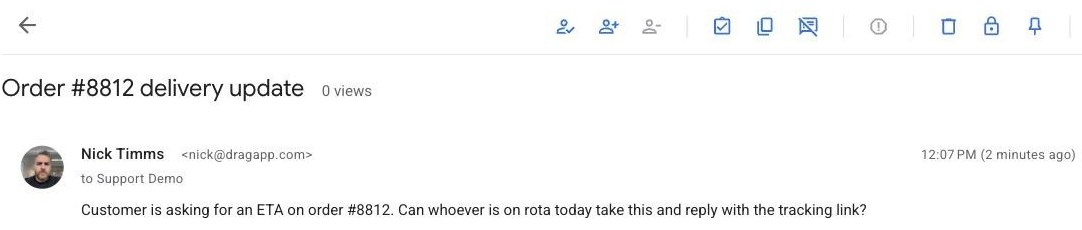
Three settings decide whether it works for customer email. Conversation history has to be on (Google: "you must turn on conversation history"). On Google Workspace, a group only accepts email from outside your company once an admin lets group owners allow it and the owner turns it on: Google's organization-wide Groups policies list incoming email from outside the organization as "Unchecked (not allowed)" by default. And to reply as support@ rather than as yourself, a group owner or manager gives members the "Who can post as group" permission. Group owners and managers can also set an auto-reply for people outside the company.
It does not give you a warning when two members reply at once, internal notes on a conversation, response timers or reports, and the work happens in Google Groups rather than in your Gmail inbox. Our Collaborative Inbox guide covers the setup screen by screen.
Google's native shared inbox: what it adds and what it doesn't
Google Workspace now has a native shared inbox: an admin creates an address such as support@ in the Admin console and adds people as delegates, who can "read, send, and delete messages" and view and add its contacts. It is listed for Business Starter, Business Standard and Business Plus, and Google says it is "being released in phases"; if the option is missing from your Admin console, Google says to use delegated Gmail accounts instead (Google's create a shared inbox page, updated October 7, 2026).
It solves access, not workflow. Each reply shows the shared address as From and the person as Sent by, so customers and the team can see who answered, but Google's page describes no assignment, statuses or tracking. Run it with the same labels, filters and searches as above. Our Gmail shared inbox guide compares it with delegation and the other ways to share one address.
When Gmail is not enough: the signs it's time for a help desk add-on
Gmail stops being enough when the team spends more time coordinating than answering. These are the signs to look for:
- Duplicate replies happen more than about once a week, even with the claim rule.
- You have a response target in hours, which Gmail cannot check.
- You need to know first reply times or workload per person and are counting by hand.
- Questions about one email live in chat or forwards, away from the email itself.
- More than a handful of people answer, and the labels are no longer kept the same way.
At that point there are two directions. A help desk add-on keeps the team in Gmail and turns the habits into features: assignment instead of an owner label, a collision warning instead of "check before you reply", notes on the email instead of a chat link, and reports instead of counting. A standalone help desk moves the team out of Gmail into a separate app, which makes sense when most requests arrive by phone, chat or a customer portal rather than email; our help desk software comparison covers those.
If you already pay for a standalone help desk but your team would rather work in Gmail, the choice is the same in reverse. Standalone help desks usually take in a Gmail address by forwarding it to their own system, so replies are written in their app, not in Gmail. Keep the help desk if its extras (a customer portal, phone, many brands) earn their cost; if the team mostly answers email, a help desk add-on lets them stay in the inbox they already use.
Which help desk tools work best with Gmail
The help desk tools that work best with Gmail are the ones that run in Gmail itself, so the team keeps one inbox: Drag, Keeping and Hiver all add assignment, statuses and reports to a shared Gmail address. The sections below run from the lowest starting price, so Drag, which is our product, comes first; the chart puts Drag first, then lists the others by their highest price.
Pricing comparison: Gmail help desk add-ons and Collaborative Inbox (October 2026)
| Tool | From (billed annually) | Trial | AI |
|---|---|---|---|
| Drag | $12 a seat a month | 7 days, no card | Included from $18 (Plus) |
 Keeping | $14 a user a month | 14 days, no card | From $24 (Advanced) |
 Hiver | $25 a user a month | 7 days, no card | On every plan |
| Groups inbox | Free with Workspace | n/a | None |
Drag
Drag turns a shared Gmail address such as support@ into a board your team works together in Gmail: each email gets one owner, teammates see when someone is already replying, notes and @mentions stay off the customer thread, and SLA rules flag emails before they miss their response target. Automation rules tag, assign and send an acknowledgment as email arrives, and reports show response times and workload per person. WhatsApp and live chat conversations land on the same boards. Varley, Drag's AI, tags and drafts replies from your help center and past conversations, with AI included on the Plus and Pro plans.
Pricing is $12, $18 and $24 a seat a month billed annually, with a 7-day free trial and no card. Boosted Commerce runs support for its portfolio of brands on Drag (their story); Anton von Rueden, its President and COO, called it "simple, cost-effective and infinitely scalable".
Keeping
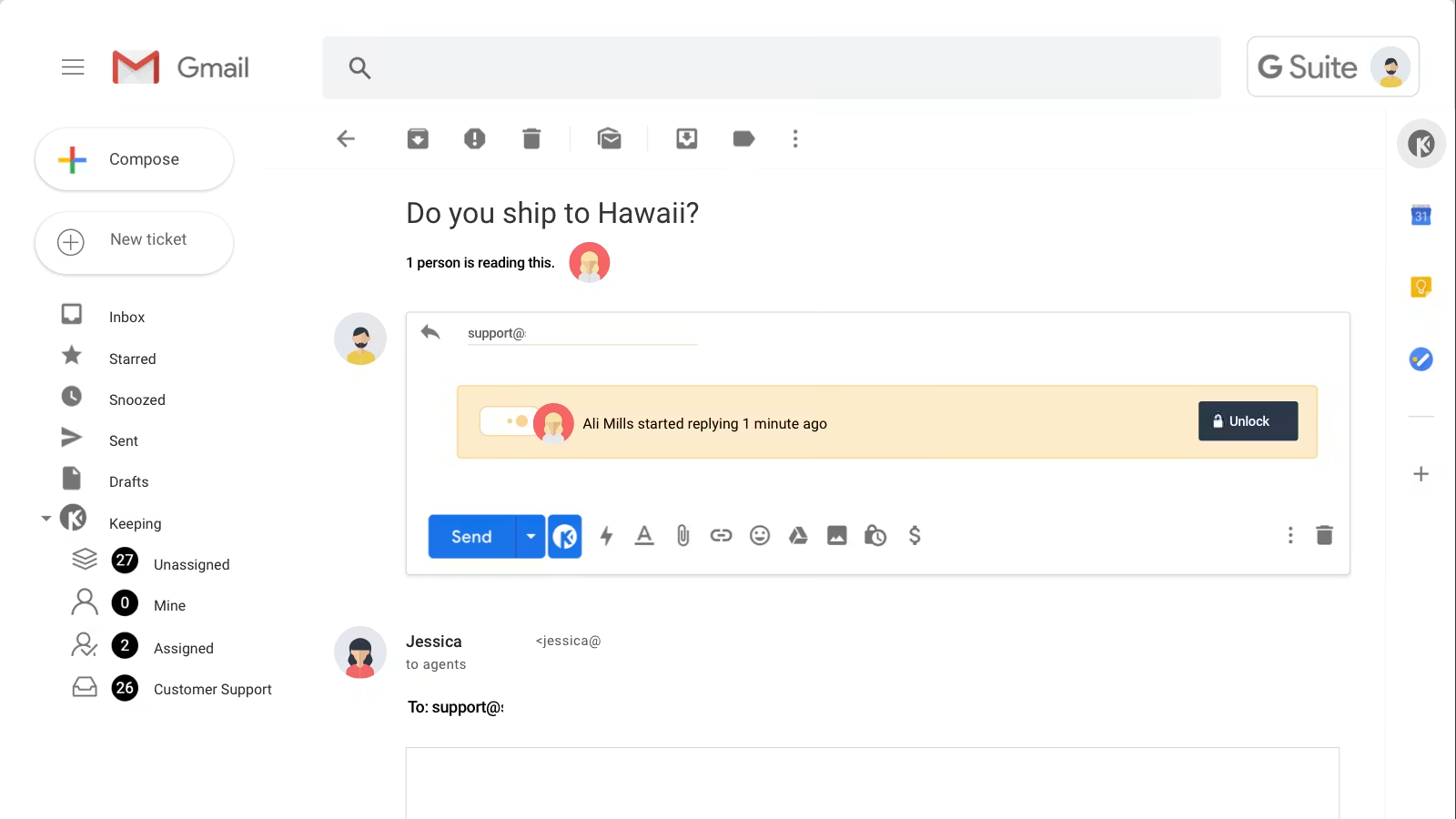
Keeping is a help desk for Gmail that adds assignment, statuses and collision warnings to a shared address. Its pricing page lists Essentials at $14 a user a month billed annually ($19 monthly), Advanced at $24 ($29) with SLAs and its "Thank You" detection AI, and HIPAA at $49 ($59) for teams that need a signed BAA. Every plan has a 14-day free trial with no card and a 2-user minimum.
Hiver
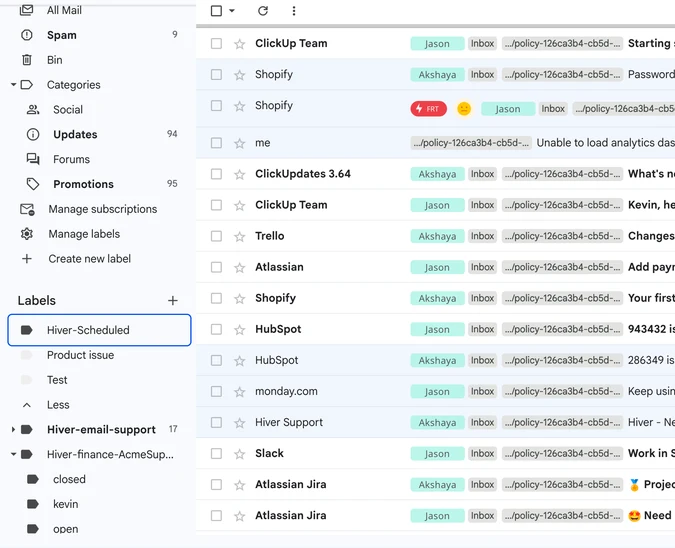
Hiver adds shared inboxes to Gmail and lists AI Agents and AI Copilot on every plan. Its pricing page shows Growth at $25 a user a month, Pro at $55 and Elite at $85 (the monthly-billing prices are $35, $65 and $95), a 7-day trial with no card and a 2-seat minimum; Growth is capped at 10 users and 2 shared inboxes.
Drag · with Varley
Outgrown labels? Keep Gmail, add the help desk
Drag turns support@ into a shared board in the Gmail your team already uses: give every email one owner, see when a teammate is already replying, set response targets and track response times. Varley, Drag's AI, tags and drafts replies on Plus and Pro. 7-day free trial, no card.
Can you track SLAs and resolution time with just Gmail?
You can track response targets in Gmail only by the day, and you cannot measure resolution time at all. Gmail's older_than: search accepts days, months and years ("Use d (day), m (month), or y (year)"), so label:support-new older_than:1d lists conversations that have waited more than a day, but nothing shorter. Gmail records when each message arrived and when each reply was sent; it does not record when a conversation was resolved, because that is your label, not an event Gmail sees.
Here is what you can do for free.
- Run the past-target search every morning and clear it before anything else.
- Count once a week: emails labeled Support-Done that week (for example
label:support-done after:2026/10/01 before:2026/10/08), what is still open per owner, and how many sat past target. - Log by hand if you must, in a sheet with one row per email, which most teams stop doing within a month.
For first reply times, resolution rates and hour-level targets, you need a tool that records when an email was assigned, answered and closed. Our SLA guide for customer support has a calculator for setting the targets themselves.
Common mistakes when using Gmail as a help desk
The six most common mistakes are sharing the password, replying before claiming, forwarding to ask questions, deleting instead of archiving, using the inbox as a to-do list and having no escalation rule:
- Sharing the support account's password instead of adding delegates, so nobody knows who sent what and access never gets removed.
- Replying before claiming, so two people answer the same customer.
- Forwarding an email to a colleague to ask a question, which splits the conversation into copies.
- Deleting instead of archiving, so the history is gone when the customer writes back.
- Using the inbox as the to-do list, with no status labels, so "read" ends up meaning "handled".
- No escalation rule, so a legal threat or a cancellation waits in triage like any other email. Name one person who takes those, and add a filter that labels them Escalate.
Gmail help desk FAQs
These are the questions teams ask most when they start running support from Gmail.
Does Google have a help desk or ticketing system?
No. As of October 2026, Google Workspace has no help desk or ticketing product. The closest native tools are a Google Groups Collaborative Inbox, which can assign and close conversations, and Google's new shared inbox, which gives a team one address with delegated access. Response timers, collision warnings and reports come from add-ons or a separate help desk.
Can I turn a personal Gmail account into a help desk?
Yes, for a small team. A personal Gmail account can have up to 10 delegates, so up to ten people can answer from it with their own logins, and labels, filters and template auto-replies all work. Google's native shared inbox and Collaborative Inbox are Google Workspace features, so a team that grows usually moves the address to Workspace.
Which is best for a small team: Collaborative Inbox or a help desk add-on?
For two or three people answering a few dozen emails a day, a Collaborative Inbox or a delegated account with the label kit is usually enough and costs nothing extra. Once duplicate replies or missed targets happen every week, or you need to see response times, an add-on pays for itself, because it does the tracking your team is doing by hand.
Can Gmail show open, pending and closed statuses?
Yes, with labels, though Gmail does not enforce them. Map open to Support-New and Support-Open, pending to Support-Waiting and closed to Support-Done, then archive. A customer reply to a closed email lands back in the inbox and, with the support@ filter, gets Support-New again, so it shows up in triage. Remove Support-Done when you take it, or it will still count as closed.
How do I remove someone from a Gmail help desk?
On a delegated account, remove them as a delegate in the support account's settings; their own Google login keeps working and nobody else's access changes, which is the main reason to use delegation instead of a shared password. In a Collaborative Inbox, remove them from the group. Before removing them, swap their Owner label (or, in a Collaborative Inbox, reassign their conversations) to a teammate.
Related guides: Gmail support, ticketing and shared inboxes
These guides go deeper on running support, ticketing and shared inboxes in Gmail:
- Gmail for customer support: the full playbook for running support in Gmail, from ownership rules to metrics.
- Google ticketing system: ticketing with Google Forms, Sheets and Collaborative Inbox.
- Gmail shared inbox: every way to share one Gmail address, compared.
Ready to run support@ as a help desk without leaving Gmail? Start a 7-day free trial of Drag, no card needed.

Co-founder
Co-founder at Drag, writing about Google Workspace, shared inboxes, and how teams actually run email.