













If you have to manage more than one email, find out now how to share Google contacts between them to help the team’s productivity.
Key takeaways
- Delegation shares your whole contacts list, labels included, but Google still has no native way to share just one label.
- Everyone in your Workspace domain already shares the directory automatically, check it before buying anything.
- Fine-grained sharing (specific labels, synced groups) is third-party territory via the Workspace Marketplace.
Table of contents
Remember when you only had one email account? Those were the simple days. But they are long gone. We're taking on more. And use our digital addresses as a center for our work responsibilities. Therefore, we have to organize them well. It is only fair to have more than one email account. This habit also demands us to share Google contacts between accounts. Once you start having to swap from account to account, copying and pasting email addresses and details, you realize you would save time if you could easily share contacts between your Gmail accounts or Google Workspace accounts. This would be helpful not only for individuals, but also for companies. That's because collaborators need access to the same information. Especially when creating a distribution list. But there are ways to flip this worry into having a shareable system for your contacts. In this article, we will help you find a solution to this problem. We are aware that it may not be as easy or intuitive as one might think. However, it's totally doable to share Google contacts between accounts. Stick with us!
The short version: Google gives you two native routes. Contacts delegation (Google Workspace) hands a colleague your whole contacts list to view and manage, including labels, but it is all-or-nothing, you cannot share just one label's contacts natively. For team-wide shared contacts, the Workspace directory covers everyone automatically, and anything finer, sharing a specific label, syncing groups, needs a third-party tool from the Workspace Marketplace. The steps for each route, and the honest limits, below.
| Route | Best for | Syncs? | Works outside your domain? | Free Gmail? |
|---|---|---|---|---|
| Export/import (CSV or vCard) | One-time transfers | No, snapshot only | Yes | Yes |
| Contacts delegation | An assistant managing your contacts | Yes, live | No, same domain only | No, Workspace only |
| Workspace directory | Everyone seeing coworkers' details | Yes, automatic | No | No |
| Third-party sync tools (ContactsFlow class) | Shared labels, teams, fine control | Yes, live | Usually yes | Some |
| Attach a vCard to an email | Sending one contact to anyone | No | Yes | Yes |
Why you should share Google contacts
Decades ago, teams and collaborators were sharing physical phone books with important contacts on them. Now, in a digital world, especially with remote work becoming the main choice for many companies, it is crucial to have easy access to contacts online. This is why it’s necessary to share Google contacts and even are essential for a business that values integration among teams and processes. Relevant information should be in a secure place. Yet accessible to the ones who need it. That makes collaboration and productivity more fluent.
3 ways to share Google Contacts between accounts
Do you need to share contact labels with users or groups of users? And keep the sharing always in sync? There are a few different paths you can take.
1. Manually transferring your contacts
If you don’t need to sync all contacts in real-time and don’t mind manually copying contacts from one account to another, there's an easy way. You can follow a step by step to share Google contacts with another account of your own or a collaborator. You can do it by exporting contacts and, then, importing them to the selected account. To share Google contacts between accounts:
-
Go to your Gmail and click on the menu in the top right corner.
-
Select the “Contacts” option.
-
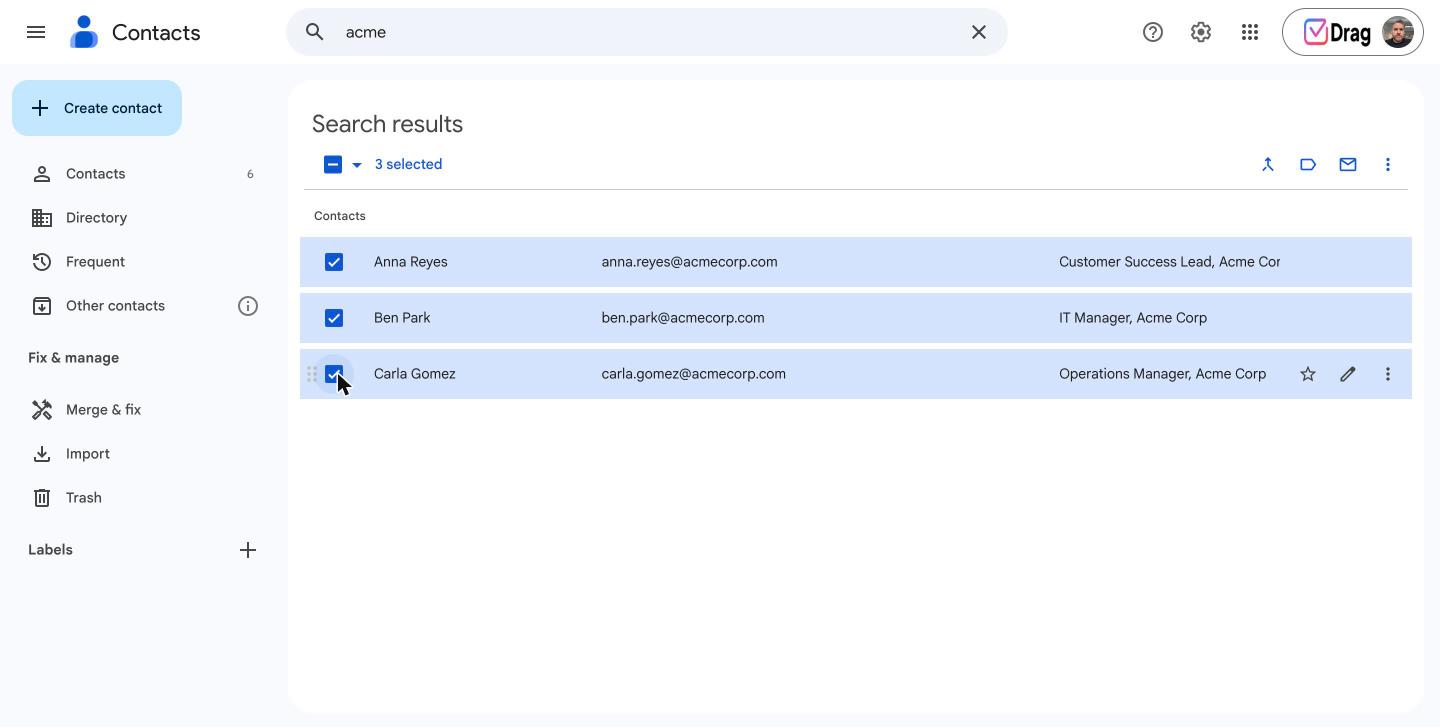
On the “Contacts” screen, you will be able to see all the contacts you have saved so far. You can also edit them and make changes you find necessary.
-
On the top right of the screen, you will see the options “Import” and “Export”.
-
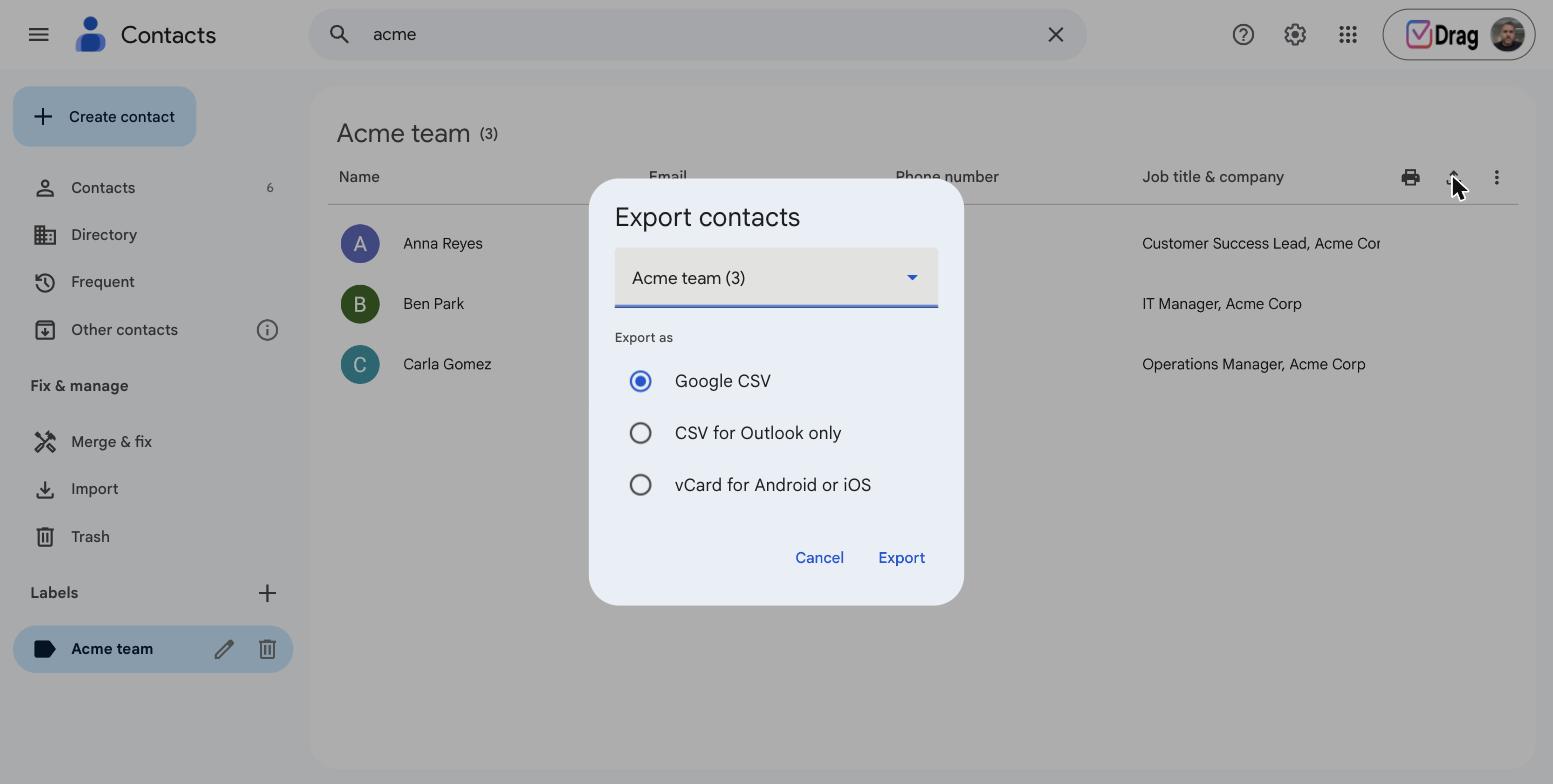
If you want to share Google contacts from the account you are accessing, then you should click on “Export”, which will open a window similar to the one below. You will be able to choose the format to download those contacts, such as CSV, and then save it on your computer.
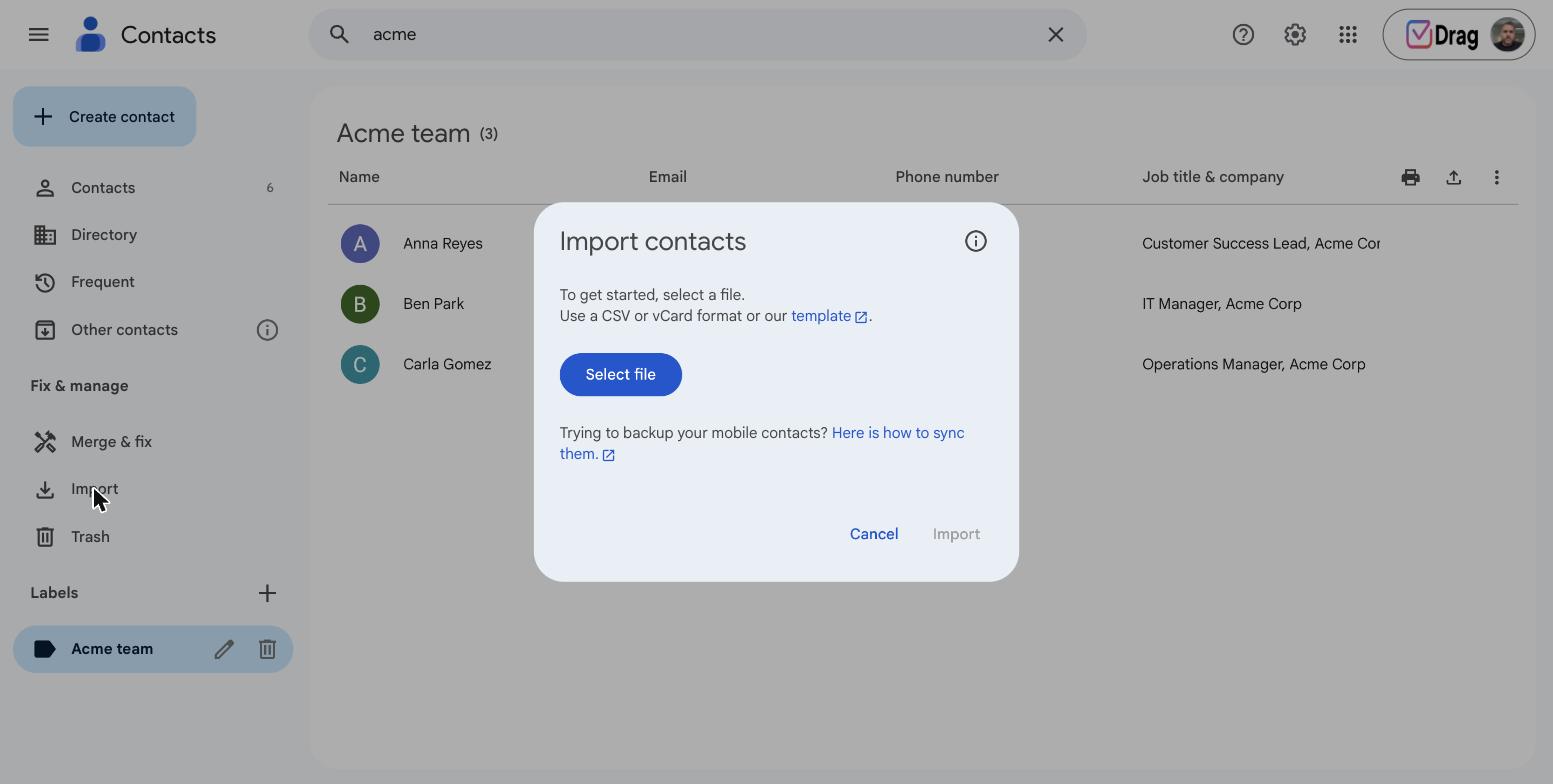
Now, how to import them into your other Google account? Once your file is safe and sound on your device, then you can switch to the other account and do the same process as above. The only difference is that you will have to click on “Import”.
2. Using Gmail Delegation
A distinction worth naming before the steps: Gmail delegation shares your inbox, while Contacts delegation, covered above, shares your contacts, they are separate settings, and this section covers the inbox kind for teams that want both.
Need access to other users’ accounts? One of the best features Google Workspace offers is Gmail Delegation, which allows a user to access another user’s Gmail emails and contacts, without having the password to it.
This usually works wonders for personal assistants, but granting access to an account can also be quite useful for small teams that share email inboxes. There are limits to this feature. But it's better and safer than simply sharing passwords around the office. Keep in mind that Google Delegation has limitations such as:
- The delegate user cannot access shared contacts from mobile phones or other apps.
- You cannot find shared contacts using Gmail/Google Contacts search feature.
- Shared contacts don't show up in Gmail autocomplete.
- It's impossible to set specific lists. All contacts will be shared with the delegate.
- You cannot restrict permissions (e.g. “View Only”).
- Contacts cannot be shared with Groups of users, you will need to share them one by one.
3. Using an extension such as ContactsFlow
You can download specialized tools from the Google Workspace Marketplace. One of these tools is ContactsFlow. This solution will allow you not only to assign access privileges to certain contact lists, but also to decide which fields should be visible or not (like personal phone number or email). The shared contacts in Google Workspace will be synchronized across all apps and devices of the authorized users.
Sharing contacts with someone outside your organization
Every native route above stops at your domain's edge: delegation and the directory are internal-only by design. Outside it, you have three honest options. For a handful of contacts, attach them as vCards, open the contact, use the export option, and send the .vcf file, which any mail app can open. For a whole set, a CSV export handed over (or imported by the recipient) does the job as a one-time copy. And for a living, synced list shared with an external partner, only the third-party route works: tools in the ContactsFlow class can publish a label to any Google account you authorize. Nothing native keeps external contacts in sync, and any guide claiming otherwise is describing a workaround, not a feature.
Drag · with Varley
The inbox your team and Varley work in together
Shared inbox and live chat for Gmail teams, with Varley, Drag’s AI, included from $18. Plus an MCP server your own AI tools can drive.
What if you're on free Gmail, not Workspace?
The honest answer: your native options shrink to one. Delegation and the directory are Workspace features, so a personal Gmail account shares contacts the manual way, export a CSV or vCard, import it on the other side, repeat when things change. That is fine for a one-time move (switching accounts, onboarding a family member) and painful as a system. If two or three people genuinely need one live contact list on free Gmail, a third-party sharing tool is the only real fix, or, if the contacts belong to a shared purpose like a small business inbox, that is usually the signal the account itself should graduate to Workspace.
Taking team collaboration to the next level
And if the contacts you are sharing belong to a team inbox, support@, sales@, the cleaner fix is sharing the conversations themselves: Drag turns those addresses into shared boards on Gmail, contacts, context, and history included. The 7-day trial needs no card.
Sharing Google Contacts FAQs
How to Share Contacts from One Google Account to Another Google Account?
Google doesn’t provide a built-in feature for automatic contact syncing between accounts, but you can do it manually or with third-party tools.
Method 1: Export and Import Contacts.
- Open Google Contacts in the source account.
- Click Export, select Google CSV or vCard, and download the file.
- Sign in to the destination account, go to Contacts, and click Import.
- Upload the exported file to transfer contacts.
Method 2: Use a Contact Sharing App.
For ongoing sharing, tools like ContactsFlow or ContactBook allow multiple Google accounts to access and edit the same contact list.
How Do I Forward a Google Contact?
Google Contacts doesn’t have a direct “forward” option, but you can share a contact’s details in two ways:
Method 1: Copy and Paste Contact Details.
- Open Google Contacts.
- Click on the contact you want to share.
- Copy their name, email, and phone number.
- Paste the details into an email or message and send it.
Method 2: Export and Send as a File.
- Select the contact(s) you want to share.
- Click Export, choose vCard (VCF) or CSV, and download.
- Attach the file to an email and send it.
- The recipient can import it into their Google Contacts
Can I share just one contact label with someone?
Not natively, this is Google Contacts' most-requested missing feature. Delegation shares everything or nothing, and the directory covers everyone automatically. Sharing a specific label (say, "Suppliers") with chosen people requires a third-party tool in the ContactsFlow class, which syncs labels across accounts with per-person permissions. If you only need to email a label's members yourself, see how to create a group email in Gmail.
How do I share Google contacts with someone outside my company?
For a few contacts, export them as vCard (.vcf) files and email them, any contact app imports those. For a full list, hand over a CSV export. For a continuously synced external share, only third-party tools work: Google's native routes (delegation, directory) are restricted to accounts in your own Workspace domain.
Can free Gmail accounts share contacts?
Yes, but only manually: export a CSV or vCard from one account and import it into the other, repeating when contacts change. Delegation and the company directory are Google Workspace features. For a live shared list on free Gmail, a third-party sharing tool is the only working route.
Do shared Google contacts sync to my phone?
Directory and delegated contacts follow your Google account, so they appear wherever that account is signed in, though delegated contacts are limited to the web interface for some actions. CSV imports become ordinary contacts and sync like any other. Third-party shared labels sync to phones through the tool's own connection.
Are shared contacts updated automatically?
It depends on the route. Delegation, the directory, and third-party sync tools are live, so edits appear for everyone. CSV and vCard transfers are snapshots, and they never update. If "always current" matters, pick a live route and treat exports as backups, not sharing.

Co-founder
Co-founder at Drag, writing about Google Workspace, shared inboxes, and how teams actually run email.
