













Gmail delegation explained: setup steps, the delegate limits Google actually enforces, what delegates can and cannot do, and when a shared inbox works better.
Table of contents
Google's native Gmail delegation is an interesting tool with features relevant to various digital workspaces. It includes managing someone's messages and replies from their account, which helps roles like executive assistants. However, some users might need a more comprehensive alternative to Gmail delegation. In this article, we'll explore the positive, the negative, and the other options you might need for Gmail delegation. Back in 2010, Google launched Gmail delegation, which allows you to provide someone else with access to your inbox and emails. This is great for executives who use an executive assistant to manage their email and calendar for them. This functionality may be handy in various situations. However, some limitations may be real deal-breakers for teams to delegate emails in a productive and secure manner.
The short version:
- Open Gmail and click the gear icon, then "See all settings".
- Open the "Accounts and Import" tab and find "Grant access to your account".
- Click "Add another account" and enter the delegate's address.
- Click "Send email to grant access"; the delegate confirms via the email Google sends them.
- The delegate then opens your mailbox from their own account menu. Personal Gmail allows up to 10 delegates; Workspace accounts support more when an admin allows it.
The rest of this guide covers each step, what delegates can and cannot do, the limits Google enforces, and what to use when delegation runs out of road.
What is Gmail delegation?
If you need to grant another user access to your email to help you manage them, Gmail delegation might be the right solution. It's a native Gmail option that can be used by individuals who require extra attention to their email-based work. For example, a company's director receives a high volume of emails during the day, so their assistant filters them regularly and deals with certain topics, all while categorizing specific conversations for the executive to deal with themselves. Another scenario in which Gmail delegation might be useful is when a team has a catch-all address, such as it@company or support@company. Multiple users need access to this account so that they can manage the tasks attached to these emails, but they also need their own accounts to work on individual tasks. If that catch-all is a support address, our guide to running a help desk in Gmail shows the labels, filters and searches that turn a delegated account into a support queue. Gmail delegation is also a more convenient and secure solution than forwarding emails or giving another user your password to access your Gmail account. Here's a quick glimpse at Gmail delegation:
What a delegate can do:
- View your inbox
- Reply to emails on your behalf
- Manage your contacts
- Delete your emails
What a delegate can't do:
- Change your password
- Change any of your Gmail settings
- Send and receive chat messages
Google caps how far delegation stretches, and the caps differ by account type. A personal @gmail.com account can have up to 10 delegates. Work and school accounts on Google Workspace support up to 1,000 delegates when an admin allows it, though only around 40 people can actively use a delegated mailbox at the same time. If your plan involves more people than that, or delegates who should see only part of the mail, you have outgrown delegation, which is what the alternative below is for.
How to implement Gmail delegation?
Setting up Gmail delegation can be pretty simple:
-
Open Gmail on your browser and log in to the account that'll get the delegate(s;
-
Click on Settings > See all settings;
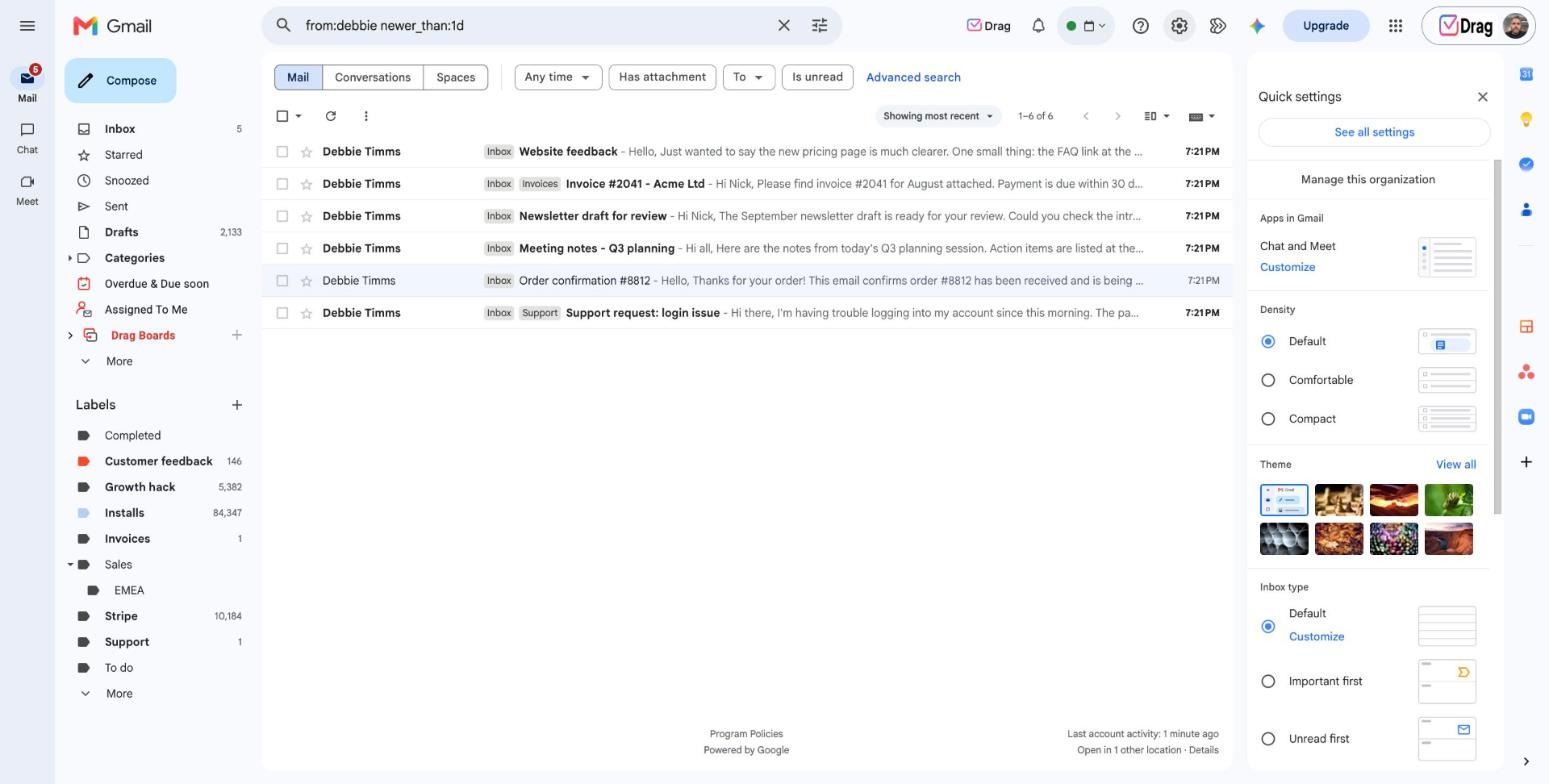
-
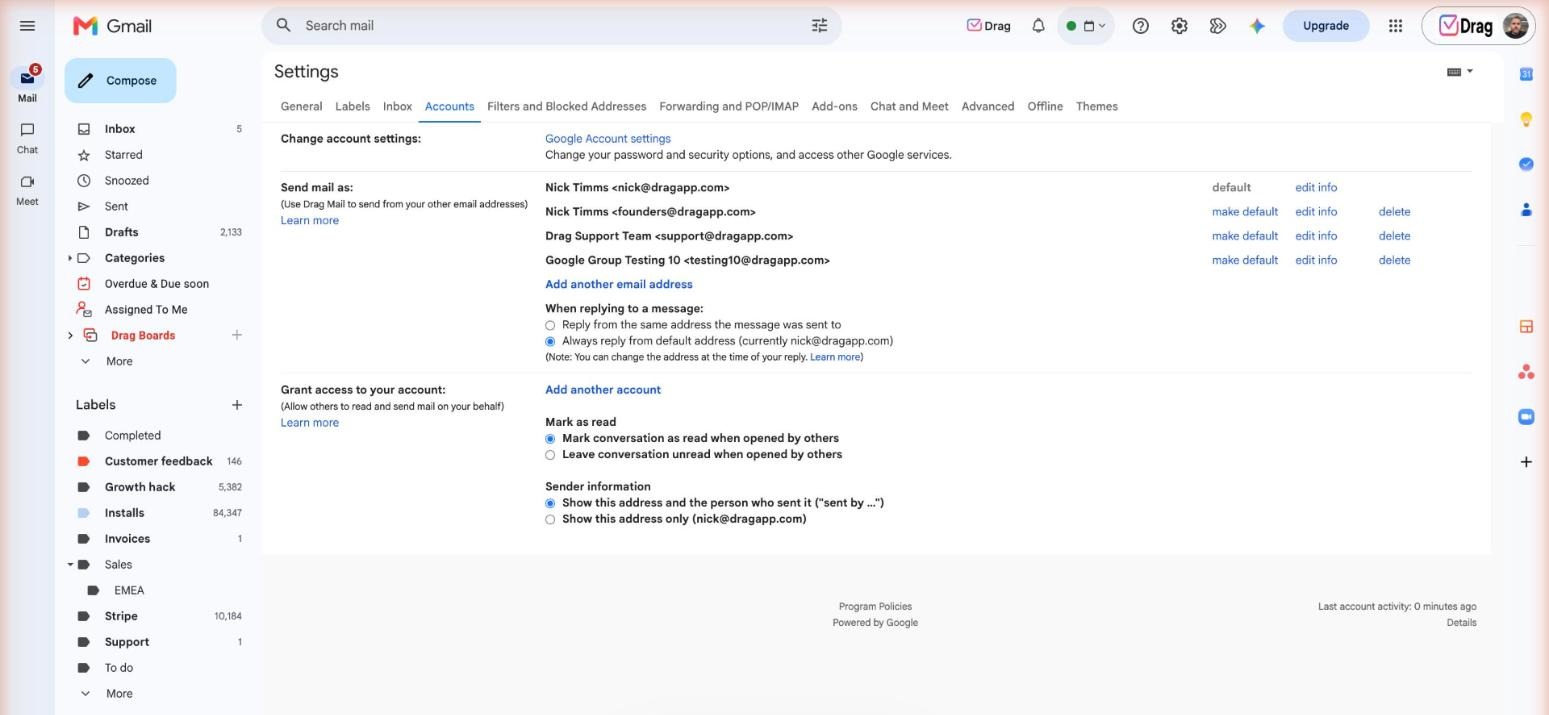
Go to the tab called Accounts and Import;
-
Find the Grant access to your account section;

-
There, click on the Add another account link;
-
Enter the email address of your delegate, then click on Send email to grant access;
-
The delegate will receive an invitation link;
-
Then, they have to open this link to get access to the shared account;
-
Now, they will be able to log into this account using their own Gmail login credentials.
If you need to manage delegates and their access to the account, open the Accounts and Import tab again. There, you can check all users who have access to the shared account. If needed, click on Revoke access to remove their access to the shared account. This is useful, for example, when someone leaves the team.
Using and removing delegate access
Once the delegate accepts, both sides have a few practical rules to know. The invitation expires if it is not accepted within a week, and Gmail can take up to half an hour, occasionally longer, to verify a new delegate after they confirm.
Accessing an account as the delegate: sign in to your own Gmail, click your profile picture in the top right, and choose the account marked "Delegated" in the menu. It opens in a new tab. Use the account switcher each time rather than bookmarking the delegated inbox, because the direct link can change. Delegated access has historically been desktop-only; Google is rolling out delegated-account access in the Gmail mobile apps, so it may or may not be available on your phone yet.
Removing a delegate: open Settings, then "See all settings", then the "Accounts and Import" tab, and click "Delete" next to the delegate under "Grant access to your account". Access ends immediately, which is the step to remember when someone leaves the team.
Drag · with Varley
The inbox your team and Varley work in together
Shared inbox and live chat for Gmail teams, with Varley, Drag’s AI, included from $18. Plus an MCP server your own AI tools can drive.
Gmail delegation limitations
Can't choose which emails to share
Gmail delegation allows users to share whole inboxes, which sometimes is very useful and convenient. You don't need to worry. You know that all your messages will arrive at your assistant. However, it can be inconvenient in most situations, in which you don't want your assistant to have access to ALL of your emails. It turns out that there is no functionality in Gmail delegation that allows you to select which emails you want to share. Let's say you are working on multiple projects, and one of them is about a particularly sensitive subject. In this case, the Gmail delegation would not work very well to delegate emails.
Can't share emails cross-domains
Unfortunately, Gmail delegation doesn't allow users to share inboxes and email cross-domains. On Google Workspace, delegation is limited to accounts in the same organization. Personal @gmail.com accounts are different: they can delegate to any other Gmail address, inside or outside a company. It means that if you have a domain @company.com, but your assistant uses @gmail.com, the delegation cannot be done.
The best alternative to Gmail delegation
If Gmail delegation isn't enough to promote collaboration within your team, you might need an extra resource. Namely, a shared inbox platform, like DragApp. A shared inbox is a collective inbox in which authorized users can see, manage, and reply to messages sent to one or multiple addresses. First of all, you can share email cross-domains. In Drag, it's possible to share boards between @company.com domains and @gmail.com domains. There are no limitations. You don't need to purchase a Google Workspace domain for every team member to be able to share/delegate emails. Much like regular Gmail delegation, users can manage the other inbox from their accounts. The difference, however, is usability: on a shared inbox, there's a lot more flexibility on what to do with these emails.
Choose which emails to share
You can choose which emails to share. Sharing emails in Drag is easy. Just create a Shared Board, invite your assistant, and populate it with the emails that you want to share. Another key factor is using workspace routing. With this feature, you can send emails to specific workspaces automatically based on custom rules, such as subject lines, keywords on the email text, and sender's address. So, for instance, if you work with customer service and need to delegate cancellation emails for your assistant to manage, you can create a rule that sends all the messages containing specific cancellation keywords to their to-do column.
Shared drafts
DragApp was developed with a shared drafts space in mind. That means collaborators can see incoming mail, @mention colleagues, and work together on solving inquiries. That way, a fully multifaceted team is always on call to offer the best support possible.
This is how to use Drag to delegate emails to your assistant
The initial step is installing the Drag extension from the Chrome Store and accepting the required access. Then, you're ready to create your board(s) and share them with others. Here's a step-by-step guide:
-
Open your team's Gmail inbox;
-
Scroll to Drag Boards on the left sidebar;
-
Click on the ‘+‘ icon;
-
Pick which type of board you want to create. In this case, a Gmail shared inbox:
-
To complete this step, add the team's email address and click Next;
-
The next screen will ask you to invite team members, so add your delegates here:
-
Give your board an applicable name and click Next;
-
Authenticate it;
-
Now you'll be redirected to the shared board with Gmail delegation.






Using task distribution systems
After you've set up a shared inbox to do Gmail delegation, you can also benefit from Drag's extra resources in task management. Managers and account leaders can assign tasks manually, but they can also use round-robin email assignments. With round-robin, tasks, and emails are allocated among users based on availability. That means your delegate will receive new responsibilities when they finish what they're working on. This resource helps users focus on the tasks at hand instead of looking into their schedules.
With Drag, you can also set up business hours for each workspace. This is key for customer-facing roles, especially those with 24/7 availability. More often than not, managers will need to delegate email-based tasks to teams based on time zones and shifts, so having dedicated business hours keeps your tasks organized. 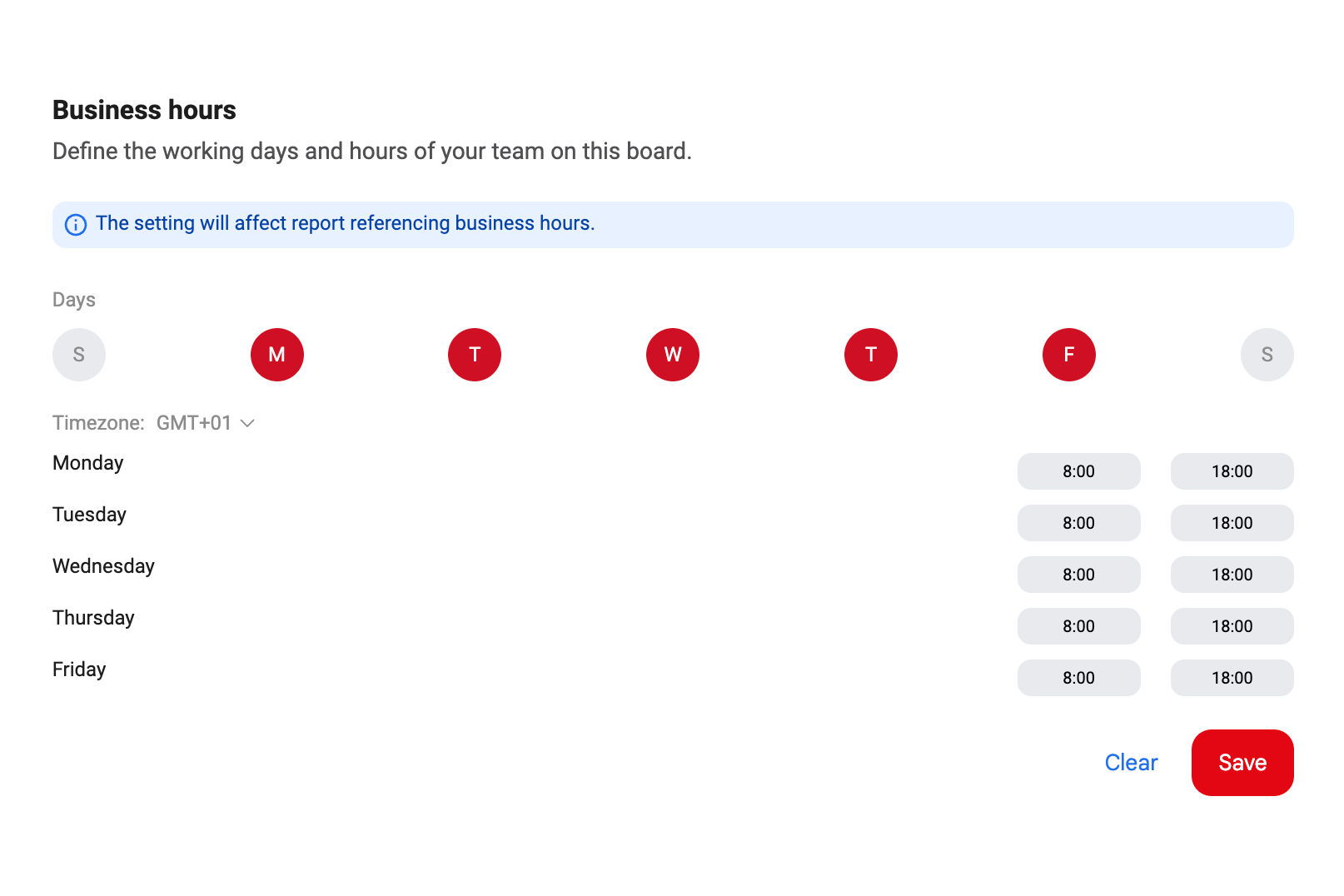
Frequently asked questions
What are Gmail delegates?
Gmail delegates are users who can see and manage your emails from their accounts, reply to them, and fulfill your email-based tasks. This is a native Gmail feature often used by executive assistants and customer-facing teams.
Can Gmail delegation mess up my account?
No, Gmail delegation allows users to work with emails. They don't have admin access to your Gmail account. Delegates can send emails on your behalf, read your messages, and manage your inbox, but they can’t change account settings or passwords. This means your personal and security settings remain protected, even if someone else is handling your emails.
Can you pick which emails are shared on Gmail delegation?
No, when you add a delegate, they have access to all your incoming and outgoing emails. There is no option to restrict access to specific messages or folders. If privacy is a concern, consider using filters, labels, or a shared inbox tool that provides more control over visibility.
What's the alternative to the Gmail delegation system?
If Gmail delegation isn’t the right option for your team, you can use a shared inbox to manage and assign email-based tasks. Tools like DragApp allow teams to collaborate on emails without sharing full access to a personal inbox. These solutions help improve workflow by enabling task assignments, tracking conversations, and setting role-based permissions.
How many delegates can a Gmail account have?
Up to 10 on a personal @gmail.com account. Google Workspace accounts can be granted up to 1,000 delegates by an administrator, but only about 40 can work in the mailbox simultaneously, so large teams need a shared inbox tool rather than delegation.
Can a delegate send email as me?
Yes. A delegate can read, send, and delete messages on your behalf, and recipients see your address as the sender with the delegate's address shown alongside. Delegates cannot change your password, alter your settings, or use chat as you.

Co-founder
Co-founder at Drag, writing about Google Workspace, shared inboxes, and how teams actually run email.
