













Three ways to create a group email in Gmail: a contact label, a Google Group with its own address, or a shared inbox when replies need an owner.
Key takeaways
- To email a group in Gmail, save the people under one label in Google Contacts and type the label name in the To field. It is free on any Gmail account, but only you can use it.
- If the team needs its own address, such as sales@, create a Google Group. On Google Workspace, email from outside your organization is blocked by default until an admin allows it and the group lets outsiders post.
- Gmail caps one email at 500 recipients on a personal account and 2,000 on Google Workspace, of which at most 500 can be outside your organization (checked 2 October 2026).
- If customers write to the group address and someone has to answer, use a shared inbox so every email has one owner: Groups Collaborative Inbox, Google's native shared inbox, or a tool such as Drag.
Table of contents
- How to create a group email list in Gmail with a contact label
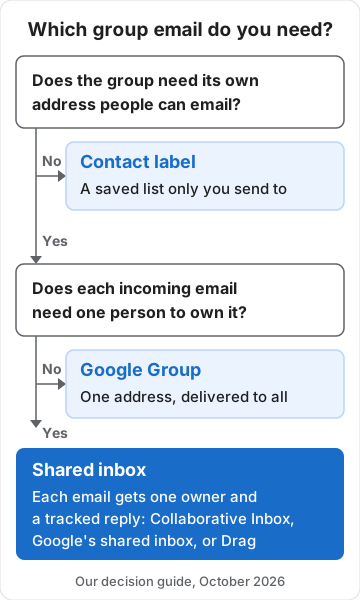
- Which kind of group email do you need?
- How to add, remove or rename people in a Gmail contact group
- How to create a group email address with Google Groups
- Recommended Google Groups settings for team@, sales@ and support@
- Gmail group email limits (2026)
- How to send a group email without showing everyone's address
- Can you create a group email on iPhone or Android?
- When a group email isn't enough: shared inboxes for team replies
- Common problems with Gmail group emails, and fixes
- Frequently asked questions
- Related guides: Google Groups, shared inboxes and Gmail sending
The short version: to create a group email in Gmail, open contacts.google.com, tick the people you want, click Manage labels, create a label (say "Sales team"), then type that label's name in the To field of a new Gmail message. That label is your group email list, and it works on any Gmail account for free.
Two cases need something else:
- The team needs its own address, like sales@ or team@, that other people can email: create a Google Group.
- Customers write to that address and someone has to answer: use a shared inbox, so each email gets one owner.
Whichever you choose, Gmail caps one email at 500 recipients on a personal account and 2,000 on Google Workspace, of which no more than 500 can be outside your organization.
Every limit and setting on this page was checked against Google's help pages on 2 October 2026. The team templates are our own recommendations.
How to create a group email list in Gmail with a contact label
A contact label turns a set of contacts into one name you can type in Gmail's To, Cc or Bcc field, and Gmail expands it into every address on the label. You set it up once in Google Contacts, on a computer.
1. Open Google Contacts. Go to contacts.google.com, signed in to the account you send from. From Gmail you can also open it from the Google apps grid at the top right.
2. Select the people. Tick the box next to each contact you want in the group. If someone is not a contact yet, click Create contact and add them first.
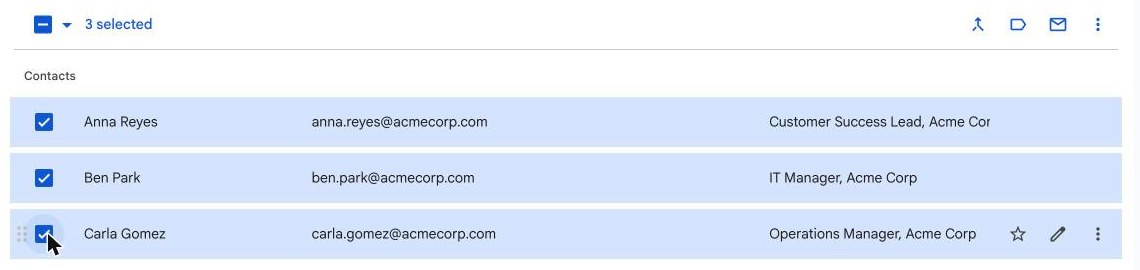
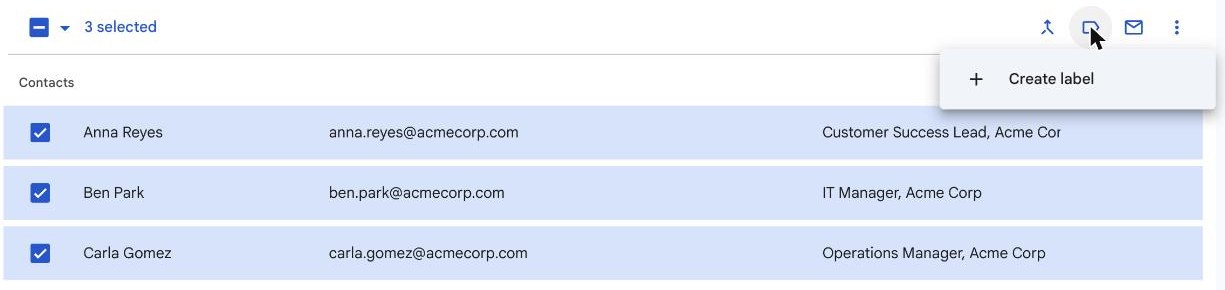
3. Create the label. With the contacts still selected, click Manage labels (the label icon at the top right of the list), then Create label. Give it a name you will recognize when typing, such as "Acme team", and click Save. The selected contacts go straight onto the new label.
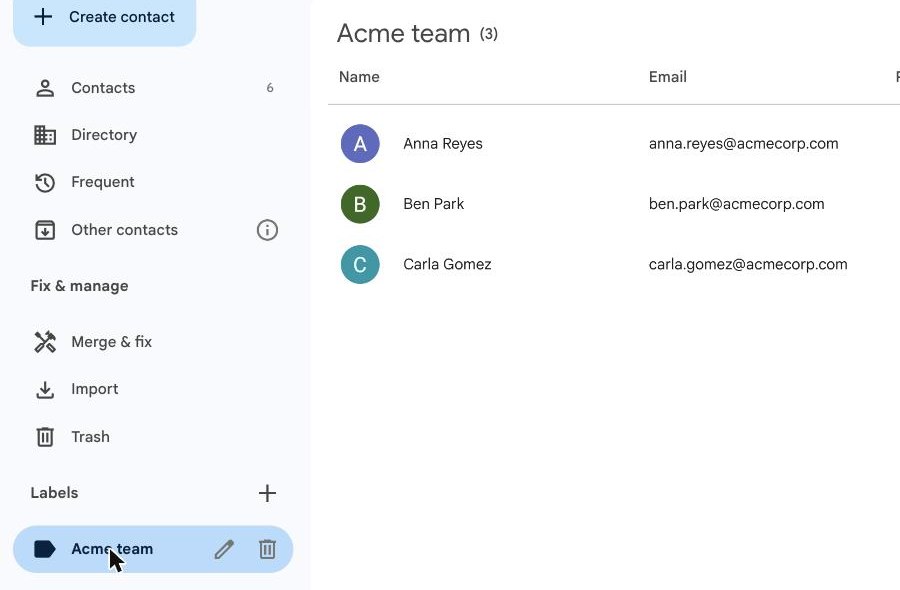
4. Check the label. Click the label under Labels on the left to see who is on it.
5. Send to the group. In Gmail, click Compose, start typing the label name in the To field and select it. Gmail fills in every member's address.
Three things catch people out:
- Only the default address is used. Google's help says that if a contact has more than one email address, only their default address is added to the label group. Check it before sending.
- Everyone sees everyone. A label in the To field shows every address to every recipient, and reply all goes to the whole list. Put the label in Bcc instead when the people on it do not know each other (our Cc vs Bcc guide covers the etiquette).
- Mail merge sends separate copies. On paid Google Workspace plans (Business Standard and Plus, Enterprise Standard and Plus, Education Standard and Plus, and Workspace Individual), you can add the label to the To field and turn on mail merge. Each person gets their own copy, can't see who else received it, and replies arrive as separate threads. Google allows up to 1,500 recipients per mail merge message and 1,500 mail merge recipients a day, and keeps the remaining 500 sends in your daily limit for regular email.
Which kind of group email do you need?
A group email in Gmail is one of three things: a contact label (a sending shortcut only you can use), a Google Group (a shared address that delivers to every member), or a shared inbox (a shared address where every email has one owner).
| Option | Own address | Cost | Best for |
|---|---|---|---|
| Contact label | No | Free | Lists you send to |
| Google Group | Yes | Free | team@, sales@ |
| Shared inbox | Yes | $0 to $24/seat | support@, hello@ |
- Who can send to it: only you for a contact label; anyone the group's settings allow for a Google Group.
- Where replies go: a reply to a label goes to you (or to everyone, on reply all). Replies to a Google Group go to the group or the sender, depending on its settings. In a shared inbox, every email lands in one queue with one owner.
If you only ever send to the list, the label is enough. If other people need to write to the group, you need a Google Group. Our distribution list guide goes deeper on one-way broadcast lists, and labels vs a shared inbox explains why Gmail labels can't be shared across a team.
How to add, remove or rename people in a Gmail contact group
You manage a contact group from the Labels list in Google Contacts: add people by applying the label, remove them by unticking it, and rename or delete the label from the label itself.
- Add people: select the contacts, click Manage labels, tick the label and click Apply.
- Remove people: click the label, tick the contacts to remove, click Manage labels (the label icon) and untick the label. The contacts stay in your address book.
- Rename or delete the label: point to the label under Labels and use the edit (pencil) or delete (bin) icon, then follow the steps on screen.
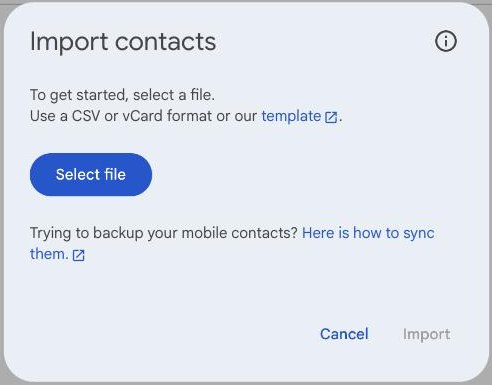
- Add a whole list from a spreadsheet: click Import, choose a CSV file and click Import. To land everyone on a label in one go, fill the Labels column in Google's CSV template with the label name (separate several labels with :::). Google takes up to 3,000 contacts per import, so split bigger files.
How to create a group email address with Google Groups
A Google Group gives the group its own address: anyone the settings allow can email it, and every member receives the message. It is also the right answer if you were about to make a Gmail account for a group and share the password, because every member keeps their own login.
1. Open Google Groups. Sign in at groups.google.com and click Create group. On Google Workspace, if Groups is missing, your admin needs to turn on Groups for Business.
2. Enter the group info. Add a name, the group email address and a description. Google allows group names up to 73 characters and addresses up to 63 characters before the @.
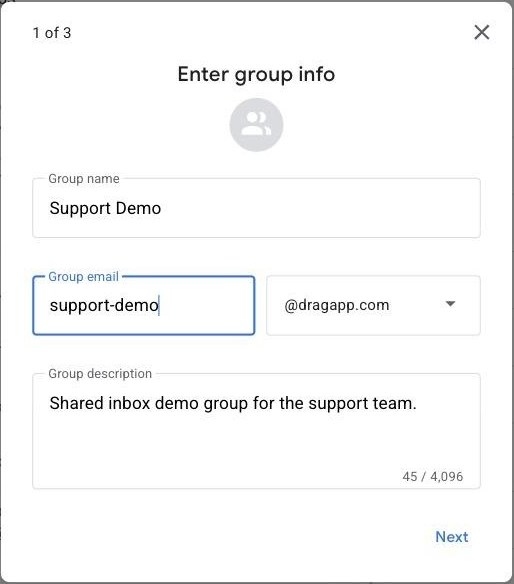
- On a personal Gmail account, the address ends in @googlegroups.com.
- On Google Workspace, it uses your company domain. Google notes that some organizations add a suffix, so a group called "training" can become training-user-created@yourdomain. If you need a clean address like sales@, ask your admin, who can create groups from the Admin console.
3. Choose the privacy settings. Google asks who can join the group, who can view conversations, who can post, and who can view members.
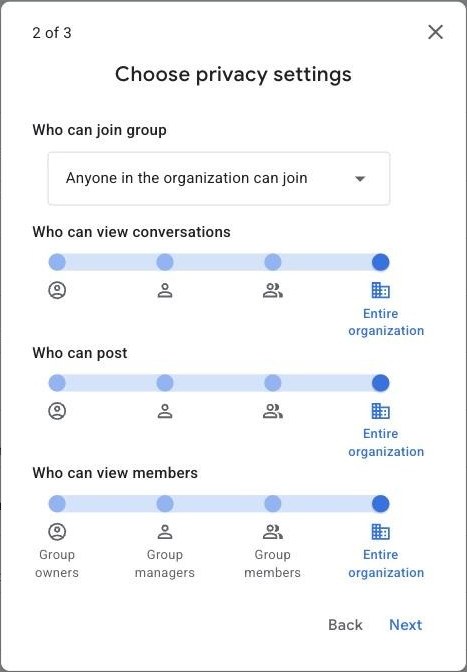
4. Add members and create the group. Add the people who should receive the group's email, then click Create group. On an @googlegroups.com group, you can invite people who don't have a Google Account, but you can't add them directly.
5. Wait a few minutes, then test. Google says to wait a few minutes before sending to a new group, or the first messages may not be delivered. Then send a test from an account outside the group.
The setting that trips up most Workspace teams: Google's organization-wide Groups policy has two switches, one that lets group owners accept email from external users and one that lets them add external members, and Google lists both as off by default. Until your admin turns on the first, a sales@ or support@ group will not receive email from customers, however the group itself is set up. Our Google Groups guide covers the rest of the settings.
Recommended Google Groups settings for team@, sales@ and support@
A team group needs three choices made on day one: who can post, who can see the members, and whether one person should own each reply. These are the settings we would start with. They are our recommendations, not Google defaults, and you can change them later in Group settings.
| Group | Who can post | Who can view members |
|---|---|---|
| team@ (internal announcements) | Group managers, or the entire organization | Entire organization |
| sales@ (prospects write in) | Anyone on the web (your admin must allow external email) | Group managers |
| support@ (customers write in) | Anyone on the web (your admin must allow external email) | Group managers |
For all three, set "Who can view conversations" to group members. Then:
- Turn on Collaborative Inbox for sales@ and support@ as soon as more than one person replies, so each conversation can be taken by one person (more on this below). team@ doesn't need it.
- Hide the member list from outsiders. On any group customers write to, keep "Who can view members" and "Who can view member email addresses" at group managers, so a stranger can't collect your team's addresses.
- Decide how replies go out. If members reply from their own inboxes, the customer sees a personal address and the rest of the team never sees the answer. Owners and managers can send as the group address (see the FAQ below); for everyone else, use a shared inbox.
Gmail group email limits (2026)
Gmail caps one email at 500 recipients and 500 emails a day on a personal account, and at 2,000 of each on Google Workspace (at most 500 recipients outside your organization), counting every address a label expands to. These are Google's published figures as of 2 October 2026.
| Limit | Personal Gmail | Google Workspace |
|---|---|---|
| Recipients per message (To, Cc and Bcc together) | 500 | 2,000, at most 500 outside your organization |
| Emails sent per day | 500 | 2,000 (500 on trial accounts) |
| Total recipients per day | Not published | 10,000 |
| External recipients per day | Not published | 3,000 |
| Mail merge | Not available | 1,500 recipients per message, 1,500 a day |
Sources: Google's Gmail sending limits for personal accounts and sending limits in Google Workspace, which also lists a daily cap on unique recipients. Workspace counts over a rolling 24 hours, and the limits include mail sent by delegates and vacation responders. If you go over, Gmail shows "You have reached a limit for sending mail", and you can send again within 1 to 24 hours.
How to send a group email without showing everyone's address
The simplest way to hide recipients is to put the contact label in the Bcc field, so each person sees only your address and their own. Three options, from simplest to most private:
- Bcc the label. Add the label to Bcc and your own address to To. Reply all then only reaches you.
- Use mail merge on an eligible Workspace plan. Each person gets a separate copy addressed only to them, and replies come back as separate threads.
- Email a Google Group with "Who can view members" and "Who can view member email addresses" set to group managers. Recipients see only the group's address.
Can you create a group email on iPhone or Android?
You can create a contact group on Android, but Google documents no way to do it in its iPhone apps. On Android, Google's help says to open the Contacts app, tap Label, then New label, and add contacts to it.
On an iPhone, the documented route is to create the label on a computer at contacts.google.com; once it exists, it syncs to your account. Google's help also only documents emailing a label from Gmail on a computer. If a label doesn't come up in a phone's Gmail app, start the email on a computer, or use a Google Group address, which works from any email app because it is a normal email address.
When a group email isn't enough: shared inboxes for team replies
A group address that customers write to needs more than delivery: each email needs one owner, a status, and a record of the reply. Without that, either two people answer the same email or everyone assumes someone else did. There are three ways to add it.
1. Groups Collaborative Inbox (free with Google Workspace). Turn it on for the group and members can take a conversation, assign it to a teammate, and mark it complete, no action needed, or a duplicate. It works in the Google Groups interface, not in Gmail. Our Collaborative Inbox guide walks through the setup.
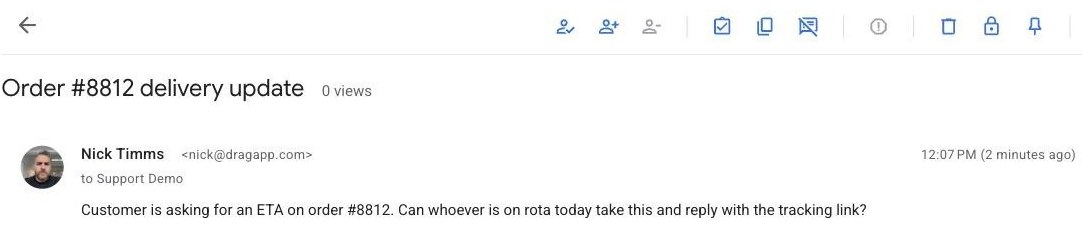
2. Google Workspace's native shared inbox. An admin sets up a shared email address in the Admin console and adds teammates as delegates, who can read, send and delete its email, and by default each email shows which delegate sent it. Google's shared inbox page (updated 30 September 2026) lists Business Starter, Standard and Plus and says it is being released in phases. It documents no assignment or statuses. There is no add-on to buy, but Google publishes no license terms and the address is a mailbox account, so we would budget a seat for it. Our Google Workspace shared mailbox guide has the details.
3. A shared inbox tool on top of Gmail. Drag turns the group's address into an assignable board for your Gmail team, with an owner on every email and Varley, Drag's AI, drafting replies on the Plus and Pro plans. Plans run from $12 to $24 a seat, with AI included from $18. If you are weighing it against the free routes, our Google Groups alternatives guide compares the options.





Drag · with Varley
Customers emailing your group address? Give every email an owner
Connect support@ or sales@ to Drag and every email lands on a shared board in Gmail: assign it to one person, see when a teammate is already replying, and keep notes on the conversation. 7-day free trial, no card.
See how email assignment works in Drag, or compare every route on our shared inbox page.
Common problems with Gmail group emails, and fixes
Most group email problems come down to the account you are signed in to, a contact's default address, a group or admin setting, or a sending limit.
- The label doesn't appear when you type it in Gmail. Check you are signed in to the same Google account in Contacts and Gmail, and that the label has at least one contact with an email address.
- Someone on the label never gets the email. Gmail uses only each contact's default address. Open the contact in Google Contacts and check which address is the default, then ask them to check spam.
- A group member doesn't get the group's email. In Google Groups, check the member's subscription in the group's member list (Each email means they get every message), then their spam folder.
- Customers' emails to the group never arrive. On Workspace, your admin has to let group owners accept email from external users, and the group's "Who can post" setting must include people outside your organization.
- A brand new group doesn't deliver. Google says to wait a few minutes after creating a group before sending to it.
- "You have reached a limit for sending mail." You went over the per-message or daily limit in the table above. Wait up to 24 hours, then split large sends into smaller batches.
- Replies go to one person, not the group. That is how labels work: there is no group address to reply to. Use a Google Group if replies should reach everyone.
Frequently asked questions
How do I make a Gmail account for a group?
Don't share one Gmail password around the team: every reply then looks like it came from the same person, and nobody knows who sent what. On personal Gmail, a Google Group gives you a free @googlegroups.com address the whole group can use. On Google Workspace, use a Google Group or ask your admin for Google's native shared inbox, which by default shows who sent each email.
Can I create a group email in Gmail without Google Contacts?
Not as a saved list: Gmail keeps groups in Google Contacts, not in Gmail itself. Without Contacts, you can paste the addresses into the To field each time, or create a Google Group and email its single address. Gmail also suggests people you email often as you type, which helps for small groups.
Which is best for a small team: a contact label or a Google Group?
Use a contact label if you are the only person who sends to the list and nobody needs to write to it. Choose a Google Group as soon as the team needs one address that clients or colleagues can email, because a label belongs to one person's contacts and stops working the moment that person is away.
Can I send email as the group address from Gmail?
Yes, if you are a group owner or manager. Google's Groups help says to set the group's "Who can post" to anyone on the web (on Workspace, your admin must allow external email first), add the group address in Gmail's settings as a send-as address, and confirm it with the code Google emails to the group. Your emails then show the group address.
How many people can be in a Gmail contact group?
Google gives no maximum for a label, but a Google account can hold up to 25,000 contacts, according to Google's Contacts import help. The tighter limit is sending: one email can reach 500 recipients on personal Gmail and 2,000 on Google Workspace, so a bigger list needs a Google Group or a mailing tool.
Is it free to create a group email in Gmail?
Contact labels and Google Groups are free on any Google account. Groups Collaborative Inbox is free with a Google Workspace subscription, which is itself paid. Google's native shared inbox has no add-on to buy, but Google publishes no license terms for it. Shared inbox tools that add assignment and AI, such as Drag, charge per seat.
Related guides: Google Groups, shared inboxes and Gmail sending
- Google Groups guide: every Groups setting, from email lists to forums.
- Google Groups Collaborative Inbox: turning a group into a free shared queue.
- Google Workspace shared mailbox: Google's native shared inbox and delegation, explained.
- Gmail shared inbox: every way to share one address in Gmail, compared.
Ready to give your team's group address a proper inbox? Start a 7-day free trial of Drag, no card needed.

Co-founder
Co-founder at Drag, writing about Google Workspace, shared inboxes, and how teams actually run email.
