












Should you use Kanban in Gmail? Here's everything you need to know about it. Discover tips and the best tools to help you.
Table of contents
- What's Kanban?
- Why should you use Kanban in Gmail?
- Can you build a Kanban board in Gmail for free, without any tools?
- Best practices when using Kanban in Gmail
- How can users implement Kanban in Gmail?
- How can a shared inbox enhance Kanban in Gmail?
- Quick comparison: What's the best way to use Kanban in Gmail?
- Free and paid Kanban tools that work with Gmail
- The benefits of using Kanban in Gmail
- What you need to know about Kanban in Gmail
- Frequently asked questions
Kanban in Gmail means turning your inbox into a visual board: emails become cards, columns show status (to do, in progress, done), and work moves left to right instead of piling up in a list. There are three ways to get it, and they suit different situations: a free makeshift version using Gmail's own labels and Multiple Inboxes, a task-manager integration that sends emails to an external board, or a shared inbox tool like Drag that makes Gmail itself the board, which is the approach built for teams. This guide covers all three, with the honest limits of each, the tools worth considering, and the practices that keep a board useful instead of decorative.
What's Kanban?
Kanban is a project management method developed by Toyota in the 40s to optimize manufacturing resources. The main concern was establishing a productive line that minimized loss and waste, all while keeping up with individual steps. In short, by monitoring each step of your factory, you can notice patterns, predict outcomes, and use your resources accordingly.
What Kanban in Gmail uses
The Kanban method uses a visual, all-encompassing system to follow an entire project or workflow. There are task cards, columns and boards. At its core, a project can be divided into three columns: to do, in progress and done. So a team can divide their work into small tasks, write them on cards, and set them into these columns, moving them along as needed.




Each board can represent a department, product/service, or workflow, depending on the team's needs. You can add more steps, such as a brainstorming stage at the start or a ready-for-approval stage before finalizing. And the tasks should be small enough that they move along quickly, offering a clear view of the overarching progress. The Kanban method can be done with actual boards and post-it notes, but for teams that work remotely, across platforms and asynchronously, Kanban in Gmail is a great solution.
The principles of Kanban
- Organize your current work: the basis of Kanban is knowing how your current system works. Instead of redoing your entire workflow, focus on managing the ongoing projects.
- Start incremental changes: as you move your project along, you'll notice small hurdles. Those can be a sign your system needs change. Kanban is, by design, very flexible, which means you can tweak certain tasks and steps to be more productive.
- Identify priorities: with Kanban in Gmail, you'll be able to notice which tasks are priorities and why. That allows managers to assign specific plans to their teams in a strategic manner.
- Look for feedback: another advantage of Kanban is that you can monitor the success of specific tasks and projects in real-time. With that in mind, teams can also offer feedback constantly, which allows managers to reevaluate ongoing efforts quickly and, if needed, reallocate resources efficiently.
Why should you use Kanban in Gmail?
Kanban boards mean your emails can have much more information. Gmail doesn't need to be only an inbox. The flexibility of Kanban allows you to create multiple workflows across different Kanban boards, to keep track of multiple activities such as:
- CRM
- Helpdesk system
- Internal project management
What are the pros of implementing Kanban in Gmail?
The biggest benefit of using Kanban in Gmail is that it's a visual tracker. So instead of browsing through endless messages, your team can check the progress of each workflow at a glance.
- Each task is a card: instead of CC and BCCs cluttering your inbox, you get the entire task inside a dedicated space. This is even more useful for customer-facing teams handling customer support email
- Collaboration features: often, support agents need a lot of back and forth before sending a solution to the customer. If this process is done through a Kanban board, you can monitor each reply's progress to foster efficiency
- Visual tracker: when a team is working together to develop a new product or close sales, they should keep up with their collaborators' progress
Are there limitations with Kanban in Gmail?
Sure! While Kanban is very useful for most teams, it's important to know that it isn't the only possible solution, and there are some drawbacks, such as:
- Adaptability: if the tasks can't be broken down into small, incremental progress, it's time to reevaluate your options
- Lack of information: some tasks might require more detail, with your inbox featuring both a traditional email list and a preview view that allows users to add more resources to tasks
- User barriers: your tasks need to be clear and time-sensitive. If they stay too long in the same spot, that means your boards aren't aligned to the ongoing projects and your team might spend too long trying to adapt it to the structure
- Information overload: Your boards shouldn't be cluttered and disorganized; otherwise, it'll defeat the visualization purpose
Can you build a Kanban board in Gmail for free, without any tools?
Yes, up to a point, and it is worth understanding this method even if you outgrow it. Gmail's own features can imitate a board:
- Create a label for each column: "To do", "In progress", "Waiting", "Done".
- Turn on Multiple Inboxes (Settings, then "Inbox type", then "Multiple inboxes") and set each section's search query to one label, for example label:to-do.
- Your inbox now shows the sections stacked on the main screen. Moving a card is relabeling an email.
The honest limits: sections stack vertically rather than sitting side by side, so it never quite looks like a board; there is no drag and drop, no assignment, and nothing is shared, so a teammate cannot see your columns or know who is handling what. As a personal triage system it costs nothing and takes five minutes. The moment a second person needs the same view, you need one of the two approaches below.
Drag · with Varley
The inbox your team and Varley work in together
Shared inbox and live chat for Gmail teams, with Varley, Drag’s AI, included from $18. Plus an MCP server your own AI tools can drive.
Best practices when using Kanban in Gmail
Before you even begin using Kanban in Gmail, you should be aware of some essential best practices to make sure it's working for you.
Add a tagging system to your Kanban in Gmail
Your Kanban boards should offer a quick view of your projects. Add:
- Columns for each step of the workflow
- Color-coding your cards
- Custom tags based on specific projects, teams and products


Set up an archiving system
Decide what leaves the board and when. A simple rule works: cards sit in "Done" for one week so the team sees what shipped, then get archived in a weekly sweep. In Gmail-based boards this maps to archiving the email, which keeps it searchable without keeping it visible. Without this habit, "Done" becomes the longest column on the board and the visual clarity that justifies Kanban disappears.
Five habits that keep a Kanban board working
Boards fail from neglect more than from design. Five habits prevent it: shape the board around your real process rather than a template, and delete the columns you do not use; keep work-in-progress capped, because ten cards in one column is a list, not a flow; set priorities and dependencies when a card enters the board, not when it stalls; make the board the agenda for stand-ups, so it stays the source of truth; and archive done work weekly, since a clean board is the whole point of the method.
How can users implement Kanban in Gmail?
There are two main methods for adding a Kanban visual system to your Gmail: a simple task manager or a shared inbox with project management tools.
How can I connect Gmail to a Kanban-style task manager?
You can use a dedicated task management tool to organize your projects with a Kanban board. There are multiple options, free and paid, that allow users to create personalized panels and categories to follow their workflows. Trello is the clearest example: install its Gmail add-on, open any email, and send it to a board as a card that links back to the original thread. Kanbanchi works the same way for Google Workspace teams, and lightweight sidebar tools like Kanban Tasks build the board on top of Google Tasks without leaving Gmail at all. The pattern is identical across all of them: the email generates a card, but the board lives outside your inbox, so managing the work still means switching contexts.
What are the pros and cons of dedicated task managers for Kanban in Gmail?
The main pro is that users can quickly get all of their tasks organized and ready to go, no complicated setup system. The disadvantage, however, is that after they've finished a task, they'll still have to go back to Gmail, bring any required files and drafts and reply to the message itself.
Why is a shared inbox the best solution for Kanban in Gmail?
With a Gmail shared inbox, your team's entire workspace is collaborative. This means the team can access incoming mail simultaneously and work on related tasks without leaving the same interface. A shared inbox can be a great scenario for using Kanban in Gmail, considering that all the internal and external communication happens through this workspace. Here's how it works:
- You set up a team address, such as support@companyname or sales@companyname.
- Then, you choose a shared inbox software, like our solution DragApp.
- The next step is inviting your team members to access it.
On the shared inbox, you can set up a workspace that aligns with your workflow, including Kanban. Here's how it looks on Drag:
What are the key benefits of a Gmail shared inbox?
- Instant collaboration: everyone who has access to this workspace will be able to check, manage, and sort tasks based on the emails your inbox receives
- Gmail's interface: DragApp is an add-on. That means you don't have a steep learning curve and the onboarding is much easier
- Practicality: instead of manually importing emails and transforming them into tasks, Drag already automates the process for your team
How can a shared inbox enhance Kanban in Gmail?
Besides visually streamlining your work, Drag's resources can help you redefine your team's efforts to build efficiency in the long run.
Is there full automation?
Yes! While standard task management tools still require users to import and export data from their email inboxes, that isn't the most productive way to work. With a shared inbox, not only does everyone have real-time access to incoming mail, but the platform automatically sorts them into tasks. With Drag, you can create custom automation rules that sort and tag tasks according to email content. For instance, as soon as your customer support team receives a new message from a client inquiring about errors, it'll be added to the to-do column on your Kanban board with the relevant tag.
Can I build an efficient workflow?
Since collaboration is key for a productive team and Kanban improves your workflow management, that is a key part of Drag. Managers can assign their team tasks manually and automatically, based on workload, availability, and priorities. Each card/task can be assigned to specific members, who will have it added to their lists. Here's a look into a card:
Another key collaboration feature is @mentions. Mentions allow users to tag another team member to add the card to their list. For example, if an IT team is working on a product and they need a reviewer's feedback, it's pretty simple: just @ them to call their attention to the next steps.
Is there good internal communication?
Yes, which is crucial to avoid inbox clutter. Your Kanban tools, like a shared inbox, should minimize the steps to move a task forward and help you focus internal communication on what truly matters. Drag, for instance, offers task-based live chats. That means team members working on a specific card can chat inside it, which allows people to follow up quickly. If someone is working on writing a sales pitch, for example, they can ask their collaborators for help in real-time.
While Kanban itself is a visual method, it benefits from other resources, such as adding all relevant information to cards so that team members don't need to reach out and ask further questions. With Drag, you can upload files directly to cards and custom shared email notes that help keep everyone in the loop.
Of course, teams aren't always online, so there needs to be a system that updates you on any relevant changes when you log into a shared inbox. With Drag, an activity log notifies users of any changes made to the cards they're tagged on and assigned to.

Can I track analytics to optimize my work with Kanban in Gmail?
Yes. Regular feedback is a critical part of the Kanban method. After all, it was developed and optimized to offer teams the ability to evaluate and change their processes based on incremental changes. With that in mind, when using Kanban in Gmail, managers need to organize and track their workspace based on reliable data. Drag offers custom analytics reports based on filters. You can track information such as user productivity, board response times, and volume of new cards based on time and dates.
This aligns with the Kanban methodology because it helps leaders make evidence-based decisions to promote growth and minimize barriers.
Quick comparison: What's the best way to use Kanban in Gmail?
| Kanban via Task Manager | Kanban via Shared Inbox | |
|---|---|---|
| How it works | Connect Gmail to a separate Kanban-based task manager platform. Tasks are imported or sent from Gmail and managed in a visual board outside your inbox. | Turn Gmail itself into a Kanban workspace using a shared inbox add-on like DragApp. Emails become tasks that can be managed, assigned, and tracked within Gmail. |
| Setup methods | Requires connecting Gmail manually or via add-ons. Tasks are either sent to the app’s email address or created manually. | Simple setup: install the add-on, share a Gmail workspace (e.g., support@company), and invite team members. |
| Automation | Limited automation. Tasks often need to be imported or exported manually. | Full automation with custom rules according to your workflow: automatically tag, sort, and assign tasks from incoming emails. |
| Collaboration | Some tools allow comments or file sharing, but team members work in a separate interface. | Real-time collaboration within Gmail: @mentions, live chats, file sharing, shared notes, and activity logs inside each card. |
| Interface | Uses an external tool, often with a learning curve and a separate workspace. | Uses Gmail’s familiar interface, no switching needed. |
| Efficiency | Good for individuals or small teams with limited task volume who want a visual overview of their projects. | Ideal for teams needing centralized, real-time collaborative workflows on Gmail without context switching. |
| Internal communication | Depends on external chat or comment tools. | Built-in task-based live chat and shared notes directly on email cards to keep discussions organized. |
| Analytics | Limited with free tools, paid plans available for detailed reports. | Comprehensive analytics on productivity, response time, and workflow optimization directly in your inbox. |
| Best for | Entrepreneurs or small teams wanting a simple Kanban view with basic Gmail integration. | Teams managing shared email addresses (sales@company or it@company) who need full collaboration, automation, and analytics within Gmail. |
Free and paid Kanban tools that work with Gmail
If you want a real board rather than the label workaround, these are the current options, from free personal tools to team platforms. Prices verified at publication.
 1. Drag
Gmail itself becomes the board: emails are cards, columns are shared with the team, assignment, automation rules and analytics included, and the board can be managed from Claude or ChatGPT through Drag's MCP server. From $12 per user per month with a 7-day trial and no card. Best for teams running shared addresses like sales@ or support@ who want the board where the email already is.
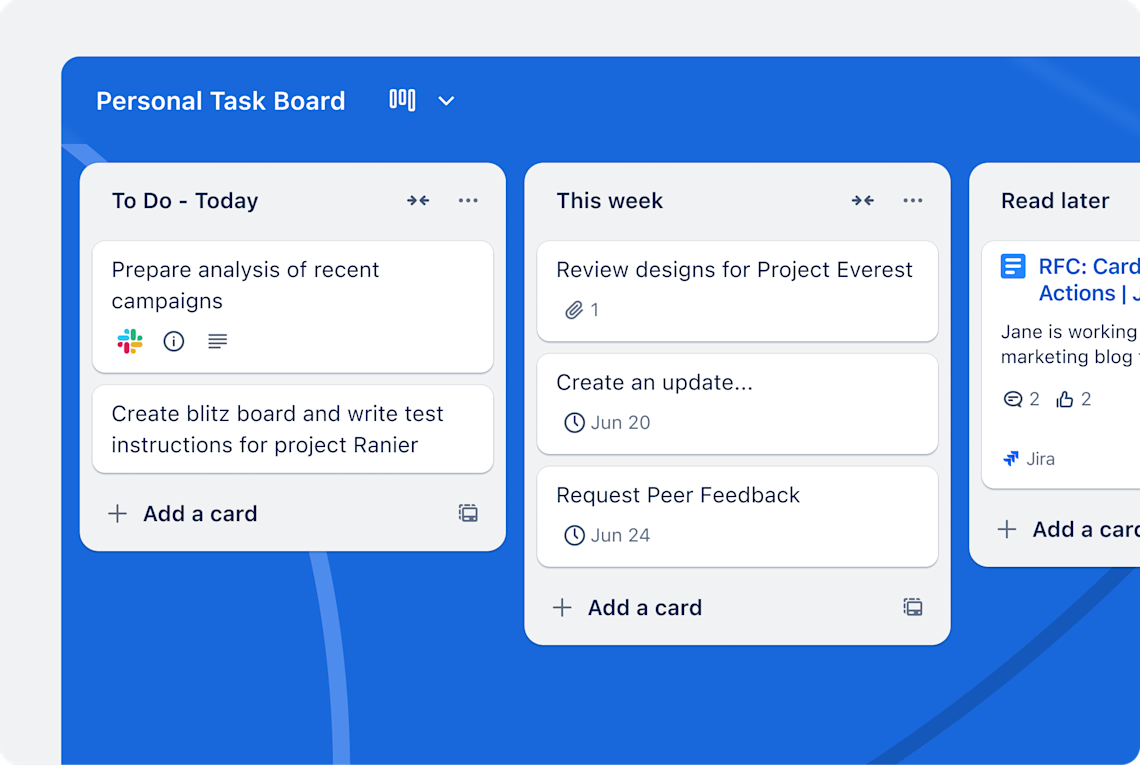
 2. Trello
Free for up to 10 boards and 10 collaborators per workspace; the Standard plan is $5 per user per month billed annually. The generalist board with a Gmail add-on that turns emails into cards on an external board. Best for personal projects and teams already living in Trello.
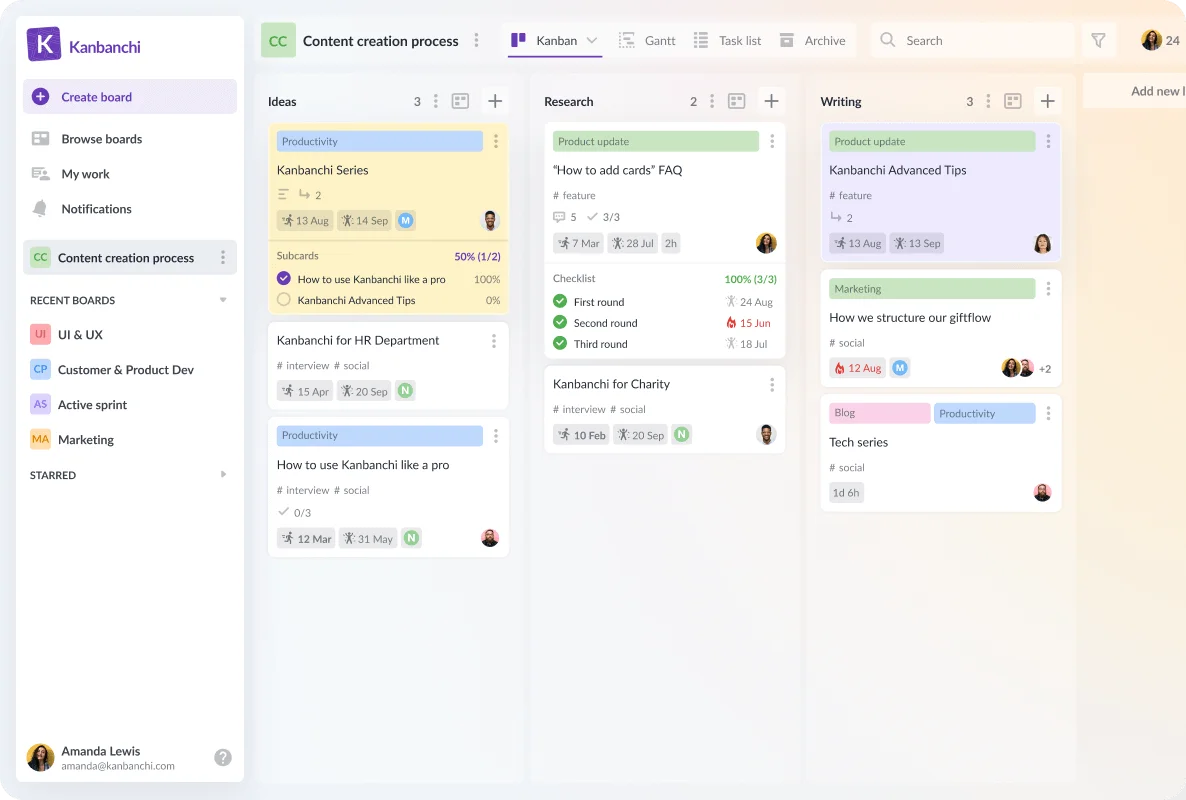
 3. Kanbanchi
From $5.99 per user per month on the Essential plan ($3.97 billed annually). Built for Google Workspace, with a Gmail add-on that sends emails to its boards. Best for Workspace organizations that want boards plus Gantt charts outside the inbox.
4. Kanban Tasks
Free for personal use; team sharing costs $5 per user per month. A lightweight board in the Gmail sidebar built on Google Tasks. Best for solo users who want the smallest possible tool.
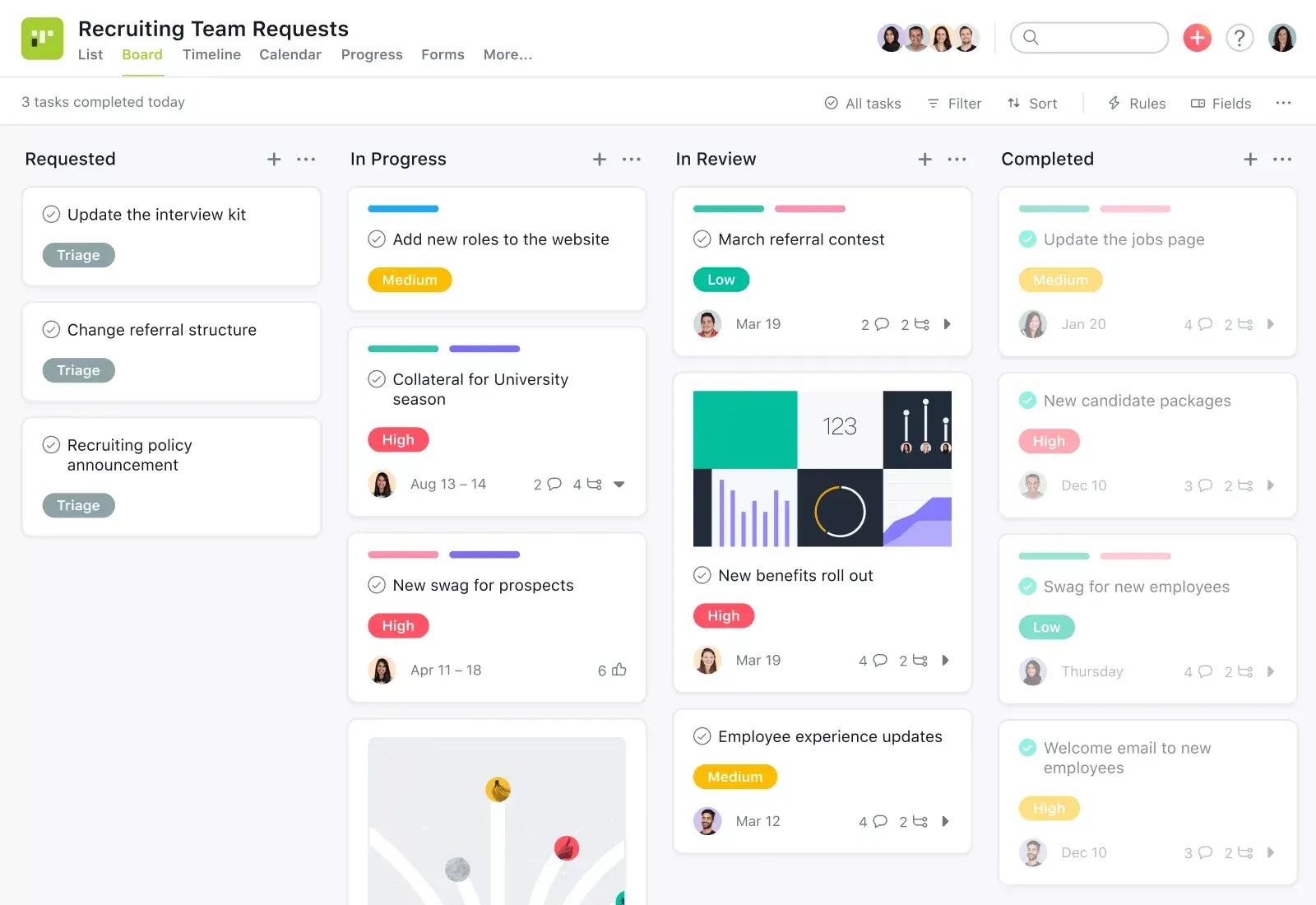
 5. Asana
The free Personal plan now caps at 2 users; the Starter plan is $10.99 per user per month billed annually. Board views within a full project platform, connected to Gmail via add-on. Best for teams whose work is projects first and email second.
One tool worth naming because searchers still find it: Flow-e, once a popular Kanban layer for Gmail, was discontinued in 2020. If you came here looking for it, our guide to Flow-e alternatives covers the migration.
The benefits of using Kanban in Gmail
At its core, Kanban is a simple, clear way to visualize your work. By streamlining and organizing your tasks and checking their steps to a conclusion, you can prioritize your time and resources. With the help of tools like a shared inbox, the managers and collaborators can automate the process, collect feedback, and build a functional system. Using Kanban in Gmail helps teams, especially at small and medium-sized companies, focus their efforts on tasks that move their projects along and eliminate bottlenecks. That allows them to concentrate on what matters.
What you need to know about Kanban in Gmail
Kanban in Gmail is a way to organize your emails visually, using boards and task cards to manage workflows. Each email becomes an actionable card that tracks progress, deadlines, and team updates, and you can move tasks between columns like “To Do,” “In Progress,” and “Done.” Using Kanban in Gmail boosts productivity by giving you a clear, visual overview of your work. It helps teams prioritize tasks, reduce inbox clutter, and collaborate faster. There are two main methods to set up Kanban in Gmail:
- Use a task manager connected to Gmail. You can send or sync emails to your Kanban board manually.
- Use a shared inbox add-on (like DragApp) to turn Gmail itself into a Kanban workspace. This method is easier to set up and allows full automation, tagging, and team collaboration directly in Gmail.
Frequently asked questions
What is Kanban in Gmail and how does it work?
Kanban in Gmail is a way to organize your emails visually, using boards and task cards to manage workflows. Each email becomes an actionable card that tracks progress, deadlines, and team updates, and you can move tasks between columns like “To Do,” “In Progress,” and “Done.”
How can using Kanban in Gmail improve productivity?
Using Kanban in Gmail boosts productivity by giving you a clear, visual overview of your work. It helps teams prioritize tasks, reduce inbox clutter, and collaborate faster.
What’s the best way to set up Kanban in Gmail?
There are two main methods to set up Kanban in Gmail:
- Use a task manager connected to Gmail. You can send or sync emails to your Kanban board manually.
- Use a shared inbox add-on (like DragApp) to turn Gmail itself into a Kanban workspace. This method is easier to set up and allows full automation, tagging, and team collaboration directly in Gmail.
Is Kanban in Gmail good for teams or individuals?
Both! Individual users can track personal goals and deadlines visually, while teams can manage shared inboxes like support@company or sales@company collaboratively. For teams, tools like DragApp allow members to assign, comment, and chat inside each email card.
What are the best tools for using Kanban in Gmail?
It depends on your workflow needs. For complete team collaboration and automation, DragApp is the best choice. It transforms Gmail into a shared Kanban board with live chats, analytics, and automation rules. That's ideal for support, sales, and internal project management.
Can I use Gmail as a Kanban board for free?
Yes, with limits. Labels plus the Multiple Inboxes setting give you stacked, label-based sections that behave like columns for one person. It costs nothing, but there is no drag and drop, no assignment, and no shared view, so teams outgrow it quickly.
What happened to Flow-e for Gmail?
Flow-e, an early Kanban overlay for Gmail, was discontinued in January 2020. Emails and boards built on it stopped working, and its former users largely moved to shared inbox tools that build the board on Gmail itself.

Co-founder
Co-founder at Drag, writing about Google Workspace, shared inboxes, and how teams actually run email.
