













The three honest ways to get multiple Gmail accounts in one inbox: the free native setup step by step, where each method breaks, and the right route for teams and AI tools in 2026.
Key takeaways
- Gmail can natively show several accounts in one inbox using forwarding plus send-as aliases, free, and replies go out from the right address.
- The native routes are built for one person's accounts: nothing is shared, nothing is assigned, and each added account is another verification to maintain.
- Team addresses and AI access are where the native routes stop: a shared inbox layer consolidates the accounts once, for the whole team and any connected AI tool.
Table of contents
- Here's what's included in this article.
- What about connecting multiple accounts to AI tools?
- A Quick Tip for Google Workspace or businesses in Gmail
- The benefits of merging your Gmail accounts
- Multiple Gmail accounts in one inbox: Step-by-step guide
- Multiple inboxes in Gmail
- DragApp: Multiple Gmail business accounts in one inbox
- Try Drag's Shared Inbox
- Wrapping up
- Frequently asked questions
There are three honest ways to get multiple Gmail accounts into one inbox, and they solve different problems. Send-as with forwarding pulls your other addresses into your main inbox so you can read and reply from one place, free, in about ten minutes of setup. Gmail's built-in account switching keeps the inboxes separate but one click apart, which is fine until the tab-juggling costs you a missed reply. And for shared team addresses, or accounts an AI assistant needs to reach, a shared inbox tool consolidates them properly, with assignment and one governed connection. This guide walks through each setup step by step and tells you plainly which fits your situation.
Here's what's included in this article.
There are a number of ways to achieve multiple Gmail accounts in one inbox. Here is a summary:
-
- Merging Gmail accounts using a forwarding option
- Managing multiple inboxes in one Gmail account using Gmail's multiple inboxes
We understand that making the decision can be hard. If you're a business user, you can shortcut straight to our recommendation for Multiple Gmail business accounts in one inbox, or get advice from one of our team.
| Method | Best for | Setup effort | Replies from the right address? | Shared with a team? | The catch |
|---|---|---|---|---|---|
| Send-as + forwarding | Reading and replying to several of your own accounts in one inbox | About 10 minutes per account | Yes | No | Each added account is another verification to maintain |
| POP fetcher | Legacy imports only | Not recommended | Yes | No | Being retired by Google: unavailable to new users in 2026, existing users until January 2027 |
| Multiple Inboxes view | Sectioning one account into labelled panes | Minutes | One account only | No | Organizes labels, not separate accounts |
| Account switching | Keeping accounts separate but one click apart | None | Yes, per account | No | The tab-juggling costs missed replies |
| Shared inbox tool | Team addresses and AI access | Minutes | Yes | Yes, with assignment | Paid, from $12 per user per month |
We usually separate our lives into parts, such as family, work, leisure, and others. And we tend to do the same with our emails. If you have multiple email accounts, you know very well what we're talking about.
It's common to have at least two inboxes: one for work and one for personal usage. This is excellent since mixing both kinds of emails can be confusing.
You may know of someone who has three or even four email accounts. And no one can blame them for wanting an inbox just for e-commerce related emails, another one for academic purposes, and the third one for work.
Although this may not be the best solution, it is the most accessible people can think of.
When it comes to business emails, it still can happen, mainly for people who need to keep a personal, professional inbox and a team inbox. Imagine how great it would be to have them in the same account. No switching between tabs or windows all day long and saving time. If this is your case, you should know that there are some ways of having multiple Gmail accounts in one inbox. In this article, you are going to learn the complete process step by step. We hope that after this reading, you can finally centralize your emails in just one place in a way that your workflow can be improved 100%.
What about connecting multiple accounts to AI tools?
The newest version of this problem is not a second browser tab, it is an AI assistant. Claude, ChatGPT, and similar tools can now connect to Gmail, but their built-in connections hold one Google account at a time, so the multi-account question comes right back with new stakes. The honest routes mirror this page: swap the single connection as you need it, run community software with the risks that carries, or consolidate the accounts that matter into one shared inbox and give the AI a single governed connection. We cover all three, with the trade-offs, in our full guide to connecting multiple Gmail accounts to Claude.
A Quick Tip for Google Workspace or businesses in Gmail
The POP fetcher route still exists, but Google has raised its cost: since the shutdown of less-secure app access, it requires two-factor authentication and an app password on the account being fetched, and mail arrives on a delay rather than instantly. It remains a fair choice for pulling in an old account you rarely use. For accounts you work from daily, forwarding plus send-as is faster to set up and faster in use.
Gmailify is Google's bridge for non-Gmail addresses: link a Yahoo or Outlook account and Gmail's interface, search, and spam filtering apply to it as if it were native. It only works with the providers Google supports, and it is built for one person's accounts rather than anything shared. If your other addresses are all Gmail already, the send-as and forwarding route above does the same job with fewer moving parts.
Drag · with Varley
The inbox your team and Varley work in together
Shared inbox and live chat for Gmail teams, with Varley, Drag’s AI, included from $18. Plus an MCP server your own AI tools can drive.
The benefits of merging your Gmail accounts
Sometimes having separate accounts for different purposes is ideal. For example, having a personal account separated from a business Gmail account is essential to your work productivity. It also saves a lot of space for each account. You can also get some specific benefits from having multiple Gmail accounts in one single inbox for each of the cases. For personal purposes Having several personal accounts for shopping, education, and others can be confusing. Besides, you lose a lot of time switching between one another. For business You don't need to switch from your business inbox to your team inbox all the time.
Multiple Gmail accounts in one inbox: Step-by-step guide
This step-by-step applies to people who want to merge different Gmail accounts. It consists of receiving emails from a secondary inbox on a primary account. This way, you can use just one of them. So the first decision you need to make is choosing which one is to be the primary account, usually, it's the one you use the most. Then you can follow these steps.
- Go to "account settings"
- Add another email address
- Send Verification
- Confirm the changes
- Forwarding and POP/IMAP settings
- Confirm the forwarding email address
- Select a forwarding option
Note: You can do this process between multiple Gmail accounts (@gmail.com) or two accounts from the same Google Workspace domain (@company.com).
Go to "account settings"
On the selected primary email address account, click the gear icon and select the option "Settings".
Then, click "Accounts" in the top navigation. Then click on the link "Add another email" in the section "Send mail as".
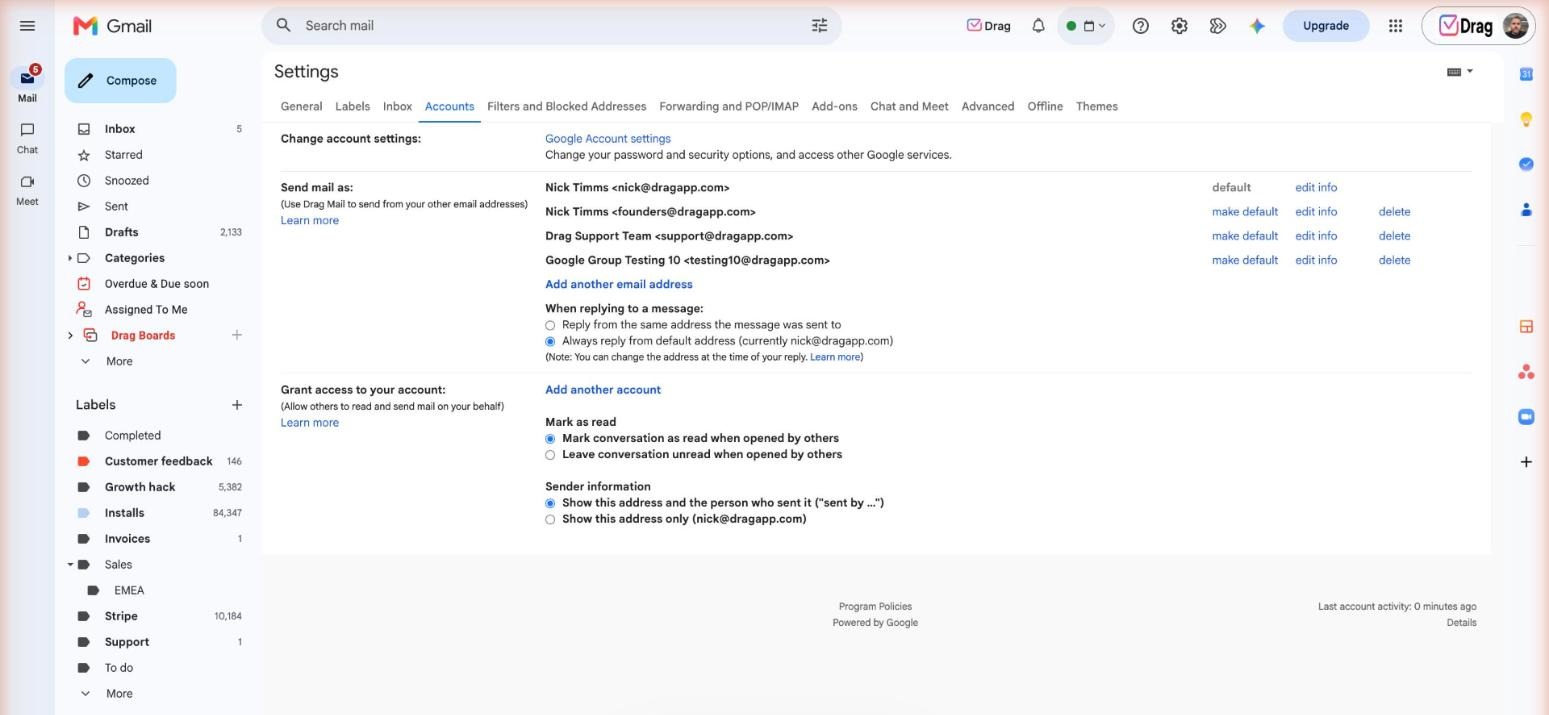
Add another email address
A pop-up will open where you need to fill in the following information:
- Your full name or name of the team in case of a business email
- Your secondary email address
You can either check or uncheck the box to the left of "Treat as an alias." If you want to send and receive messages in your Gmail inbox from this secondary inbox, you should mark it. Also, keep it checked if you need to send email messages from a group mailing list. Now, if you need to send emails on behalf of another user or account, you should uncheck it. It depends on the case, so you should look at this Google article to learn more about this option.
There is a link right under the checkbox that offers you an optional step "Specify a different 'reply-to' address." It means that the replies to messages you send will go to this address. If you would like to add this email address, click on it, and a type box will appear. After completing the info on this popup window, click the "Next Step" button.
Send Verification
On the next screen, you will have to send a confirmation email to your secondary Gmail inbox. Just click on the button, and it will automatically send you an email. Don't close the popup.
Confirm the changes
Next, go to your secondary inbox and open the confirmation email. You can copy or paste the verification code into the proper popup field. Or you can click on the indicated link inside the email.
Forwarding and POP/IMAP settings
Now you need to go to your secondary email account to set your emails from this account to the primary one. Go to Settings by clicking the gear icon, and choose the tab "Forwarding and POP/IMAP." Then on the section "Forwarding," click the "Add a forwarding address" button. A pop-up will open, and you need to type the primary inbox address. After that, you need to click "Proceed," A confirmation code will be sent to the primary inbox.
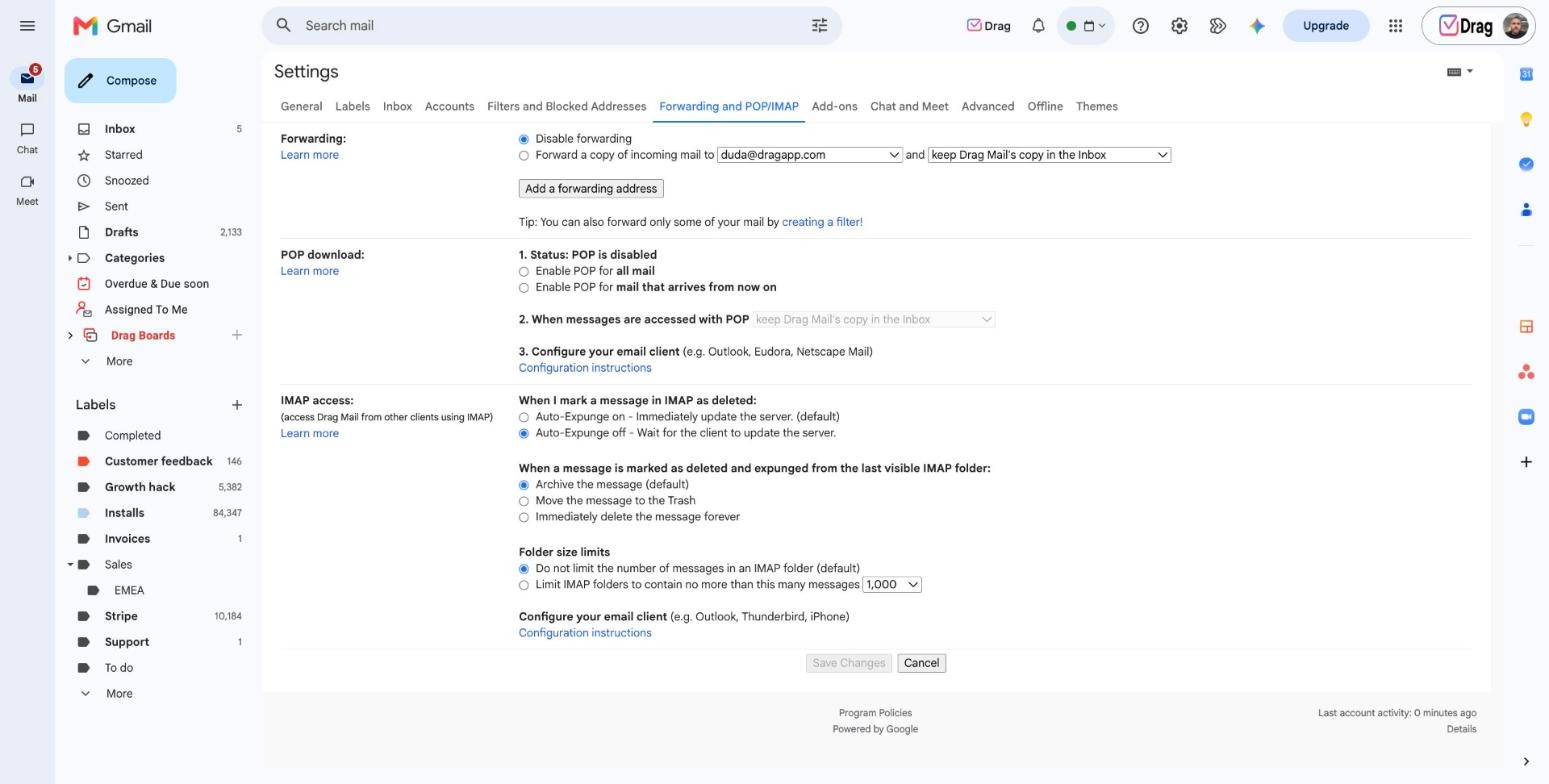
Confirm the forwarding email address
Next, go to your primary inbox and open the confirmation email. Here you can either copy the confirmation code or click the link that is on the email. If you choose to copy the code, paste it into the proper field in the "Forwarding" section of your secondary account. Then click the "Verify" button. If you click the link, you will eliminate some extra steps. A new tab will open, where you need to click "Confirm", no need to come back to the popup window.
Select a forwarding option
Lastly, on your secondary account settings, click the drop-down under "Forward a copy of incoming mail to…" and select the desired option. This option decides what is going to happen with the incoming emails on the secondary Gmail account. After this, all the emails from your secondary account will be forwarded to your primary Gmail account.
Multiple inboxes in Gmail
Besides merging your accounts, you can have multiple inbox options in Gmail. It consists of creating specific places for each kind of email, working more like a folder inside your inbox. Let's see how to set it.
Navigate to your Gmail settings
First, click the gear icon at the top right of your primary Gmail inbox account.
Then scroll down until you find the option "Multiple Inboxes" under the session "Inbox type".
Set the multiple inbox sections
To customize your inbox, click on "Customize" next the "Multiple Inboxes" option. Here, you are going to name your search queries and your sections. Later we will set Gmail labels for these sections to work correctly. The correct format is "is:inbox-name." Remember to type your queries in lower-case, and if there is more than one word in the name, use a dash instead of space.
Create labels
In the left-side menu of your inbox, scroll down and click on the "+" button next to the Labels session ("Create a new label"). You may need to click "More" to see this option. Now you are going to create the labels with the same names as your previously set inboxes. Just type the name and hit "Create." After that, mark the emails you want to separate in each inbox with their respective labels. They are going to look like this:
DragApp: Multiple Gmail business accounts in one inbox
The manual process of setting multiple inboxes that you have just seen works very well. But you can also depend on specific tools to share mailboxes to make your life easier. Drag is a shared inbox extension in Gmail. And it's a way of having multiple Gmail accounts in one inbox, but shared with other people. For example, you have your business email (name@company.com), but you indeed have access to at least one other inbox (team@company.com).
Try Drag's Shared Inbox
If you’re a business using multiple Gmail accounts, try Drag now for a more comprehensive way of collaborating on Gmail accounts. With shared inbox software like Drag, you can have additional inboxes inside your account. It means you don't need to switch accounts or even share login and passwords with your team to access a shared email address. You will be able to collaborate seamlessly with multiple people inside an inbox at the same time, improving the process you have to perform together and eliminating possible obstacles you may be facing lately.
Everybody in the team can know precisely what each one of them is working on at the moment. It prevents duplicated answers, miscommunication, and many other mistakes that often happen in shared mailboxes. Besides that, you can stop using "FWD," "CCs, and "BCCs," which generate infinite email threads. Everybody receives emails in real-time on this collaborative inbox, so you don't need to use any of that. But Drag is not just a shared inbox. There are lots of other features that can help to improve your workflow.
Kanban boards






In Drag, you can share inboxes and visualize them as a Kanban board or in the traditional list or preview views.
Drag is comprised of 'shared workspaces', which can be company email accounts such as support@, a Google Group, or just a blank canvas to share emails and tasks. In the Kanban view, you can rename the columns with stage names that you usually go through while handling emails. Inside these columns, you can create tasks or drag and drop your emails. Also, the emails sent to your team email address will arrive on the board set for it. It's possible to move these cards between the columns, so you know in which stage that specific email or task is at the moment.
Workflow Automation
Automation is a feature that helps people who have to perform the same processes over and over. It consists of presetting rules to automate your workflow according to your necessities, the steps you take to accomplish tasks, answer emails, and so on. Examples of actions that can be automated are:
- Move to (a specific workspace or column/list)
- Assign (to a specific user or in a round-robin manner)
- Change color
- Gmail action (eg. archive, mark as read/unread)
- Apply tag
- Change status
- Send an email template or email sequence
Integration with Google Calendar
When there are tasks, there are also due dates that come with them. In Gmail, you don't have the option of setting due dates inside an email, but with Drag, you can. The best part is that every time you place a due date, an event is created on your Google Calendar, so you can keep track of them whatever you are.
Group Live Chat
Drag also offers a chat inside your inbox so that you can communicate with your team in real-time. Besides, it's possible to mention people inside the chatbox. This way, they will receive an email notification with a direct link to the conversation. With this feature, you can notify specific people to call their attention to something important on an email/card. The chat is particular about the card, so all the information exchanged will be about it. It's not a general chat like Google Chat. Moreover, you can keep the subject in just one place without sharing thoughts about it in third-party communication tools.
Analytics and reports
Drag also allows you to track analytics and generate reports across all of your boards. This way, it's possible to see how you and your team are performing. You can filter your information by the board, user, and date in the three drop-down menus located below the tabs' names across any tab. You can measure and compare changes between the current period and the previous one.
Wrapping up
The process of having multiple Gmail accounts in one inbox is simple, as you can see. It can help people who need to centralize their several accounts in just one place. But remember that this may not be a solution for teams that need to share their inboxes since you would need to share a login with them so everybody can have access to the emails. In that case, choose an excellent shared inbox software that will help to boost your workflow and productivity. Multiple Gmail accounts, one inbox.
Frequently asked questions
Can I see all my Gmail accounts in one inbox?
Yes. Set up forwarding from your other accounts into your main one, then add each as a send-as alias so replies go out from the right address. It is free and takes about ten minutes per account.
How many Gmail accounts can I link together?
Google does not publish a hard cap on send-as aliases for ordinary use, and account switching supports multiple signed-in accounts per browser. The practical limit is maintenance: every linked account is another verification and another set of filters to keep working.
Is there a way to share one of the accounts with my team?
Not through the native routes, which link accounts for one person only. A shared team address needs either a Google Group or a shared inbox tool, which adds assignment, notes, and visibility on top of the same Gmail. That is what Drag, our shared inbox for Gmail, does: it costs $12 to $24 a seat, with AI included from $18 and a free 7-day trial.
Can AI tools like Claude read all my linked accounts?
Not through the native linking: an AI connected to your main account sees that account's inbox, and built-in AI connections hold one Google account at a time. Connecting several accounts to an AI properly is its own decision, covered in our guide to connecting multiple Gmail accounts to Claude.

Co-founder
Building Drag for nearly ten years: shared inboxes, boards, and now the AI and agent layer, all on Gmail, plus HeyHelp for the personal inbox. Writes the honest versions of the comparisons.
