












Master how to use Gmail with this 2026 guide! Explore advanced tips and tricks to optimize your email experience, organize your inbox, and more.
Key takeaways
- Gmail's power is in the layer most people skip: filters, labels, templates, offline, and delegation turn it from an inbox into a system.
- Gemini now lives in the side panel on paid plans, drafting, summarizing, and searching your mail, an assistant for you, not a manager for a team.
- The moment an inbox is shared, Gmail needs a team layer on top: that is shared-inbox territory, and every deep guide here is one click away.
Table of contents
Gmail is one of the most popular webmail services available nowadays, with over 1.5 billion users on Google's last published count. In this complete guide, you are going to learn how to create a new Gmail account, how the inbox works, and have a look at advanced tips. Besides that, you are going to learn how to improve Gmail with third-party services.
The short version: Gmail in 2026 is three products in one: the mail basics everyone knows, a layer of power features most people never turn on, filters, labels, templates, offline, delegation, and Gemini, the AI now built into the side panel that drafts, summarizes, and finds things for you. This guide covers all three layers with links to our deep guides on each, whether you are setting up your first account or squeezing a shared team inbox for everything it has.
What is Gmail
Basically, Gmail is the free web-based email service provided by Google. A little bit of history, Google started developing Gmail in 2001. Later it was announced to the public in 2004 when its beta test version was available to a closed circle of people. It was finally launched to the public in 2007. This long time of development and testing resulted in a great email tool because Gmail is now one of the most used email services in the world. Its popularity is due to many of its features, and its simple interface, which makes learning how to use it easier and quicker.
How to use Gmail?
Gmail has many upsides, which are the main reasons why it is so loved around the world. The main features are storage, layout, integration, personalization, advanced search, Gmail labels and filters. Let's see how each one of them works in Gmail, and how you can benefit from them.
Storage
While its competitors offered 2 to 4 megabytes, Google has increased its storage capacity over time. Now it is 15 gigabytes of initial storage in Gmail. This amount is available for free, and it's enough to save all the most important emails you need for future reference. Just remember that the free 15 GB is shared between Gmail, Google Drive, and Google Photos. You can purchase more space if you want, or if you are part of a company, the better option is to consider one of the Google Workspace plans.
Layout
Gmail was the first webmail service to break with the interface pattern of an inbox, bringing a cleaner visual and organization to its users. One thing Gmail brought is the vision of emails grouped according to the subject line. When you receive a reply to a message, all previous related messages are displayed in a collapsible vertical thread. This facilitates the visualization of the entire conversation and helps you review previous discussions easily. You can also choose between three different views of your inbox: Default, Comfortable, or Compact.
Security and Anti-Spam
Gmail is constantly updating its anti-malware and anti-virus scanners, so you can be as protected as possible. One example of that is that all the file attachments are saved on Google's servers. So if a virus or malware is attached to a message, a warning is displayed, then it quarantines this message. When it comes to spam, Gmail has great filters that prevent potential spam messages from arriving in your main inbox.
Organization features
Receiving many emails per day can make any inbox messy. That's why Gmail offers some resources to help to organize it. Label: It is similar to an email folder. The difference is that you can apply various labels to one single email. Filters: Create filters to order and manage all the incoming emails. These filters apply labels, forward messages, or delete emails automatically, depending on how you set them. Stars: When you put a star on a message it goes to the top of your inbox, at the same time you mark it as a priority to be answered or checked. Tabs: You can use Tabs to separate your emails by category. There are some standard tabs that are already set in your inbox: Primary, Social and Promotions.
Gmail Search Box
Whenever you need to find an email message, you can search for it in the Gmail search box and find it very quickly. This box has the Google Search engine attached, which allows you to get instant results. To do a search, just enter the criteria you need in the search bar and hit enter. You can also make advanced searches by clicking the arrow located in the right corner of the search box. A dialog box will drop down with more search parameters, so you can find your messages based on From, To, Subject, message content, attachments, size, and others. Related: How to Recover Deleted Emails in Gmail
How to create a Gmail account
When you first visit the Gmail homepage, in the middle of the page, and at the upper right, you'll see the blue box Create An Account. Click one of these buttons to start creating your account. On the next page, there is a simple form where you need to enter some information:
- Your first and Last name;
- A valid username, and in case the one you type is not available, some suggestions will appear;
- Your preferred password and confirmation;
Just click Next to confirm this data. The next step consists of entering your cell phone number for security reasons. You are going to receive a verification code by SMS for confirmation. Then you need to enter some additional information to secure your account: a recovery email, your birthday, and your gender. Then on the following screen, you can agree to add your phone number to your account, so you can use it across Google services, such as receiving video calls & messages. You can also skip this part if you are not willing to accept that. The next step is to read and agree with Gmail's Privacy and terms. After agreeing with these terms your account will be created. Related: Create a Gmail Account Without Phone Number
Drag · with Varley
The inbox your team and Varley work in together
Shared inbox and live chat for Gmail teams, with Varley, Drag’s AI, included from $18. Plus an MCP server your own AI tools can drive.
How to set up your Gmail account
After creating your account you need to configure it, so you can start using it to send and receive emails. Just follow these steps:
- Click on next on the Welcome popup;
- Then choose a view: Default, Comfortable or Compact;
You will need to do some additional steps since your account is just 10% configured.
- Choosing a theme: click on this button and choose a theme if you want to personalize your Gmail account layout.
- Learn how to use Gmail: click on it to open the "Help" pop-up, and get rid of your doubts about how Gmail works.
- Get Gmail for Mobile: you can download the official Gmail mobile app by clicking on this option.
- Import Contacts and Mail: if you are migrating from another Gmail account you can import the emails you have on this account. It's also possible to import contacts you had on this previous account.
- Change profile image: It's always good to set a profile picture, so you can be identified easily by your recipients.
After completing all these steps your account will be 100% set up and you are ready to start using it according to your purposes. Related: Gmail Read Receipt
Gmail tips and tricks
Now that you have your account set up and you are also familiar with the basics of Gmail, how about to level up and start learning more advanced tips?
Undo a Sent Email
If you sent an email by mistake, or with spelling errors, or even hit the "Send" button by accident, it's possible to undo this action. Then right after you click the "Send" button, you have 30 seconds to avoid the message getting to the recipient. A small pop-up will appear on the bottom-left of the screen. Just click "Undo" and the email won't be sent. It will appear again on the Compose email window, so you can make the proper alterations before sending it again.
Smart Compose
Gmail has a Smart Compose feature, developed to help save your time while writing an email. It predicts what you are going to write before you do it, working as an autocomplete tool. If you need to write your emails faster, this is a great feature. The Smart Compose is powered by machine learning, so the more you write, the better. This also means that its personalized suggestions are adjusted to the way you usually write, to maintain your writing style. When the prediction matches what you want to complete, just press the right-arrow button. This feature can surprise you with its precision, but in case it's not what you want to complete, it's easy to simply ignore the suggestions. To turn the Smart Compose on or off follow these steps:
-
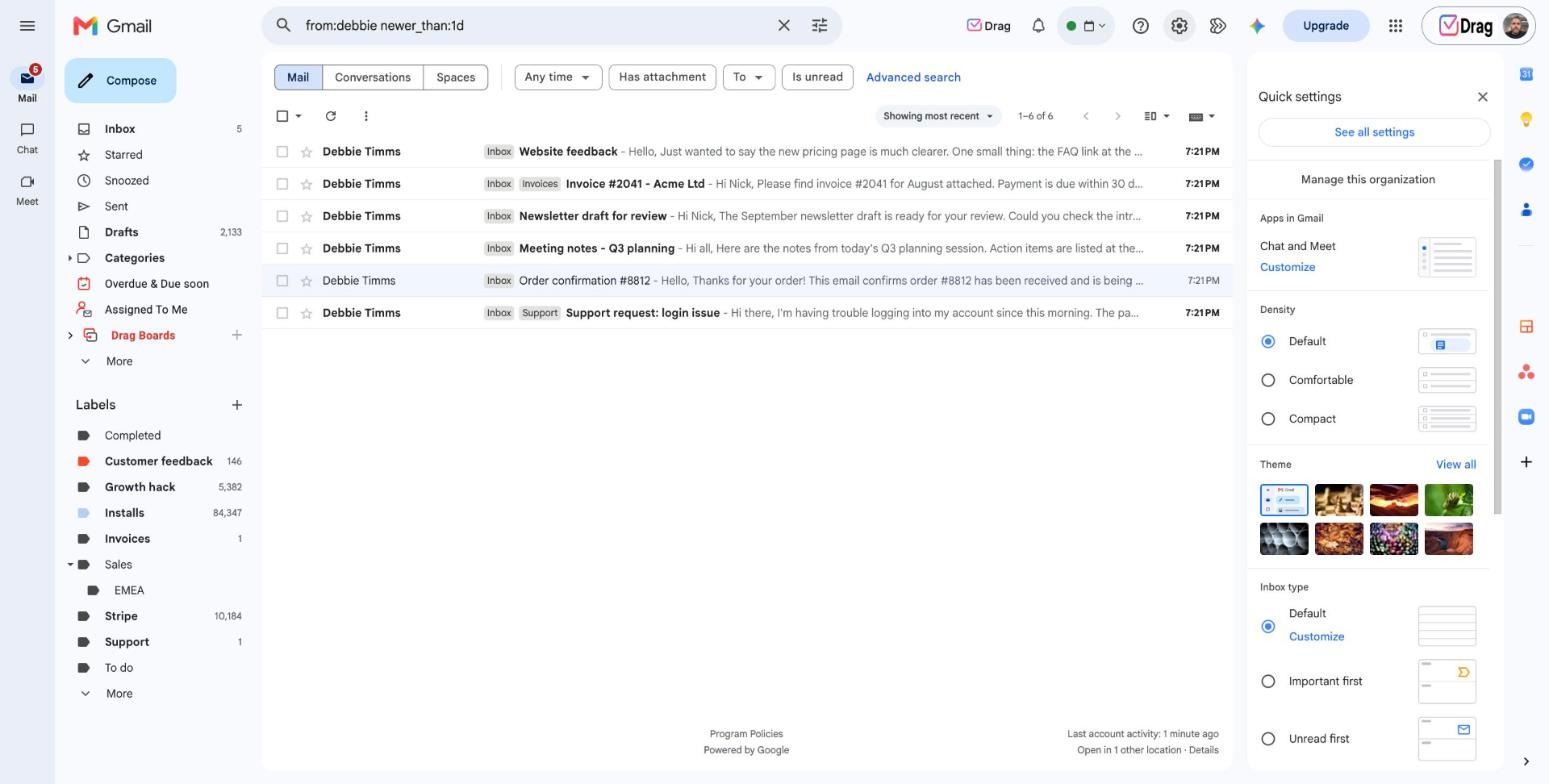
In the top right of Gmail, click the gear icon that represents the settings menu, and choose the option "Settings".
-
On the tab General, scroll down to "Smart Compose."
-
Select Writing suggestions on or Writing suggestions off.
Right above the option to turn on or off this feature, you can also choose if you want it personalized to your writing style.
Gmail's offline access
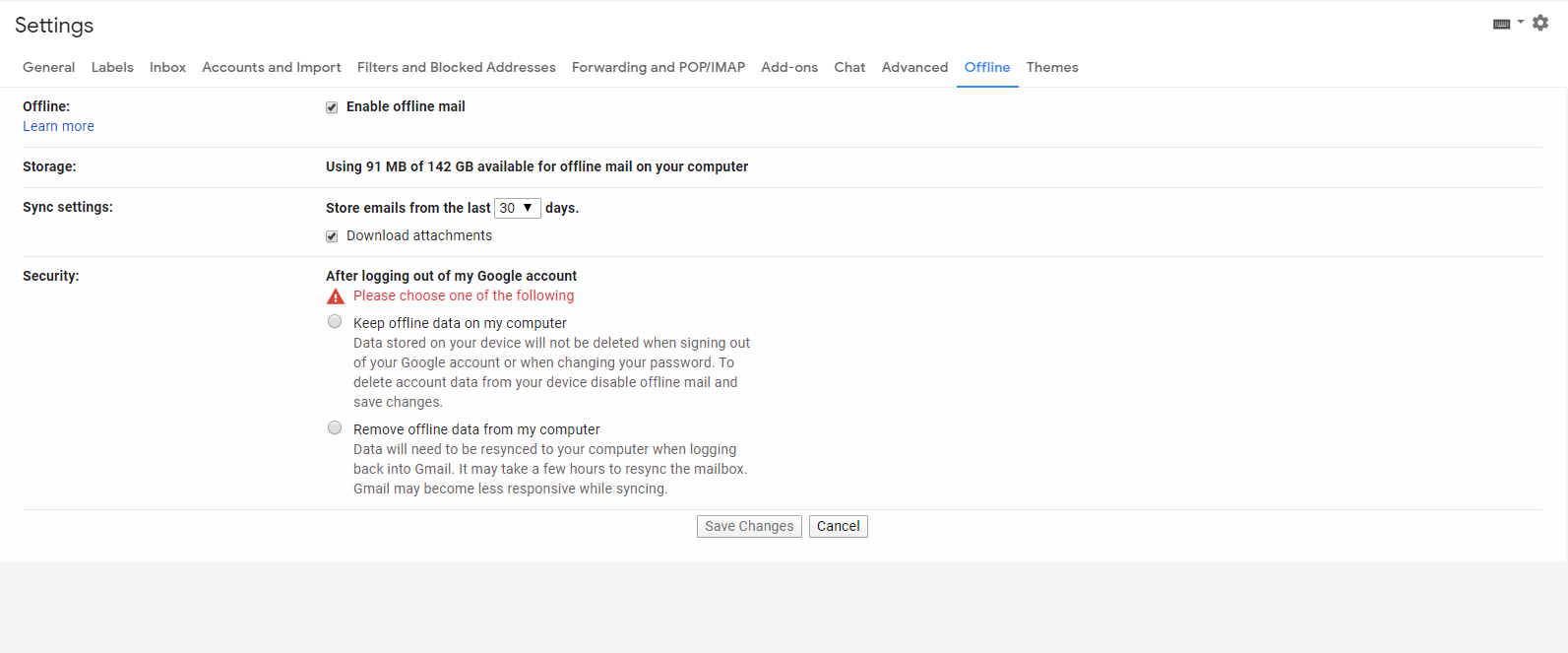 Sometimes we struggle with the internet connection while we are working on important tasks. Gmail offers a feature that allows us to still use Gmail with limited or no connection. To set the feature click on the gear symbol on the upper right corner of the page, and choose the option "Settings". Then go to the tab "Offline" and mark the box "Enable offline mail". New configurations will appear and you will be able to choose if you want to store emails from the last 7, 30 or 90 days.
Templates
If you send a lot of emails with repetitive answers, Gmail Templates will help to improve your productivity. Instead of typing the same things over and over, you can set up some pre-written emails. To set these templates, follow these steps:
-
Click on the Gear icon, then choose "Settings".
-
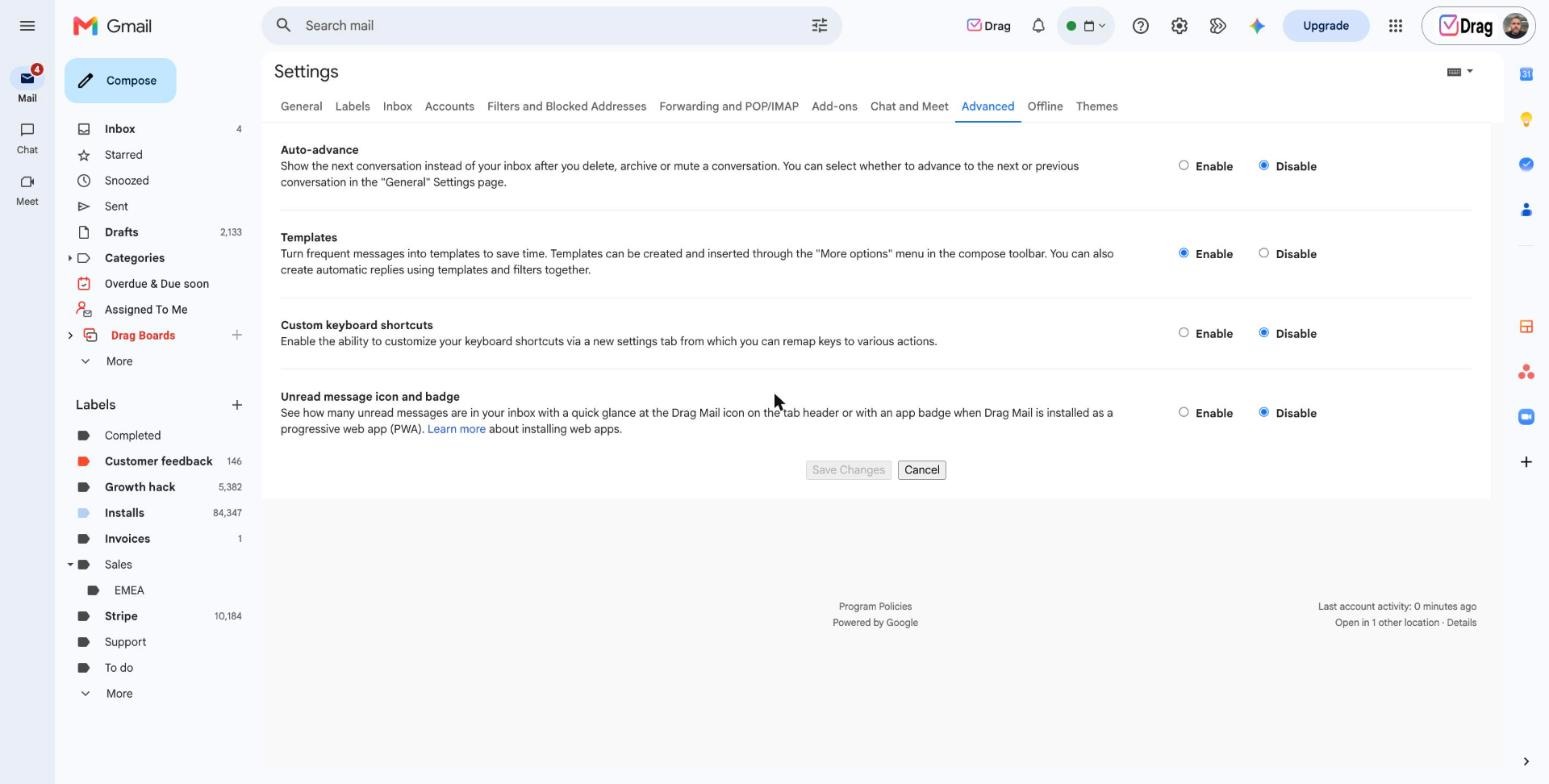
Click the tab "Advanced".
-
Mark the box 'Enable' on the "Templates" section, then hit "Save Changes".
-
After that, click "Compose on the upper left corner of the screen, and start typing the message you want to save as a template.
-
Click the three dots icon located at the bottom of the compose pop-up. Choose the option 'Templates", then click on "Save draft as template" > "Save as new template".
-
Give a name to your template.
After creating your new template, you can use it either for replies or for composing new emails. Just remember to follow these steps:
-
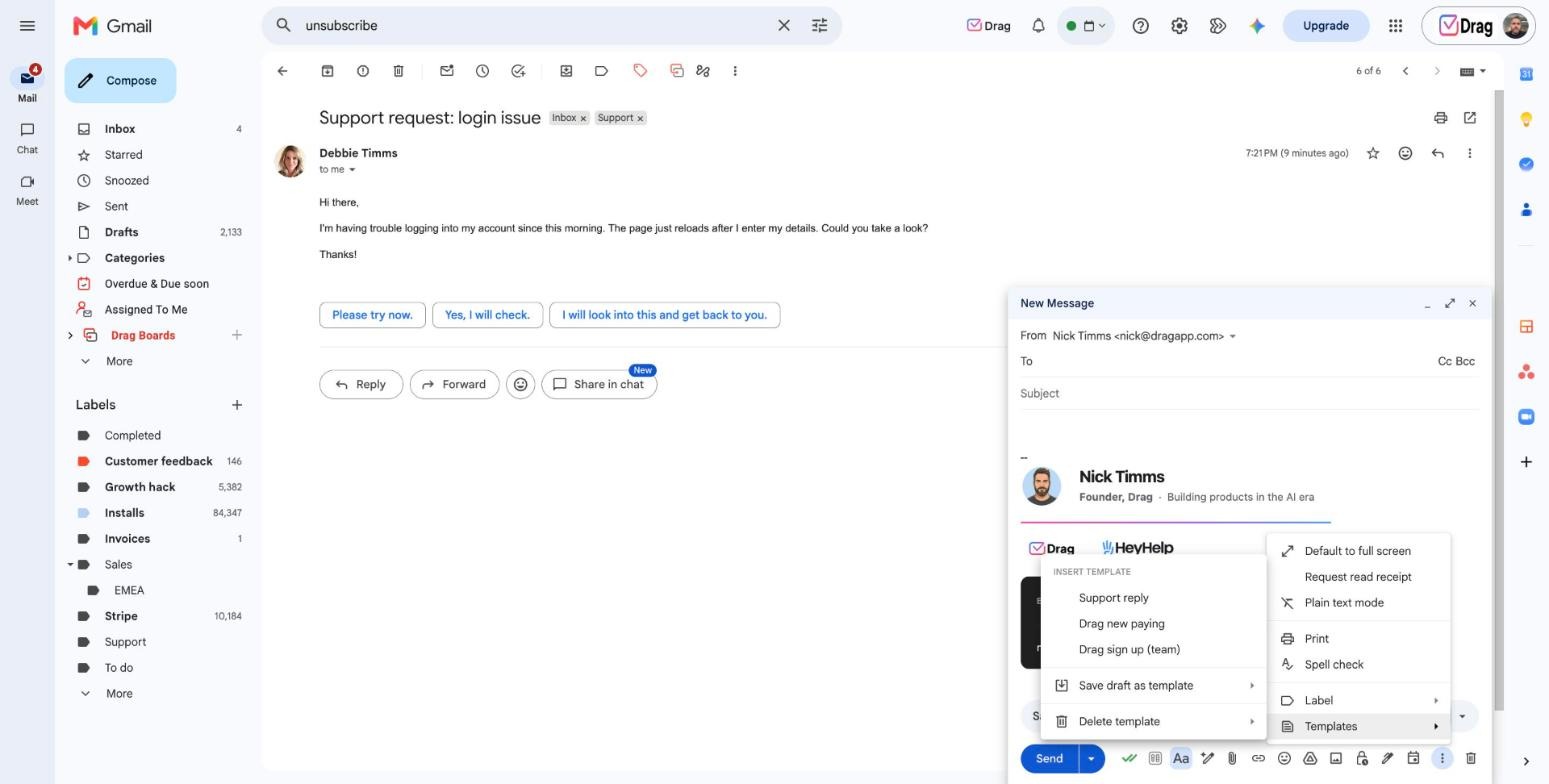
Click the three dots icon on the right-bottom of the compose window
-
With the mouse over 'Templates, click on the template you want to use.
-
Your template will be pasted on the composition box, and you can make the required adjustments before sending it.
Gmail Add-ons
Each person, or team, has its processes while working inside an inbox. That is the main reason why Google allows you to personalize the experience inside Gmail using Add-ons. To see the available ones, on the vertical bar on the right side of the screen, click on "Get add-ons" represented by the "+" symbol. A Google Workspace Marketplace popup will open with a search bar and the featured add-ons that work with Gmail. Choose those that will facilitate your life dealing with emails, and that will make sense with the type of business you have.
Mailtrack
With this add-on, you can know when the emails you send are opened. This is a great feature to track the performance of your emails, and also to know the next steps you should take with a client, for example. Some of its features include:
- Real-time notifications
- Full tracking history
- Reminders
- Link Tracking
- Daily email report
It was developed mainly for sales, account managers, business development, and people who deal directly with clients. Also for teams, coordinators and internal communications.
GMass: Mail merge
If your company needs to send mass email marketing, this is an add-on you should have installed. It also offers a mail merge system for Gmail.
- You can send email marketing campaigns to thousands of email addresses.
- Mail merge with data from Google Sheets.
Useful Keyboard Shortcuts
Keyboard shortcuts are ideal to facilitate your daily activities on the internet. It wouldn't be different when it comes to Gmail. Spending more time writing than searching for tools enhances your productivity. That's why we separated some shortcuts that will be useful to you. But first, you need to enable them, by clicking the gear symbol, and going to "Settings". On the tab General look for Keyboard Shortcuts and mark "Keyboard shortcuts on". Here are some of the main ones you can start using right now:
| Action | Shortcut |
|---|---|
| Archive | e |
| Mark as spam | ! |
| Delete | # |
| Reply | r |
| Reply in a new window | Shift + r |
| Forward | f |
| Forward in a new window | Shift + f |
| Undo last action | z |
| Mark as read | Shift + i |
| Mark as unread | Shift + u |
| Go to Inbox | g + i |
| Go to Sent messages | g + t |
| Compose | c |
| Search mail | / |
Moreover, it's possible to create your own custom keyboard shortcuts, too. To customize them go to the tab "Advanced" inside Gmail settings, and enable "Custom keyboard shortcuts". A new tab called "Keyboard shortcuts" will appear on Gmail settings. Click on it to start customizing them.
 Gemini in Gmail: the AI layer
Gmail now ships with Gemini in the side panel on paid Google plans: it drafts replies in your tone, summarizes long threads into bullets, answers questions across your mailbox ("what did the landlord say about the deposit?"), and helps write from scratch with Help me write. Two honest notes. First, availability tracks your plan, most Workspace tiers and Google's consumer AI plans include it, free Gmail gets glimpses. Second, it is an assistant for your own mail: it will not manage a team's shared queue, assign conversations, or track who answered what, for that layer, AI needs to live in a shared inbox tool, which is where this guide's team section points.
If you want to go deeper on AI in Gmail, our guides to the best Gmail AI assistants, AI email management, AI extensions for Gmail, and ChatGPT prompts for email cover the whole toolbox.
Powering up your Gmail with Drag
Drag is a unique Gmail shared inbox. This means you and your team can collaborate inside a shared mailbox, to improve the process you have to perform together, and also eliminate possible obstacles you may be facing lately. A shared inbox allows a team to share an email address without the need for everybody to use the same password. Each person works from their own accounts, which is more secure and viable. With Drag's shared inbox everybody in the team knows exactly what each one of them is working on at the moment. Because of that, it prevents duplicated answers, miscommunication and many other errors that can frequently occur at work. Besides that, with a shared inbox you can stop using FWD, CCs, and BCCs, that generate infinite email threads. Everybody receives the emails in real-time on this collaborative inbox, so you don't need to use any of that. But Drag is not just a shared inbox, it also offers a bunch of features that can help to improve your workflow.
Kanban boards




In Drag, you can have the Kanban View, which turns your inbox just like Trello. At Drag, there are boards, and inside each board, you can create columns. Rename the columns with stage names that you usually go through while handling emails. By default, you have three columns named To Do, Doing and Done, which are the simplest stages for task or email management. Then inside of these columns, you can create cards containing tasks. Or you can turn your emails into tasks inside a shared inbox. When you create a collaborative inbox with your team, all the emails sent to your team email address will arrive on this board as cards. Easily drag and drop these cards between columns to keep track of your progress, and let your teammates know in what emails you are working on. For instance, if you work with projects, customer support or sales pipeline, you can automatically turn emails into tasks, opportunities or tickets, and rely on Drag to help you manage your work through different stages.
Integration with Google Calendar
It's common to have deadlines for certain tasks while working on a team. On native Gmail, you don't have the option of setting due dates inside an email. But with Drag every time you set a date and time to a task or email it's automatically added to your Google Calendar.
Workflow Automation
If you have a lot of repeatable tasks in your daily work, this new feature will take care of them in the best way possible. It's something that will help you improve your processes even more: automation. You can preset rules to automate your whole workflow, according to all your necessities, steps you take to accomplish tasks, answer emails and so on. Since each board and workflow is different it's possible to create several different automations for each one of them. At the same time, these automation are cross-boards, which means actions in one board can influence another board if you want to. You can customize three factors in automation: board, conditions, and actions. Besides that you can choose from 5 actions:
- Move to (someone)
- Assign to (someone)
- Change color
- Gmail action
- Apply tag
Email Delegation
With Drag you can easily delegate emails and tasks to other team members or your assistant, for instance. This tool is useful when you need to share some emails with someone, and not your whole inbox. To do that is simple:
- You need to create a custom Shared Board with the person you want to share the emails/tasks with.
- Then you populate this board with the emails and/or tasks you need to share.
Besides that, you have two other possibilities while delegating with Drag: Sharing emails cross-domains: This means you can share boards between both your company domain and @gmail.com domains. Changing sender alias. In case you are not the person replying to the email, the person that you delegated this task to is able to select if they are going to send the email from your address or their personal address. Related: Use Gmail for Business Email
Group Live Chat
Drag also offers a chat inside your inbox, so you can communicate seamlessly with your team. In addition, it's possible to mention people inside the chatbox, so they will receive an email notification with a direct link to the conversation. They will be sent to the specific card you started the chat. These are some advantages of using Drag's live chat:
- You can notify specific people to call their attention to a specific thing on an email/card, or just simply assign a certain task to them.
- The chat will be about the card, so all the information exchanged will be about that specific matter. This means no more suffering to find a piece of information inside a unique chatbox or on an email thread.
- You don't need to use a third-party tool, such as Slack or Skype, to share thoughts, or solve problems about a specific case with your teammates.
Gmail Guide FAQs
How do I stop Gmail from running out of storage?
- Gmail’s Storage Limits: Gmail shares 15 GB of storage with Google Drive and Photos, often leading to unexpected space shortages, especially due to large attachments or inactive accounts.
- Managing Large Attachments: Use
has:attachment larger:20MBin Gmail’s search bar to find and delete space-consuming emails. Also, empty Trash and Spam, as deleted emails still count toward storage. - Using Google Drive for Storage: Transfer large files to Google Drive and clean up redundant backups using Google One’s "Clean Up Suggested Items".
- Avoiding Account Deletion: Google deletes inactive accounts after 24 months, including emails, Drive files, and Photos. To prevent data loss, sign in periodically or enable Google Takeout for backups.
- Upgrading for More Space: If storage remains an issue, consider Google One’s 100 GB plan ($24/year) or Google Workspace’s enterprise-tier storage (starting at 5 TB/user).
Is Gmail free to use?
Yes, personal Gmail is free with 15 GB of storage shared across Google services. Businesses use the paid version through Google Workspace, which adds a custom domain, admin controls, more storage, and the deeper Gemini features, plans start around $7 per user per month.
What is the difference between Gmail and Google Workspace?
Gmail is the mail product; Google Workspace is the paid business suite wrapped around it, your own domain (you@yourcompany.com), shared drives, admin and security controls, and team features. The Gmail interface is nearly identical in both; the difference is ownership, control, and the tools around the inbox.
Does Gmail have AI built in?
Yes, Gemini lives in Gmail's side panel on paid Google plans: it drafts replies, summarizes threads, and answers questions about your mail. It assists one person's inbox; it does not manage a team's shared queue, which is where dedicated tools take over.
Can a team share one Gmail inbox?
Natively only through workarounds, password sharing (risky) or delegation (limited). The real answer is a shared inbox tool on top of Gmail: addresses like support@ become boards with assignment, statuses, and AI, in the interface everyone already knows. Our shared inbox guide covers the options.
Summarizing
We hope that this complete guide on how to use Gmail has helped you to see that your user experience on it can be a lot better. One of the best email services in the world deserves to be used at its full potential. So now, how about trying new add-ons to improve your experience, or trying a shared inbox like Drag to enhance the collaboration between your team?
Enhance your experience in Gmail today.


Gmail is the platform; what your team builds on it is the multiplier. When one inbox needs many hands, Drag turns Gmail into shared boards with assignment, notes, and AI, without anyone leaving the interface they know. The 7-day trial needs no card.

Co-founder
Building Drag for nearly ten years: shared inboxes, boards, and now the AI and agent layer, all on Gmail, plus HeyHelp for the personal inbox. Writes the honest versions of the comparisons.
