













Move emails to folders in Gmail automatically: the exact filter steps, five ready-made recipes, and what teams should use instead.
Table of contents
To move emails to folders in Gmail automatically, you create a filter: tell Gmail what to match (a sender, a subject, a keyword) and what to do with it (apply a label, archive, star). Gmail does not use folders in the classic sense; labels play that role, and a filter is the rule that files messages under them on arrival. Set up well, this is one of the highest-return five minutes you can spend in your inbox: the McKinsey Global Institute found that around 28% of the average workweek goes to reading and answering email.
The short version:
- Open Gmail and click the search options icon on the right side of the search bar.
- Enter your criteria: a sender address, subject line, or keywords.
- Click "Create filter" at the bottom of the search panel.
- Choose the action: "Apply the label" is the move-to-folder step, and you can add archive ("Skip the Inbox"), mark as read, or star.
- Tick "Also apply filter to matching conversations" to file the emails you already have, then click "Create filter".
Every future email that matches the rule now files itself. The rest of this guide covers each step with screenshots, five ready-made filter recipes, and what to use instead when a whole team works from the same inbox.
The advantages of Gmail auto move to folder
The Gmail auto move to folders function, also known as "Filters," is a feature in Gmail that allows you to move emails automatically, by sorting and categorizing them based on various criteria. To set up a filter, you can specify certain criteria such as the sender's email address, keywords in the subject, terms included in the body of the email, attachment file types, etc. Then, you also specify what action you want Gmail to take when an email fits the criteria, such as moving emails automatically to a specific folder, marking them as read, flagging as important or applying a label to it. Once you set up filters, Gmail auto move to folders will sort all incoming emails, allowing you to stay organized and prioritize your emails more efficiently. Here are the top advantages of knowing how to move emails automatically:
Enhanced efficiency
The Gmail auto move to folder function enhances efficiency by automating the process of organizing emails. It reduces the effort required to manually sort through messages and move them to different folders. By using filters to automatically move emails to specific folders, it prioritizes important emails, and eliminates the need for manual searching
Time-saving
A well-labeled inbox can save employees time. First, it allows them to quickly identify important emails that require their immediate attention. Second, when emails are sorted and categorized, it becomes easier to search and refer back to them when needed. The Gmail auto move to folder feature helps people avoid spending too much time on it. In turn, they can better manage their time at work.
Custom inbox system
An organized inbox can be customized to each company's needs and reflect their workflow. You are able to:
Create labels and filters based on the company's workflow
Companies have different workspaces and systems. You can create filters that reflect this need. For example, a company that works with customer support on a daily basis might have folders that reflect these issues.
Use colors to make the system appealing
Color-coded labels can be used to visually differ between types of emails or to indicate their status. 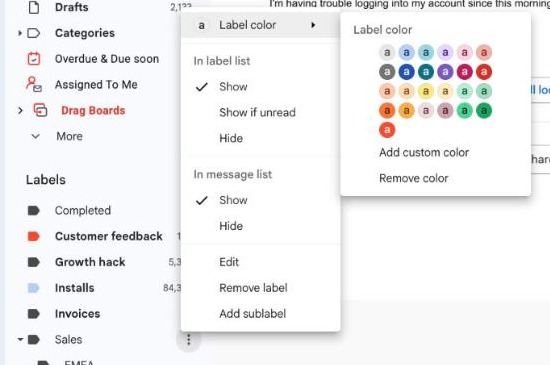 You can move emails automatically and tag them according to which department is responsible.
Assign multiple labels to an email
The biggest advantage Gmail has by using labels instead of traditional folders is that emails can be assigned multiple Gmail labels. For instance, for an email that is both urgent and related to customer support, you can set Gmail auto move to folder and label them as such.
Foster collaboration and consistency
Companies can define a Gmail auto move to folder system to ensure that everyone is using the same labels and filters. This can make it easier to find emails across different team members and departments. In turn, it increases collaboration in projects and enhances productivity. By customizing the Gmail labeling system, a company can create an organized Gmail inbox, move emails automatically as needed and reflect its own needs and workflows.
Focus and productivity
Having a focused and productive team is key to good performance. But how does email affect this scenario? By setting up systems that avoid clutter, teams can have distraction-free time to work on their projects. Then, they avoid getting stuck in email searches, which, in turn, makes tasks faster to complete. On the other hand, when a team member needs help from someone else, they will have a quick response, since that person isn't stuck sorting their messages.
How to move emails automatically
The Gmail auto move to folder feature is called a filter. If a user or team creates filters in their inbox, then the system will move emails automatically according to the rules. This can mean creating a Gmail label. That way, all related messages can be accessed from the same tag, functioning as a folder. To filter emails automatically on Gmail, follow these steps:
- Open Gmail and go to the search bar at the top.
- Enter the search criteria for the emails you want to filter. For example, you can search for emails from a sender’s address, with a specific subject line, with related keywords or file types.
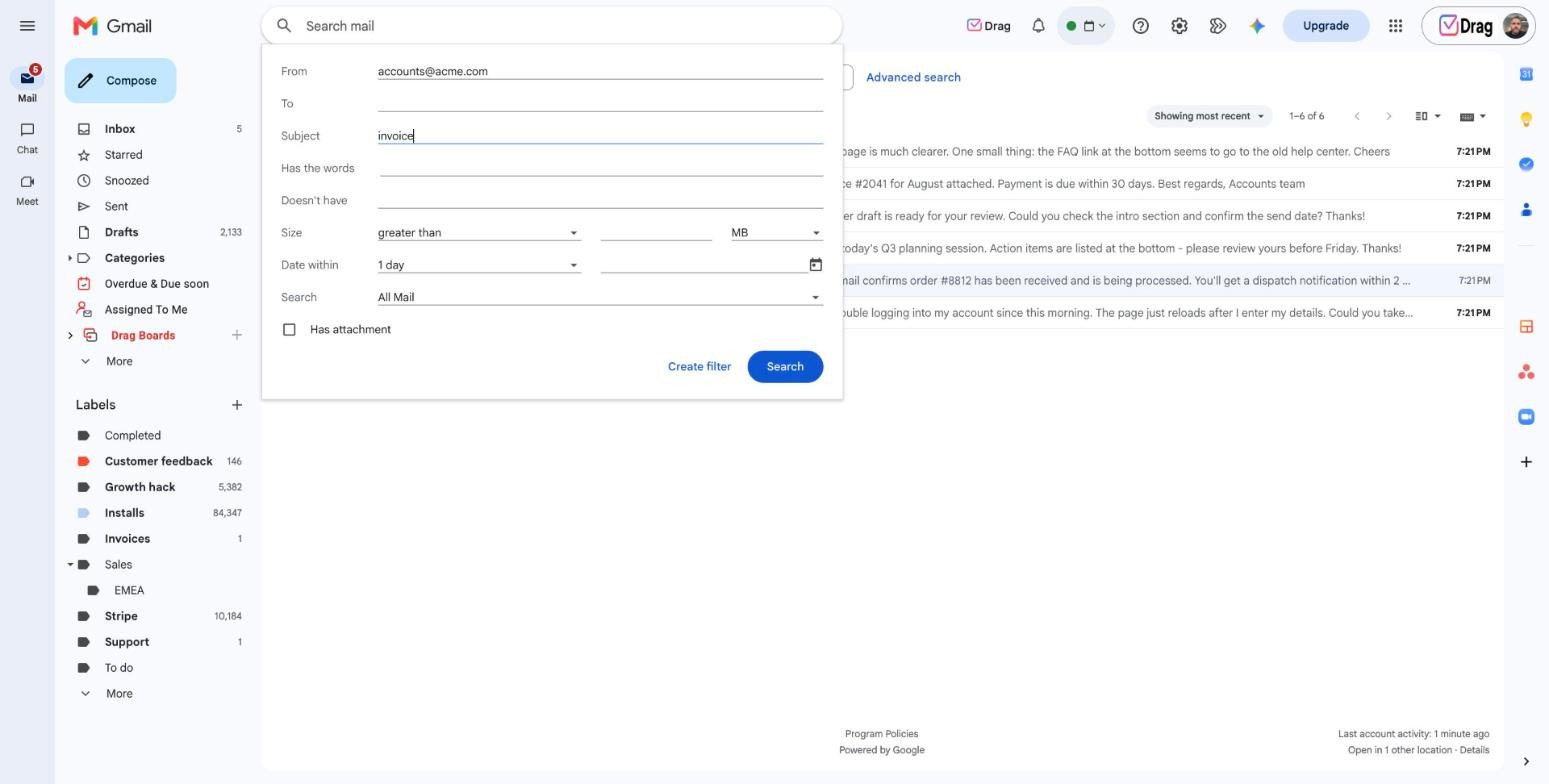
- Then, when you have entered your search criteria, click on the "Create filter" button at the bottom right.
- In the "Create filter" window, select what you want Gmail to do. That is, using the Gmail auto move to folder feature. You can apply a label to move emails automatically. Additionally, you can mark as read, archive, delete or mark as important.
- Then, click on the "Create filter" button to save the filter.
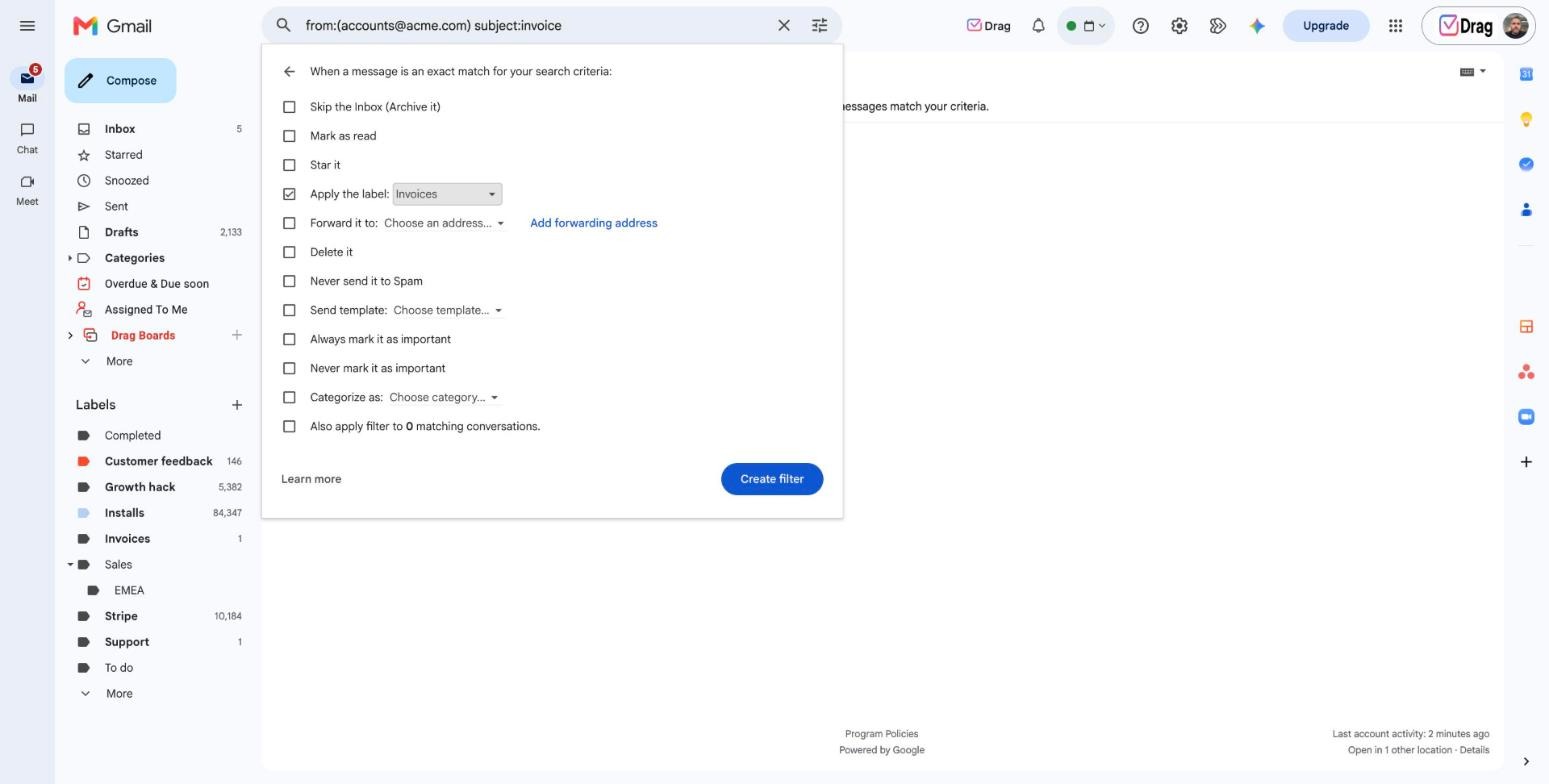
- From now on, any new emails that match the filter criteria will be sorted by the Gmail auto move to folder system you set up. Pro tip: you can create multiple filters to automatically sort different types of emails.
- Find the folders at the left menu on your inbox. There, you will see all sorted messages in the same folder.
Five ready-made filter recipes
The fastest way to start is to copy a working recipe. These five cover the most common cases; paste the criteria into Gmail's search options panel and pick the action:
| Goal | Filter criteria | Filter action |
|---|---|---|
| File invoices automatically | Subject: invoice OR receipt | Apply label "Finance", Skip the Inbox |
| Calm the newsletter noise | Has the words: unsubscribe | Apply label "Newsletters", Skip the Inbox, Mark as read |
| Never miss your manager | From: your manager's address | Apply label "Priority", Star it, Always mark as important |
| Route client mail by domain | From: @clientdomain.com | Apply label "Clients/AcmeCo" |
| Collect attachments for review | Has attachment, larger than 5MB | Apply label "To file", Never send to Spam |
Two habits make recipes hold up over time. First, prefer stable criteria (sender domains, structural words like "invoice") over one-off subject lines that change with every email. Second, review your filter list quarterly under Settings, then "Filters and Blocked Addresses": dead filters pile up silently, and two contradictory rules can bounce a message somewhere you will never look.
Alternatives to moving emails to Gmail folders
Many teams using Gmail opt for using a Gmail shared inbox to work on. Instead of traditional inboxes with shared login information, a shared inbox allows multiple people to access and use it at the same time. By using a shared inbox such as DragApp, team members can work together in responding to emails, assign emails to individual members and monitor the progress of conversations in real-time. As a result, this enhances communication and coordination among team members, leading to greater productivity and faster response times. Shared inboxes are frequently used in customer support, sales, HR and finance teams, where there is a need for several team members to manage incoming emails and ensure they are addressed promptly.
Kanban boards in Gmail
An alternative to using Gmail folders is turning Gmail inboxes into Kanban boards. This is another feature offered by DragApp. Kanban boards typically consist of columns that represent steps of a project or workflow, such as: "to-do," "in progress," and "done." This way, you can organize emails across stages and still be able to visualize them all at the same time, which is not possible across Gmail folders.




This makes it easier for team members to understand the current status of a project and find the next steps. Additionally, Kanban boards promote transparency by making the progress visible to everyone on the team. This helps to avoid confusion and promote accountability. By using a Kanban board, teams can identify areas where work is getting stuck, making it easier to optimize workflows and increase efficiency. In addition, Kanban boards help teams prioritize work by providing a clear overview of their to-do lists.
Drag workspaces
If you prefer to organize emails into folders but need these folders to be shared, Drag workspaces may be the solution for you. Drag workspaces look just like folders in your Gmail, but offer much more than just organizing emails.


1. They can be viewed in different layouts
As mentioned above, Drag workspaces can be viewed in a Kanban board layout. However, they can also be viewed in the traditional list or preview views.
2. They can be shared with different users
Each Drag workspace can be shared with different teams. This allows companies to organize emails across departments while maintaining privacy and data security. For example, by having a Customer Support workspace shared with the Support team, and another IT Support workspace shared with the technical team, that will only have access to the support emails that were escalated to their team.
3. They can support emails and tasks
Another advantage of using Drag workspaces is that you can manage not only emails, but also tasks. Tasks and emails can be treated the same way, managed side by side.
4. They can be a shared inbox
Many teams using Gmail opt for using a Gmail shared inbox to work on. Instead of traditional inboxes with shared login information, a shared inbox allows multiple people to access and use it at the same time. By using Drag workspaces, you can connect an inbox such as support@ and have those emails loading in real-time. Team members have then the ability to work together in responding to emails, assign emails to individual members and monitor the progress of conversations in real-time.
Drag · with Varley
The inbox your team and Varley work in together
Shared inbox and live chat for Gmail teams, with Varley, Drag’s AI, included from $18. Plus an MCP server your own AI tools can drive.
How to move emails automatically in a shared inbox
Creating an automation rule means using the rules of Gmail auto move to folder, but instead of labels, it turns the messages into cards. Here's how to do it:
- Access your shared inbox and click on the Drag icon on the top right
- Select "Automations" on the left menu
- At this menu, you can name your automation and set up its rules
- For instance, if you regularly receive messages with the subject line "Invoice" and need to add them to the "Suppliers" board, you can select "Subject" and "Contains", adding the keywords on the text box.
- Now, the next step is choosing what to do with these incoming messages. Use the "Then" field to choose the action. You can add multiple actions, such as applying labels, moving to a specific board and column, tagging another user, etc.
Once you set up the filter, each incoming message on your shared inbox that meets the rules will be sorted accordingly.
Frequently asked questions
Does Gmail have folders?
Not in the classic sense. Gmail uses labels, which appear in the left sidebar and behave like folders, with one advantage: a single email can carry several labels at once, so the same message can live in "Clients" and "Invoices" without being duplicated.
How do I automatically move emails to a folder in Gmail?
Create a filter: click the search options icon in the Gmail search bar, enter your criteria, click "Create filter", then choose "Apply the label" and pick or create the label you want. Add "Skip the Inbox" if you want matching emails to bypass the inbox entirely.
Can I apply a new filter to emails I already received?
Yes. When you create the filter, tick "Also apply filter to matching conversations" and Gmail will file every existing email that matches, not just future ones.
Why is my Gmail filter not working?
The usual causes are criteria that are too narrow (an exact subject line that varies), a conflicting filter running first, or the message arriving via a forwarding rule that changes the sender. Check Settings, then "Filters and Blocked Addresses", and test by running your criteria as a plain search: if the search does not find the email, the filter cannot either.
How do teams move shared emails automatically?
Gmail filters only work inside one person's mailbox. For a shared address like support@ or invoices@, a shared inbox tool such as Drag applies automation rules at team level: incoming emails can be routed to a board, assigned to a person, and labelled automatically, so the sorting happens once for everyone rather than in each individual inbox. Drag costs $12 to $24 a seat, with AI included from $18.

Co-founder
Co-founder at Drag, writing about Google Workspace, shared inboxes, and how teams actually run email.
