













Most deals start and end as email. How to run a working CRM inside Gmail with a shared inbox: stages, ownership, automation, AI, and when you need more.
Key takeaways
- Most deals start and end as email, which is why a shared inbox with pipeline stages can be a working CRM for email-first teams: the record lives where the conversation already is, so nothing needs logging.
- The setup is five steps: connect the sales address, turn stages into columns, give every deal one owner, automate the repetitive motion, and put reporting and AI on top.
- The honest boundary: this replaces a lightweight CRM for email-centric sales, not an enterprise CRM: the moment you need forecasting across hundreds of deals, territory management, or deep marketing automation, buy the real thing.
- Everything below works in the Gmail you already have; the tools involved are verified and dated.
Table of contents
The classic CRM failure is not the software, it is the logging: the deal happens in email, the record lives somewhere else, and the gap between them is where pipelines rot. For email-first teams there is a simpler architecture: make the inbox the record. A shared inbox with pipeline stages gives you the CRM essentials, one place per deal, one owner, visible stages, follow-up that fires on time, without the copy-paste tax that kills CRM adoption. This guide is the honest how-to: the five-step setup, what it genuinely replaces, and the point at which it stops being enough.
When Gmail is the CRM (and when it is not)
The shared-inbox-as-CRM works when three things are true: your deals arrive and progress by email, your pipeline fits on a board a human can read (dozens of live deals per rep, not hundreds), and your team already lives in Gmail. It is the natural fit for agencies, services firms, B2B teams with considered sales, and any founder-led sales motion. It is the wrong fit when you need multi-touch attribution, forecasting across large volumes, or territory logic, and the last section covers that boundary honestly.
Shared-inbox CRM vs traditional CRM, side by side
| What you are comparing | Shared-inbox CRM | Traditional CRM |
|---|---|---|
| Where the deal lives | In the email thread itself | In a database you copy the thread into |
| Data entry | None: the email is the record | The part reps skip, which is why pipelines rot |
| Adoption | The team already lives in Gmail | The second tool that needs enforcing |
| Pipeline view | Board columns over real threads | Dashboards over typed-in records |
| Follow-up | Reminders and sequences on the thread | Tasks that reference the thread |
| Reporting | Response times, stage counts, workload | Deeper: forecasting, attribution, territories |
| Cost | From $12 a seat, AI included from $18 | $15 to $150+ a seat, AI usually extra |
| Breaks down when | Hundreds of concurrent deals, multi-channel attribution | Reps stop logging, which is usually month two |
The honest summary of the table: the traditional CRM is more powerful on paper and weaker in practice for email-first teams, because its power depends on the logging discipline that email-first sales never sustains.
The five-step setup
Step 1: Connect the sales address as a shared inbox
Your sales@ or hello@ becomes a board the whole team can see: in Drag that is creating a board, choosing Shared Inbox, and authenticating the address, and the same shape exists in other shared-inbox tools. The point of the step: every deal conversation now lands in one visible place instead of one person's inbox, which is the difference between a pipeline and a rumor.
Step 2: Turn your stages into columns
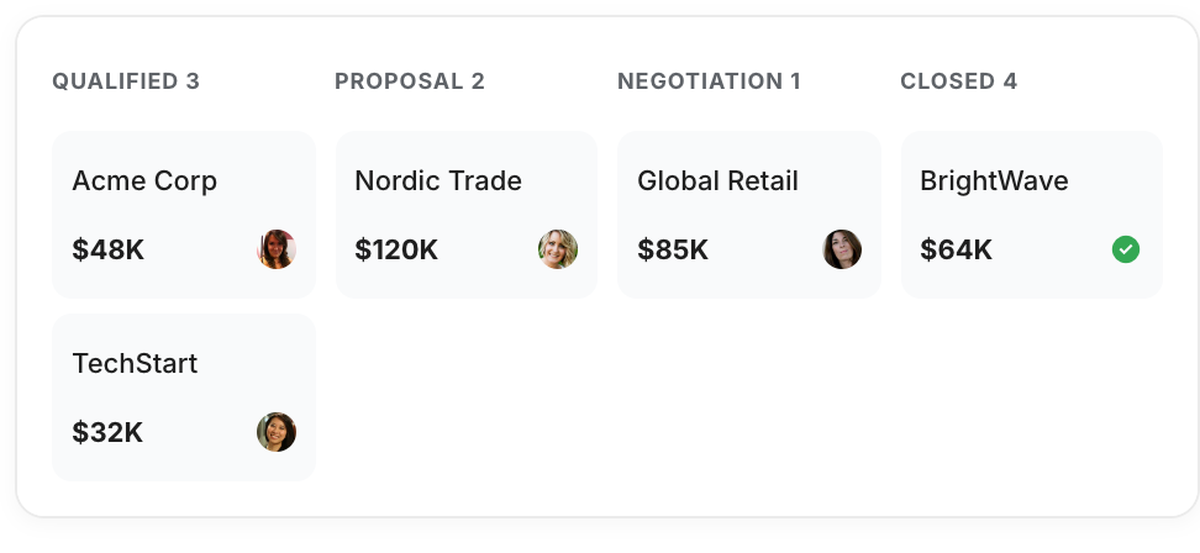
New, Qualified, Proposal, Negotiation, Won: whatever your real stages are, they become columns, and a deal moves by dragging its email thread. Tags and color-coding add the second axis a pipeline needs, deal size, product line, or source, without more columns. The discipline this enforces is the CRM discipline that matters: at any moment, every deal is visibly somewhere, and a stalled column is a stalled pipeline you can see from across the room.
Step 3: Give every deal exactly one owner
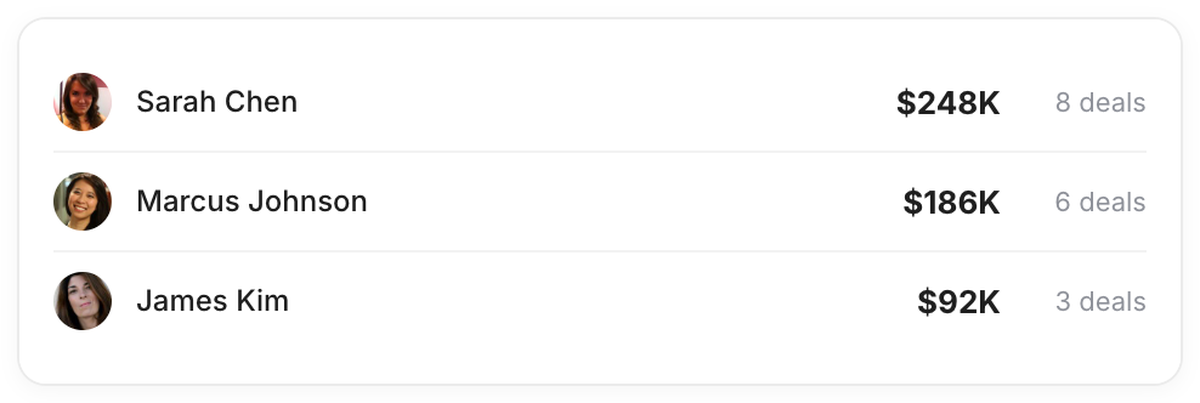
Assignment is the difference between a shared inbox and a shared excuse. Every incoming deal gets an owner (manually, or auto-assigned by keyword, sender, or round robin), collision detection stops two reps answering the same prospect with two prices, and the ownership is visible, which is what makes follow-up someone's job instead of everyone's intention. And @mentions bring a teammate into the thread with full context, which replaces the forward-and-CC dance that leaks deals.
Step 4: Automate the repetitive motion
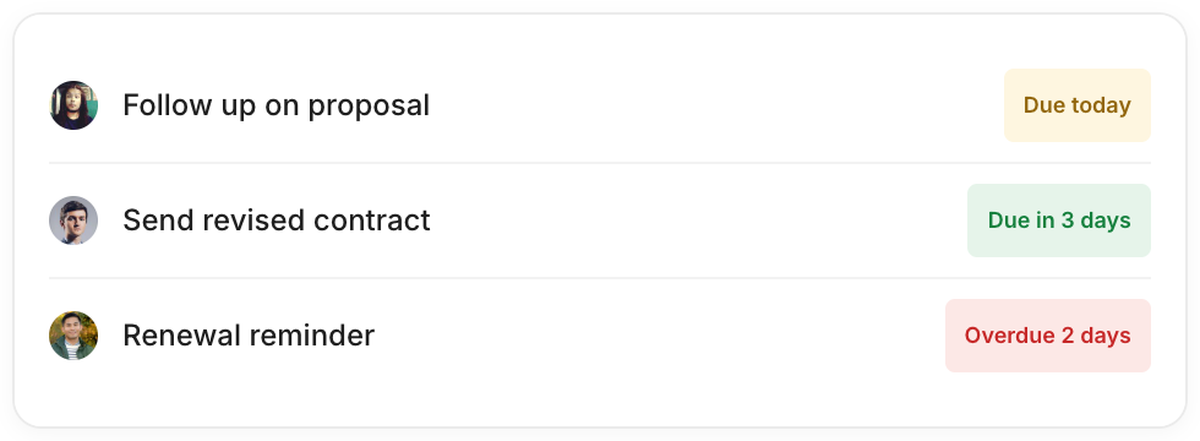
Templates for the emails you send ten times a week; sequences for the follow-up cadence nobody sustains manually; rules for the routing ("demo booked" goes to the closer, won deals hand to customer success automatically). This step is where the shared-inbox CRM earns its keep: the admin work that makes teams abandon CRMs is exactly the part that automates.
Step 5: Put reporting and AI on top
Track the two numbers that predict revenue: response time to new inquiries and deals-per-stage over time. Then let the AI layer work the queue: assists that draft the follow-up, summarize a long thread before a call, and tag incoming deals, included in the seat in Drag from $18 rather than metered. And because Drag ships an MCP server, an assistant like Claude can work the pipeline directly: ask which deals have not heard from you in a week, or have it draft the morning's follow-ups. That is what an open agentic CRM looks like when the CRM is your inbox. The integrations layer (Zapier, the API, MCP) connects the pipeline to whatever else you run. That last capability, the MCP server, is genuinely new for 2026, and among the classic CRM suites, agent access like this is still either metered as a paid add-on or limited to developer previews rather than included in the seat.
Concrete numbers to hold the pipeline to: first response to a new inquiry inside one working hour (deals answered in the first hour close at multiples of deals answered the next day); no card in New inquiry older than one day; no card in Proposal sent without a dated reminder on it; and a Monday ten-minute board review where anything stalled for a week gets one decision, push or close. Track exactly two trends weekly, new inquiries in and stage-to-stage movement, and the board is doing the reporting job a CRM dashboard does, one tab closer to the actual deals.
Drag · with Varley
The inbox your team and Varley work in together
Shared inbox and live chat for Gmail teams, with Varley, Drag’s AI, included from $18. Plus an MCP server your own AI tools can drive.
What this looks like in practice: a week on an agency pipeline
Take a five-person agency running new business through hello@. The board has five columns: New inquiry, Discovery call, Proposal sent, Negotiation, and Won. A prospect emails on Monday; the rule assigns it round-robin to Ana, and it lands in New inquiry with her face on it. She replies from a template inside the hour, books the call with the scheduling link in her signature, and drags the card to Discovery call. Wednesday, after the call, she sends the proposal from a shared template the whole team has refined for a year, drags to Proposal sent, and sets a reminder for Friday. Friday the reminder fires, she nudges, the prospect asks for a revised scope, and she @mentions the founder on the thread for a pricing call, no forwarding, full context. The following week the card reaches Won, an automation hands the thread to the delivery team's board, and the client never learns that the agency's CRM is the inbox they have been emailing all along. Nothing in that week was logged, because everything in that week was already the record.
What this replaces, and what it does not
Run honestly, this setup replaces the lightweight CRM tier: the spreadsheets, the $15-a-seat pipeline tools, and for many email-first teams the lower tiers of the big suites. What it does not replace: HubSpot or Salesforce at enterprise scale, forecasting across hundreds of concurrent deals, marketing attribution, or territory management. If your need is a full-featured free tier to grow into, the free CRMs for Gmail compared covers the tool route; if your sales run on email and the pipeline fits on a board, the shared-inbox route above costs less and gets adopted, which is the metric CRMs actually fail on. The deeper sales-specific setup lives in managing a sales pipeline in Gmail, and the general shared-inbox foundation in the Gmail shared inbox guide.
Frequently asked questions
Can Gmail be used as a CRM?
Yes, for email-first sales: a shared inbox with pipeline columns, single-owner assignment, templates, and automation covers the CRM essentials without separate data entry, because the email thread is the record. The setup takes an afternoon; the guide above covers the five steps.
What stages should a Gmail sales pipeline have?
Start with five: New inquiry, Discovery or Qualified, Proposal sent, Negotiation, Won. Fewer than four and the board hides where deals stall; more than seven and moving cards becomes its own admin. Rename them to your actual motion, the stages should read like your sales process, not a template.
What is the difference between a shared inbox CRM and a traditional CRM?
A traditional CRM is a separate database you copy the deal into; a shared-inbox CRM makes the inbox itself the pipeline. The trade: no logging and instant adoption, versus lighter reporting and no enterprise features like forecasting or territories.
How do sales teams share one email address in Gmail?
A shared inbox tool connects sales@ to a board every rep can see, with assignment so each deal has one owner and collision detection so two reps never answer one prospect differently. How teams run it.
Does this work with AI tools?
In Drag, yes, twice over: AI assists (drafting, summarizing, tagging) are included in the seat from $18, and an MCP server lets assistants like Claude or ChatGPT query and work the pipeline directly, which classic CRMs do not offer.
When should a team switch to a real CRM?
When the pipeline stops fitting on a readable board: hundreds of concurrent deals, forecasting needs, multi-channel attribution, or territory management. Until then, the switch usually costs more in adoption than it returns in features.

Co-founder
Co-founder at Drag, writing about Google Workspace, shared inboxes, and how teams actually run email.
