












How to set up a shared inbox in Google Workspace: the native shared inbox, delegation and Google Groups, with admin steps, licensing and limits.
Table of contents
- Google shared inbox options in Workspace, compared
- How to set up Google's native shared inbox
- A dedicated account with Gmail delegation
- A Google Groups Collaborative Inbox
- The route to avoid: sharing the password
- Google Workspace shared mailbox licensing, storage and security
- Which route should you choose?
- When the built-in routes are not enough
- Frequently asked questions
The short version: Google Workspace does not appear to have a license-free shared mailbox of the kind Microsoft 365 offers: Google's help page states no license terms, and the shared address is an ordinary account. It has three built-in ways to set up a shared inbox, and a fourth that adds what they lack:
- The native shared inbox: an administrator creates it in the Admin console. It is delegation set up centrally, and it is still rolling out.
- A dedicated account with Gmail delegation: works today, and Google lists no edition restriction for it. The team works in Gmail.
- A Google Groups Collaborative Inbox: no extra license, basic assignment, worked in the Groups interface.
- A shared inbox tool on top of Gmail: adds owners, status, collision warnings, automation and reporting.
This page is the administrator's view: what to set up in the console, what each route costs in licenses, and where each stops. If you are a team member looking for the Gmail-side walkthrough, use our Gmail shared inbox guide. For the concept itself, see what a shared inbox is.
One thing to know before you plan around the native shared inbox: it was not in our own Business Starter Admin console on November 11, 2026. See what we found in our console.
Google shared inbox options in Workspace, compared
| Native shared inbox | Dedicated account + delegation | Groups Collaborative Inbox | Shared inbox tool (e.g. Drag) | |
|---|---|---|---|---|
| Who sets it up | Workspace administrator | Administrator creates the user; the account adds delegates | Group owner or manager | Any team member |
| License cost | Probably one seat for the address; Google does not say | One seat for the address | None | Per user, from $12 a month billed annually |
| Editions | Business Starter, Standard, Plus | No edition restriction listed by Google | Editions with Groups for Business | All editions with Gmail |
| Where the team works | Gmail | Gmail | Google Groups interface | Gmail, or the tool's own apps |
| Shows who replied | "Sent by" field | "Sent by" line | Member's own address by default | Yes, with full history |
| Assign an email to a person | No | No | Basic | Yes, with statuses |
| Warning when two people reply | No | No | No | Yes |
| Automation and reporting | No | No | No | Yes |
| Stated limits | None stated; expect delegation's | 1,000 delegates; 40 at once recommended | Group membership | Per plan |
1. How to set up Google's native shared inbox
Google Workspace's native shared inbox is a shared email address that an administrator creates in the Admin console and gives people access to as delegates. Google lists it for Business Starter, Business Standard and Business Plus and says it is "being released in phases" (Google Workspace help, last updated October 26, 2026). Enterprise and Education editions are not on that list.
It is not a new kind of mailbox. Google's own delegation page says "In Gmail, delegated accounts and shared inboxes are the same" (Google Workspace help, last updated October 26, 2026). What the feature adds is central setup: the administrator creates the address and its users in one flow, where delegation used to mean signing in as the account and adding people one by one.
What we found when we checked. Drag runs on Business Starter, a supported plan. On November 11, 2026, more than a year after Google's help page first appeared, the option was not in our Admin console. The Users section offered "Add a user", "Update a user's name or email" and "Create an alternate email address", and nothing else. Check your own console before you plan around it. If it is missing, Google's advice is to use a delegated account now and convert it later. We are not alone: in the same administrators' thread cited below, another administrator reported on June 30, 2026 that he still did not have it.
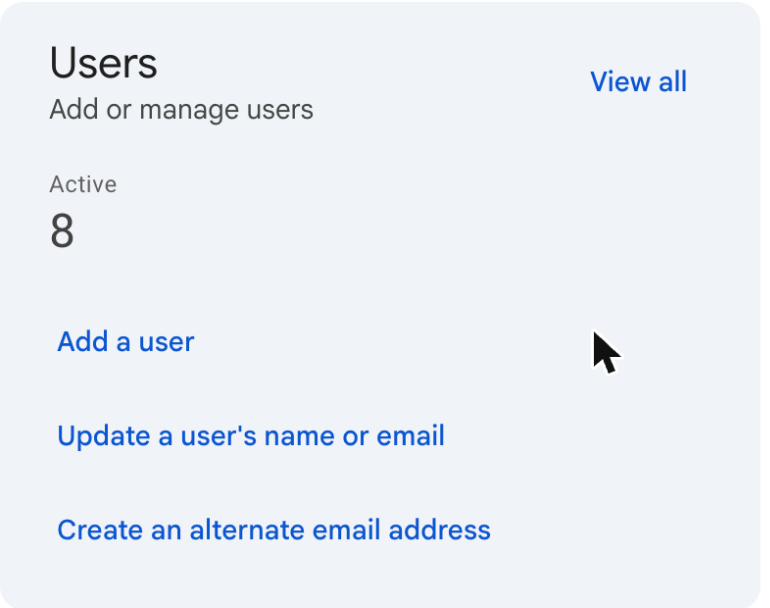
Create a new shared inbox:
- Sign in to the Google Admin console with an administrator account.
- On the Home page, in the Users section, click Set up a shared email address.
- Enter the shared address, such as sales@yourcompany.com.
- Click Add new users and enter the details for each person.
- Click Continue. Sign-in instructions are sent to each person.
- Click Next, review the list, and click Next again. If you do not click Next, the users are added but cannot open the shared inbox.
- Click Done.
This flow creates new user accounts, and each new user takes a paid seat. Google documents choosing existing people only in the convert flow below, and adding or removing delegates afterwards from the shared inbox's own Gmail settings. For a new address with existing teammates, the documented path is to create the address as an ordinary user first, then convert it and pick the teammates.
Convert an existing account: start the same way and enter the address of an account you already have, including a delegated one. Click Next, use Search by name or email address to pick the people who should have access, review, and click Done. This is also a way to keep a departing employee's mailbox answered: convert it and add the people who will cover it.
Manage it afterwards: anyone with access can add or remove delegates. Sign in to Gmail as the shared inbox, open Settings, See all settings, Accounts, and use Grant access to your account. The Mark as read and Sender information options are in the same place.
Who replied: each email shows the shared address in From and the delegate in Sent by. An administrator can change this for the whole domain under Sender information shown to recipient, so that recipients see the account owner only.
2. A dedicated account with Gmail delegation
This is the route that works today, and Google's delegation page lists no edition restriction for it: create support@ as a real user and delegate it to the team. Each person opens the mailbox from their own login, in Gmail.
-
Turn on mail delegation. In the Admin console, go to Apps, Google Workspace, Gmail, User Settings, Mail delegation, check Let users delegate access to their mailbox to other users in the domain, and save.
-
Create the account. Add a user for the shared address. It takes a paid seat.
-
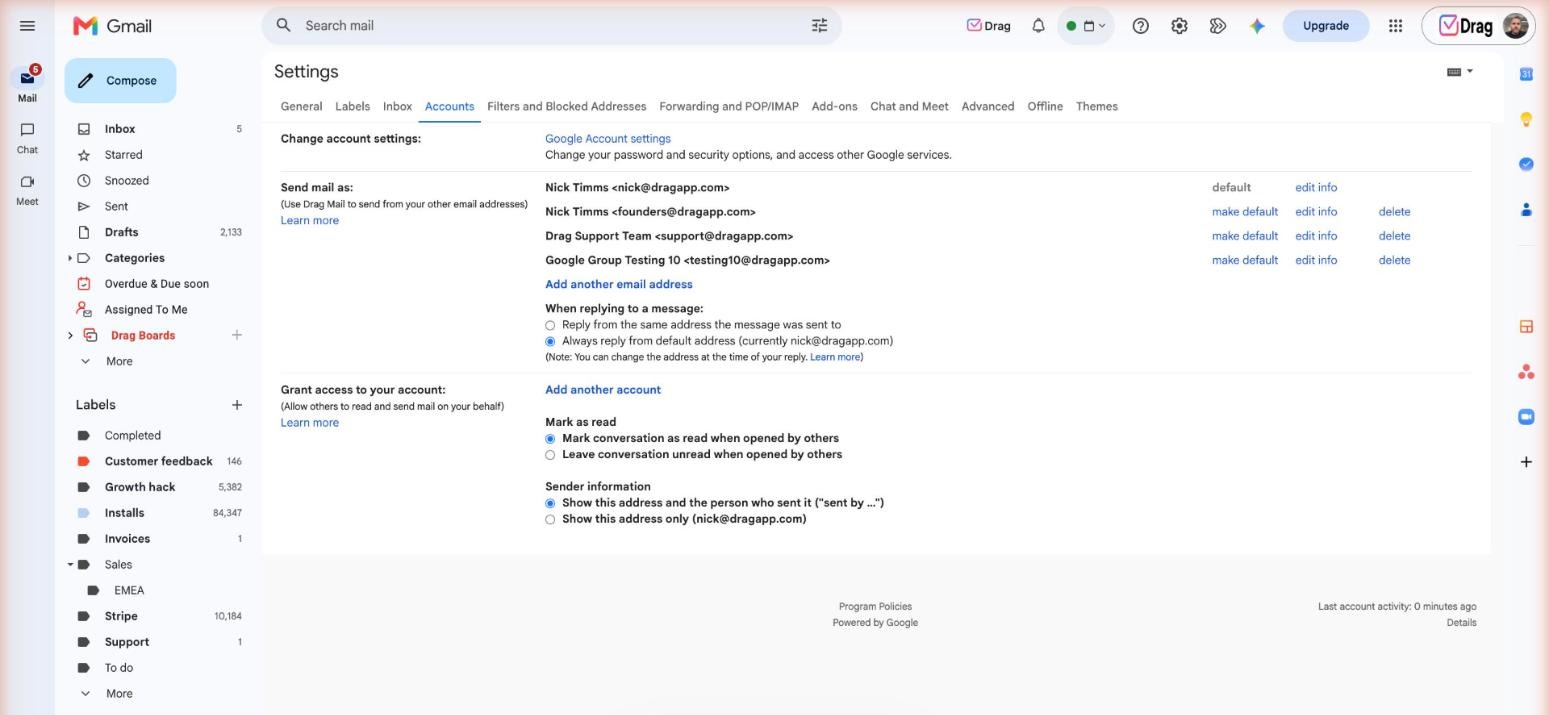
Add delegates. Sign in to Gmail as the shared account. In Settings, See all settings, Accounts, under Grant access to your account, click Add another account for each teammate. A Google Group can be added as a delegate and counts as one.
-
Teammates accept. Each accepts the invitation and opens the mailbox from their own account switcher. The invitation expires after a week, and Google says access can take up to 24 hours to start working (Gmail help, checked November 11, 2026).
What delegates can do: read, send and delete messages. They cannot change the account's password or chat from it, and Gemini in Gmail is not available to delegates. Google announced delegated mailboxes in the Gmail apps for iPhone and Android on June 30, 2026, and said on August 21, 2026 that it had resumed the rollout (Google Workspace Updates). It has not confirmed completion, so check the app. Access still has to be granted on the web first.
Limits: up to 1,000 delegates per account, and Google says that, with typical use, 40 delegates can use it at the same time. An email alias cannot have delegates, because an alias is not an account. Put the shared address on its own account, never on a person's inbox: delegates see everything in the mailbox.
Team-side steps and screenshots are in our Gmail delegation guide.
Drag · with Varley
The inbox your team and Varley work in together
Shared inbox and live chat for Gmail teams, with Varley, Drag’s AI, included from $18. Plus an MCP server your own AI tools can drive.
3. A Google Groups Collaborative Inbox
A Collaborative Inbox is a Google Group with assignment switched on. It is the only built-in route that needs no license for the shared address, and the only one where members can take a conversation, assign it and mark it complete.
-
Make sure Groups for Business is on for your organization.
-
Create the Group with the shared address, or open an existing one, and add the members.
-
Turn on conversation history. The collaborative features need it.
-
In Group settings, under Enable additional Google Groups features, select Collaborative Inbox (Google help, checked November 11, 2026).
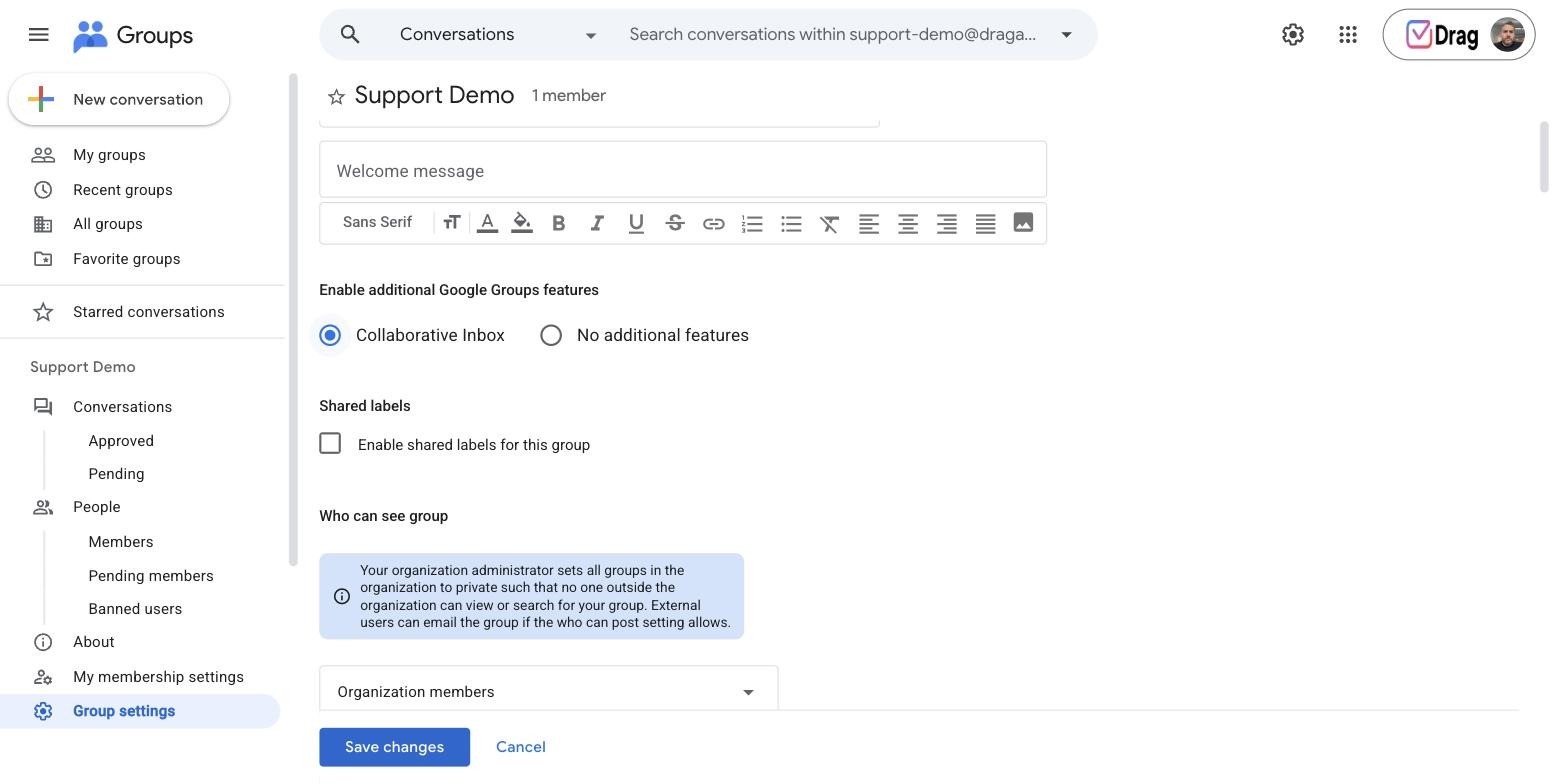
-
Set permissions: who can view conversations, who can post (in our experience customers cannot email the address unless people outside your organization are allowed to post), and Who can moderate metadata, which lets members take, assign and complete conversations.
Where it stops: the team works in the Groups interface and not in Gmail. There is no warning when two people reply, no automation and no reporting, and, as our Collaborative Inbox review describes, a member who answers from Gmail without copying the Group leaves the others unable to see the reply. For where it breaks in practice, see that review.
The route to avoid: sharing the password
Several people signing in to one account with one password gives you no record of who replied and no way to remove one person's access without changing it for everyone. Sign-ins from many devices and places can also trigger Google's security checks and lock the account. Delegation or a Collaborative Inbox replaces it within a day.
Google Workspace shared mailbox licensing, storage and security
Licensing. This is where Google Workspace differs most from Microsoft 365, where a shared mailbox holds 50 GB without a license of its own and supports up to 25 users, though each person opening it needs their own licensed mailbox (Microsoft Learn, last updated March 13, 2026).
| Route | What it adds to your Workspace bill |
|---|---|
| Groups Collaborative Inbox | Nothing |
| Delegating a mailbox you already have | Nothing |
| A new dedicated account with delegation | One seat |
| Native shared inbox | Probably one seat; Google's help page does not say |
On the native shared inbox, one administrator in the GAM community thread (October 2025) described it as a regular user account that needs a Workspace license. Budget one seat until Google says otherwise. On Business Starter that is $7 a user per month with a one-year commitment (US list price, checked October 26, 2026); the other plans are in our Google Workspace pricing guide.
Storage. A shared address on its own account uses storage like any other user account.
Security. Whichever route you choose:
- Enforce 2-Step Verification on every account that can open the shared address. One compromised login exposes the whole mailbox.
- Give access to named people, never by password, and review the delegate list every quarter.
- Remove a delegate the day they leave. Delegates can delete mail, and a deletion removes it for the whole team.
Which route should you choose?
- An info@ address with a few emails a day, no budget: a Collaborative Inbox, or delegate a mailbox you already have.
- A team that wants to stay in Gmail and only needs shared access: a dedicated account with delegation today; convert it to the native shared inbox when the option reaches your console.
- A team working a real queue, such as support@ or sales@, where emails get missed or answered twice: a shared inbox tool on top of Gmail.
When the built-in routes are not enough
Every built-in route gives shared access and stops there. None shows who owns an email, warns when two people reply, routes mail by rule or reports on response times. That is fine for a low-volume address and painful for a busy one.






A shared inbox tool adds that layer to the Gmail accounts you already have. Drag is ours, so weigh this accordingly: every email gets an owner and a status, a warning shows when a teammate is already replying, notes stay on the thread, and reports show how fast the team answers. The team works in Gmail or in Drag's web, desktop and mobile apps. Varley, Drag's AI, tags and summarizes email, drafts replies and resolves routine conversations on its own.
Drag costs $12, $18 or $24 per user a month on annual billing, with a 7-day trial, no card and no seat minimum (prices as of November 2026). Four other tools work with Google Workspace mail: Missive, Hiver, Gmelius and Front. The chart shows each one's published price range per user a month on annual billing.
For a side-by-side of every tool, see the best shared inbox software. Once a shared mailbox is running, the shared mailbox best practices cover ownership, statuses and response targets. Drag's own setup is on the shared inbox for Gmail page.
Frequently asked questions
Does Google Workspace have a shared mailbox?
Not a license-free one like Microsoft 365's, as far as Google documents. Google Workspace has three built-in routes: a native shared inbox that an administrator creates in the Admin console, a dedicated account shared by Gmail delegation, and a Google Groups Collaborative Inbox. The first two are mailbox accounts with delegates, so a new shared address appears to need a paid seat.
How do I create a shared inbox in Google Workspace?
If your Admin console has it, go to the Home page, Users section, and click Set up a shared email address, then add users. If it does not, create a user for the address and add teammates as delegates in its Gmail settings, or turn a Google Group into a Collaborative Inbox. Never share the password.
Do Google Workspace shared mailboxes need a license?
A Google Groups Collaborative Inbox needs no extra license. A dedicated account shared by delegation takes one paid seat. Google's help page for the native shared inbox does not state license terms, but it is a mailbox account, and one administrator in the GAM community described it as needing a Workspace license. Budget one seat for the address.
What is the difference between delegation, Collaborative Inbox and the native shared inbox?
Delegation shares one mailbox with named teammates, who work it in Gmail. Google's native shared inbox is the same thing set up by an administrator: Google says that in Gmail, delegated accounts and shared inboxes are the same. A Collaborative Inbox is a Google Group with assignment switched on, worked in the Groups interface, not in Gmail.
How many people can use a Google Workspace shared mailbox?
A delegated account can have up to 1,000 delegates, and Google says that, with typical use, 40 delegates can use it at the same time. Google's page for the native shared inbox gives no separate number, but it says the two are the same in Gmail, so expect the same limits. A Collaborative Inbox is limited by its Group's membership.
What is the difference between a shared mailbox and a distribution list?
A distribution list copies each email to every member's own inbox, so there is no shared view and no record of who answered. A shared mailbox is one inbox the team works together, each person from their own login. In Google Workspace a plain Google Group is the distribution list. See shared mailbox vs distribution list.
What do teams add on top of a Google Workspace shared mailbox?
A shared inbox tool, when the built-in routes run out. It adds an owner and status on every email, a warning when two people reply, internal notes, routing rules and reporting, on the Gmail accounts the team already uses. Drag, our product, starts at $12 per user a month, billed annually, with AI included from $18.

Co-founder
Building Drag for nearly ten years: shared inboxes, boards, and now the AI and agent layer, all on Gmail, plus HeyHelp for the personal inbox. Writes the honest versions of the comparisons.