





Auto-reply in Gmail with the vacation responder or a template plus a filter, six templates to copy, and how to auto-reply from a team address.
Table of contents
- What this guide covers
- How to auto-reply to emails in Gmail: the steps
- Gmail auto-reply options compared
- What an auto-reply email is, and when to send one
- Six auto-reply email templates to copy
- Auto-responders for a business email address
- Where Gmail auto-replies stop working for a team
- Auto-replies for a team address with Drag
- Sources
- Frequently asked questions
The short version: Gmail auto-replies two ways. The vacation responder, under Settings, See all settings, General, sends one message to everyone who writes, usually once per sender and again if they write after four days. To answer common inquiries with a template, enable Templates on the Advanced tab, save the reply as a template, and create a filter that matches those emails and check Send template. A Google Group address such as support@ sends its own auto replies from Group settings.
Drag is our product. It appears in one section near the end of this guide, auto-replies for a team address with Drag, so weigh that.
We checked every Google step below against Google's help pages on November 16, 2026. Drag's prices were read the same day, per user a month on annual billing.

Founder’s Take
A personal note from Nick, co-founder of Drag
An auto-reply is a promise. "We'll get back to you within a day" takes a second to send, and Gmail will send it for free from a vacation responder, a filter or a Google Group.
The harder part is who keeps the promise. Nothing in Gmail shows who owns the email after the template goes out. If your auto-reply names a time, make sure someone can see the clock running.

I also build these startups with Duda and a Mac Mini.
What this guide covers
- How to auto-reply to emails in Gmail: the steps
- Gmail auto-reply options compared
- What an auto-reply email is, and when to send one
- Six auto-reply email templates to copy
- Auto-responders for a business email address
- Where Gmail auto-replies stop working for a team
- Auto-replies for a team address with Drag
- Sources
- Frequently asked questions
How to auto-reply to emails in Gmail: the steps
Pick the method by what the reply has to do. One message to everyone while you are away is the vacation responder. A specific answer to a specific kind of email is a template plus a filter. A reply from a team address run as a Google Group is set in the group itself. All three are free with Gmail or Google Workspace.
Method 1: the vacation responder, for everyone who writes
- Open Gmail on a computer, click Settings at the top right, then See all settings.
- On the General tab, go to the Vacation responder section and select Vacation responder on.
- Fill in the date range, subject and message. To reply only to people in your contacts, check the box under the message.
- Click Save Changes.
The reply runs from 12:00 AM on the first day to 11:59 PM on the last, unless you click End now on the banner at the top of the inbox. Google sends it to most people only the first time they write, and again if they write more than four days later while it is still on. If you edit the message, people who already had the old one get the new one the next time they write.
Email that lands in spam, or that was sent to a mailing list you belong to, gets no reply. Your signature appears under the message.
Method 2: a template plus a filter, for common inquiries
This is how you automatically reply to common email inquiries with a template. It takes two parts: the saved reply, and a filter that decides which emails get it. Google says plainly that you must create a filter to send a template as an automatic reply.
Save the reply as a template
-
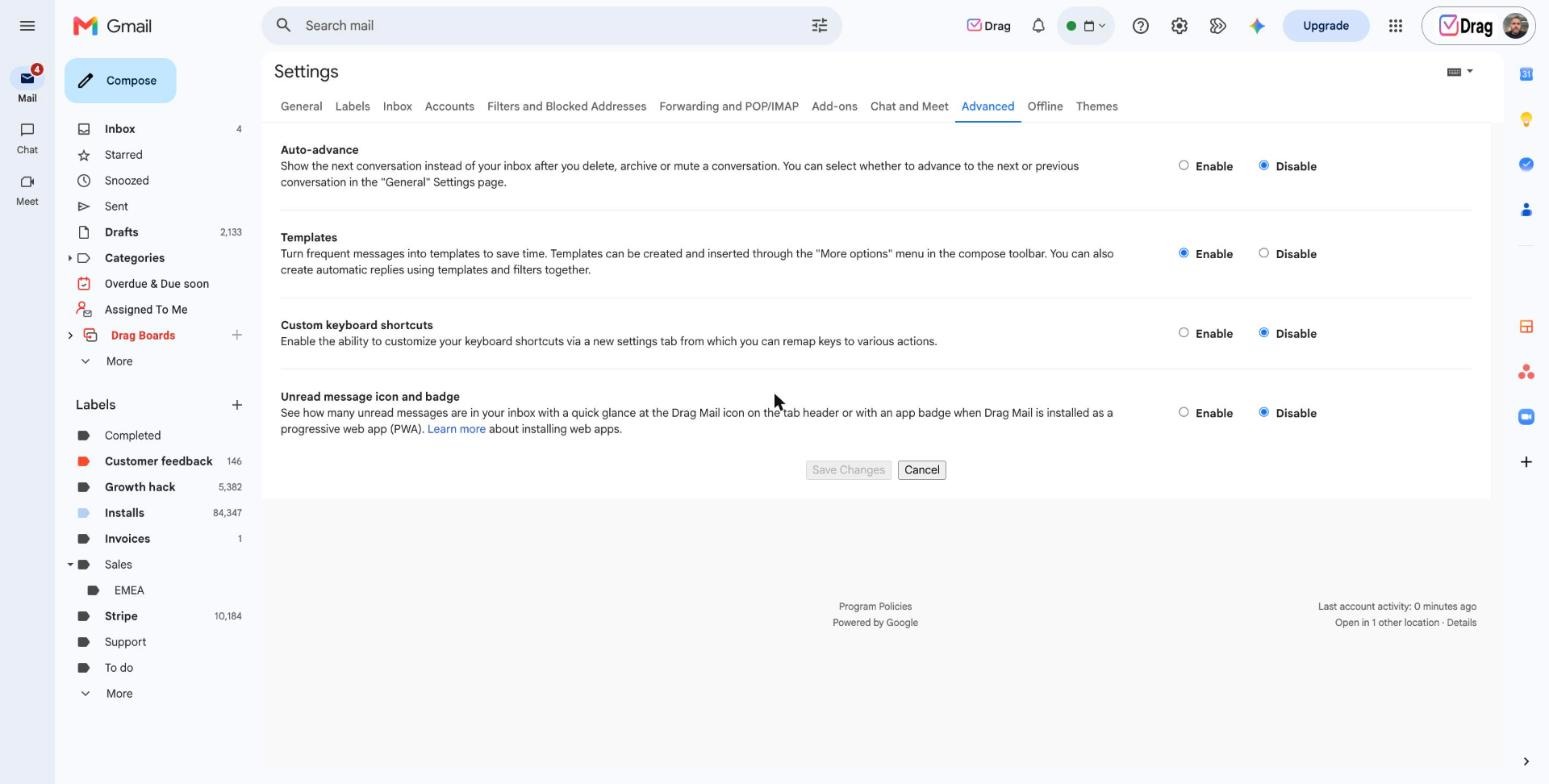
Click Settings, See all settings, then the Advanced tab. Next to Templates, select Enable and click Save Changes.
-
Click Compose and write the reply. Use one of the templates further down as a start.
-
Click More options at the bottom of the compose window, then Templates, Save draft as template, Save as new template. Give it a name you will recognize and save.
Create the filter that sends it
-
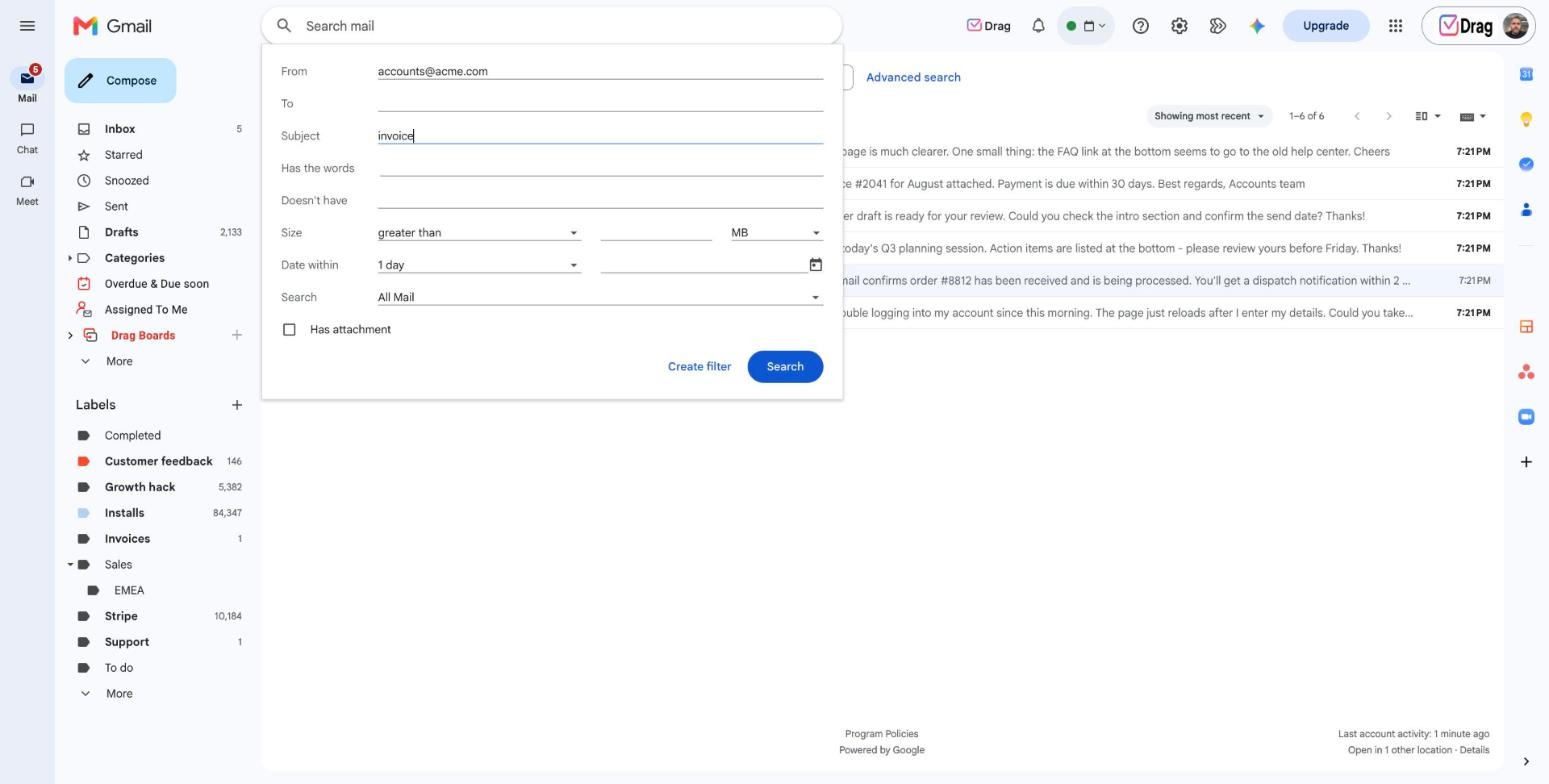
Click Show search options in the search box. Enter what the emails have in common: words in the subject, words in the body, the sender, or the address they were sent to. Click Search to see which emails match before you go on.
-
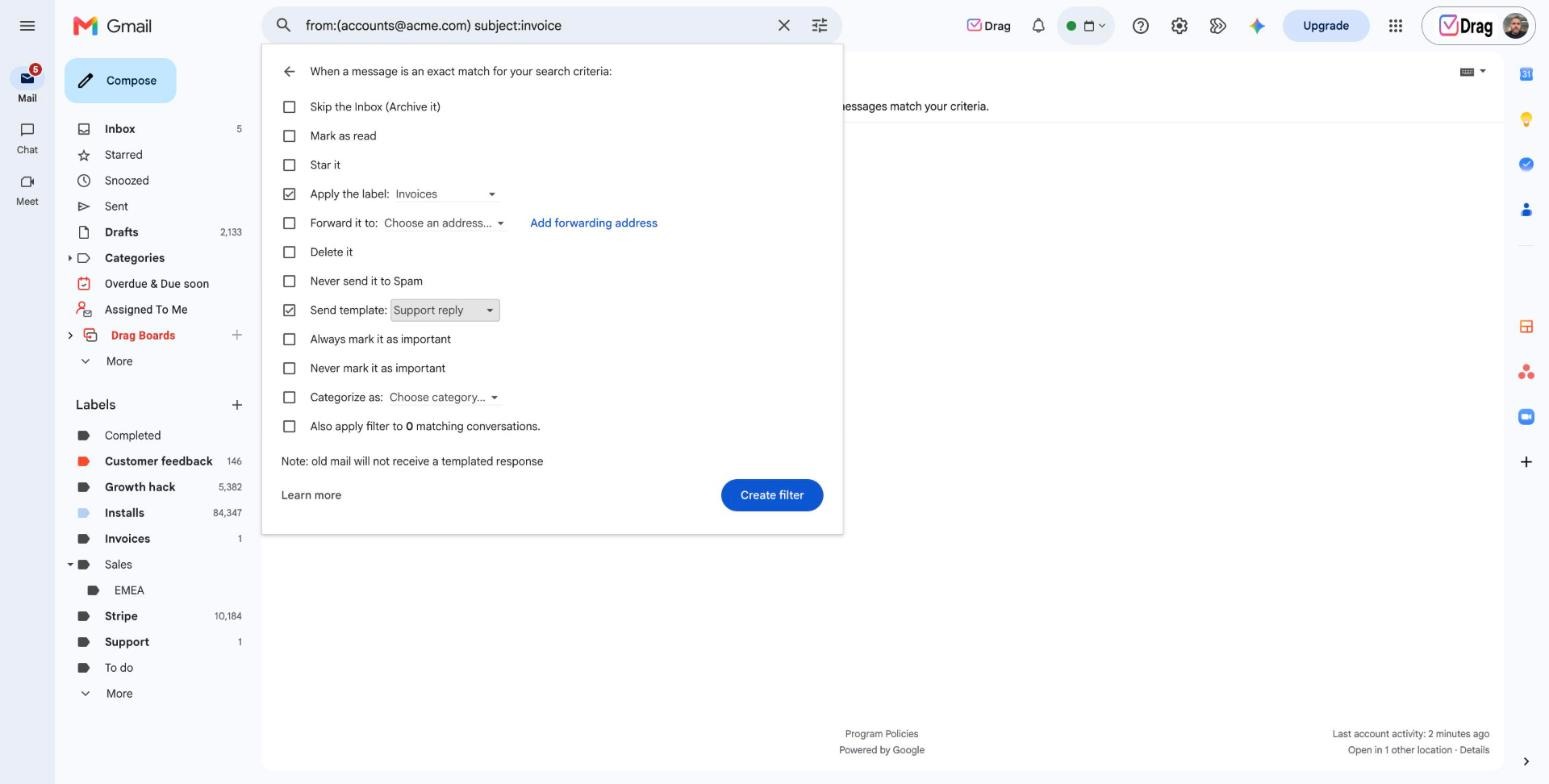
Click Create filter, check Send template, choose the template, and click Create filter again.
-
Send a matching email from another address and check the reply arrives. The filter window notes that old mail will not receive a templated response, so only new email gets it. Google's help does not say how often a filter sends the template to the same sender, so send two tests if that matters to you.
Make the criteria narrow. A filter on "price" also catches "price increase" from a supplier. One template and one filter per inquiry type keeps each reply right. To change a filter later, open Settings, See all settings, Filters and Blocked Addresses. Templates work only in Gmail on a computer. Our Gmail canned responses guide covers inserting templates by hand.
Method 3: auto replies on a Google Group address
If support@ or sales@ is a Google Group, the group can answer for itself. You need the Owner or Manager role in the group.
- Sign in to Google Groups with your work account and click the group's name.
- On the left, click Group settings, then Email options.
- In the Auto replies section, check each reply you want and write its message. Internal members, external members and non-members each get their own reply.
- Click Save changes, then test from an outside address.
If the group moderates messages, the auto reply goes out only after a message is approved. Our Collaborative Inbox review covers running the rest of a group address.
Gmail auto-reply options compared
| Vacation responder | Template plus filter | Google Group auto replies | Drag auto-responder | |
|---|---|---|---|---|
| Best for | Out of office | Answers to common inquiries | A group address such as support@ | A team address the whole team works |
| What decides who gets it | Dates, optionally contacts only | Filter criteria: sender, subject, words, To address | Internal member, external member or non-member | Sender, subject, keywords or board |
| Different replies for different emails | No, one message | Yes, one filter per template | No, one per audience | Yes, one rule per reply |
| Repeat replies to the same sender | First email, again after four days | Not stated by Google | Not stated by Google | Each email that matches a rule |
| Shared across the team | No, one account | No, one account | Yes, set once in the group | Yes, one library and one set of rules |
| Business hours | No, dates only | No | No | Yes, on Pro |
| Cost | Free | Free | Included with Google Workspace | From $18 per user (Plus) |
What an auto-reply email is, and when to send one
An auto-reply email is a message sent automatically when an email arrives, by rules you set in advance. An autoresponder is the tool or rule that sends it. People use the two words for the same thing.
You need one when the same kinds of email keep arriving and the first answer is always similar. The common cases:
- To confirm a request was received. First response time is the number customers notice. A reply that thanks them and gives a realistic wait stops the "did you get my email?" follow-up. Our guide to professional email response times has the benchmarks.
- To answer a known problem. Repeated questions about one error or one setting can get the fix straight away, with a person following up if it does not work.
- To send product details. Price, packages and how to buy answer a first sales inquiry while the prospect is still comparing.
- To say you are away. The out-of-office reply, with who to contact instead.
An auto-reply is the first answer, not the last one. It follows basic email management best practices only if a person still reads the email and replies when the auto-reply said they would.
Six auto-reply email templates to copy
Copy one, replace the brackets, and save it as a Gmail template or a vacation responder message. Keep each to what the reader needs next: that you have the email, when they will hear back, and what they can do in the meantime. More examples are in our customer service email examples, and the best practices for customer service email cover the person's reply that follows.
1. Support request received, with a wait time
For a busy support queue. Give a real wait time, and change it when the queue changes.
Subject: We have your message [ticket or order number if you have one]

Hi [first name],

Thanks for contacting [company] support. Your message has reached our team, and we usually reply within [time, such as 1 business day].

If you have a screenshot or an order number, reply to this email with it and it will be added to your request.

Many answers are already in our help center: [link]

[Your name or team name]
[Company]
2. Sales inquiry, with product details
For new leads, for example after a campaign. Answer the questions they are likely to ask first.
Subject: Your question about [product or service]

Hi [first name],

Thanks for your interest in [product or service]. Here is the short version:

[One or two sentences on what it does and who it suits]
Pricing: [plans and prices, or a link to the pricing page]
Next step: [book a call, start a trial, or reply with your requirements]

One of our team will follow up within [time] to answer anything specific.

[Your name]
[Company]
3. Service outage
For when a known problem brings in the same email many times. Set it while the problem lasts, and switch it off when it is fixed.
Subject: We are aware of the issue with [service]

Hi [first name],

Thanks for letting us know. We are aware that [service or feature] is [not loading, running slowly], and our team is working on a fix.

You can follow updates here: [status page link]

We will reply to you directly once it is resolved. You do not need to send another email.

[Team name]
[Company]
4. Common problem, with the fix
For a question your team answers word for word several times a week. Put the fix first.
Subject: How to fix [problem]

Hi [first name],

Thanks for getting in touch. Most messages about [problem] are solved by these steps:

1. [Step one]
2. [Step two]
3. [Step three]

If that does not fix it, reply to this email and someone from our team will help within [time].

[Team name]
[Company]
5. Outside business hours
For a team address that is not staffed around the clock. Say when you open, not only that you are closed.
Subject: Thanks, we will reply when we open

Hi [first name],

Thanks for your email. Our team is offline right now and back at [time and time zone] on [next working day].

If it is urgent, [phone number or emergency contact].

We will reply as soon as we are back.

[Team name]
[Company]
6. Out of office
For a personal inbox while you are away. Name a colleague only after they have agreed to cover.
Subject: Out of office until [date]

Hi,

Thanks for your email. I am away until [date] with limited access to email, and will reply when I am back.

If it cannot wait, please contact [colleague's name] at [address].

[Your name]
Auto-responders for a business email address
A business auto-responder usually answers for a team address, not a person. How you set it up depends on what that address is in Google Workspace.
- support@ is a Google Group. Use the group's own auto replies (method 3). Personal out-of-office replies will not cover it: Google's vacation responder skips email sent to a mailing list you belong to, so a member's away message will not answer a customer who wrote to the group.
- support@ is its own account, shared by delegation. Sign in as support@ itself and set the vacation responder or template filters there, so the reply goes out from the address the customer wrote to. Google's delegation help does not say whether delegates can change those settings, so plan for whoever holds the account's sign-in to do it. Our Gmail delegation guide covers the sharing.
- support@ forwards to one person's inbox. Template filters in that one inbox work, but the replies come from that person's address.
Whichever setup you use, a few rules make a business auto-responder help rather than annoy:
- Promise only what someone will keep. "Within one business day" is a commitment. If nobody tracks it, leave the time out.
- Give a next step. A help center link, a status page or a fix answers some emails on the spot.
- Ask for what you will need. An order number or a screenshot in the first reply saves a round of email.
- Keep it short and sign it from the team. People skim auto-replies on a phone.
- Review them every quarter. Prices, opening hours and links go stale faster than anyone remembers.
Where Gmail auto-replies stop working for a team
Gmail's tools send the first reply well. The trouble starts after it, and the signs are specific:
- The auto-reply promised a time, and the email sat past it. Nothing in Gmail shows who owns the email after the template goes out, so the follow-up depends on someone noticing.
- Two teammates set the same filter. Each account that receives the email and holds the filter sends its own copy, so the customer gets the template twice.
- Templates drift apart. Templates and filters live in one account. When one person updates the wording, nobody else's copy changes.
- You want a different reply at night. Gmail filters cannot match on time of day, and the vacation responder works in whole dates.
- The wrong emails match. A keyword filter answers a supplier, a newsletter or a customer whose words were slightly different, and there is no record of what was sent to whom.
- You cannot say how fast the team replies after the auto-reply. There is no report, only scrolling.
Labels and rules to move email into folders automatically help one person keep up. Once two of these signs show up in a month, the address needs a shared inbox, where the reply, the owner and the follow-up live in one place for everyone.
Auto-replies for a team address with Drag
Drag turns a team address such as support@ into one shared board that everyone works together, on Gmail and in its own web, Mac, Windows, iPhone and Android apps. Every email becomes a card with an owner and a status, so the auto-reply is the start of the work, not the end of it. More than 240,000 people have used Drag since 2017.
A different reply for each kind of email. Drag's auto-responder sends a template from the shared address the moment an email arrives, matched on sender, subject, keywords or board. Billing questions get one reply, support requests another. The same rules can tag the email and route it to the right board, and they run on Drag's servers, so they work while the team is offline.
One template library for the whole team. Shared templates open from the Gmail compose window in one click, with fields such as the customer's name filled in for you. When someone improves the wording, everyone sends the new version.
Replies that follow the clock. On Pro, business hours let an auto-reply fire only outside opening hours, or send different messages on weekdays and weekends.
AI after the acknowledgement. Varley, Drag's AI, drafts the real reply on Plus and resolves routine conversations on its own on Pro. It also answers questions about your inbox, helps you set Drag up, and learns from your team's replies and documents.
Nothing waits unseen. Assignment gives every email an owner, collision detection stops two people answering the same customer, and reporting shows how fast the team replies after the auto-reply. "Our auto-responder handles the first reply for 70% of incoming emails. Customers love the instant acknowledgement," says Holly Jenkins, Chief Operating Officer at Waste Logics.
The price. The auto-responder comes with Plus at $18 and Pro at $24 per user a month on annual billing ($22 and $30 monthly), with no seat minimum. Starter, at $12, includes shared templates and up to 10 automation rules. Four people answering support@ pay $72 a month on Plus, AI drafts included. Non-profits get 50% off. See the pricing page for every plan.
Drag · with Varley
Auto-replies your whole team shares
Drag sends the right auto-reply from support@ the moment an email arrives, then gives that email an owner, a status and an AI draft, so the promise in the auto-reply is kept. It works on Gmail and in its own web, Mac, Windows, iPhone and Android apps, with the auto-responder from $18 per user on annual billing. 7-day free trial, no card.
For more ways to take repeat work out of Gmail, see our guides to automating Gmail, Gmail email templates and WhatsApp auto-replies.
Sources
Google's steps were checked on these help pages on November 16, 2026: Create a vacation reply in Gmail, Create a template in Gmail, Create rules to filter your emails, Set up auto replies for a group and Delegate and collaborate on email. Drag's prices and plan features come from our pricing page, read November 16, 2026. Gmail has over 1.5 billion users on Google's last published count.
Frequently asked questions
How do I automatically reply to common email inquiries with a template?
In Gmail, enable Templates on the Advanced tab of settings, write the answer once and save it as a template. Then open the search options, describe the emails it should answer, click Create filter and check Send template. Every new email that matches gets that reply. Build one template and one filter for each type of inquiry rather than one catch-all.
What is the difference between an auto-reply and an autoresponder?
Mostly wording. An auto-reply is the message; an autoresponder is the setting or tool that sends it. Email marketing tools also use autoresponder for a timed sequence sent after someone signs up, which is a different job: that is outreach, while an auto-reply answers an email a person sent you.
How do I set up an auto-reply for a shared email address like support@?
It depends on what support@ is. As a Google Group, an Owner or Manager sets auto replies under Group settings, Email options. As a separate account, sign in as that account and set the vacation responder or a template filter there. A shared inbox tool sets one reply for the whole team and tracks the email afterwards.
Does Gmail's vacation responder reply to every email?
No. It answers most people only the first time they write, and again if they write after four days while it is still on. It skips email in spam and email sent to a mailing list you belong to. You can also limit it to your contacts, which keeps it away from strangers and automated senders.
Can Gmail send an auto-reply only outside business hours?
Not with its own tools. Filters match on sender, recipient, subject and words, never the time an email arrived, and the vacation responder runs for whole days. Teams that close at night either keep a general reply that works at any hour or use a shared inbox with business-hours rules.
What should a business auto-reply email say?
Three things: that the email arrived, when a person will answer, and what the reader can do meanwhile, such as a help center link or a status page. Add a request for an order number if you will need it. Leave out promises nobody tracks, and sign it from the team rather than one person.
Can I use Gmail templates on my phone?
Google says templates can be turned on and used only in Gmail on a computer, so creating, editing and inserting them happens in Gmail in a browser. Google's help does not say whether a filter that sends a template behaves differently on a phone, so set the filter up on a computer and test it from another address.
Why is my Gmail auto-reply not sending?
Check the rule that applies. The vacation responder stays quiet for email in spam, email sent to a mailing list, and anyone it already answered in the last four days. A template filter fires only when its criteria match exactly, and only once Templates is enabled. A moderated Google Group holds its auto reply until the message is approved.

Co-founder
Co-founder at Drag, writing about Google Workspace, shared inboxes, and how teams actually run email.
