













Sortd review: boards and shared inboxes inside Gmail from $10 a user, the 10 and 20 user caps, what its AI does, and what 10 or 21 people pay.
Table of contents
The short version: Sortd turns Gmail into shared boards: each email becomes a card with an owner, deadline and notes, and inboxes like sales@ are shared without moving mail. On annual billing, Starter is $10 per user (up to 10 users), Essentials $16 (up to 20) and Business $22 (no cap). There is no free plan. It suits up to 10 people on Gmail in Chrome. The catch: an 11th person moves everyone to $16, a 21st to $22.
Drag is our product. It is a shared inbox for teams on Gmail, and it appears in one section below, The same team on Drag, so weigh that.
We read Sortd's prices on its own pricing page on November 16, 2026. All prices are per user per month on annual billing; Sortd's pricing page shows no monthly prices.

Founder’s Take
A personal note from Nick, co-founder of Drag
We first reviewed Sortd in March 2023, when it still had a free plan and Business was $15 a user. Today it is $10, $16 and $22, and the plan you are on is decided by headcount: 10 people pay $100 a month, 11 pay $176.
That is the thing I would check first. Boards on Gmail are a good idea. But a team that hires steadily should price the plan it will be on next year, not the one it starts on.

I also build these startups with Duda and a Mac Mini.
What this guide covers
- Sortd plans and prices in 2026
- What Sortd does well
- Where the bill or the product gets harder
- What a team pays: 10 people and 21 people
- The same team on Drag
- Questions to ask before you sign
- Sources
- Frequently asked questions
Sortd plans and prices in 2026
Sortd sells three plans today and lists a fourth as upcoming. Every plan starts with a trial: the plan cards say 7 days with no credit card.
| Plan | Price per user, annual | Users | Shared inboxes | What the plan adds |
|---|---|---|---|---|
| Starter | $10 | Up to 10 | Up to 2 | 5 shared boards, Kanban and Planner views, 5 automation rules, 6 months of history, Chrome only |
| Essentials | $16 | Up to 20 | Up to 10 | Unlimited boards, Table and Deadline views, Google Calendar sync, shared templates, email tracking, AI that tags email by status, 2 years of history |
| Business | $22 | No cap | No cap | CRM pipelines, SLA rules, shared contacts, Zapier, API and MCP access, AI tags for urgency and sentiment, unlimited history and automations, data export, Chrome and Edge |
| Business Plus | Not on sale | Not listed | Not listed | Listed as upcoming, with an AI agent that drafts replies, a follow-up nudge agent and complaint detection |
There is no free plan. Sortd's pricing page has a monthly billing toggle and says yearly billing saves up to 40%, but it shows no monthly figures. Sortd's own comparison page with Drag puts its monthly prices from $14.
What Sortd does well
Sortd is a Chrome extension and Gmail add-on that adds boards to your inbox. A slider at the top of Gmail switches between the normal inbox and the board view, where emails sit as cards in columns such as To do, Current and Done. You can set columns up by status, by person or by deadline. Sortd is aimed at people who juggle many projects and conversations at once.
Setting it up takes minutes
You add Sortd from the Chrome Web Store, open Gmail and follow a short setup window. You name your team, choose who to share boards with, and link the shared mailboxes your team already uses, such as sales@. Sortd says plainly that there is no mailbox migration: your mail stays in Gmail.
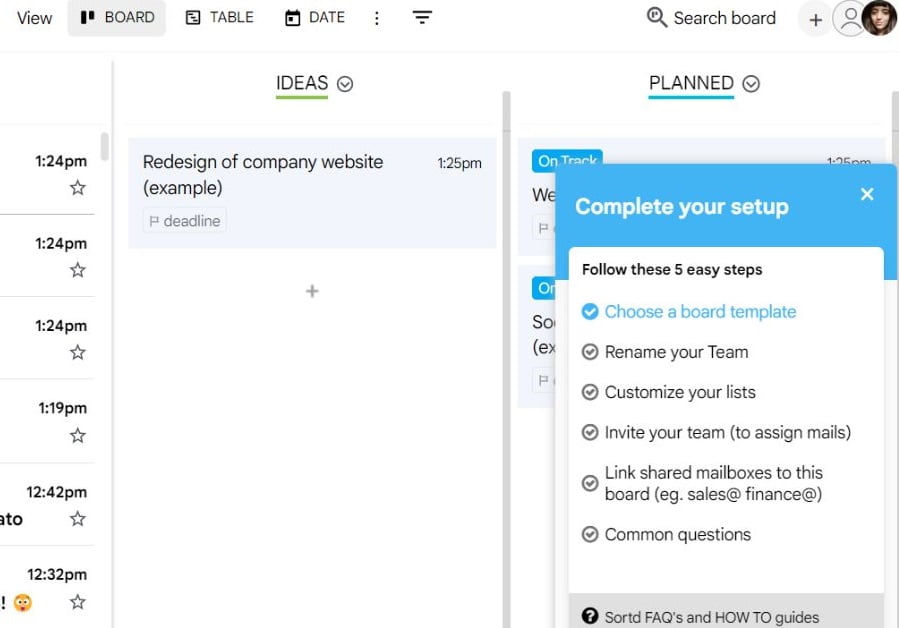
Turning an email into a task
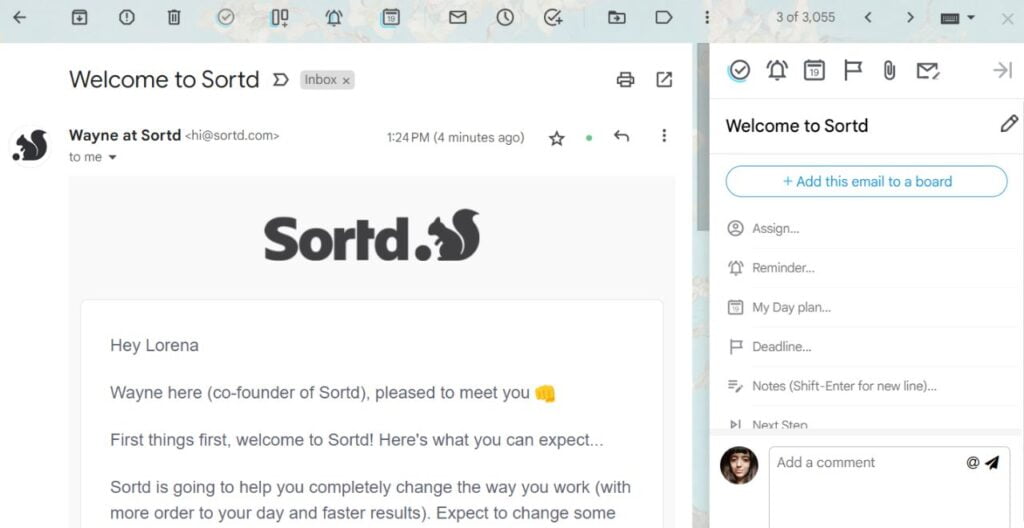
Select an email and click the add to board icon in Gmail's toolbar, or open the email and use the panel on the right, which has an "Add this email to a board" button above the card's fields. Our screenshots are from our first test in March 2023; the steps are the same today, though the design may have changed.

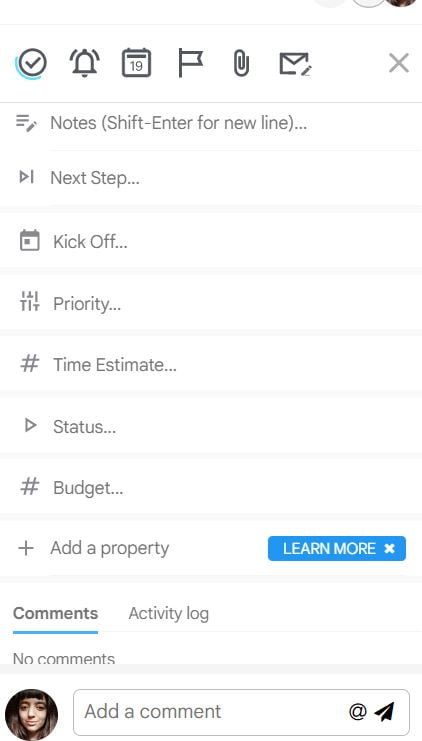
Cards that carry the context
Each card can hold an owner, a deadline, reminders and notes, and teammates can mention each other on it. Say an email arrives about a product launch: you turn it into a card, assign it, note what the launch needs, and set the date. Anyone who picks it up later finds the whole story on the card, not in a forwarded thread. Extra fields such as priority or budget are custom fields, which today start on Essentials.
More than one way to see the work
Kanban and Planner views come with every plan. Essentials adds a Table view and a Deadline view, which lines cards up by due date. Sortd also includes a personal board and a day planner, so one person can plan their own day beside the team's work.

Sales from the inbox, and your own AI agent
The $22 Business plan adds CRM pipelines, shared contacts and advanced custom fields, which suits a team that runs sales from email. It also opens Sortd's API and MCP server: your own AI agent can read conversations, assign work and create drafts, and send email once you grant it. Sortd says it has no per-resolution charges. It also has apps for iPhone and Android.
Where the bill or the product gets harder
The caps move the whole team. Starter stops at 10 users and Essentials at 20. The 11th person moves everyone from $10 to $16, so a $100 monthly bill becomes $176. The 21st person moves everyone to $22: 20 people pay $320 a month and 21 pay $462.
Starter is small. The $10 plan lists 2 shared inboxes, 5 shared boards, 5 automation rules and 6 months of history. Custom fields, calendar sync, Zapier and the API start on higher plans. A team that keeps cards open for longer projects will feel the history limit.
The AI tags; it does not write yet. On Essentials, AI tags shared email by status, such as To Respond and Awaiting. Business adds tags for urgency and sentiment, and AI inbox labels in beta. Sortd's own agent that drafts replies is listed for Business Plus, a plan that is not yet on sale. Until then, drafting means connecting your own agent through the API on Business.
Email only, mostly in Chrome. Sortd works in Gmail in Chrome, and also in Microsoft Edge on Business. Its site lists no live chat for your website, no WhatsApp inbox and no help center for your customers. Sortd's own shared inbox page says a dedicated help desk may suit a team that needs chat and phone in one queue.
The pricing page gives two answers in places. On November 16, 2026, Sortd's pricing page showed Essentials with both 10 and 20 automation rules, Business Plus both at $29 and as "Pricing to be announced", a 7-day trial on the plan cards and a 14-day Business trial in a note, and Essentials' AI status tags as both included and launching soon. Ask Sortd which applies to you.
When we tested it in 2023, a card could sit on one board at a time, so work shared by two teams needed someone to keep both up to date. We have not been able to re-check this on the current version.
How Sortd's price has moved
When we first reviewed Sortd in March 2023, it had a free plan with 30 days of history, Essentials at $10 per user and Business at $15.
Its entry price was $8 on annual billing in 2021, and $12 a month in 2024 and 2025. In 2026 Sortd added a new $10 Starter plan below the old entry plan, which became Essentials at $16. So the $10 entry price of 2026 is a new, smaller plan, not a price cut: the plan teams used to start on now costs $16. Its March 12, 2026 product update said the free plan was being discontinued.
What a team pays: 10 people and 21 people
These are Sortd's prices on annual billing, per month, for the cheapest plan each team size allows.
| Team size | Sortd plan | Price per user | Monthly bill | Yearly bill |
|---|---|---|---|---|
| 10 people | Starter | $10 | $100 | $1,200 |
| 10 people, with AI status tags | Essentials | $16 | $160 | $1,920 |
| 21 people | Business | $22 | $462 | $5,544 |
At 10 people, Starter is Sortd's lowest bill, as long as 2 shared inboxes, 5 boards and 6 months of history are enough. At 21 people there is only one plan left: Business at $22, whether or not the team needs pipelines or the API.
The same team on Drag
Drag is a shared inbox for teams on Gmail and Google Workspace, used by more than 240,000 people since 2017. Like Sortd, it turns email into boards, with an owner and notes on every conversation and a warning when someone else is already replying. Your team can work on Gmail through a Chrome extension, or in Drag's own web, Mac, Windows, iPhone and Android apps.






AI that writes the reply. Varley, Drag's AI, tags and summarizes email and drafts replies from the $18 Plus plan. On the $24 Pro plan it also resolves routine conversations on its own. Varley answers questions about your inbox, helps you set Drag up, and learns from your team's replies and the documents you give it.
One price per user at any size. Every Drag plan works for any team size, with no seat minimum, so the 11th and 21st person cost the same as the first. Boards, notes, collision detection, rules and reporting come with every plan.
More than email. Live chat for your website and a public help center for your customers are on every plan, from $12. A shared WhatsApp inbox is on Pro. Pro also connects Claude, ChatGPT, Gemini, Microsoft Copilot and Cursor, so the assistant your team already uses can read the queue, assign email, draft replies and send them.
Here is the like-for-like bill, per month on annual billing. Drag's plans are Starter $12, Plus $18 and Pro $24 per user ($16, $22 and $30 on monthly billing).
| Team size | Sortd | Drag, like for like | What the Drag plan includes |
|---|---|---|---|
| 10 people, no AI | Starter, $100 | Starter, $120 | Shared inboxes, boards, live chat and a help center |
| 10 people, with AI | Essentials, $160 | Plus, $180 | Varley tags, summarizes and drafts replies |
| 21 people | Business, $462 | Plus, $378 | Varley drafts replies; no plan change as you grow |
| 21 people, AI connected to your own assistant | Business, $462 | Pro, $504 | Varley resolves routine conversations; Claude, ChatGPT and others connect |
Sortd costs less for teams of up to 20 people, by $2 per user on each plan. From 21 people, Drag Plus is $84 a month less than Sortd Business and includes AI that drafts replies.
Your Sortd inboxes are already Gmail addresses, so nothing about your email moves. Drag has ready-made Claude prompts that carry out the setup in your browser, and onboarding help comes with Plus and Pro. For the full side by side, see our Sortd alternative page.
Drag · with Varley
Your team is about to pass 10 or 20 people on Sortd?
Drag gives your team shared inboxes and boards on Gmail and in its own apps, at the same price per user at any size. Varley, Drag's AI, drafts replies from $18 per user on annual billing, with live chat and a help center on every plan. 7-day free trial, no card.
Questions to ask before you sign
- How many people will answer email in a year? If the answer is over 10 or over 20, price the next plan now, because the whole team moves.
- Is 6 months of history on Starter enough for cards that stay open on long projects?
- Do you need more than 2 shared inboxes or 5 shared boards? Both limits apply on the $10 plan.
- Which automation limit applies on Essentials, 10 rules or 20? The pricing page shows both.
- Will you need AI that drafts replies? Sortd's own drafting agent is on a plan with no price or date yet.
- Does anyone on the team use a browser other than Chrome? Edge is supported on Business.
- What is the monthly price if you do not want to pay for a year up front?
Sources
- Sortd pricing page, read November 16, 2026.
- Sortd product updates page (free plan discontinued, March 12, 2026; API and MCP tools, June to September 2026), read November 14, 2026.
- Sortd pages on AI features, connecting AI agents, its mobile app, its features and its shared inbox use case, read November 14, 2026.
- Sortd's own comparison page with Drag, for its monthly prices, read November 14, 2026.
- Archived copies of Sortd's pricing page on archive.org, 2021 to 2026 (latest capture April 21, 2026).
- Our own test of Sortd in Gmail, March 2023.
- Drag pricing, November 16, 2026.
Frequently asked questions
Is Sortd worth it?
It depends on headcount and on what you want from AI. Cards with owners, deadlines and notes make it clear who is handling what, and setup takes minutes because the mail never moves. The sums change past 10 and 20 people, since everyone moves to the next plan, and drafting replies with Sortd's own AI is not on sale yet.
How much does Sortd cost per month?
On annual billing, Sortd is $10 per user on Starter, $16 on Essentials and $22 on Business, read on November 16, 2026. A team of five pays $50 a month on Starter. The pricing page offers monthly billing but shows no monthly figures, and says paying yearly saves up to 40%. Sortd's own comparison page puts monthly prices from $14.
Does Sortd still have a free plan?
No. Sortd's free plan, which once included a personal board and 30 days of history, was discontinued in 2026. Its product update of March 12, 2026 announced the change, and the pricing page now lists only paid plans. New users get a free trial with no credit card instead, so you can test the boards before paying for a year.
Can my whole team share an inbox in Sortd?
Yes. You link an address your team already uses, such as support@ or sales@, and its email shows up as cards on a shared board. Starter allows up to 2 shared inboxes for up to 10 users, Essentials up to 10 inboxes for up to 20 users, and Business has no limit on either.
Does Sortd use AI?
It does, mainly to label email. Essentials tags shared conversations by status, Business adds urgency and sentiment tags and AI inbox labels in beta. On Business you can also plug in your own agent through Sortd's API and MCP server to write drafts. An agent built by Sortd that drafts replies is listed for an upcoming plan.
Is there a Sortd app for phones or desktop?
Sortd has apps for iPhone and Android, where you can see boards, turn an email into a task and assign it. On a computer it runs inside Gmail as a Chrome extension, and on the Business plan in Microsoft Edge too. Its site lists no separate desktop app for Mac or Windows.
What happens when my team grows past 10 people on Sortd?
The Starter plan stops at 10 users, so adding an 11th moves every seat to Essentials at $16. A team of 10 paying $100 a month would pay $176 at 11. The same thing happens again at 21 users, when the whole team moves to Business at $22 per user.
What is a good Sortd alternative for a Gmail team?
Drag keeps the boards and shared inboxes on Gmail, adds its own web, desktop and mobile apps, and charges the same per user at any team size. Varley, its AI, drafts replies from $18 per user. Our Sortd alternative page compares the two side by side, plan by plan.

Co-founder
Co-founder at Drag, writing about Google Workspace, shared inboxes, and how teams actually run email.


