













Here you will find the best email Chrome extensions to upgrade your Gmail into a fully customized workspace.
Key takeaways
- Chrome extensions are where Gmail's deepest transformations live, from tracking and scheduling to full shared-inbox workflows, because the browser gives them room the Marketplace sandbox does not.
- Every price here comes from the vendor's own page, dated July 2026, and dead or pivoted tools from earlier versions are named in the removals record rather than quietly dropped.
- Extension bloat is real: each one loads with Gmail, so the honest strategy is one serious workflow extension plus at most a couple of single-job tools, not ten.
Table of contents
Email Chrome extensions change what Gmail can do by modifying it in your browser: layouts, tracking, scheduling, whole workflows layered onto the inbox. They are the browser-side siblings of Gmail add-ons, which install from Google's Workspace Marketplace and run inside Gmail without a browser, and this guide covers the extension class only, with every price read from the vendor's own page in July 2026.
The extensions at a glance
| Extension | What it does | Price, July 2026 |
|---|---|---|
 Drag Drag | Shared inboxes and boards on Gmail | $12/user/mo |
 Mailsuite (Mailtrack) Mailsuite (Mailtrack) | Email tracking and read receipts | Free tier; about €10/mo annual |
 Grammarly Grammarly | Writing, grammar and tone | Free tier; £10/mo Pro |
 Docusign Docusign | eSignatures from the inbox | £8/mo single user |
 InboxWhenReady InboxWhenReady | Scheduled inbox lockout | Free tier; $4/mo |
 Briskine Briskine | Reusable email templates | Free tier; $7/person/mo |
 HubSpot Sales HubSpot Sales | CRM tracking and logging in Gmail | Free for 2; $7/seat/mo |
Also on this page: two extensions that are not email tools, what we removed and why, and the FAQ.
Context switching
One of the issues faced by teams in any industry is context switching. This is the amount of time you waste going from platform to platform. Time spent logging into accounts and browsing through databases to find what you need. Whether it’s messages, files, or any other relevant pieces of information to do your job. For instance, if you have to log into the corporate account to find the standard solutions to clients’ complaints, you’re going to take longer and risk dissatisfaction. Whereas if standard responses are built into a ticketing system, the process is much faster. The same scenario happens in marketing, for example. If you manage an ecommerce website, you most likely do email campaigns for registered clients. You can set up these distribution lists in Gmail using Gmail add-ons and extensions are some of the simplest ways to handle the task. Delegation is another part of the job that can be optimized by email Chrome extensions. The practice of having a shared account and forwarding emails from that inbox to the teammates responsible for each task can be tedious and time-consuming. On the other hand, if you access the shared inbox and delegate tasks, you reach your result much faster. A step further, and you could even set up automated delegation.
Interface and visualization
The best argument for teams to use Google products as work tools is the low learning curve. Especially since most people are already used to Google Workspace software. Extensions take advantage of Google’s familiar interface, lowering the learning curve and breaking implementation barriers. That being said, Gmail does have its limitations. If you want to organize your inbox or turn your messages into tasks, you will probably need an email Chrome extension. Kanban boards, for example, are visually appealing. They provide a more concrete way to show your workflow. You can tag teammates, add schedules and use emails as task cards, moving them from “backlog” to "in progress" to "complete". But you can't do that within Gmail itself. Nor can you organize your messages in many different forms. So to bypass these limits, you go to extensions.
Drag AI
The inbox your team and your AI work in together
Shared inbox, live chat, and AI in Gmail, with an MCP server your AI tools can drive.
How to install an email Chrome extension?
If you decide to install the best Gmail extensions you need to access the Chrome Web Store. There, you can browse through many categories. Some of them are productivity, organization, design and many other functions that can add features to Google’s apps. There's a category specifically for extensions developed to work within Gmail. Those are valuable to entrepreneurs and managers because with them it's possible to customize your Gmail`s functions and interface. So find the extension with the feature you would like to try on Gmail and then, just click on it. The page will direct you to its full description and reviews. There you can see how other users classify the extension on a five-star scale and also relevant comments and descriptions about the day-to-day use. Another important aspect of this page is the add-on’s documentation. It contains the team behind the development and important information regarding the compatibility and safety of your data. If the extension is indeed what you’re looking for, you just need to install it in your browser, look for its button next to the toolbar, and get started on using it. Most of the time, you can find a step-by-step guide on the extension page or a FAQ directory on the extension menu.
Troubleshooting and uninstalling
Of course, sometimes you might need to test a few different extensions to see which one is the right fit for your needs. It’s important to know that they might pose compatibility issues when installed together, so it’s best practice to test one at a time. Most of them offer free services or a trial period for paid subscriptions, where you can see if the software is going to be useful for a company. If it doesn't work, you can cancel your subscription and proceed to uninstall the extension from your browser. If you decide to keep using the software, you’ll need to register for an official account and, if needed, add payment information for premium services. Keep in mind that many extensions need to be updated from time to time to stay on top of your browser updates. If you don’t update one or the other, you might run into synching issues or poor usability, which will affect your experience. Staying up to date on both fronts ensures that you won't have disconnections when you need the extension the most.
Are Chrome extensions safe to use?
It's important to know that Chrome extensions are heavily monitored by Google. So, if an extension is available on the page, it's been audited by Google itself as well as tested and reviewed by a global community of developers. You should pay attention to nonlegitimate extensions: if they are not on the official Chrome page, they might not have been authorized to work with Gmail and pose data breach risks for companies. Before installing any extension, check the developer's own site for a changelog and recent releases, and read the Chrome Web Store listing itself: recent user reviews, the permissions it requests, and when it was last updated.
Which email Chrome extension do you need?
To make sure entrepreneurs and managers encounter the ideal tools for their emails, we’ve compiled a list of the best Gmail extensions that every company could use. Below are our ideas for productivity, organization, communication and even scheduling that might fit companies from across industries, sizes and proposals and will turn your email inbox into a productive workspace.
Drag

Best for: teams that want their shared addresses managed inside Gmail, the heaviest honest use of the extension class.
Full disclosure: Drag is our product. It turns support@ and sales@ into a shared inbox with boards inside the Gmail your team already uses, every email a card with an owner, notes, and due dates, with AI included from the middle plan and an MCP server on the Pro plan. It also runs as a standalone app with the same boards, which matters here: the extension is the convenient door, not a cage.
- Pricing: $12, $18 (AI included), $24 per user per month billed annually. 7-day trial, no card, no free plan.
- Rating: 4.7 from over 1,200 reviews.
- Watch-outs: it is a team tool; solo users wanting single-job utilities are better served by the lighter entries here.
Want to try it on your own inbox? Start a 7-day trial of Drag, no card required.
Mailsuite (Mailtrack)

As the top email tracker in the world, this extension lets you know if and when your emails are being read. With that in mind, you can set up marketing strategies and follow up when needed, with supporting data to organize the next steps. There’s a free version, with a disclaimer on your signature.
- Pricing: served in euros from the UK at about €10 per month on annual billing (€119.90 a year), or €19.99 billed monthly. Check your regional rate.
- Watch-outs: the free tier adds a Mailtrack signature to every email you send, which is the cost of the free plan rather than a bug.
Grammarly
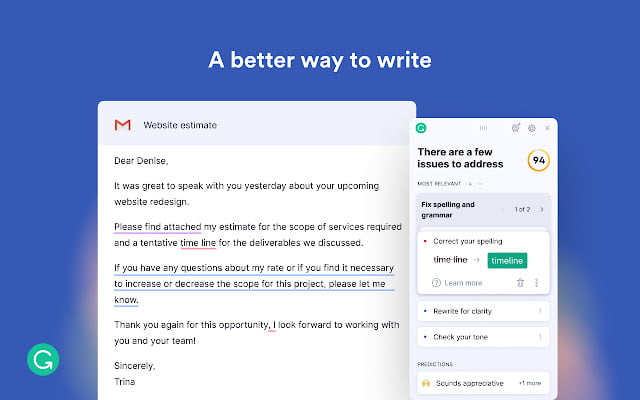
Many professionals across industries have a hard time writing emails. Worries about tone, relevant information and, of course, good grammar, are common in the workplace. Grammarly is an extension developed to help people avoid writing mistakes and have their messages come across clearer. When you add this extension to your browser, you will be notified in real-time if the email you’re writing is clear, concise and polite, all while helping you find more appropriate alternatives to your words. Grammarly claims to catch more errors than regular word processors. It’s a pretty useful tool to grow your company’s reputation, by ensuring your prospects receive the relevant information in the best way possible. It can help your team’s conversations as well, since it prevents crossed wires and mismatched tones.
- Pricing: there is a permanent free tier, not a trial. Pro is served in the UK at £10 per user per month, with a 7-day trial on the paid plan.
- Watch-outs: the free tier covers basic corrections; tone and rewriting suggestions are the paid product.
Docusign
Another business practice that went mostly digital in the past couple of years is documentation. In the past, you’d almost certainly need to physically send a contract or a proposal to your suppliers, clients and employees. But if they were far away, that posed an issue. Now extensions like Docusign make this task much easier, allowing you to send legal documents directly from your Gmail. Then, the other party signs and you’re legally allowed to conduct the agreement. The eSignature can be done through virtually any device, making the process much quicker for today’s fast-paced industries.
- Pricing: served in the UK at £8 per month for Personal, which is a single-user plan rather than a per-user one; Standard is £20 per user per month and Business Pro £33.
- Watch-outs: the entry plan is single-user, so the first time a second person needs to send documents the price more than doubles.
InboxWhenReady
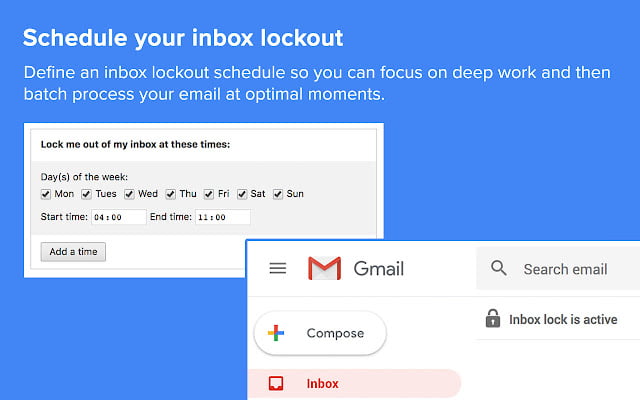
For those users who get overwhelmed with their inboxes and somehow miss important messages, this extension is a timesaver. Basically, it works by blocking new emails from reaching you for a predetermined time. That way, you can deal with the ones already in your inbox, which allows for better organization and time management. Instead of a messy inbox, you can reply, archive, forward or delete messages and even reach Inbox Zero if that’s your goal.
- Pricing: the basic subscription is free and displays a message on your email signature. The pro version is $4 per month paid annually.
- Watch-outs: it hides your inbox rather than organizing it, so it solves distraction and does nothing about ownership or volume.
Briskine
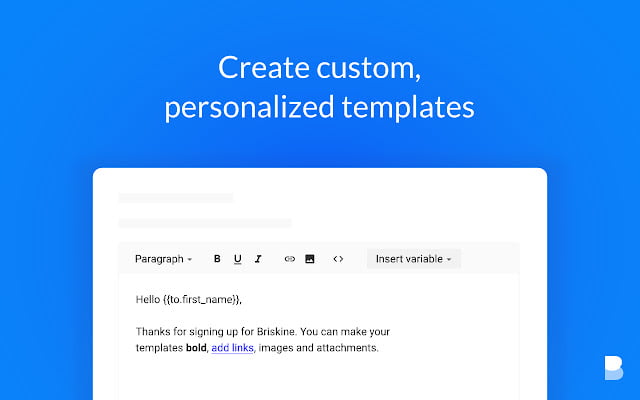
Looking for automated layouts? Briskine is a Chrome email extension that helps you build and resume templates for any kind of email, from prospects, to billing, to customer support to company announcements. That way, you can easily go through all your email needs without wasting time. You can add custom shortcuts for common messages and Briskine will automatically write them for you.
- Pricing: the free plan covers one person and 30 templates. Premium is $7 per person per month, with unlimited people and templates.
- Watch-outs: templates are per-person by default, so team-wide consistency needs the paid plan.
HubSpot Sales
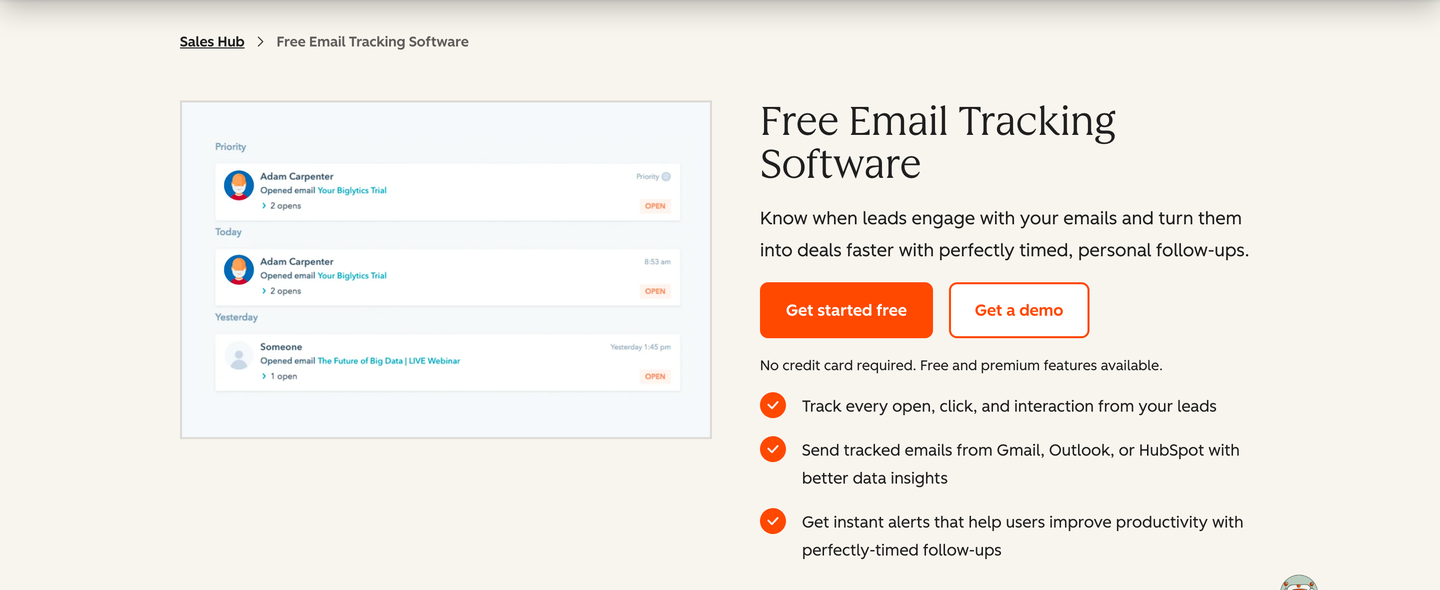
HubSpot is one of the leading applications which converts your inbox into a more productive marketing tool. It further helps you stay connected with leads. It provides the user with a feature that allows the user to track and log the emails that you send from your Gmail account. You can also initiate calls with contacts given in your inbox.
- Pricing: there is a free tier for up to 2 users. Sales Hub Starter is $7 per seat per month billed annually, $20 billed monthly; Professional is $90 per seat per month billed annually.
- Watch-outs: the jump from Starter to Professional is the steepest on this page, and this extension moved here from our add-ons guide because HubSpot publishes no first-party Gmail add-on on the Workspace Marketplace.
Not email tools, but installed beside them
Two extensions here are not email tools and earn their place because they live in the same browser sessions Gmail work leans on.
Dropbox. If, instead of protected information, you need to share large files with coworkers and clients, you need a reliable digital space. Dropbox stores, shares and organizes files in personalized directories, and with the Gmail extension you can bypass attachment limits and share what you need with a dedicated link. Dropbox also publishes a Workspace Marketplace add-on, so it is priced in the add-ons guide rather than counted twice here.
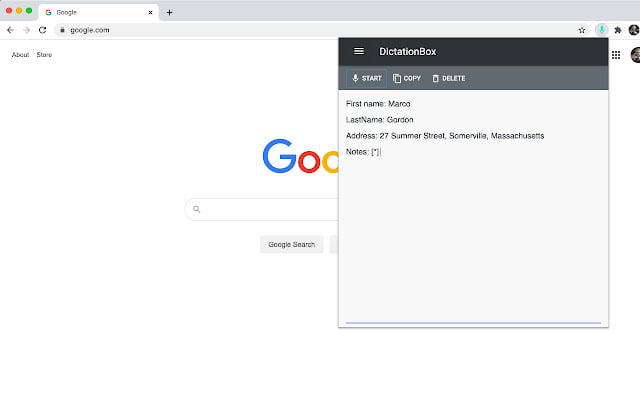
DictationBox. Writing emails on the go? Speech-to-text is your friend, but it might not be as reliable as an email you sit down to write. However, to boost productivity and avoid mistakes, DictationBox supports over 100 languages and has built-in commands that you can use while emailing for free.
How this guide is verified
Every price on this page was read from the vendor's own pricing page in July 2026 and is dated. Tools removed from earlier versions are named here with the reason: Zoom, a video conferencing platform rather than an email tool, whose current Pro price we could not read from Zoom's own page; and Digify, a document security and rights-management product rather than an email tool, whose pricing we could not read from its own page either. Tools belonging to the add-ons class were moved to the sibling guide rather than counted twice, and HubSpot Sales arrived here from that guide for the same reason in reverse. Corrections are recorded rather than silently overwritten.
Four corrections from this update are worth stating plainly. This page described Dropbox Plus as giving you 1TB; it has been 2TB since 2017. It described Grammarly's free offering as a "free trial"; Grammarly has a permanent free tier. It listed Mailsuite at $5.99 per month billed annually and Docusign at "$10 per user/month"; both figures are restated above from the vendors' own pages, and Docusign's entry plan is single-user rather than per-user. All four are fixed above.
Conclusion
Your digital workspace needs to be ready both for your professional communication, but also for your own task list and your important conversations with people in your company. Ideally, everything is the same space. This is why Drag brings your tasks, your files, your calendar and chats to your Gmail account and makes it much easier to reach whatever you need without changing tabs. Drag is one of the top essentials that can help you and your company spend less time worrying about organization and more doing what you love. If you want to test it, sign up for a free trial.
Email Chrome extension FAQs
What is the best Chrome extension for Gmail?
It depends on the job: full disclosure, our own Drag is the deepest team transformation, turning shared addresses into boards, while single-job standouts like Mailsuite for tracking and Briskine for templates earn their slots at low prices. The table above is the fast comparison.
How do I install a Gmail Chrome extension?
From the Chrome Web Store: open the extension's listing, review the permissions it requests, and add it to Chrome; it activates on your next Gmail load. Desktop only, per browser profile.
Are Chrome extensions safe for Gmail?
The honest checks: read the permissions, check when the listing was last updated, look for the developer's own changelog, and uninstall what you stop using, because every extension you keep loads with your inbox.
What is the difference between a Chrome extension and a Gmail add-on?
Chrome extensions install from the Chrome Web Store into your desktop browser and can reshape the inbox itself; add-ons install from the Google Workspace Marketplace and run inside Gmail's own sandboxed panel, on desktop and mobile, and admins can deploy them domain-wide. The deepest workflow tools are extensions; the most deployable ones are add-ons, and many products ship both.

Co-founder
Co-founder at Drag, writing about Google Workspace, shared inboxes, and how teams actually run email.
