










MCP server, connector, plugin, skill: four words, two AI assistants, and a lot of confusion. A plain-English guide to what each word means in Claude and in ChatGPT as of 2026, from a team that runs its own MCP server.
Key takeaways
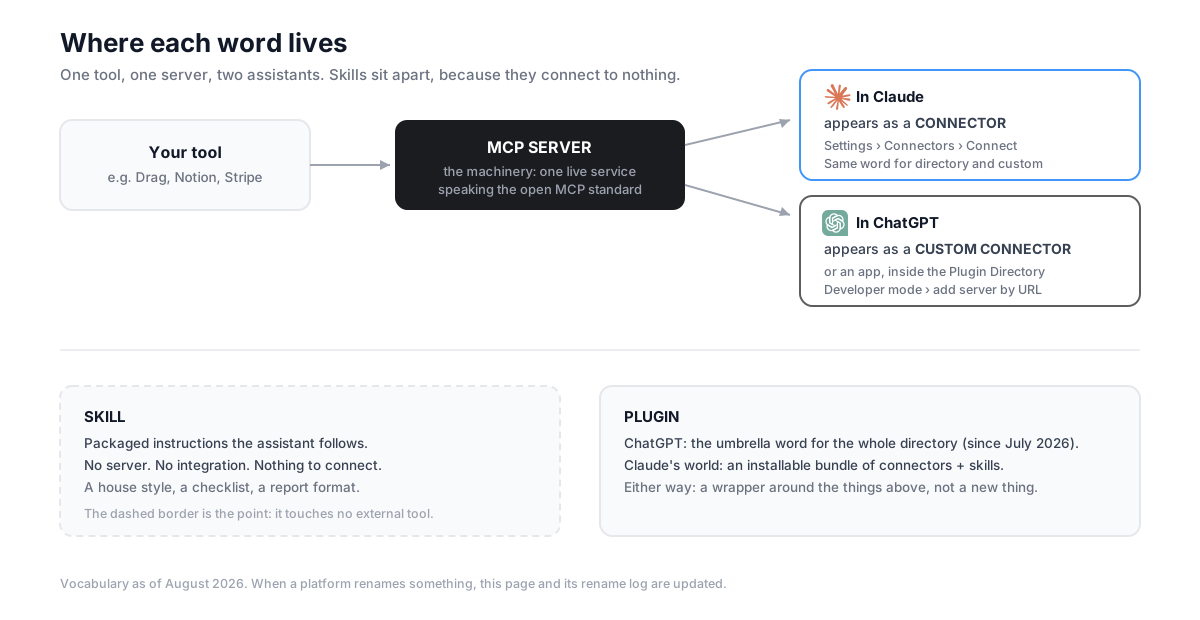
- An MCP server is the machinery: a live service that tells an AI assistant what a tool can do, built on the open Model Context Protocol standard. A connector is the same thing seen from the user's side: the thing you click Connect on in the assistant's settings.
- Plugin means different things per assistant in 2026: in ChatGPT it is the umbrella word for the whole integration directory (revived in July 2026), while for Claude it names installable bundles of connectors and skills, mainly in Claude Code and Cowork.
- Skills are instructions, not integrations: packaged know-how the assistant follows, like a house style or a review checklist. They need no server and touch no external tool, which is exactly what separates them from everything else on this page.
- For a buyer the practical question is not the vocabulary but the direction: does the thing read your data, act in your tools, or change how the assistant behaves? This page maps each word to that question.
Table of contents
- MCP server, connector, plugin, skill: the four words in one table
- MCP server: the machinery underneath everything
- Connector: an MCP server, seen from the user's side
- Plugin: one word, two meanings across ChatGPT and Claude
- Skill: instructions, not integrations
- Connector, skill, or plugin: which one you actually need
- App, GPT, tool, action, developer mode, agent: the second-tier words
- The rename log: every name change behind these words, dated
- Frequently asked questions
- Related guides: the lists this dictionary serves
The short version: an MCP server and a connector are the same thing seen from two sides (the machinery and the button), a skill is packaged instructions with no integration at all, and plugin is the ambiguous one, meaning ChatGPT's whole integration directory since July 2026 but an installable bundle of connectors and skills in Claude's world. If you came here mid-setup: the thing you attach in an assistant's settings to reach Gmail, Notion, or a CRM is a connector, the thing running behind it is an MCP server, and you can safely use either word. Everything subtler is below, in one table and four short sections.
The vocabulary earned a page because both assistant makers keep renaming things: OpenAI has used plugins, GPTs, apps, and plugins again for overlapping ideas since 2023, and Anthropic's connectors, skills, and plugins each mean something specific. We run our own MCP server (a live, 47-tool server for Gmail shared inboxes that connects to both Claude and ChatGPT), so we deal in these words daily, on the builder's side, where getting them wrong breaks things.
For a worked example of these distinctions on one app, the Gmail MCP comparison shows connector, official server, community server, and tool-native MCP side by side.
MCP server, connector, plugin, skill: the four words in one table
| Word | What it is | In Claude | In ChatGPT |
|---|---|---|---|
| MCP server | The machinery: a live service that describes a tool's abilities to an AI, on the open Model Context Protocol standard | Runs behind every connector | Runs behind apps and custom connectors |
| Connector | The user-facing side of an MCP server: what you click Connect on | The official word for attachable integrations | The word for data integrations (Gmail, Drive) |
| Plugin | Depends who is speaking | An installable bundle of connectors, skills, and tools (Claude Code, Cowork) | Since July 2026, the umbrella word for the whole integration directory |
| Skill | Packaged instructions the assistant follows; no server, no integration | Folders of best practices the assistant loads for a task | Listed in the Plugin Directory alongside apps |
MCP server: the machinery underneath everything
MCP (Model Context Protocol) is an open standard, introduced by Anthropic in late 2024 and since adopted across the industry, including by OpenAI in 2025. An MCP server is a live service that speaks this standard for one product: it tells the assistant "here are my tools: search threads, draft a reply, look up an invoice", and handles the doing when the assistant calls one. One server, any compliant assistant, no custom integration per app: that is the whole point, and it is why the same Drag server serves Claude and ChatGPT alike.
You only need the phrase "MCP server" in two situations: you are adding a custom connector by pasting a server address, or you are a vendor deciding whether to build one. Everyone else experiences MCP servers only through the next word.
Here is the claim made concrete, the same server, ours, used from both assistants:
What's waiting in support from overnight? Draft replies to the three oldest.

Found 9 open threads from overnight in the Support board. Three drafts are ready for your review; nothing was sent.
Drafting needed your permission the first time. Sending always does.
Which support threads mention the pricing change? Draft a reply to each.
4 threads mention it, all from annual-plan customers. Drafts are ready in each thread; nothing was sent.
Drag connects to ChatGPT as a custom connector through its MCP server.
Different assistant, different permission model on top, identical tools underneath. That interchangeability is what the standard buys, and it is why the vocabulary on this page is worth five minutes: the words differ per platform, the machinery does not.
Connector: an MCP server, seen from the user's side
A connector is what an MCP server looks like in the assistant's interface: a card in a directory, a Connect button, a sign-in, and then a list of tools with permission controls. In Claude, connector is the official word for the whole category. In ChatGPT, connectors more specifically means the data integrations, Gmail, Google Drive, Microsoft 365 and the like, that search and read your work content, while acting integrations tend to be called apps.
The distinction that actually matters to a buyer is not connector versus app but read versus act. Most native connectors read. The ones that act, sending the reply, creating the task, are rarer and more valuable, and they are usually custom connectors running on a vendor's own MCP server. Our lists of the best Claude MCP servers and best Claude connectors mark that line entry by entry.
Drag · with Varley
The inbox your team and Varley work in together
Shared inbox and live chat for Gmail teams, with Varley, Drag’s AI, included from $18. Plus an MCP server your own AI tools can drive.
Plugin: one word, two meanings across ChatGPT and Claude
Handle this word with care, because the two assistant makers use it differently as of August 2026:
- In ChatGPT, plugin is back as the umbrella. OpenAI retired the original 2023 plugins system in spring 2024, launched apps in 2025, then in July 2026 replaced the App Directory with a Plugin Directory that holds skills, apps, and app templates. When a ChatGPT user says plugin today they mean anything from that directory. The full story of that journey is in what happened to ChatGPT plugins.
- In Claude's world, a plugin is an installable bundle: connectors, skills, and tools packaged together so a team can add a whole capability at once, mainly in Claude Code and Cowork. It is a distribution format, not an integration type.
If someone says plugin and you are not sure which they mean, ask what it connects to. If the answer is "nothing, it changes how the assistant works", they probably mean something closer to a skill.
Skill: instructions, not integrations
A skill is packaged know-how: a folder of instructions, examples, and sometimes scripts that the assistant loads when a task calls for it. A house writing style, a review checklist, a report format. Skills need no server and touch no external system, which makes them the odd one out on this page: everything else is about reaching your tools, skills are about behaving the way you want once there.
The two combine naturally, and that combination is where assistants get genuinely useful: a connector gives the assistant your shared inbox, a skill teaches it your support tone, and the result is drafts that are both grounded in real threads and written your way.
Connector, skill, or plugin: which one you actually need
Skip the vocabulary and ask what you are trying to change:
- The assistant should see your data (mail, files, docs, CRM): you need a connector. Start from the directory in the assistant's settings; our no-code Claude list is the gentle on-ramp.
- The assistant should act in a tool (reply, create, update): you need a connector with write tools, which usually means a vendor's own MCP server. Drag's is the example we know best, 47 tools for a shared Gmail inbox, connectable in about two minutes.
- The assistant should behave differently (tone, format, process): you need a skill, no integration required.
- Your team should get several of these at once: that is what plugin bundles are for in Claude's world, and what the Plugin Directory is for in ChatGPT's.
App, GPT, tool, action, developer mode, agent: the second-tier words
Six more terms orbit the four above, and each has a one-sentence answer:
- App: ChatGPT's word for an integration that acts (Canva generating a design), living in the Plugin Directory alongside connectors.
- GPT: a custom-configured version of ChatGPT with its own instructions, from the 2024 era; still exists, no longer the main integration path.
- Tool: what a connector's individual abilities are called, "search threads" and "create task" are tools; permissions are granted tool by tool.
- Action: OpenAI's older word for a GPT calling an external API; in modern usage, what a tool does when invoked.
- Developer mode: the ChatGPT setting that accepts custom connectors by MCP server URL, available on every plan including Free, verified September 2026.
- Agent: an assistant using tools toward a goal with some autonomy; a marketing word more than a platform word, and the one to trust least in vendor copy.
The rename log: every name change behind these words, dated
Vocabulary claims on this page carry dates because the platforms keep renaming things. The record so far:
| When | Platform | What changed |
|---|---|---|
| March 2023 | ChatGPT | Plugins launch in beta, the first third-party integration system |
| January 2024 | ChatGPT | GPT Store opens; GPTs positioned as the plugin replacement |
| March 19, 2024 | ChatGPT | Plugins closed to new conversations |
| April 9, 2024 | ChatGPT | Plugins shut down entirely |
| November 2024 | Claude | Anthropic introduces MCP, the open standard under everything since |
| 2025 | ChatGPT | OpenAI adopts MCP; connectors and apps launch, App Directory becomes the storefront |
| 2025 | Claude | Connectors become the user-facing word; skills and plugin bundles follow |
| July 9, 2026 | ChatGPT | App Directory becomes the Plugin Directory; the word plugins returns |
When the next rename lands, this page and this log get updated. If you cite this page, keep the date with it.
Frequently asked questions
Is a connector the same as an MCP server?
Functionally yes: a connector is an MCP server as the user experiences it, a Connect button and a permission list instead of a protocol and an endpoint. The vendor runs the server; the assistant renders it as a connector. In conversation you can use either word and be understood, which is not true of plugin.
Do MCP servers work with both Claude and ChatGPT?
Yes, that is the point of the standard. One server, like Drag's at its published address, connects to Claude as a connector and to ChatGPT as a custom connector in developer mode. Each assistant applies its own permission model on top, but the tools underneath are identical.
What is the difference between a skill and a connector?
A connector reaches outward: it gives the assistant access to an external tool's data and actions through a live server. A skill points inward: it is packaged instructions that change how the assistant works, with no server and no external access. Connectors are about what the assistant can reach; skills are about how it behaves.
Why did ChatGPT bring back the word "plugins"?
OpenAI retired the App Directory on July 9, 2026 and replaced it with a Plugin Directory covering skills, apps, and app templates. The word carries years of search habit and familiarity from the 2023 era, which is presumably why it returned. The system underneath is the modern apps-and-MCP one, not the 2023 plugin system.
What does MCP stand for?
Model Context Protocol: an open standard, introduced by Anthropic in November 2024, that lets AI assistants discover and use a tool's capabilities through a common interface. It is the reason a vendor can build one integration and have it work across Claude, ChatGPT, and other compliant assistants rather than maintaining one per platform.
Related guides: the lists this dictionary serves
This page is the dictionary; the shopping lists are the best Claude MCP servers, the best no-code Claude connectors, the best Claude skills and plugins for work, and the best ChatGPT plugins and connectors. The history behind ChatGPT's side of the vocabulary is in what happened to ChatGPT plugins, the standard itself is documented in our MCP docs, and the deeper comparison of integration approaches is MCP vs API.

Co-founder
Building Drag for nearly ten years: shared inboxes, boards, and now the AI and agent layer, all on Gmail, plus HeyHelp for the personal inbox. Writes the honest versions of the comparisons.
