













Decagon and Sierra are the two best-funded AI support agents, and every comparison page ranking for this matchup is written by a vendor selling itself. We sell neither. The honest head-to-head: control models, reported pricing, audited resolution claims, and who should pick which.
Key takeaways
- The real difference is the theory of control: Decagon hands the pen to your support operators (agent behavior written as plain-English procedures your CX team edits), Sierra builds you a deeply engineered branded agent with white-glove deployment across chat and voice.
- Neither publishes pricing. The reported economics: Decagon around a $50,000 annual platform fee plus per-conversation usage; Sierra roughly $1.50 per resolution on contracts that typically start near $150,000 a year.
- Both flagship resolution claims are vendor-measured and differently defined: Decagon's 80% at Duolingo counts deflection (the ticket never reached a human), Sierra's up-to-80% at Airtable is a flagship case with the definition unpublished.
- Scale check, 2026: Sierra raised $950M at over a $15B valuation in May with $100M ARR reported in late 2025; Decagon raised $250M at $4.5B in January. Both are durable picks; below roughly 10,000 conversations a month, the honest answer is neither.
Table of contents
The short version: Decagon and Sierra are the two best-funded pure-play AI support agents, selling to the same enterprise buyer with opposite theories of control. Decagon gives your operators the pen: agent behavior is written as plain-English operating procedures your CX team edits, tests, and iterates without waiting on the vendor. Sierra builds you the most engineered version of a branded agent: white-glove deployment, strongest on chat and voice, backed by the deepest pockets in the category. Neither publishes pricing (reported: ~$50K platform plus usage for Decagon, ~$1.50 per resolution on ~$150K-and-up contracts for Sierra), and both flagship resolution numbers are vendor-measured under different definitions. Pick Decagon if operator control and iteration speed decide it; pick Sierra if engineered depth, voice, and vendor scale decide it; below roughly 10,000 conversations a month, pick neither.
One thing to know about this page: we sell a shared inbox, not an enterprise AI agent, so we have no horse in this race. As of August 2026, every comparison ranking for this matchup is published by a vendor that appends itself as the answer. This one is the referee's version, built on the same receipts as our resolution-rates audit and AI support pricing report.
Decagon vs Sierra at a glance
 Decagon Decagon |  Sierra Sierra | |
|---|---|---|
| Theory of control | Operators write agent behavior as plain-English procedures | Engineered, deeply branded agent built with the vendor |
| Channels | Chat, email; voice growing | Chat and voice first-class, plus email |
| Deployment | Engineering up front, then operator-led iteration | White-glove, vendor-led |
| Published pricing | None | None |
| Reported economics | ~$50K annual platform fee plus per-conversation usage | ~$1.50 per resolution; contracts typically from ~$150K/year |
| Flagship claim | 80% of Duolingo's tickets handled with no human (deflection) | Up to 80% of conversations resolved (Airtable case) |
| 2026 scale signal | $250M Series D at $4.5B (January) | $950M at over $15B (May); $100M ARR reported late 2025 |
| Best for | Mid-market and up wanting behavioral control | Enterprises wanting the most engineered branded agent |
Figures as of August 2026. Reported pricing comes from published deal reporting, not vendor rate cards; both companies quote per deployment.
The real difference: who holds the pen
Strip away the funding headlines and the products disagree about one thing: who should control how the agent behaves.
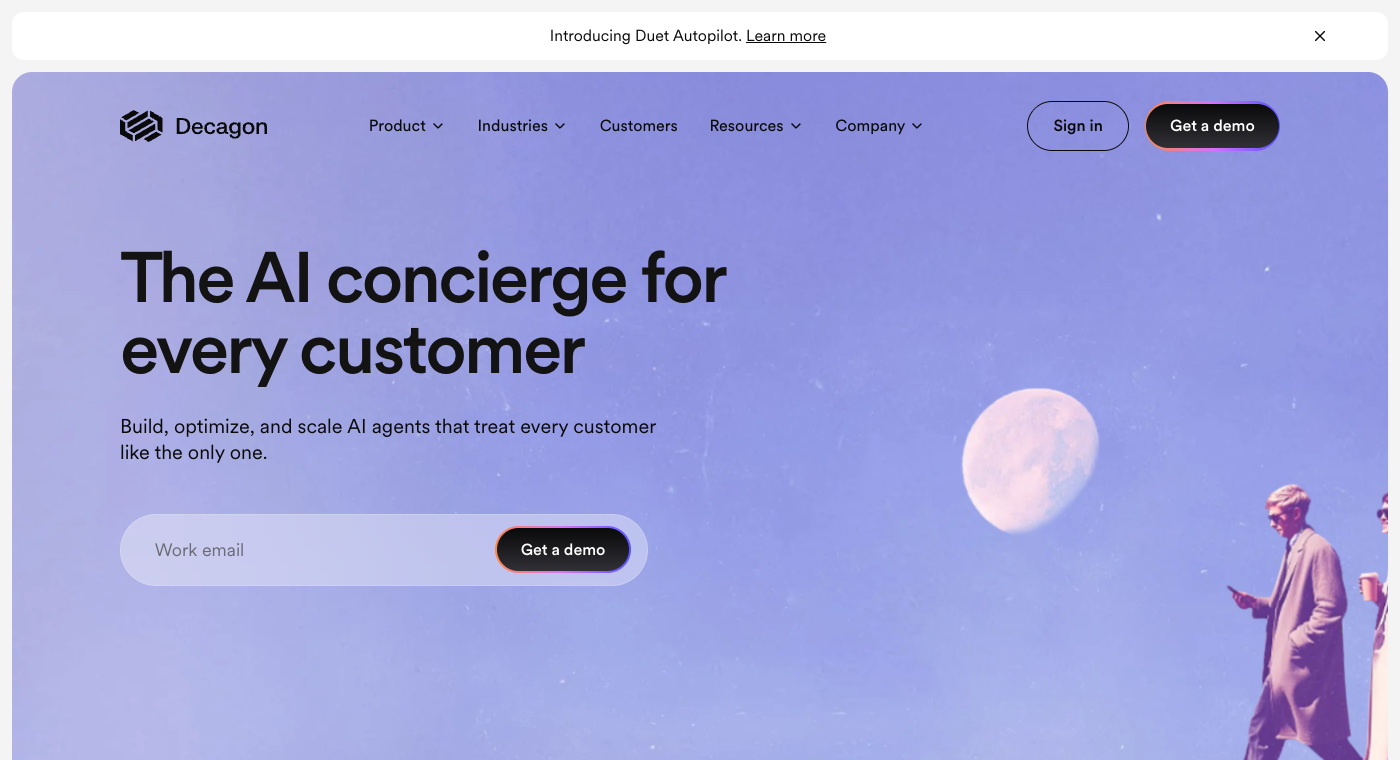
Decagon's bet is that the people closest to the customer should write the rules. Agent behavior lives in plain-English operating procedures that support operators (not engineers, not the vendor) define, test, and change. When the agent mishandles refunds-after-30-days, your CX lead edits the procedure that afternoon. Deployment still expects engineering up front, but the ongoing iteration loop belongs to your team. Decagon's own positioning has moved toward the "AI concierge" framing since its January raise, but the operator-control architecture is the durable difference.
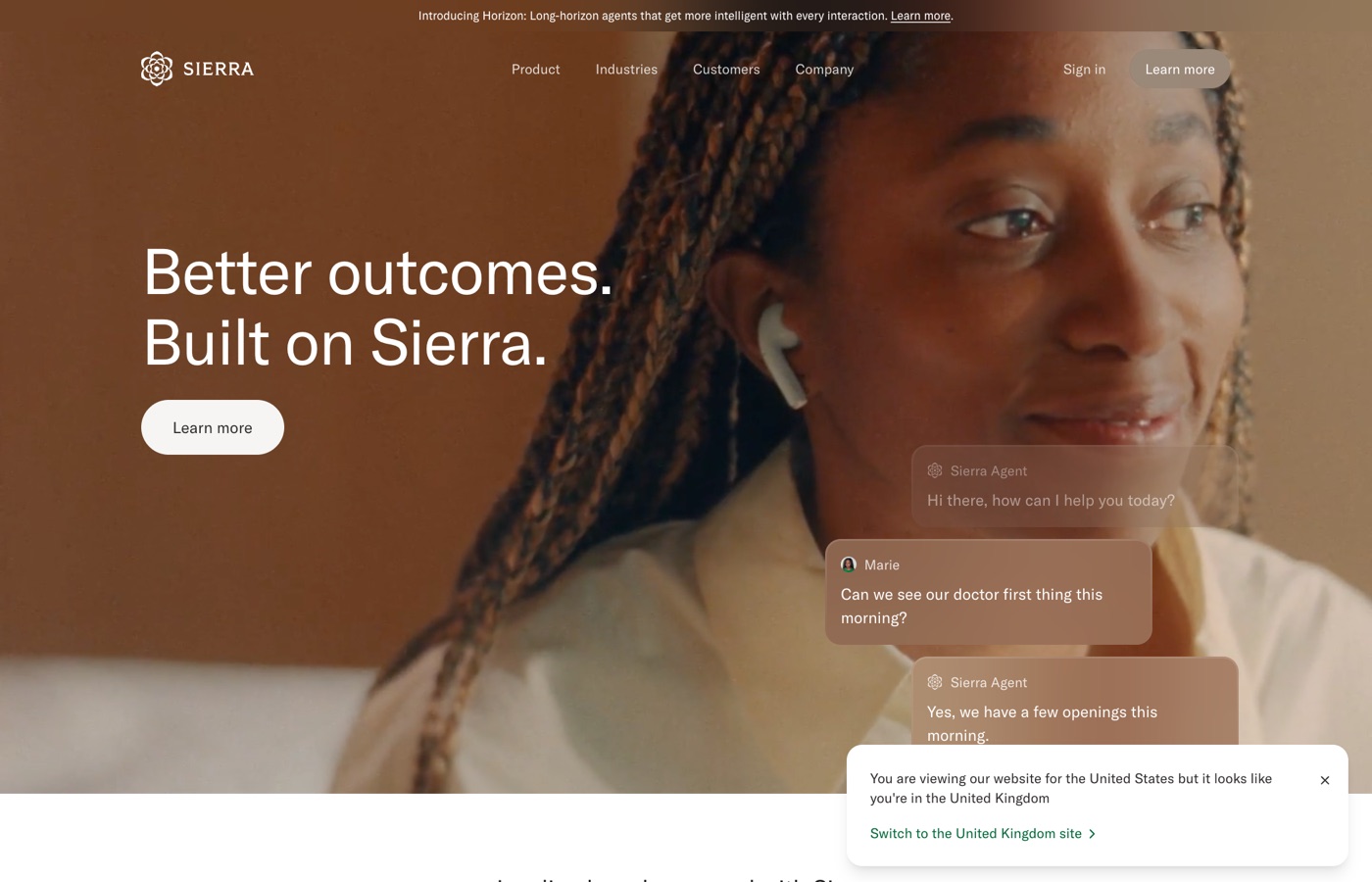
Sierra's bet is engineering depth. Its agents are built with the vendor, deeply customized to the brand, and strongest where the hardest channel problems live: voice in particular, where Sierra is ahead of most of the category. Founded by Bret Taylor (former Salesforce co-CEO, OpenAI board chair) and Clay Bavor, it is the category's credibility pick, and its declared ambition is to be the global standard for AI customer experience. The trade: white-glove means the vendor is in the loop for more of the iteration.
A useful test when you demo both: ask each vendor to change a specific agent behavior live in the call, and watch who does the changing: your operator or their engineer.
Pricing: neither publishes, both are quotable
Neither company has a pricing page, which means every evaluation starts from a quote you cannot benchmark publicly. The reported economics, from deal reporting rather than rate cards: Decagon deployments carry around a $50,000 annual platform fee plus per-conversation usage; Sierra runs outcome-based contracts at roughly $1.50 per resolution, typically starting near $150,000 a year.
The math that number implies: at Sierra's reported rate, an entry contract prices in on the order of 100,000 resolved conversations a year before the per-unit cost competes with mid-market tools. That is the honest volume bar for this whole aisle. Before signing either, get three things in writing: the definition of a billable unit (resolution, conversation, or deflection), what happens to the bill in a spike month, and the pilot's measurement method on your own tickets. Our state of AI support pricing carries the category-wide receipts.
Drag · with Varley
The inbox your team and Varley work in together
Shared inbox and live chat for Gmail teams, with Varley, Drag’s AI, included from $18. Plus an MCP server your own AI tools can drive.
The 80% vs 80%: same number, different meanings
Both companies advertise an 80 percent figure and the figures do not mean the same thing. Decagon's is 80 percent of Duolingo's tickets handled with no human involved: that is deflection, the ticket never reached a person, which is not identical to the customer getting an answer that worked. Sierra's is up to 80 percent of conversations resolved in its Airtable case study: an "up to" flagship number whose definition of resolved is unpublished. Both are the vendor's own measurement of its best-case customer. Production evidence across the category clusters at 40 to 70 percent, and the only number that predicts your queue is a pilot on your own tickets measured by your own definition. The full audit of every vendor's claim is the deciding read here.
Who should pick which
Pick Decagon when the thing that has burned you before is vendor dependency: you want your support leadership editing agent behavior weekly, you have engineering for the initial integration, and your queue is high-volume with well-documented flows. Mid-market and up.
Pick Sierra when the brand experience is the product: consumer-facing scale, voice as a first-class channel, appetite for a built-with-the-vendor deployment, and procurement that reads a $15B war chest and a Fortune-500 roster as the safety it is. Sierra is the pick when you are buying certainty as much as software.
Split honestly: if both fit, the tiebreak is your iteration culture. Teams that treat support flows as living documents lean Decagon; teams that want a finished system installed lean Sierra.
Who should pick neither
If the contract minimums rather than the capability brought you here, you are shopping in the wrong aisle, and that is worth saying plainly. Three honest routes down: the AI already inside your help desk (judge it before paying a second vendor); the per-outcome self-serve tier (Fin at $0.99 per resolution and cheaper options below it, mapped in Fin alternatives); or the seat-included model, where AI works your queue with humans in the loop. That last one is the layer we sell: Drag turns Gmail into an AI shared inbox from $12 a seat with AI included at $18 and its own MCP server, and it is the right answer only for team-scale queues, not for Duolingo's. For the wider four-way field, including Fin and Ada, the agents compared referee page puts all of them side by side.
Frequently asked questions
Is Decagon better than Sierra?
Neither is better outright; they optimize different things. Decagon maximizes operator control (behavior written as plain-English procedures your team edits), Sierra maximizes engineered depth and channel coverage, especially voice. Match the control model to your team: iterating operators favor Decagon, install-and-run enterprises favor Sierra.
Is Sierra better than Decagon for voice support?
By most accounts yes: voice is Sierra's strongest channel and central to its platform, while Decagon's voice capability is newer. If phone support is a primary channel rather than an add-on, that alone can decide the comparison in Sierra's favor.
What does Decagon cost vs Sierra?
Neither publishes pricing. Reported economics as of August 2026: Decagon at around a $50,000 annual platform fee plus per-conversation usage; Sierra at roughly $1.50 per resolution on contracts typically starting near $150,000 a year. Both quote per deployment, so get the billable-unit definition in writing.
What resolution rates do Decagon and Sierra actually achieve?
Their flagship claims are 80% (Decagon at Duolingo, measured as deflection) and up to 80% (Sierra at Airtable, definition unpublished). Both are vendor-measured best cases; production evidence across the category clusters at 40 to 70 percent. Run a measured pilot on your own tickets before trusting any number.
How big are Decagon and Sierra as companies?
As of 2026: Sierra raised $950M in May at a valuation over $15B, with $100M ARR reported in late 2025. Decagon raised a $250M Series D in January at a $4.5B valuation. Both are among the best-funded companies in enterprise AI, so vendor durability is not the differentiator.
Should a small team buy Decagon or Sierra?
No. Both are built and priced for enterprise volume; reported entry contracts imply tens of thousands of conversations a month before the math works. Smaller teams should use the AI inside their help desk, a per-outcome agent like Fin, or an AI-included shared inbox, and revisit this aisle at enterprise scale.

Co-founder
Building Drag for nearly ten years: shared inboxes, boards, and now the AI and agent layer, all on Gmail, plus HeyHelp for the personal inbox. Writes the honest versions of the comparisons.
