












Intercom renamed itself Fin and agreed to a $3.6B Salesforce acquisition. The 8 best alternatives for 2026 if you would rather not ride out the transition: real costs, AI included, honest fits.
Key takeaways
- Intercom's Fin AI is billed at $0.99 per outcome on every plan, and 'outcome' is broad: it includes a customer who simply exits without asking for more help, which makes the bill hard to forecast.
- Seats run $29 to $132, and usage (Fin outcomes, Copilot, SMS/WhatsApp) is charged on top, so the real invoice is usually well above the headline seat price.
- Intercom renamed itself Fin in 2026 and has agreed to be acquired by Salesforce, worth weighing if you are signing a multi-year contract.
- For Gmail teams that want AI included and predictable pricing, Drag is the best-value alternative: $12 to $24 a seat, AI included.
Table of contents
- Two kinds of Intercom alternative
- What this guide covers
- Intercom alternatives compared at a glance
- Pricing comparison: Intercom against the field
- Pricing history: how these prices have moved since 2021
- Drag - best for email-driven Gmail teams
- Missive - best for multi-provider collaboration
- Hiver - best for multichannel close to the inbox
- Front - best for deep multichannel and routing
- Help Scout - best for simple, polished email support
- Freshdesk - best full help desk on a budget
- Zendesk - best for enterprise omnichannel ticketing
- Crisp - best chat-first option for small teams
- When Intercom is still the right choice
- How to choose an Intercom alternative
- Frequently asked questions
The best Intercom alternative for most Gmail support teams in 2026 is Drag, which keeps AI in the seat at $12 to $24; the honest routing for everyone else is below, because the right pick depends on which half of Intercom you are replacing. Start with why the search happens at all. Intercom's Fin is one of the best AI support agents on the market, and that is not really in dispute. What sends teams looking for an alternative is the bill. Fin is priced at $0.99 per outcome on every plan, and "outcome" is broader than it sounds: you are charged not only when Fin genuinely resolves an issue, but also when a customer simply stops replying and leaves the conversation. Add seat costs of $29 to $132, Copilot at around $29 a seat, and usage-based channel fees, and the real invoice is hard to predict and often well above the headline price. There is also a bigger change in the background: Intercom renamed itself Fin in 2026, and Salesforce signed a definitive agreement in June 2026 to acquire it for about $3.6 billion, expected to close by early 2027 pending regulatory clearance. A platform mid-acquisition is worth weighing carefully before signing a multi-year deal.
If you want AI that is included in the seat and pricing you can actually forecast, there are strong alternatives, especially for teams on Gmail. Below we compare the eight best Intercom alternatives for 2026 by real cost, AI model, and who each suits, including where Intercom is still the right choice.
A note on pricing: per seat per month on annual billing unless stated, verified August 2026. Confirm current pricing on each vendor's site.
For the full layer-by-layer cost math, see our Intercom pricing breakdown.

Founder’s Take
A personal note from Nick, co-founder of Drag
Intercom have led the game on adapting for the AI era. They've evolved quickly into an almost UI-less model where Fin and its AI intelligence is what drives the product, and honestly, the market.
They price per outcome, and that's the opening: fast-movers are already building similar functionality at a fraction of the cost per outcome, some metering cheaper, and some, like us, including the AI in the seat and pricing a resolution at half of theirs.
An honest note: prices are still high across Intercom and Fin. I think we'll soon see other products catch up, and once the outcomes are on par or ahead, charging a premium per outcome becomes a much harder play.
Two kinds of Intercom alternative
People looking for an Intercom alternative usually want one of two different things, and it is worth being clear which you are:
- A cheaper AI agent (the Fin model, for less). If what you specifically want is a customer-facing AI agent that autonomously resolves tickets, and you just want it cheaper than $0.99 per outcome, there are outcome-priced alternatives (for example Featurebase Fibi and SparrowDesk at around $0.49 per resolution, or agents like Ada). These keep the same "pay per resolution" model at a lower rate.
- A shared inbox where AI is included and your team resolves things. Many teams evaluating Intercom do not actually need a customer-facing chatbot. They need a collaborative inbox where the team handles email together, with AI helping draft, triage, and summarize, included in the price rather than billed per outcome.
This guide focuses mostly on the second group, because that is where most teams leaving Intercom actually land, and where the biggest, most predictable savings are. If you genuinely need the autonomous customer-facing agent, keep Intercom or compare the outcome-priced agents above. If you want AI included in a shared inbox, read on.
What this guide covers
- Intercom alternatives compared at a glance
- Drag - best for email-driven Gmail teams
- Missive - best for multi-provider collaboration
- Hiver - best for multichannel close to the inbox
- Front - best for deep multichannel and routing
- Help Scout - best for simple, polished email support
- Freshdesk - best full help desk on a budget
- Zendesk - best for enterprise omnichannel ticketing
- Crisp - best chat-first option for small teams
- When Intercom is still the right choice
- How to choose an Intercom alternative
- FAQ
Intercom alternatives compared at a glance
All prices per seat per month, annual billing, August 2026.
| Tool | Type | Starting price | AI model | Best for |
|---|---|---|---|---|
 Drag Drag | Gmail shared inbox | $12 (AI from $18) | Included | Email-driven Gmail teams |
 Missive Missive | Shared inbox (multi-provider) | $14 | Limited / credits | Collaboration across providers |
 Hiver Hiver | Shared inbox (Gmail/Outlook) | $25 | Included from Growth | Multichannel close to the inbox |
 Front Front | Shared inbox (multichannel) | $25 (Starter, 10-seat cap) | Add-ons that stack | Deep multichannel + routing |
 Help Scout Help Scout | Email-first help desk | $25 (Free 5 users) | $0.75/resolution | Simple, polished email support |
 Freshdesk Freshdesk | Full help desk | $19 (6-mo Free Program, 2 agents) | Freddy AI add-on | Zendesk-class features, lower price |
 Zendesk Zendesk | Enterprise help desk | $55 to $115 | $50/seat add-on + per-resolution | Enterprise omnichannel ticketing |
 Crisp Crisp | Messaging/live chat suite | $45 workspace (flat) | AI add-on | Chat-first small teams on a budget |
 Intercom Intercom | AI-first support platform | $29 to $132 | $0.99/outcome, every plan | Powerful AI-first messaging platform |
Only Drag includes AI in the seat, runs on Gmail, and offers its own MCP server.
Drag · with Varley
The inbox your team and Varley work in together
Shared inbox and live chat for Gmail teams, with Varley, Drag’s AI, included from $18. Plus an MCP server your own AI tools can drive.
Pricing comparison: Intercom against the field
The chart is the bill-shape argument in one picture: every alternative is a knowable per-seat range, and Intercom's is the one with a meter on top. The layer-by-layer math on that meter lives in the Intercom pricing breakdown.
Pricing history: how these prices have moved since 2021
Five years of direction is worth pricing into a multi-year decision, especially one signed during an acquisition. The full dataset with every archive capture exposed is on our support tool pricing history page.
Drag - best for email-driven Gmail teams
Best for: Gmail teams who want AI included and predictable pricing, not a per-outcome bill that grows with volume.
Where Intercom charges $0.99 for every outcome Fin produces, Drag includes Varley, its AI, in the seat from the $18 Plus plan. Drag turns Gmail into a shared, assignable inbox with boards, so support lives where your team already works, and its AI acts on your real inbox rather than only a knowledge base. Pricing is flat ($12 to $24 a seat) and predictable as you scale, and Drag is an independent product, not one mid-acquisition.






- Pricing: Starter $12, Plus $18 (AI included), Pro $24. No seat minimum. No per-outcome AI fees.
- G2 rating: 4.5.
- Why teams pick it over Intercom: AI included in the seat; predictable per-seat cost; Gmail-native; its own MCP server to run support from Claude or ChatGPT.
- Watch-outs: It is a Gmail shared inbox, not a full AI-first messaging platform. Teams that want a customer-facing AI chatbot at scale may prefer Intercom or Freshdesk.
See the full Drag vs Intercom comparison.
Missive - best for multi-provider collaboration
Best for: teams that want real collaboration on email across more than one provider.
Missive is a collaborative inbox with in-thread chat, shared drafts, and multi-assignee workflows across Gmail, Outlook, iCloud, and IMAP. A good fit for teams that find Intercom's platform heavier than they need.
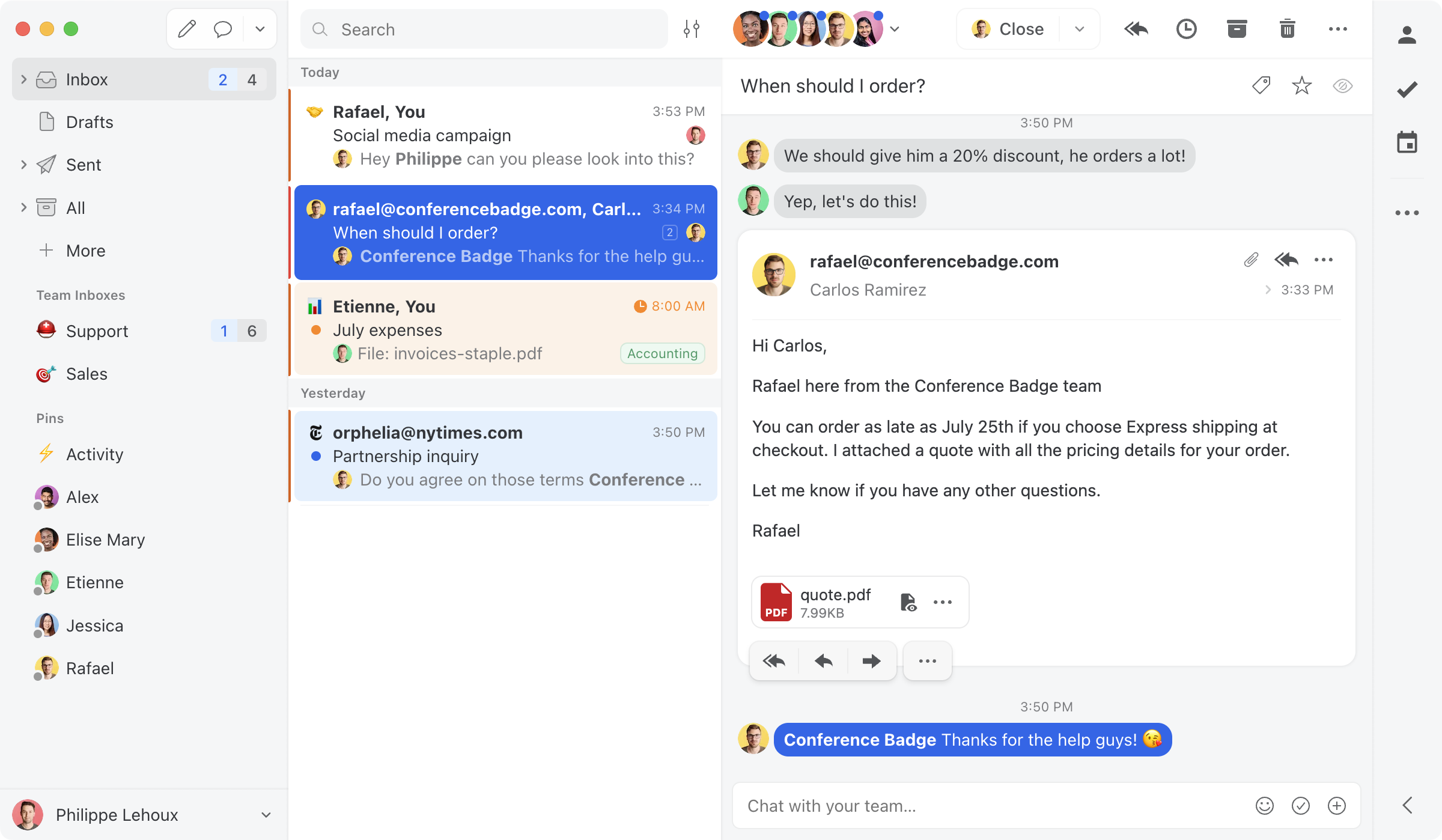
- Pricing: Starter $14, Productive $24, Business $36.
- Watch-outs: Collaboration-first; not an AI-first support platform.
Hiver - best for multichannel close to the inbox
Best for: Gmail or Outlook teams wanting light help-desk features and multichannel without a separate platform.
Hiver layers shared inboxes, assignment, CSAT, and multichannel onto Gmail and Outlook. AI is bundled from the Growth tier up rather than usage-based, so it is more predictable than Fin, though pricing climbs at higher tiers.
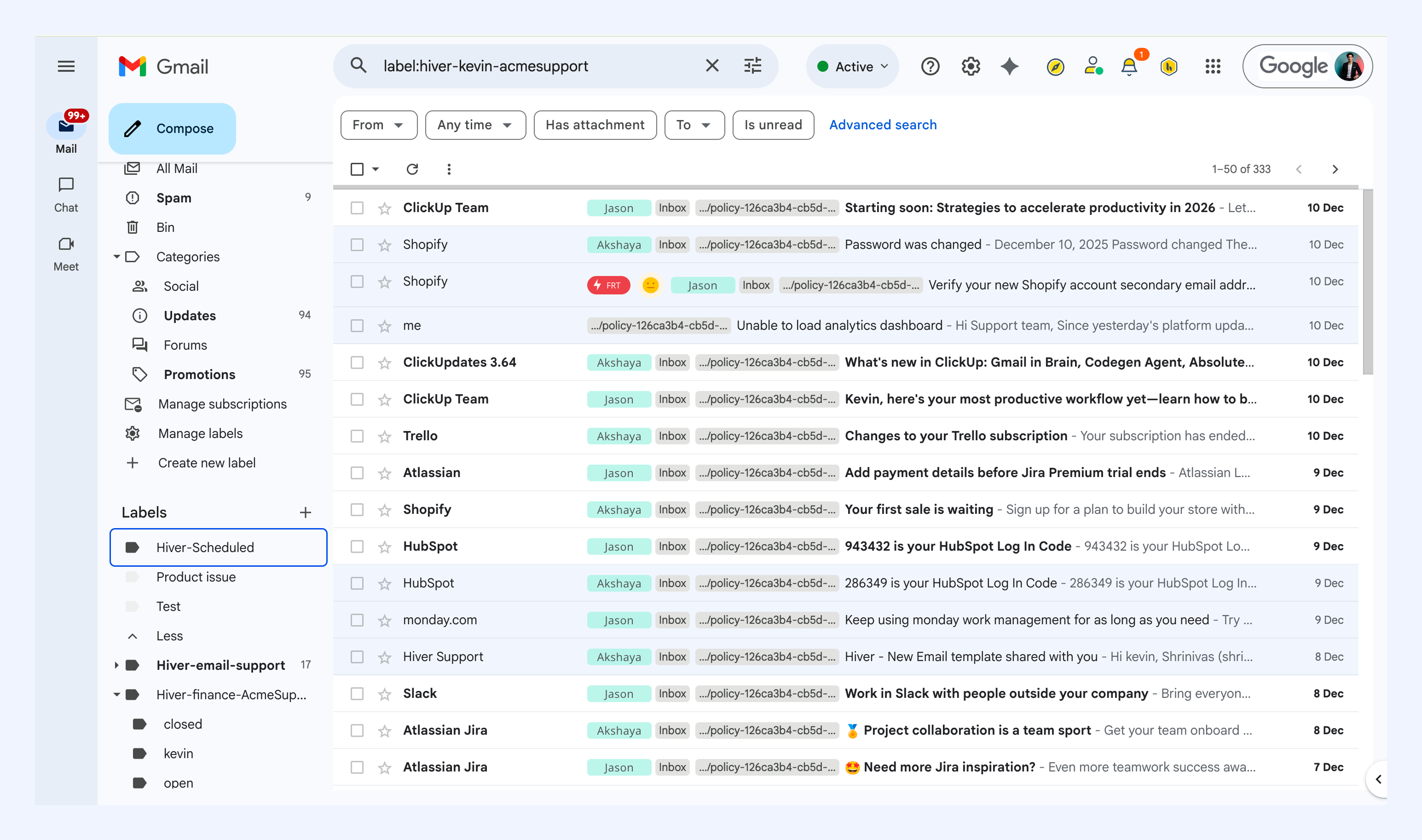
- Pricing: Growth $25, Pro $55, Elite $85, with AI included from Growth up and a 2-seat minimum.
- Watch-outs: AI extra; costs climb; no MCP server. See our Drag vs Hiver comparison.
Front - best for deep multichannel and routing
Best for: teams that want a polished multichannel inbox with mature routing.
Front combines email, SMS, social, and chat with strong routing and assignment. A capable Intercom alternative for collaborative multichannel work, though it runs $25 to $105 a seat with AI add-ons that stack.
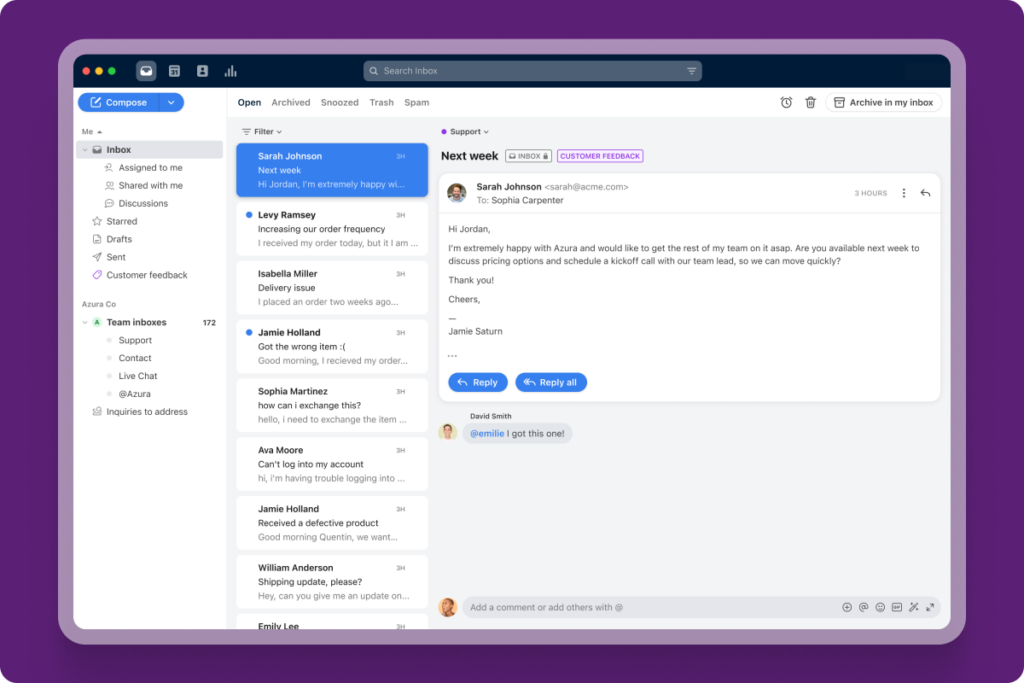
- Pricing: Starter $25 (single channel, up to 10 seats) to $105 (Enterprise); AI add-ons.
- Watch-outs: Costs climb; AI extra; standalone app. See our Drag vs Front comparison.
Help Scout - best for simple, polished email support
Best for: small-to-mid teams wanting a clean, standalone email-first help desk.
Help Scout is a well-designed email-first help desk with an excellent knowledge base. Its AI Answers is also billed per resolution ($0.75), lower than Fin's $0.99, but still usage-based, so model your volume.
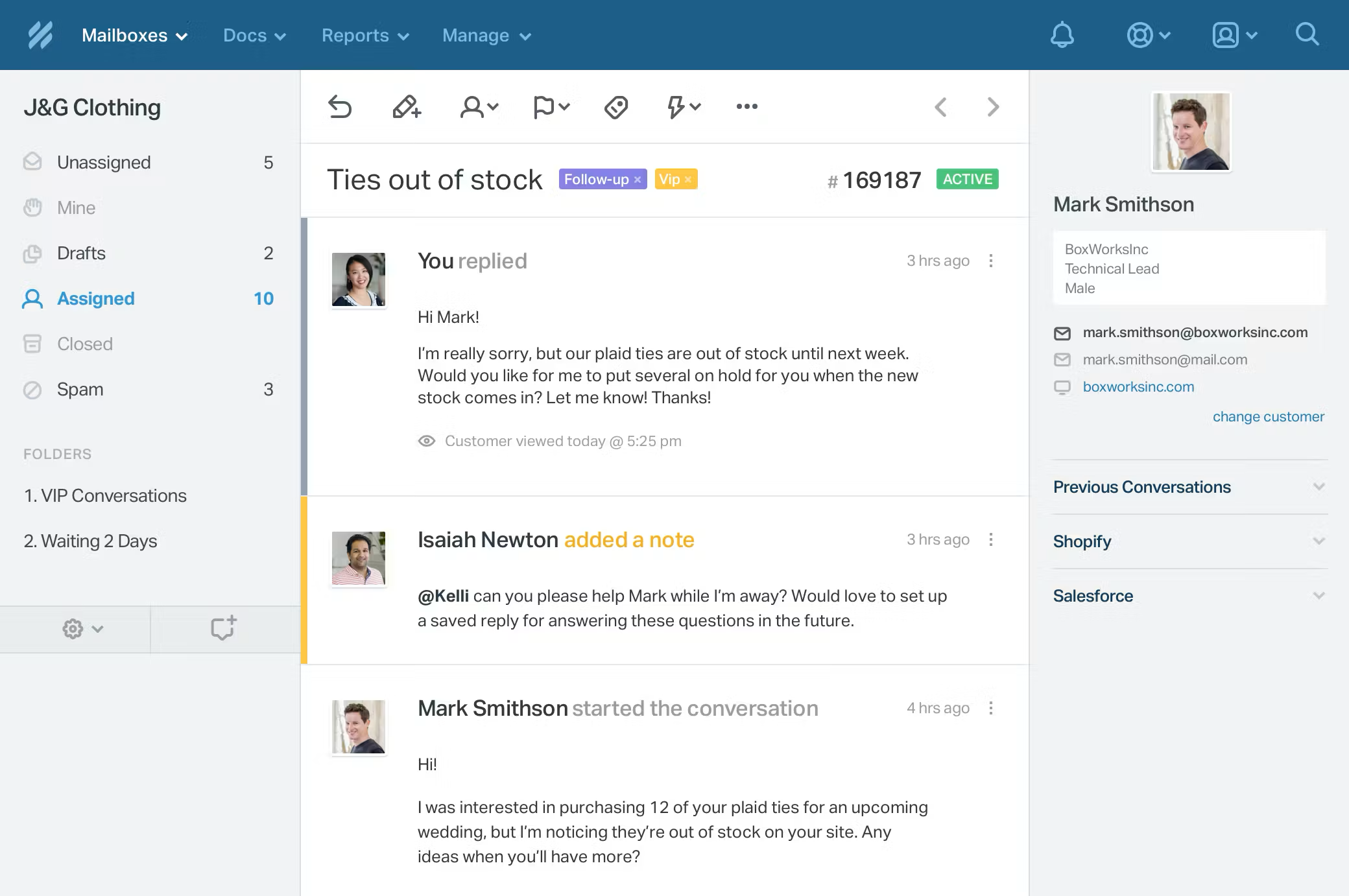
- Pricing: Free (5 users); Standard $25, Plus $45, Pro $75. AI Answers $0.75/resolution.
- Watch-outs: AI per-resolution; standalone platform, not Gmail-native. See our Drag vs Help Scout comparison.
Freshdesk - best full help desk on a budget
Best for: teams that want full ticketing and omnichannel at a lower, more predictable price than Intercom.
Freshdesk offers ticketing, automation, SLAs, and omnichannel, generally priced below Intercom. Freddy AI is an add-on rather than per-outcome, which many teams find easier to budget.
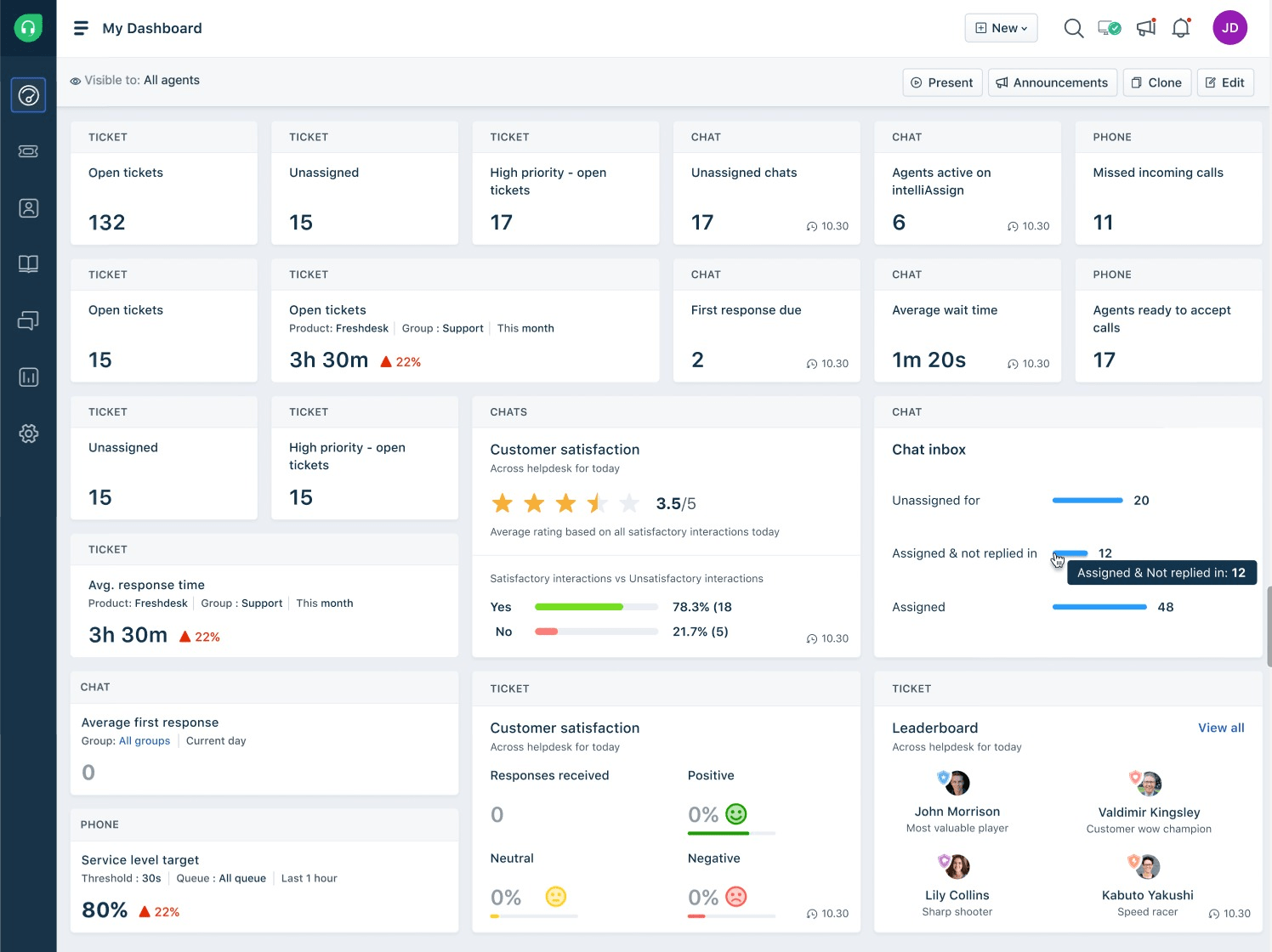
- Pricing: 6-month Free Program (2 agents), then Growth $19, Pro $55, Enterprise $89. Freddy AI add-on.
- Watch-outs: More setup than a shared inbox; AI extra.
Zendesk - best for enterprise omnichannel ticketing
Best for: large teams that need deep omnichannel ticketing, SLAs, and routing at scale.
Zendesk is the heavyweight enterprise help desk, and a common Intercom head-to-head. It is powerful, but its AI is also costly: a ~$50/seat Copilot add-on plus a per-resolution fee, so like Intercom, AI cost scales with usage.
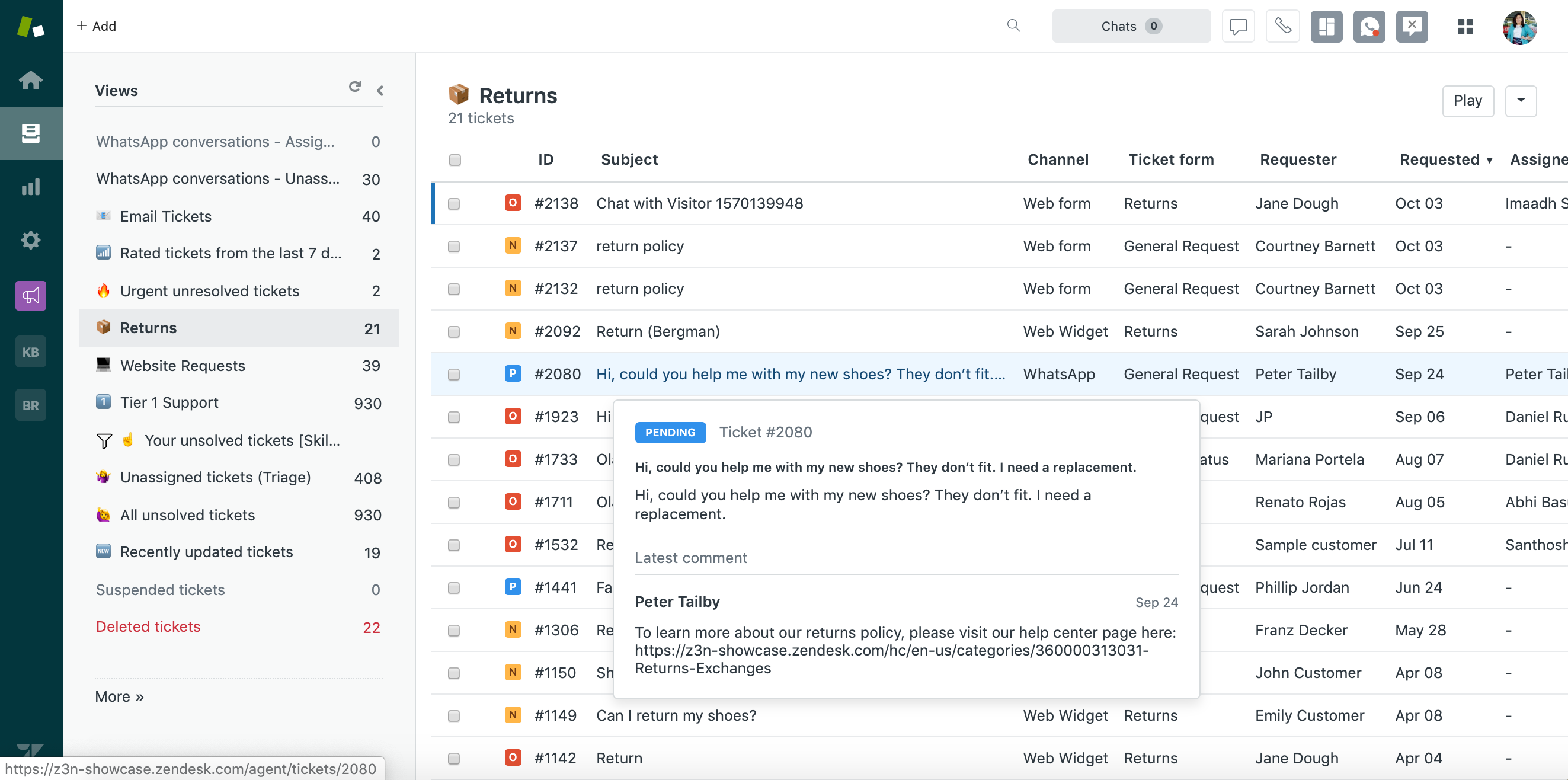
- Pricing: Suite Team $55, Growth $89, Professional $115; Copilot ~$50/seat + per-resolution.
- Watch-outs: Enterprise pricing and complexity; AI doubly charged. See our Drag vs Zendesk comparison.
Crisp - best chat-first option for small teams
Best for: small teams that want Intercom-style live chat and a messenger on a tight, flat budget.
Crisp offers a live-chat widget, shared inbox, chatbot, and knowledge base at low, flat per-plan pricing rather than per-seat or per-outcome, which appeals to small teams priced out of Intercom's messenger. Its AI features are lighter and add-on based.
- Pricing: low flat monthly tiers (per workspace, not per seat).
- Watch-outs: Lighter platform and AI than Intercom; best for smaller, chat-first teams.
When Intercom is still the right choice
To be fair to Intercom: Fin is one of the strongest AI agents available, and the platform is genuinely excellent. Stay with Intercom if you want a best-in-class customer-facing AI chatbot and messenger, an AI-first platform where human and AI agents share one inbox, and you can absorb usage-based pricing that scales with automation. For high-volume teams getting real deflection from Fin, the per-outcome model can pay for itself. The alternatives here are for teams who want AI included and predictable, or who simply want to stay in Gmail, not for those who specifically want Intercom's AI-first platform.
How to choose an Intercom alternative
Start with what you need:
- Email support on Gmail, AI included, predictable cost: Drag.
- Collaboration across providers: Missive.
- Light help-desk features near the inbox: Hiver.
- Deep multichannel and routing: Front.
- Simple standalone email help desk: Help Scout.
- A fuller help desk, cheaper: Freshdesk (or Zendesk at enterprise scale).
- Chat-first on a budget: Crisp.
The biggest difference from Intercom is the AI model: included and predictable (Drag) versus per-outcome and volume-dependent (Intercom). For Gmail teams, a week's trial of Drag against your real inbox will tell you more than any table. To model exact costs at your team size and AI volume, use the shared inbox cost calculator.
Frequently asked questions
What is the best Intercom alternative?
For Gmail teams that want AI included and predictable pricing, Drag is the best-value alternative: $12 to $24 a seat, AI included, plus its own MCP server. If you want a fuller help desk, Freshdesk or Zendesk are closer; for simple email support, Help Scout; for chat-first budgets, Crisp.
Why do teams leave Intercom?
Mostly cost and predictability. Fin is billed at $0.99 per outcome on every plan, and 'outcome' includes a customer who simply stops replying, so the bill scales with usage and is hard to forecast. Seat, Copilot, and channel fees add on top.
How much does Intercom's Fin AI cost?
$0.99 per outcome on every plan, with a 50-outcome monthly minimum ($49.50 floor). An 'outcome' can be a resolution, a procedure handoff, or a disqualification; a lead qualification is $9.99. This is on top of seat costs of $29 to $132.
What counts as a Fin 'resolution'?
Intercom counts a resolution when, after Fin's answer, the customer either confirms it helped or exits without asking for more help. The second case (an 'assumed resolution') means you can be billed when a customer simply leaves, which is why many teams find the bill unpredictable.
Is Intercom being acquired by Salesforce?
Yes, an agreement is signed but not closed. Intercom renamed itself Fin in 2026, and Salesforce announced a definitive agreement in June 2026 to acquire it for about $3.6 billion, expected to close by early 2027 pending regulatory clearance. Pricing is unchanged so far; the uncertainty is worth weighing on multi-year contracts.
What is the cheapest Intercom alternative?
Drag (from $12, AI included), Missive (from $14), and Crisp (low flat tiers) are among the lowest entry prices; Help Scout has a free tier. For teams that want AI without a per-outcome bill, Drag is usually the most predictable.
Is Drag a good Intercom alternative?
For Gmail teams, yes: it does shared-inbox support on Gmail with AI included, plus its own MCP server. It is not an AI-first customer-facing chatbot platform, so teams that specifically want that may prefer Intercom or Freshdesk.
Does Drag have an MCP server and Intercom does not?
Drag publishes its own MCP server, so you can run your inbox from Claude, ChatGPT, or Cursor. See our guide to MCP for customer support. For more on AI agents generally, see what is an AI support agent.
Co-founder
Building Drag for nearly ten years: shared inboxes, boards, and now the AI and agent layer, all on Gmail, plus HeyHelp for the personal inbox. Writes the honest versions of the comparisons.