











Tidio's 2026 plans run $0 to $300-plus a month, but the sticker is the least useful number: billing moved from per-operator to per-conversation, and the AI meters on top. Archived receipts from 2021 to today.
Key takeaways
- Tidio's 2026 customer service plans are Free ($0, 50 conversations), Starter and Growth (shown as $24.17 and from $49.17 a month on annual billing, the equivalents of $29 and $59 monthly), Plus from $300 a month plus usage, and a contact-only Premium tier billed per AI resolution.
- The number that matters is not the sticker but the unit: since 2024 Tidio bills by the 'billable conversation', which is any chat, ticket, email, or social thread a human agent replies to. Answering your customers is the metered event.
- The archives show the billing unit changing three times in five years: per-operator modules in 2021 and 2022 ($18 to $19 a seat, Chatbots jumping $18 to $49 in one year), Lyro AI arriving as a $39 add-on in 2023, then the 2024 repackaging into conversation quotas with Tidio+ at $749, restructured again by 2026 into Plus at $300 plus usage.
- For comparison, Drag runs $12 to $24 a seat with AI included from $18, unlimited users, and no conversation meter; only teams that lean on its AI hard top up credits.
Table of contents
Tidio pricing in 2026 runs from a genuinely free plan to $300-plus a month, but the sticker is the least informative number on the page: what you actually pay is decided by three separate meters, and one of them counts every conversation a human on your team answers. The customer service plans are Free, Starter, Growth, Plus, and Premium; Lyro, the AI agent, is metered separately on top; and Flows, the automation layer, has a meter of its own. This page lays out the current numbers, the three meters, and the archived history from 2021 to today, because Tidio has changed not just its prices but its billing unit three times in five years. For comparison throughout: Drag, our shared inbox for Gmail, costs $12 to $24 a seat with AI included from $18.
What Tidio costs in 2026
| Plan | Annual | Monthly | Sold as |
|---|---|---|---|
| Free | $0 | $0 | 50 billable conversations, live chat and ticketing |
| Starter | $24.17 /mo | $29 | 100 billable conversations |
| Growth ("Popular") | from $49.17 /mo | from $59 | 250 to 2,000 billable conversations, tiered |
| Plus | from $300 /mo + usage | usage-based | custom conversations and seats, premium support |
| Premium | quote only | quote only | custom limits, guaranteed 50% Lyro resolution rate, billed per resolution |
Figures verified against Tidio's own pricing page, August 2026. The $24.17 and $49.17 stickers are the annual-billing equivalents of $29 and $59 a month, the same monthly prices the plans have carried since the 2024 repackaging; the toggle's "2 months free" framing is where the odd decimals come from. Free, Starter, and Growth all cap at 10 seats.
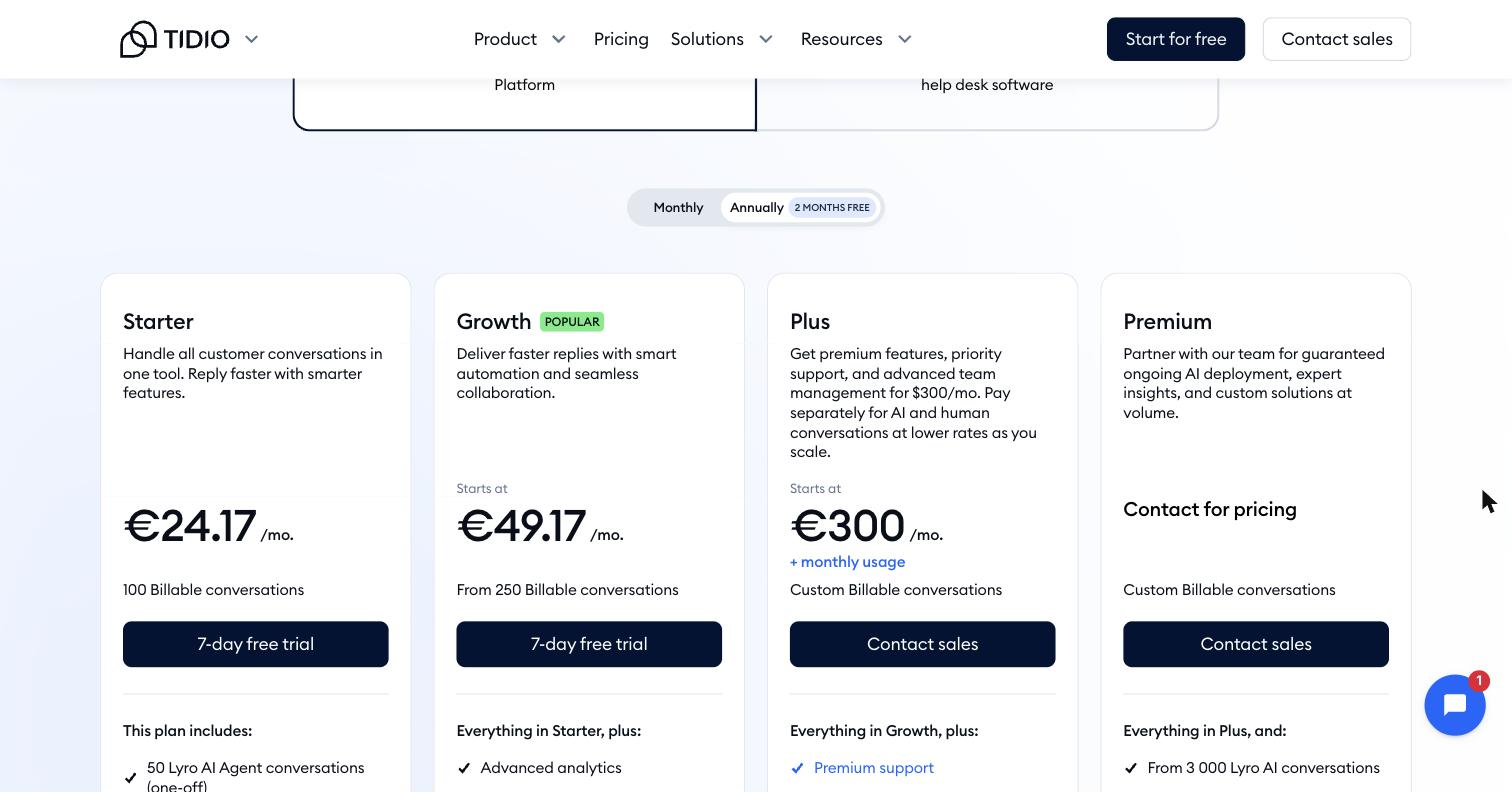
The capture above shows the page as served to a European visitor (€24.17, €49.17, €300): Tidio geo-serves its currency, and the USD ladder behind the same plans carries the same figures, per the archived captures cited throughout this page. The plan structure is identical in both currencies.
Two boundary notes before comparing. Tidio is chat-first: the product is built around a website live chat widget, with ticketing, email, and social folded in behind it, which is why it prices by conversation rather than by seat. And the Free plan is genuinely free forever, one of the few in the category that has never been withdrawn, though at 50 handled conversations a month it is sized as a trial in practice.
The three meters, and which one is yours
The bill is the sum of three separate counters, and the definitions decide everything.
Billable conversations are the core meter. Tidio's own definition: any live chat, ticket, email, or social media conversation that includes a message from a human agent, including conversations your team starts. Spam you ignore is free; a customer you answer is a billable event. The plan quotas (50 free, 100 on Starter, 250 to 2,000 on Growth's ladder) are quotas of answered conversations, which means the meter runs at exactly the speed your team does its job.
Lyro AI conversations are metered separately. Lyro, the customer-facing AI agent, is an add-on shown from $32.50 a month (the annual equivalent of $39, the price it launched at in 2023) covering its own allowance of AI-handled conversations, from 50 upward. Lyro's replies do not count as billable conversations, so the two meters run side by side: one for what the AI answers, one for what your people answer. On Premium, Lyro's billing changes shape again, to pay-per-resolution with a contractually guaranteed 50 percent resolution rate.
Flows visitors are the third counter: the automation product is metered by visitors reached, from 100 a month on the included allowance, with paid Flows shown from $24.17 a month. A busy site can spend this quota without a single conversation happening.
A team evaluating Tidio should price all three meters at once, because they compound. For how every vendor in this category prices its AI layer, see the state of AI support pricing.
Tidio pricing, 2021 to 2026: three billing units in five years
The entry price looks almost flat: $18, $19, $29, $29. What the line cannot show is that the thing being priced changed twice. Capture by capture: in 2021 and 2022 the unit was the operator, with a free plan for 3 seats and extra seats at $10 each. In 2023 the plans were toggleable modules with Lyro AI arriving beside them. By 2024 the seat was gone as the unit of pricing altogether, replaced by the answered conversation. Verified live in August 2026, the structure holds, with the top of the ladder rebuilt.
What moved, capture by capture:
- The unit changed, twice. Per-operator through 2022, toggleable modules in 2023, and conversation quotas from 2024 on. An $18 seat and a $29 quota of 100 answered conversations are not the same product at nearly the same price; they are different meters.
- The automation module jumped $18 to $49 in one year. Chatbots, the 2021 module, cost $18 in July 2021 and $49 by July 2022, the sharpest single move in the archive.
- Lyro arrived at $39, and still costs $39. The AI agent launched as an add-on in 2023 at $39 a month and carries the same monthly price today, shown as $32.50 on the annual toggle. The AI price held; its meter is simply a second counter beside the plan's.
- The cliff softened into a slope. In 2024 the step above Growth's $59 was Tidio+ at $749, with Enterprise at $2,999. By 2026 that step is Plus, from $300 a month plus monthly usage, with a quote-only Premium above it billed per AI resolution. The sticker shrank; the open-ended part of the bill grew.
None of the three models was ever a simple raise; each one changed what you are counted on, which is harder to compare and easy to underestimate.
Drag · with Varley
The inbox your team and Varley work in together
Shared inbox and live chat for Gmail teams, with Varley, Drag’s AI, included from $18. Plus an MCP server your own AI tools can drive.
What a 5-person team pays
Costed for a five-person team, monthly billing, at August 2026 prices. Tidio's plan price is the team price (seats are pooled up to the 10-seat cap), so the comparison is by plan, not per seat:
| Setup | 5-person team, monthly |
|---|---|
| Tidio Starter (within 100 conversations) | $29 |
| Tidio Growth (within 250 conversations) | $59 |
| Tidio Growth + Lyro, moderate volume | ~$98 and metered |
| Tidio Plus (the 11th seat or the 2,001st conversation) | from $300 + usage |
| Drag Starter | 5 × $12 = $60 |
| Drag Plus, AI included | 5 × $18 = $90 |
| Drag Pro | 5 × $24 = $120 |
The rows look close until the meters run. The Tidio figures hold only while the team stays inside its conversation band, its Lyro allowance, and the 10-seat cap; a busy month moves the Growth ladder up a band, and the 11th hire or the 2,001st conversation moves the conversation to Plus, from $300 plus usage. The Drag seats are flat: the same five seats cost $90 in the quiet month and the busy one, an 11th user changes nothing but the seat count, and only a team that leans on the AI hard tops up credits. Model your own numbers in the shared inbox cost calculator.
When Tidio is the better fit
Honestly: when the job is website chat, not email. Tidio is one of the strongest entries in live chat for small ecommerce teams, the Shopify integration is first-class, Lyro is a capable customer-facing bot with an unusually honest resolution guarantee on Premium, and the Free plan really is free forever. A store whose support begins with a visitor on a product page has the right shape for it. The metering also genuinely favors low-volume teams: 50 free answered conversations a month costs less than any per-seat product if that is all you need. If the meters are the sticking point rather than the category, the Tidio alternatives guide ranks the options honestly.
The Drag comparison, plainly
Drag is not a website chat widget, and this page will not pretend it is. It turns the Gmail your team already uses into a shared inbox: assignment, boards, collision detection, automation, and AI assistants included in the seat from $18, with its own MCP server so assistants like Claude can work the queue. The structural difference is the unit: Drag prices the seat and never meters answered conversations, so answering more customers never costs more, and users are unlimited on every plan. If your support starts on your website with anonymous visitors, buy the chat platform. If it starts in an inbox with customers you know, from $12 a seat, the Gmail shared inbox guide shows the shape of the alternative, and you can try it free for 7 days, no card. Full disclosure: Drag is ours, which is why every Tidio number above carries a receipt.
Every chart on this page comes from our full five-year support tool pricing history, where the archived captures and the method behind them are laid out in full.
Frequently asked questions
How much does Tidio cost in 2026?
The customer service plans are Free ($0, 50 conversations), Starter at $24.17 a month on annual billing ($29 monthly), Growth from $49.17 ($59 monthly) covering 250 to 2,000 conversations, Plus from $300 a month plus usage, and a contact-only Premium tier. Lyro AI and Flows are metered separately on top, so the full bill is the sum of three counters.
Is Tidio really free?
Yes, and durably: the Free plan has existed since at least 2021 and has never been withdrawn, which is rare in this category. It covers 50 billable conversations a month with live chat and ticketing on up to 10 seats. The practical limit is the quota: 50 answered conversations is trial-sized for most working teams.
What is a billable conversation on Tidio?
Tidio's own definition: any live chat, ticket, email, or social media conversation that includes a message from a human agent, whether your team replies or starts it. Conversations you never answer are not billed, and a thread counts once no matter how many messages it contains. The effect is that the meter counts your team's answered conversations, so the bill scales with the support you actually give.
What does Lyro AI cost?
Lyro is an add-on shown from $32.50 a month on annual billing, the equivalent of the $39 monthly price it carried at launch in 2023, and it carries its own allowance of AI-handled conversations starting at 50. Lyro's replies do not consume the plan's billable conversations. On the Premium tier, Lyro moves to pay-per-resolution billing with a guaranteed 50 percent resolution rate.
What is the cheapest Tidio alternative?
For teams whose support is email in Gmail rather than website chat, Drag starts at $12 a seat with AI included from $18, unlimited users, and no conversation meter, though it is a shared inbox rather than a chat widget, and the honest comparison respects that boundary. The full Tidio alternatives comparison ranks every route, chat platforms included.

Co-founder
Building Drag for nearly ten years: shared inboxes, boards, and now the AI and agent layer, all on Gmail, plus HeyHelp for the personal inbox. Writes the honest versions of the comparisons.