



Crisp alternatives with email, live chat and a help center in one tool, priced per user. Worked examples show what 4, 11 and 20 people pay on each.
Table of contents
- What this guide covers
- Crisp alternatives compared at a glance
- Why teams look for Crisp alternatives
- Pricing comparison: what Crisp alternatives cost for 11 people
- Pricing history: how Crisp's price has moved
- Crisp competitors by type
- Drag: best Crisp alternative for teams whose support is mostly email
- Tidio: best for small Shopify stores led by chat
- HelpCrunch: best for chat and email campaigns in one tool
- Intercom: best for an AI agent paid per outcome
- HubSpot: best for teams whose sales already run on HubSpot
- LiveChat: best for teams that sell through website chat
- Tawk.to: best for human answered chat on no budget
- Freshdesk: best for ticketing with response-time targets
- Zendesk: best for phone menus and skills-based routing
- Help Scout: best simple help desk apart from team email
- Gorgias: best for Shopify stores that edit orders from support
- Other Crisp competitors people ask about
- When Crisp is still the right choice
- How to switch from Crisp
- How to choose between Crisp alternatives
- Sources
- Frequently asked questions
The short version: The best Crisp alternatives are Drag, Tidio, HelpCrunch, Intercom, HubSpot, LiveChat, Tawk.to, Freshdesk, Zendesk, Help Scout and Gorgias. Pick Drag if your support is mostly email on Google Workspace: email, live chat and a help center, priced per user, so an 11th person adds $12 where Crisp jumps from $95 to $295. Pick Tidio or LiveChat for chat, Intercom for an AI agent, HubSpot for a CRM, Tawk.to for free and Gorgias for Shopify.
Drag is our product, so it is first on this list and you should weigh that. This page compares eleven tools. If you only want Drag against Crisp, our Crisp alternative page puts the two side by side.
We read these prices on each vendor's own site in November 2026, and LiveChat's and HubSpot's again on November 16. Per user prices are per month on annual billing. Crisp is priced per workspace, Tidio by conversations and Gorgias by tickets, so those are monthly prices for the whole team. Prices change often, so check the vendor's page before you buy.

Founder’s Take
A personal note from Nick, co-founder of Drag
Most teams who come to us from Crisp did not leave over chat. They left the week they hired their eleventh person and the bill went from $95 to $295 for the same tool.
The second pattern is quieter: they bought a chat widget, and a year later most of their support was arriving at support@ by email, forwarded into an app built for something else. Crisp is honest value for a small chat-led team. It is just priced in steps, and growing teams find the steps.
What this guide covers
- Crisp alternatives compared at a glance
- Why teams look for Crisp alternatives
- Pricing comparison: what Crisp alternatives cost for 11 people
- Pricing history: how Crisp's price has moved
- Crisp competitors by type
- 1. Drag
- 2. Tidio
- 3. HelpCrunch
- 4. Intercom
- 5. HubSpot
- 6. LiveChat
- 7. Tawk.to
- 8. Freshdesk
- 9. Zendesk
- 10. Help Scout
- 11. Gorgias
- Other Crisp competitors people ask about
- When Crisp is still the right choice
- How to switch from Crisp
- How to choose between Crisp alternatives
- Sources
- Frequently asked questions
Crisp alternatives compared at a glance
Starting prices are the cheapest paid plan, read on each vendor's own site in November 2026. HelpCrunch lists its prices on its own site, where they depend on team size and email volume.
| Tool | Starts at | How it is priced | What AI costs | Best for |
|---|---|---|---|---|
 Drag | $12 | Per user, no seat minimum or cap | Included from the $18 plan | Teams whose support is mostly email on Google Workspace |
 Tidio | Free, then $24.17 | By conversations, up to 10 agents on self-serve plans | Lyro add-on from $32.50 a month for 50 conversations | Small Shopify stores led by chat |
 HelpCrunch | Listed on its site | Per team member, or an Unlimited plan for any team size | AI conversations are an add-on | Chat and email campaigns in one tool |
 Intercom | $29 | Per seat | $0.99 per Fin outcome, Copilot $29 per agent | An AI agent paid per outcome |
 HubSpot | Free for 2 users, then $20 | Per seat | 500 HubSpot Credits on Starter, then $0.01 per credit | Teams whose sales already run on HubSpot |
 LiveChat | $19 | Per user | 10 AI resolutions a month on Essential, then $49.50 per 50 | Teams that sell through website chat |
 Tawk.to | Free | Free for unlimited agents | AI Assist add-on from $29 a month | Human answered chat on no budget |
 Freshdesk | $19 (email only), Omni from $29 | Per agent | Copilot $29 per agent on the $55 plan and up, AI agent $49 per 100 sessions after the first 500 | Ticketing with response-time targets |
 Zendesk | $19 (email only), Suite from $55 | Per agent | $1.50 to $2.00 per resolution beyond 5 or 10 per agent, Copilot $50 per agent | Phone menus and skills-based routing |
 Help Scout | Free for 5 users, then $25 | Per user | $0.75 per conversation Envoy resolves | A simple help desk apart from team email |
 Gorgias | $10 for 50 tickets (monthly) | By tickets, not by agent | $0.90 per automated interaction in its tier, then $1.50 | Shopify stores that edit orders from support |
 Crisp | Free for 2 seats, then $45 for 4 | Per workspace, with seats set by plan | $5 to $75 of monthly AI credits, then pay as you go | Chat-led teams that fill a plan's seats |
Why teams look for Crisp alternatives
Crisp is live chat, a shared inbox, a knowledge base and an AI agent called Hugo in one app on the web, Mac, Windows, iPhone and Android. It is priced per workspace, not per user, and for a team that fills its plan it is very good value. Teams rarely leave because it stopped working. They leave over three lines on the bill and one thing about where email lives.
The 5th and 11th person. Each plan has a set number of seats. Mini is $45 a month for 4, Essentials $95 for 10 and Plus $295 for 20, then $10 for each extra agent. A 5th person moves the workspace from $45 to $95. An 11th moves it from $95 to $295. In a late 2024 repackaging, the $95 plan kept its price but went from 20 seats to 10.
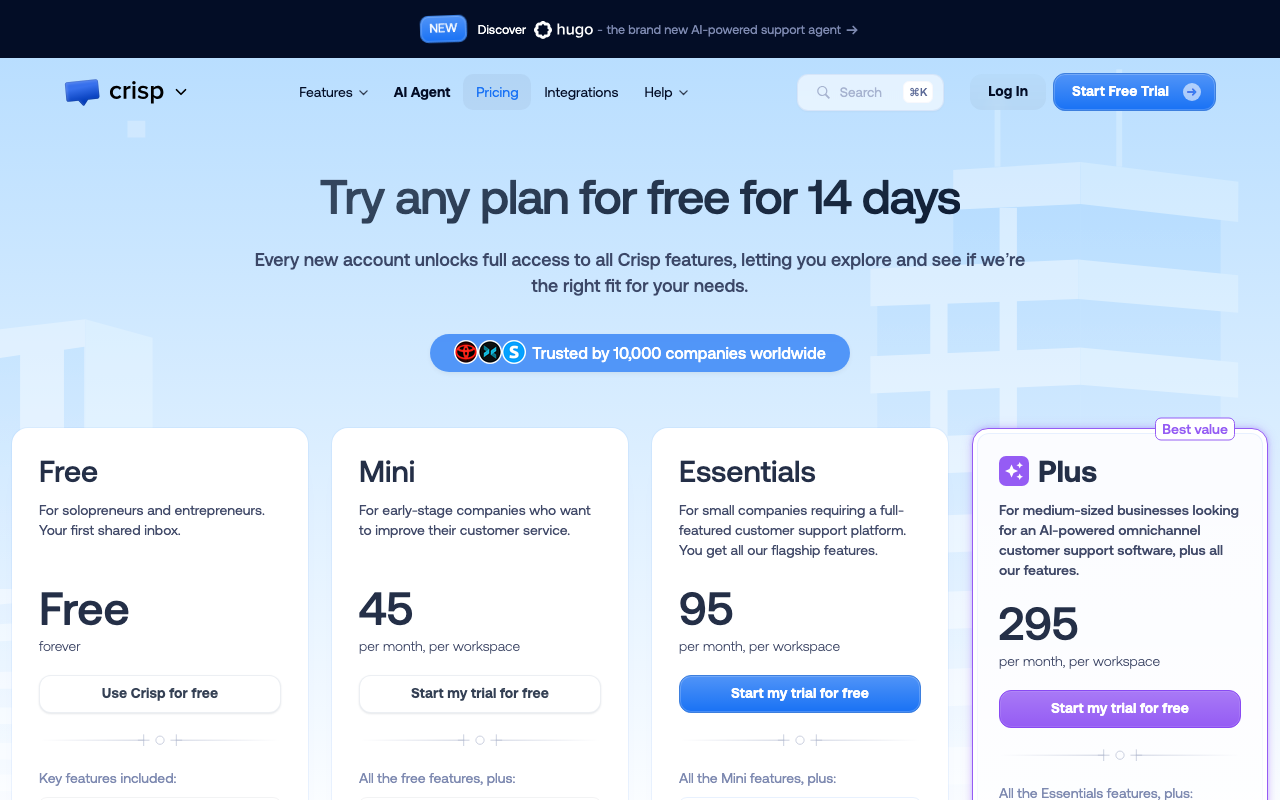
AI runs on credits that stop. Every paid plan includes AI credits each month: $5 on Mini, $25 on Essentials and $75 on Plus. Crisp puts that at about 90, 450 and 1,350 automated conversations. Credits reset each month and do not carry over. Crisp's help center says that when they run out, Hugo stops answering unless you turn on pay as you go, for which it publishes no rate.
The help center and rules start at $95. Mini has shared email, shortcuts and private notes. The knowledge base, routing rules, assignment, workflows and analytics start on Essentials. Ticketing starts on Plus.
Email is forwarded in. Crisp was built around its chat widget. Your support address forwards into Crisp and your team answers there, not in Gmail. Teams whose support turns out to be mostly email feel that most.
Pricing comparison: what Crisp alternatives cost for 11 people
List prices hide the part that matters: which plan your team size lands on. Here is the monthly bill for 11 people, the size where Crisp's price jumps, on the cheapest plan that answers both email and website chat.
| Tool | Plan for 11 people | Monthly bill | What AI adds |
|---|---|---|---|
| Tawk.to | Free | $0 | AI Assist add-on from $29 a month |
| Gorgias | Basic, 300 tickets | $50 | $27 a month for 30 automated interactions, then $1.50 each. Tickets past 300 are $0.40 |
| Drag | Starter, $12 | $132 | AI drafts on Plus: $198. AI resolves on Pro: $264 |
| HubSpot | Starter, $20 | $220 | 500 HubSpot Credits included, then $0.01 per credit |
| Help Scout | Standard, $25 | $275 | $0.75 per conversation Envoy resolves |
| Crisp | Plus, for 20 seats | $295 | $75 of credits, about 1,350 automated conversations, then pay as you go |
| Tidio | Plus, from $300 plus usage | $300 or more | Lyro priced on top |
| Intercom | Essential, $29 | $319 | $0.99 per Fin outcome |
| Freshdesk | Omni Growth, $29 | $319 | AI agent 500 sessions once, then $49 per 100 |
| Zendesk | Suite Team, $55 | $605 | 5 resolutions per agent a month, then $1.50 to $2.00 each |
Three notes on the math. Tidio's self-serve plans stop at 10 agents, so 11 people need Plus. Freshdesk's $19 plan is email only; live chat is in Freshdesk Omni. Gorgias bills by tickets, so a busy month costs more. Tawk.to, and Gorgias at low ticket volume, cost less than Drag for 11 people.
Two tools on this list are not in the chart below. LiveChat's Essential plan is $19 per user, so 11 people pay $209 a month. HelpCrunch lists its prices on its own site, where they depend on team size and email volume.
What Crisp costs at five team sizes
Crisp's price is set by plan boundaries, so the useful way to read it is by team size. Drag's bill grows by one person's price at a time.
| Team | Crisp plan | Crisp a month | Drag Starter, $12 | Drag Plus, $18 | Drag Pro, $24 |
|---|---|---|---|---|---|
| 4 people | Mini | $45 ($95 for a knowledge base) | $48 | $72 | $96 |
| 10 people | Essentials | $95 | $120 | $180 | $240 |
| 11 people | Plus | $295 | $132 | $198 | $264 |
| 20 people | Plus | $295 | $240 | $360 | $480 |
| 25 people | Plus and 5 extra agents | $345 | $300 | $450 | $600 |
Crisp costs less than Drag for a full 10 person Essentials workspace, and less than Drag's Pro plan from 13 people up. Drag costs less on every plan at 11 people, and for four people who want a help center: $48 on Starter or $72 on Plus, against $95. On Drag the help center, live chat and rules are on every plan, and Varley, Drag's AI, is in the price per user from $18.
To try your own team size, use the shared inbox cost calculator.
Each bar below runs from a tool's cheapest plan to its most expensive.
If you want Crisp's own plans broken down one by one, see our Crisp pricing guide.
Pricing history: how Crisp's price has moved
Crisp's cheapest paid plan was $25 a month for 4 seats from 2021 to mid 2024. A late 2024 repackaging renamed the plans, raised that entry price to $45, and cut the $95 plan from 20 seats to 10. AI credits appeared on every paid plan card by August 2026. The free plan for 2 seats has stayed throughout.
The lesson is simple. With per workspace pricing, the number that matters is how many seats the plan holds, and that can change while the price stays put. Our support tool pricing history shows the full set of charts.
Crisp competitors by type
Crisp competitors fall into four groups, and knowing which you want cuts the list fast.
- Shared inbox on your email: Drag. Email stays in Gmail, answered there or in Drag's own web, desktop and mobile apps, with live chat and a help center beside it.
- All-in-one chat platforms, like Crisp: Tidio, HelpCrunch, Intercom and HubSpot.
- Chat specialists: LiveChat and Tawk.to.
- Help desks: Freshdesk, Zendesk and Help Scout, plus Gorgias for online stores. Email and chat become tickets.
1. Drag: best Crisp alternative for teams whose support is mostly email
Best for: teams on Gmail or Google Workspace that chose a chat tool, then found most of their support arrives at support@.
Drag is a shared inbox for teams, used by more than 240,000 people since 2017. Every email has an owner, teammates leave notes next to it, and you can see when someone else is already replying. Boards, rules and reporting come with every plan.
Email, chat and a help center in one product. Live chat for your website and a public help center are on every plan, from $12, answered in the same place as email, with the same owners and notes. A shared WhatsApp inbox is on Pro. On Crisp, the knowledge base starts at $95.






Priced per user, with no jump between plans. Every Drag plan takes any team size, from one person up. An 11th person adds $12 to $24 a month, the same as the 2nd.
AI is in the price from $18. Varley, Drag's AI, tags and summarizes email and drafts replies on the $18 Plus plan. On the $24 Pro plan it also resolves routine conversations on its own. Varley answers questions about your inbox, helps you set Drag up, and learns from your team's replies and documents.
It works on Gmail and in its own apps. Your email stays in the Gmail account it already arrives in, with nothing to forward. Drag also has web, Mac, Windows, iPhone and Android apps for people who prefer a separate place for team email.
It works with the AI assistant you already use. Pro connects Drag to Claude, ChatGPT, Gemini, Microsoft Copilot and Cursor. Your assistant can read the queue, assign email, draft replies and send them.
- Pricing: Starter $12, Plus $18, Pro $24 per user a month on annual billing ($16, $22 and $30 monthly). No seat minimum.
- Trial: 7 days, no card.
Drag · with Varley
Outgrown your Crisp plan?
Drag gives your team email, live chat and a help center in one shared inbox, priced per user from $12 on annual billing, so the next hire adds one person's price, not a new plan. It works on Gmail and in its own web, desktop and mobile apps, with Varley, Drag's AI, included from $18. 7-day free trial, no card.
2. Tidio: best for small Shopify stores led by chat
Best for: online stores, especially on Shopify, whose support starts in the chat widget.
Tidio is the Crisp alternative people compare most. It is a chat-first app on the web, Mac, Windows, iPhone and Android, with email, Messenger, Instagram and WhatsApp on every plan and order management for Shopify. Lyro, its AI agent, is an add-on from $32.50 a month for 50 conversations.

Tidio bills by conversations a human agent answers, not by seats. Its help center says that at the limit you can no longer reply to incoming messages.
- Pricing: Free (50 conversations), Starter $24.17 (100), Growth from $49.17 (250 to 2,000), Plus from $300 plus usage. 7-day trial, no card.
- Worth knowing: self-serve plans stop at 10 agents. The help center and branding removal are add-ons.
3. HelpCrunch: best for chat and email campaigns in one tool
Best for: small teams that want live chat, a help desk, a knowledge base and email campaigns from one vendor, the closest match to Crisp's bundle.
HelpCrunch is priced per team member on its Basic and Pro plans, with an Unlimited plan for any number of team members. Its pricing page sets the price by team size and email volume, and AI conversations are an add-on, so check the figure for your team on its site.

- Pricing: Basic and Pro per team member, plus an Unlimited plan, all listed on HelpCrunch's site.
- Worth knowing: the price is set by team members and email volume together, so price your mailing list as well as your team.
4. Intercom: best for an AI agent paid per outcome
Best for: teams that want Fin, Intercom's AI agent, to answer most conversations on its own and can budget for it by the outcome.
Intercom is a polished messaging platform with live chat, a shared inbox, ticketing and a public help center on every plan. Fin answers email and chat and costs $0.99 per outcome. An outcome includes a customer who leaves without asking for more help. Copilot, which drafts for agents, is $29 per agent a month after 10 free conversations.

- Pricing: Essential $29, Advanced $85, Expert $132 per seat. No free plan. 14-day trial, no card.
- Worth knowing: email reaches Intercom by forwarding. The company is now called Fin, and Salesforce completed its purchase in September 2026. Compare Fin with Drag Pro, where Varley resolves routine conversations in the price per user. More in our Fin AI alternatives guide.
5. HubSpot: best for teams whose sales already run on HubSpot
Best for: teams that keep customer records, deals and marketing in HubSpot's CRM and want support in the same place.
HubSpot Service Hub puts live chat and a shared inbox on top of HubSpot's CRM, so every conversation sits next to the customer's record. The free plan covers 2 users, with HubSpot branding on the chat.

- Pricing: Free for 2 users, Starter $20 per seat, Professional $90 to $100 per seat plus a required $1,500 onboarding fee. HubSpot's page does not label which figure is annual.
- Worth knowing: the knowledge base starts on Professional. AI uses HubSpot Credits: 500 on Starter, 3,000 on Professional, then $0.01 each.
6. LiveChat: best for teams that sell through website chat
Best for: teams whose website chat is a sales channel as much as a support one.
LiveChat has run since 2002 and is a refined chat tool with a clean agent workspace. An AI agent and Copilot come with the Essential plan, with 10 AI resolutions a month; more are $49.50 for 50. Help desk and chatbot tools are separate products from the same team.

- Pricing: Essential $19, Growth $79 per user a month on annual billing ($25 and $99 monthly). Enterprise is by quote. 14-day trial, no card.
- Worth knowing: Growth includes 200 AI resolutions a month, so the jump from $19 to $79 is mostly about AI volume.
7. Tawk.to: best for human answered chat on no budget
Best for: teams with no budget for software that answer website chat themselves.
Tawk.to is free, with unlimited agents and unlimited chats. It makes its money from optional extras: AI Assist from $29 a month, removing its branding for $29 a month, and hired agents at $1 an hour.

- Pricing: free. Add-ons are optional.
- Worth knowing: automation and reports are light next to the paid tools here, so it suits teams that answer every chat by hand.
8. Freshdesk: best for ticketing with response-time targets
Best for: support teams that run on tickets and several sets of response-time targets.
Freshdesk turns email into tickets, with a customer portal and a help center on every plan. Several sets of response-time targets and smart routing come on the $55 plan. It has no user cap.

Freddy AI Copilot is $29 per agent a month on the $55 and $89 plans. The AI agent includes 500 sessions once, then costs $49 per 100, and unused sessions do not carry over.
- Pricing: Growth $19, Pro $55, Enterprise $89 per agent (email). Freshdesk Omni, with live chat, WhatsApp and social: $29, $79, $119. 14-day trial, no card.
- Worth knowing: coming from Crisp, you will want Omni, because the $19 plan has no live chat.
9. Zendesk: best for phone menus and skills-based routing
Best for: support teams that need phone menus, skills-based routing and many integrations.
Zendesk is the biggest help desk here. Suite plans include phone, live chat and messaging, with skills-based routing and phone menus on Suite Professional. Zendesk lists more than 1,800 apps and integrations.

AI agents come with 5 or 10 resolutions per agent a month, then $1.50 each bought ahead or $2.00 as you go. Copilot is a $50 add-on per agent on Professional plans and up.
- Pricing: Support Team $19 (email only), Suite Team $55, Suite Professional $115 per agent. 14-day trial, no card.
- Worth knowing: live chat and a help center start at $55, so 10 people pay $550 a month.
10. Help Scout: best simple help desk apart from team email
Best for: small support teams that want a help desk kept apart from the team's own email.
Help Scout is a help desk that is easy to learn. From the $25 plan it covers email, live chat, SMS, WhatsApp, Instagram and Messenger, with a help center on every plan, the free one included. The free plan covers 5 users, 1 inbox and 100 contacts a month.

AI writing help is on paid plans and AI drafts start on the $45 plan. Envoy, its AI agent, costs $0.75 for each conversation it resolves.
- Pricing: Free, then Standard $25 (up to 25 users), Plus $45, Pro $75 (10-user minimum). 15-day trial, no card.
- Worth knowing: extra inboxes are $10 a month each.
11. Gorgias: best for Shopify stores that edit orders from support
Best for: online stores whose agents refund, cancel and change orders from inside the help desk.
Gorgias is a help desk for ecommerce. Agents see a customer's orders next to the ticket and can run actions such as a Shopify refund or cancellation. Email, chat, social and a help center are on every plan, and it is priced by tickets, not by agent.

Its AI agent costs $0.90 per automated interaction within the tier you pick, then $1.50, and each one also counts as a ticket.
- Pricing: Starter $10 a month for 50 tickets (monthly only, 3 seats), Basic $50 for 300, Pro $300 for 2,000, Advanced $750 for 5,000, on annual billing. 7-day trial, no card.
- Worth knowing: tickets past your plan cost $0.36 to $0.40 each, so a holiday spike shows on the bill. More in our Gorgias alternatives guide.
Other Crisp competitors people ask about
Two more names come up on most lists. Front is a shared inbox in its own app for email, SMS, chat and social messages. Its $25 plan covers one channel type for up to 10 seats, and email with live chat needs the $65 plan.
Re:amaze puts email, live chat, social messages and an FAQ in one help desk from $26.10 per team member a month on annual billing, with $0.85 for each AI resolution beyond 5 to 20 per user.
When Crisp is still the right choice
Crisp is the better pick for a chat-led team of up to ten people that fills an Essentials workspace. Ten people pay $95 a month for the whole workspace, about $9.50 each, and that plan brings WhatsApp Business, Instagram, SMS, Line and Viber into one inbox with website chat.
How to switch from Crisp
The move is simpler than most teams expect, and the steps are much the same whichever tool you pick. Drag has ready-made Claude prompts that carry out the migration in your browser, and our support team helps.
- Start a trial and connect one shared address. Use a real inbox, such as support@, so you see real work.
- Invite the people who answer that address, then rebuild the tags, saved replies and assignment rules you used in Crisp.
- Swap the chat widget on your website, so visitors see one chat window.
- Turn off the forwarding rule that sends your support email to Crisp, once the team is answering in the new tool.
- Copy what you need from Crisp before you cancel. Past conversations, notes and knowledge base articles live in Crisp and do not move across on their own.
How to choose between Crisp alternatives
- Your support is mostly email on Google Workspace and you want chat and a help center beside it: Drag.
- You run a small Shopify store led by chat: Tidio, or Gorgias if agents edit orders.
- You want Crisp's bundle with email campaigns: HelpCrunch.
- You want an AI agent to answer most conversations: Intercom, or Drag Pro with AI in the price per user.
- Your sales and marketing run on HubSpot: HubSpot.
- Website chat is a sales channel: LiveChat. You have no budget: Tawk.to.
- You want a help desk: Help Scout to keep support apart from team email, Freshdesk for response-time targets, Zendesk for phone menus.
- Your chat-led team fills a Crisp plan exactly: stay on Crisp.
Whatever you shortlist, run a trial on one real shared address for a week. If your team is on Google Workspace, Drag's trial runs 7 days and needs no card. For the wider field, see the best shared inbox software.
Sources
Prices and features were read on these pages in November 2026. Crisp: its pricing page and its help articles on Hugo AI billing, Hugo Copilot, the Essentials plan and receiving email.
Rivals: Tidio's pricing page, FAQ and help center; Intercom's pricing page and help articles on plans, Fin outcomes and Copilot; HubSpot's Service Hub pricing page; LiveChat's pricing page; Freshdesk's and Freshdesk Omni's pricing pages; Zendesk's pricing page; Help Scout's pricing page; Gorgias's pricing page and help docs; Front's and Re:amaze's pricing pages; and Drag. HelpCrunch's pricing page was read on November 16, 2026, and Tawk.to's in July 2026. Fin's ownership comes from Salesforce's announcement of September 10, 2026 that it had completed its acquisition of Fin, formerly Intercom. Crisp's price history comes from dated Internet Archive copies of its pricing page.
Frequently asked questions
What are the best Crisp alternatives?
The best Crisp alternatives are Drag, Tidio, HelpCrunch, Intercom, HubSpot, LiveChat, Tawk.to, Freshdesk, Zendesk, Help Scout and Gorgias. Drag gives Google Workspace teams email, live chat and a help center in one shared inbox from $12 per user. Tidio and HelpCrunch are the nearest chat platforms, Intercom leads on AI agents, Tawk.to is free and Gorgias suits Shopify stores.
How much does Crisp cost in 2026?
Crisp charges per workspace, not per person. Free covers 2 seats, Mini is $45 a month for 4, Essentials $95 for 10 and Plus $295 for 20, with extra agents at $10 each. Enterprise is by quote. Paid plans include $5, $25 or $75 of AI credits a month. Crisp lists one price per plan; yearly payment is switched on in its app.
What happens when Crisp's AI credits run out?
Hugo, Crisp's AI agent, goes quiet, and new conversations wait for a person on your team until the balance resets with the next billing cycle. Pay as you go keeps it answering within a spending limit you set, though Crisp gives no rate for it. Credits left at the end of the month are lost, and Copilot's drafts spend from the same balance.
Is there a free Crisp alternative?
Yes. Tawk.to is free for unlimited agents and chats, with paid add-ons for AI and branding removal. Help Scout has a free plan for 5 users, 1 inbox and 100 contacts a month, and HubSpot's free plan covers 2 users. Tidio's free plan covers 50 conversations a month. Crisp itself is free for 2 seats.
Which Crisp alternatives work with Gmail?
Drag works on Gmail, so email stays in the account it already arrives in, and it also has its own web, Mac, Windows, iPhone and Android apps. Tidio, Gorgias and Freshdesk connect a Gmail address, then turn email into tickets answered in their own apps. Crisp and Intercom take email by forwarding it in.
Why do teams switch away from Crisp?
Mostly the bill at certain team sizes. Crisp sells seats in blocks of 4, 10 and 20, so one hire can mean a new plan rather than one more seat. AI is the second reason, because Hugo works from a monthly credit balance. The third is email: teams whose support turns out to be mostly email find that answering it in a chat app gets in the way.
Is it hard to move from Crisp to another tool?
Usually not. Your email still arrives at your own address, so switching mostly means stopping the forward to Crisp and swapping the chat widget on your site. What stays behind is Crisp's own record: past chats, internal notes and knowledge base articles. Export what you need first, then rebuild your saved replies and routing rules.

Co-founder
Building Drag for nearly ten years: shared inboxes, boards, and now the AI and agent layer, all on Gmail, plus HeyHelp for the personal inbox. Writes the honest versions of the comparisons.