








Zoho TeamInbox is a capable shared inbox at $6 to $9 a seat. But your mail is ingested into Zoho’s servers, its cheapest plan caps channels and rules and has no analytics, and there is no Drag-class AI. Drag does the shared-inbox job built on Gmail, so nothing migrates, with AI included from $18, unlimited rules and boards, analytics, and its own MCP server. Here is the honest, side-by-side comparison.

Table of contents
The verdict
The best Zoho TeamInbox alternative for Google Workspace teams is Drag: it does the same shared-inbox job, built on Gmail as the system of record, so nothing migrates into a vendor's servers, with Varley, Drag’s AI, included from $18 a seat, plus boards, live chat, WhatsApp, analytics, and its own MCP server on Pro. Zoho TeamInbox is cheaper on seats ($6 Starter, $9 Professional) and ingests mail from any provider, so it remains the better fit for mixed or non-Google mailboxes, for teams whose deciding constraint is the $6 seat, or for companies already standardised on the Zoho ecosystem. We draw those lines plainly below, which is more than their comparison page does for us.
Choose Drag if you…
- You run on Google Workspace and want the shared inbox to live where your mail already lives.
- Gmail stays the system of record, nothing migrates in, nothing is hostage on the way out.
- Varley, Drag’s AI, is included from $18 a seat, with boards, live chat and WhatsApp, and an MCP server on Pro.
Choose Zoho TeamInbox if you…
- Your mailboxes span providers beyond Google (Outlook, custom IMAP).
- The $6 seat is the deciding constraint and its caps fit you.
- Your company already lives in Zoho's ecosystem.
Drag vs Zoho TeamInbox at a glance
| Feature | Drag | Zoho TeamInbox |
|---|---|---|
| What it is & architecture | ||
| What it is | A full support platform built on Gmail | A standalone shared inbox in the Zoho ecosystem |
| Where your mail lives | In Gmail: Drag reads it there; nothing migrates | Ingested via forwarding or IMAP/POP: Zoho's servers become the working record |
| Where you work | Inside Gmail + web, desktop, and mobile apps | TeamInbox's web + mobile apps |
| Pricing & plans | ||
| Pricing (per seat) | $12 entry, Varley included at $18 | Starter $6, Professional $9 (monthly; ~$5/$7.50 annual) |
| The caps | Unlimited rules and boards on all plans | Starter: 3 incoming channels, 25 rules, no analytics; Professional lifts them |
| Free to start | 7-day trial, no card | 14-day trial (up to 5 users, no card); no free plan |
| AI & automation | ||
| AI | Varley: grounded drafts, tagging, summaries, answers from your docs, Copilot: included | Zia writing assistant only (suggestions, error-spotting); no Drag-class assists |
| MCP server | Yes, 47 tools | No |
| Channels & features | ||
| Channels | Email + live chat + WhatsApp in one queue | Email-centred; channels as add-ons (~$4 each) |
| Kanban workflow | check_circle | cancel |
| Analytics | Included | Professional tier only |
Pricing and features verified July 2026; confirm current details on each vendor’s site.
Why Gmail teams pick Drag
Architecture
Nothing migrates, nothing is hostage.
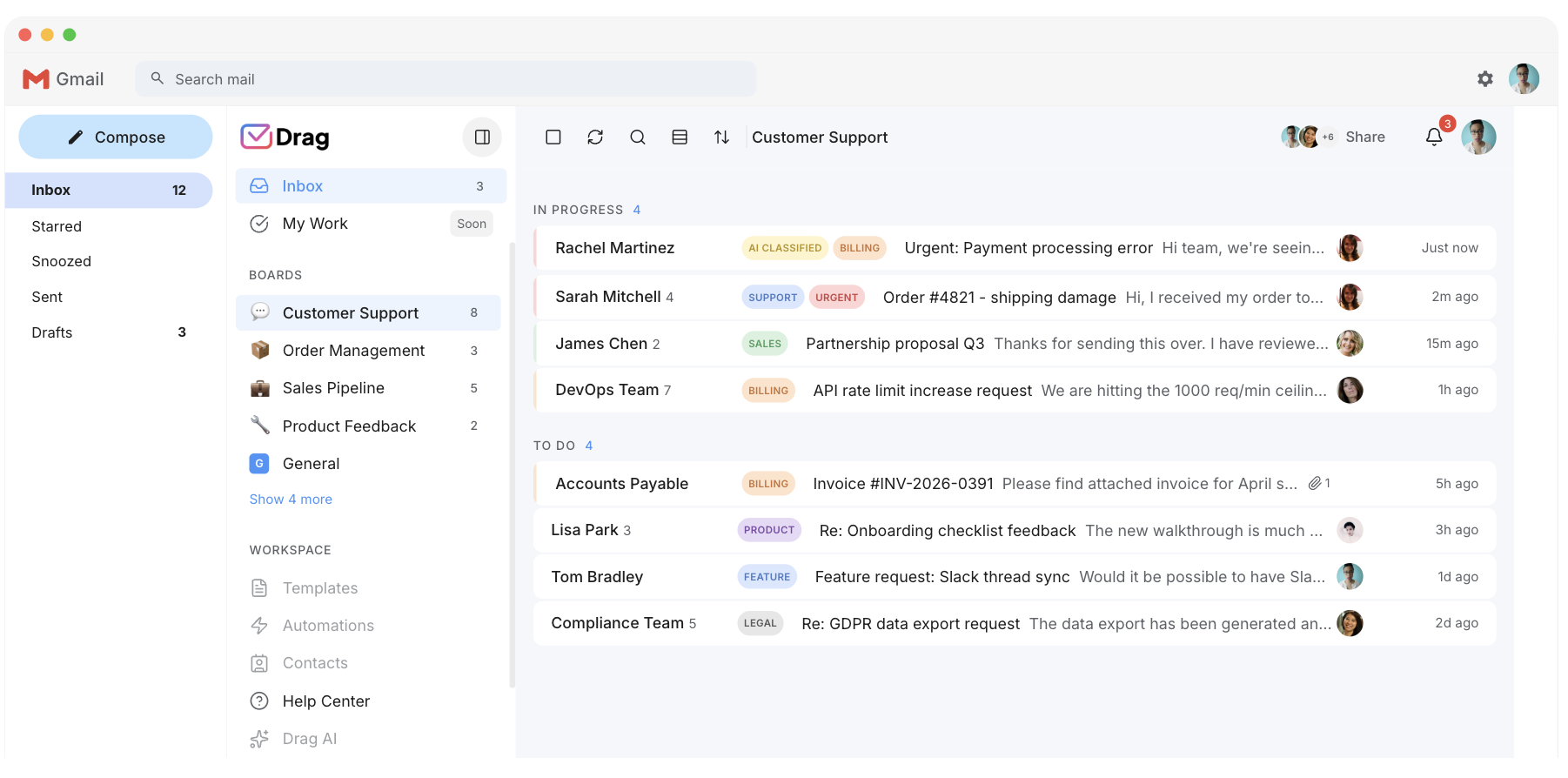
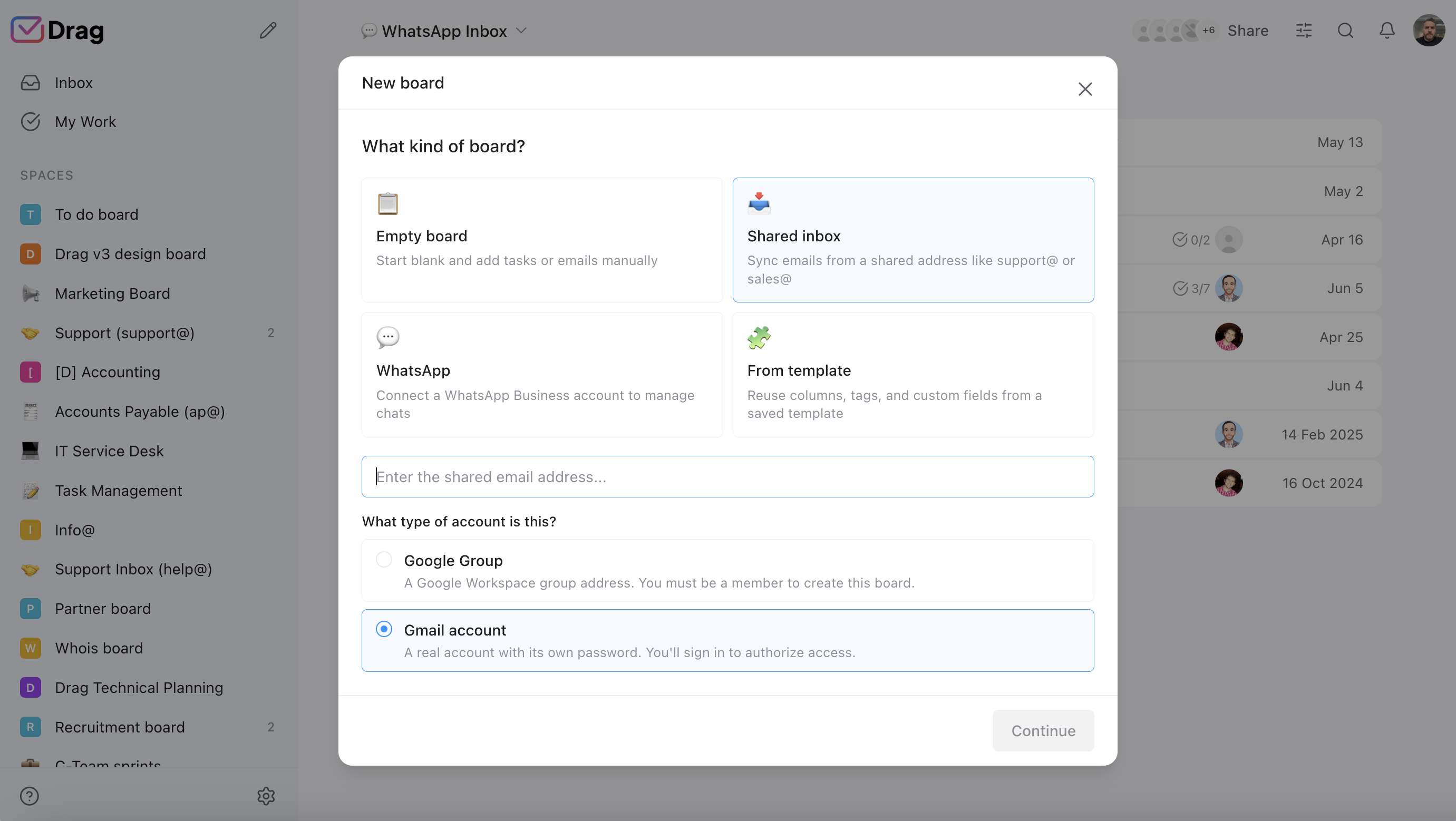
TeamInbox works with any mail provider, and that flexibility has a mechanism: your mail is forwarded or fetched into Zoho, and Zoho’s servers become the copy your team actually works. Leaving means leaving the workspace. Drag inverts the architecture: Gmail stays the system of record, Drag is the layer on top, in Gmail or in Drag’s own web, desktop, and mobile apps, and the day you leave, your mail is exactly where it always was.
Pricing
What $18 buys that $6 does not.
The honest ledger, since they are cheaper on seats: the $6 Starter carries a 25-rule cap, 3 incoming channels, and no analytics; the $9 Professional lifts those. Drag’s $18 carries Varley, Drag’s AI (grounded drafts, automatic tagging, summaries, answers from your docs, Copilot), unlimited rules and boards, analytics included, and chat and WhatsApp in the queue; Pro adds the MCP server. If the AI does one draft a day per person, the $9 difference is the cheapest hire you will make.
- Drag $18: Varley, unlimited rules and boards, analytics, chat and WhatsApp; Pro adds the MCP server.
- Zoho TeamInbox: $6 Starter caps 25 rules, 3 incoming channels, no analytics; $9 Professional lifts those.
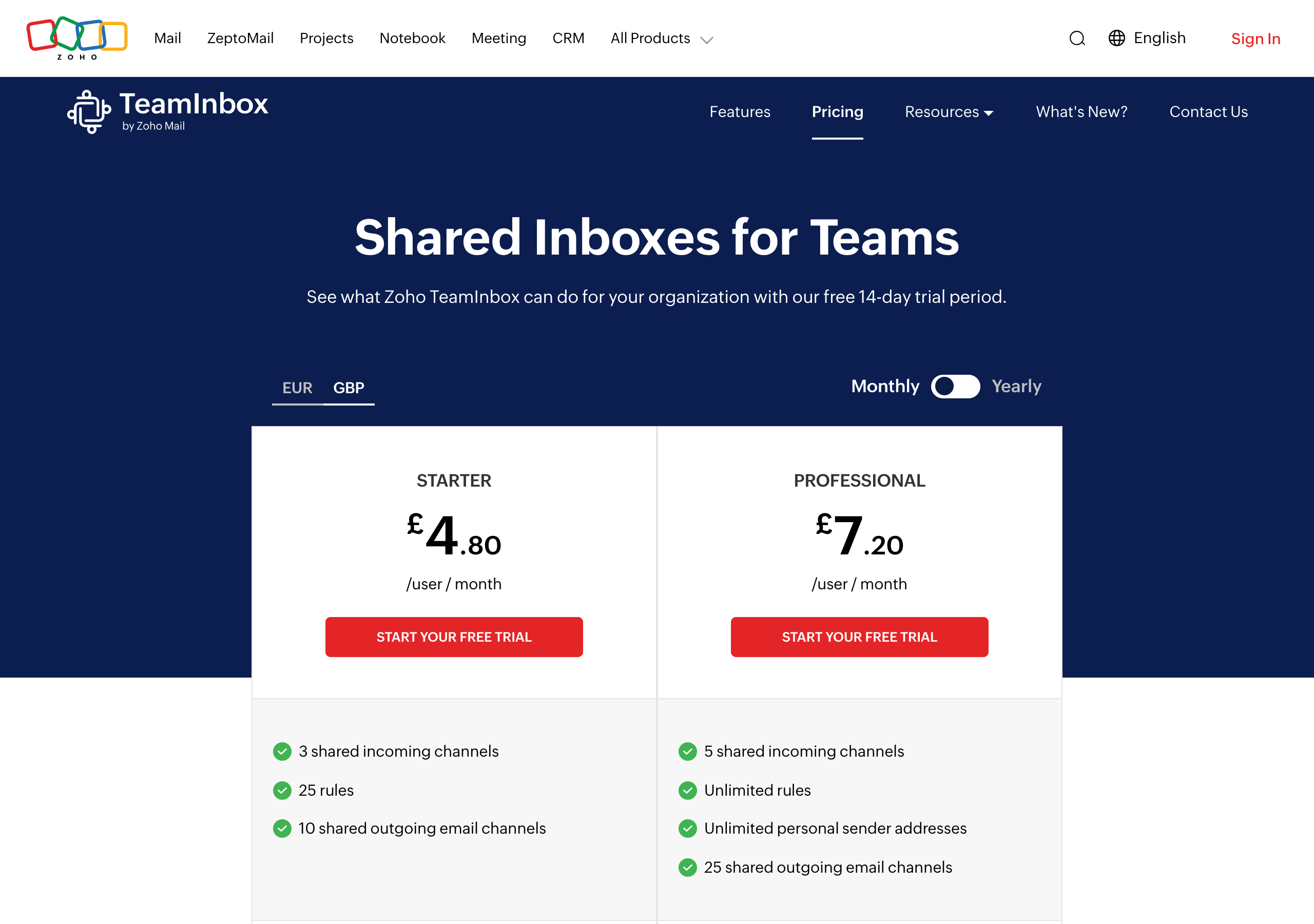
Source: Drag and Zoho TeamInbox pricing pages, July 2026.
Varley · Drag’s AI
One AI, four ways it works.
Varley, Drag’s AI, knows your help center, docs and past conversations. It drafts and tags every email, answers your team in Copilot, acts in Stripe, Slack and HubSpot when you approve, and on Pro resolves conversations on its own. Monthly AI credits come with every Plus and Pro seat, with no per-seat AI add-on.
Zoho TeamInbox offers Zia, a writing assistant, but no grounded AI suite of this kind in the seat.
- CopilotAsk Varley, then let it act
- AgentsVarley resolves conversations on its own
- IntelligenceWhat Varley knows, and the tools it acts in
- AssistsVarley in every email: drafts, tags, summaries
Included in Plus. Pro gets 2x the usage. Power users top up any time.
Varley resolves the routine ones on its own.
On Pro, Varley’s Agent reads the email, checks your policy, acts in tools like Stripe, replies in your team’s voice and closes the conversation. Anything it isn’t sure of goes to your team, with everything it found. Included in Pro.
Zoho TeamInbox has Zia for writing suggestions, but no autonomous resolution agent of this kind.

I was charged twice this month
Daniel Okonkwo · Customer
- 9:38:13
Read Daniel’s email
Billing · Urgent
- 9:38:15
Checked your refund policy
Duplicate charges: refund in full
- 9:38:18
Found both charges in Stripe
$49 on 12 April, twice
- 9:38:22
Refunded the duplicate
$49 back to Daniel’s card
- 9:38:30
Replied to Daniel
Policy cited, in your team’s voice
- 9:38:35
Closed the conversation
Logged, with its sources
Connect Claude to your inbox in about two minutes.
Paste one URL into Claude’s settings, enter your API key once, and your inbox becomes 47 tools with full read and write, WhatsApp included, on the Pro plan. ChatGPT, Gemini, Copilot and Cursor connect the same way. Then just ask:

Summarise unread Support threads and assign billing to Sarah.

Label everything mentioning refunds and move it to In Progress.

What was our first-reply time this week vs last?
Zoho’s platform-wide MCP does not cover TeamInbox, which has no MCP server of its own.
Explore the MCP serverMCP server
@dragapp/mcp-server
47
tools · 12 categories · read + write
https://app.dragapp.com/mcp
paste into Claude › Settings › Connectors

 + any MCP client
Workflow
Boards, not just a shared list.
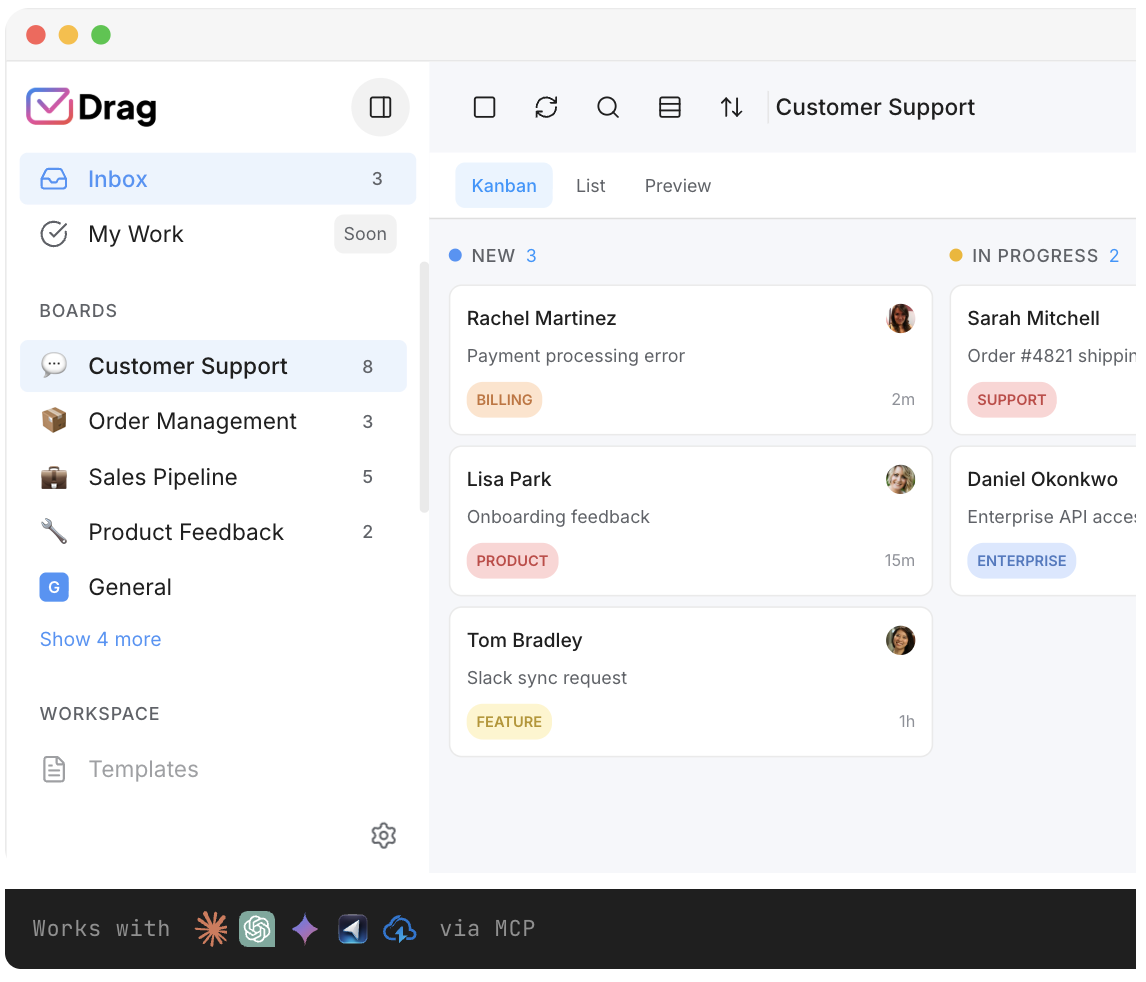
The kanban layer: columns for your actual stages, drag-and-drop triage, collision detection, and the reporting that runs the Friday meeting, included on every plan rather than tier-gated.
MCP
The queue your AI tools can drive.
Drag’s MCP server exposes 47 tools, read and write, for Claude, ChatGPT, Gemini, Copilot, or Cursor. TeamInbox has no equivalent.
Pricing: Drag vs Zoho TeamInbox
TeamInbox is cheaper on seats; the honest question is what the difference buys. Put your team size in to compare its Professional tier against Drag’s AI plan. Drag has no seat minimum.
AI features
 Drag Plus (AI included)
$2,160/yr
$18/user/mo × 10 seats · AI included
 Zoho TeamInbox Professional
from $1,080/yr+
$9/user/mo × 10 seats · Zoho TeamInbox has no Drag-class AI (Zia is a writing assistant). Professional ($9) adds analytics and unlimited rules; channels are ~$4 add-ons; there is no free plan.
Estimate based on monthly per-seat pricing, July 2026 (annual billing is cheaper, about $5/$7.50). Zoho TeamInbox shown at Starter $6 and Professional $9; no free plan, 14-day trial. Confirm current pricing on each vendor's site.
The honest comparison prices TeamInbox’s Professional tier ($9, where analytics and unlimited rules live) against Drag’s AI plan ($18): the $9 gap is what Varley, the boards and the channels cost, and Starter’s $6 is real if its caps fit you. We say all of that plainly because their comparison page does not return the favour. Full market context in the pricing report.
Drag vs Zoho TeamInbox, feature by feature
The detail layer for evaluators: honest on both sides, with the architectural split named plainly.
Shared inbox
Both do the core job: assignment, internal discussions, shared drafts, tags, templates. The split is architectural (where the mail lives) and depth (what wraps the inbox). Check both on craft; check Drag on architecture.
AI
Drag: Varley included at $18, across email and chat alike. TeamInbox: Zia, a writing assistant (real-time suggestions, error-spotting), but no grounded, in-the-seat assists. Check Drag.
Automation
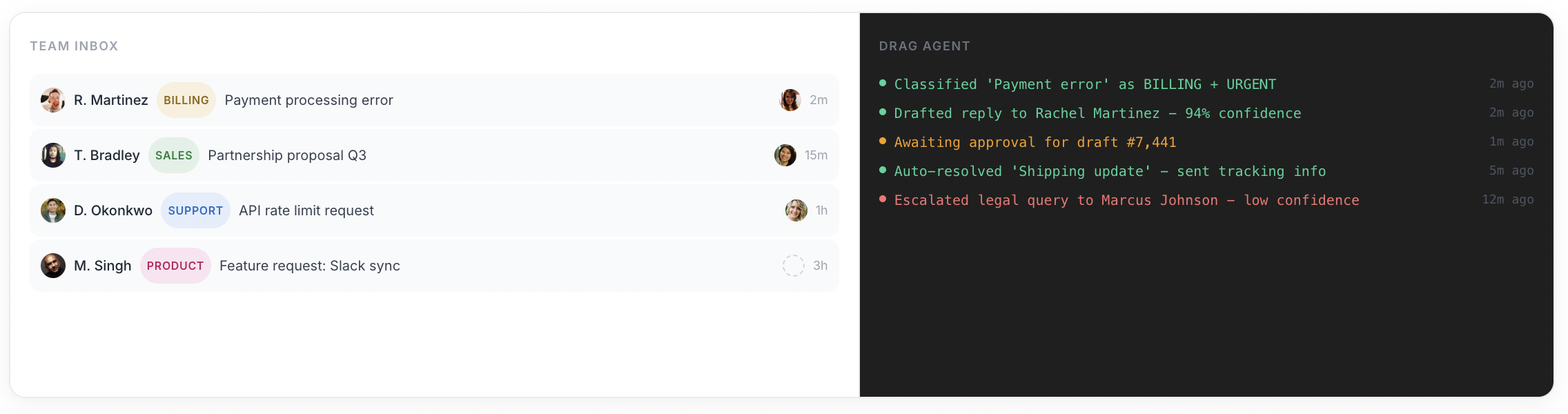
TeamInbox’s rules are real, capped at 25 on Starter; Drag’s rules are unlimited on every plan, and the boards they move threads across are the workflow. Check Drag, with the cap named.
Channels
Drag: email + live chat + WhatsApp in one queue. TeamInbox: email-centred, channels as ~$4 add-ons, 3-to-5 incoming caps by tier. Check Drag.
Providers
TeamInbox: any provider via forwarding or IMAP/POP: its genuine edge for mixed-mailbox teams, stated plainly. Drag: Google Workspace, deliberately. Honest check TeamInbox for non-Gmail teams.
Analytics
Drag: included. TeamInbox: Professional only. Check Drag.
Ecosystem
Zoho’s suite (CRM, Desk, Books) is a real gravity well: if your company runs on it, TeamInbox slots in natively. Drag’s ecosystem is Google’s plus the MCP client universe. Split check, honestly by which world you live in.
If you switch: what you keep, what changes
The honest question a TeamInbox team asks is not “is Drag cheaper” (it is), it is “what happens to the way we work today?” Here is the straight answer.
You keep
Your email in full and in place (if your mail is on Gmail, it never went anywhere: connecting Drag is an install, not a migration), your templates and help content (they ground the AI), your team’s shared-inbox habits (the concepts map one-to-one).
What changes
The working copy of your mail stops being a second system; the caps conversation (rules, channels, analytics tiers) ends; and the AI starts existing. The honest note: TeamInbox conversation history exports as records for reference; if your underlying mailboxes were Gmail all along, the threads themselves are already in Gmail and need nothing.
Where Zoho TeamInbox fits better
Three real cases, in plain text, which is one more than their page gives us.
- Mixed or non-Google mailboxes: Outlook, custom IMAP, a mix across the company: TeamInbox ingests them all; Drag is deliberately Gmail-native, and we route you to them or Missive plainly.
- The $6 constraint: if the budget is genuinely $6 a head and Starter's caps (3 channels, 25 rules, no analytics) fit your shape, it is honest value.
- The Zoho house: if CRM, Desk, and Books already run your company, the suite coherence is worth real money, and a Gmail-native tool would be the odd one out.
For most Google Workspace teams whose priority is the shared inbox built on the Gmail they already run, with AI included and nothing to migrate, Drag is the closer fit.
Switching from Zoho TeamInbox to Drag is quick
No migration project: Drag installs into the Google Workspace your support address already flows through. Connect inboxes, chat, and WhatsApp; set boards; load templates and help content; invite the team. Working the same afternoon; the 7-day trial, no card, answers fit directly.
What customers say
“What we like the most about Drag is the ability to see at a glance where a client is during their Onboarding process, through the use of columns, tasks, and tags. It has been crucial for us because Waste Logics is a growing business and this transparency allows us to work faster and smarter.”
“There really is no comparison when it comes to Drag. We have a great relationship with their team, it’s incredibly easy to use, addresses all of our needs, and the price is right!”
“Drag provided a lot of transparency and unified our team. It allowed us to bring the entire team together to manage emails and tasks collaboratively, as opposed to working in silos, across different tools.”
Frequently asked questions
Is Drag a good Zoho TeamInbox alternative?
For teams on Google Workspace, yes, deliberately: the same shared-inbox job with boards, analytics, and Varley, Drag’s AI, included from $18, built on Gmail as the system of record so nothing migrates in.
What is the main difference between Drag and Zoho TeamInbox?
Where your mail lives. TeamInbox ingests mail into Zoho's servers, which become the working record; Drag reads the Gmail you already have. Everything else (the AI, the boards, the channels, the caps) follows from that split.
How much does Zoho TeamInbox cost?
Starter $6 per user per month, Professional $9, both billed monthly (annual billing is cheaper, at about $5 and $7.50), with a 14-day trial (full features, up to 5 users, no card). There is no free plan. Channel add-ons run about $4. Verified against Zoho's pricing page at publication.
Is Drag more expensive than Zoho TeamInbox?
On seats, yes, and we say it first: $12 to $18 against $6 to $9. The $18 includes Varley, Drag’s AI, unlimited rules, boards, analytics, chat and WhatsApp, and Pro adds the MCP server: the gap is the platform. If the caps and the lighter AI fit you, TeamInbox's price is honest value.
Does Zoho TeamInbox have a free plan?
No: a 14-day trial, then paid. (Mobile-only plans from $0.99 exist as a separate, app-only product with conversation caps.) We note this because it is commonly misstated, including, until recently, on our own blog.
Does Zoho TeamInbox have AI?
It has Zia, Zoho's writing assistant, which offers real-time writing suggestions and error-spotting inside discussions and replies; it is a writing aid, not a grounded support-AI suite. Drag includes Varley, its AI, from $18: grounded drafts, automatic tagging, summaries, answers from everything your team knows and actions in your tools, with monthly AI credits in the seat.
Do I need Zoho Mail to use TeamInbox?
No, and their marketing is right about that: it ingests any provider via forwarding or IMAP/POP. The nuance their page skips: the ingested copy on Zoho's servers becomes the record your team works, which is the migration this page is about.
Can my AI tools manage the queue?
With Drag, yes: the MCP server exposes 47 tools, read and write, for Claude, ChatGPT, Gemini, Copilot, or Cursor. TeamInbox has no MCP server.
Does Drag have a free plan?
A 7-day trial, no card; plans $12, $18 (AI included from here), $24 per user annually.
What are Zoho TeamInbox's limits on the cheap plan?
Starter ($6): 3 shared incoming channels, 25 automation rules, no analytics. Professional ($9) lifts to 5 channels, unlimited rules, and adds analytics. Real caps, honestly disclosed on their pricing page.
Is Zoho's comparison of Drag accurate?
Parts of it are out of date. Drag is multichannel (live chat and WhatsApp in the same queue as email), has analytics, activity logs, roles, shared tags, and templates, and each person can send from more than one address. The parts that are true, Gmail-native and no IMAP ingestion, are our architecture, not our gaps: ingestion is the thing we exist to make unnecessary.
What about Zoho Desk?
A different Zoho product: a full help desk, not a shared inbox. If enterprise ticketing is the actual need, our help-desk comparisons cover that field; this page is about TeamInbox.
Does Drag work with Outlook or mixed mailboxes?
No: Drag is built on Google Workspace, and mixed-provider teams should genuinely consider TeamInbox or Missive; we say that plainly, which is the sentence their comparison page never wrote about us.
Can I bring my TeamInbox history?
Conversation history exports as records. If your mailboxes were Gmail underneath, the mail itself is already in Gmail and needs no migration at all.
How does setup compare?
TeamInbox: create the workspace, wire forwarding or IMAP per channel. Drag: install into the Workspace you already run; working the same afternoon. Both are light; only one involves the word forwarding.
How do I try the comparison?
Run Drag's 7-day trial against a real week on your actual queue: connect the inboxes, load your content, watch the assists work, and compare what $18 does against what $6 caps.


