













The best Loop Email alternatives for 2026, with the comparison Loop's own page makes hard: real prices, the 3-and-10-seat minimums that decide most switches, and the option that runs on the Gmail your team already uses.
Key takeaways
- Loop's job splits into two lanes, shared inbox and team chat, and most alternatives are stronger in one than both, so name which half you are replacing first.
- Every price here comes from the vendor's own pricing page, dated, with removed tools named in the verification section.
- For teams on Gmail, the structural question is whether to move email into a new client or add the team layer to the Gmail you have, and that decides most Loop comparisons faster than feature tables.
Table of contents
Loop Email pitches shared inboxes and team chat around email, and if you are searching for alternatives you have likely hit its limits or its pricing. This guide covers the honest options, with every price read from the vendor's own page in July 2026 and each tool's actual lane stated, because "Loop alternative" means different things depending on whether you wanted the shared inbox, the chat, or both.
What can a resource like Loop Email do for your company?
Loop Email is essentially a shared inbox software, developed to make your email-driven collaborative tasks easier. By accessing a team inbox along with your teammates you all get the same overview of the workload. This simplifies collaboration, making it faster and more effective.
Loop Email is alive and actively maintained at intheloop.io. Its published plans are Starter at €15 to €18.75 per user per month depending on billing term, Pro at €30 to €37.50, and Enterprise quoted custom, with a 14-day trial, no card required, and no free plan. The figure that decides most switching questions is not the rate but the seat minimums: Starter requires at least 3 users, Pro at least 10, and Enterprise at least 30, as of July 2026. A three-person team is buying three seats whether or not it needs them.
Shared inbox: what, why and where
A shared inbox is a setup that helps your organization reply to emails fast and keep a high volume of incoming messages organized. Its main features are shared labels for categorization and the transparent assignment of emails to owners. It is an invaluable tool for any team with an email-driven workflow, like customer support teams. When you are troubleshooting, you need to act quickly and efficiently, right? With a shared inbox a teammate can pick a reply on an email thread and act on it. This way your client's ticket doesn't go unattended for too long.
Why are companies switching from Loop Email?
The honest answer in 2026 is structural, not a feature checklist. The seat minimums lead: Loop's Starter plan requires three users and Pro requires ten, so small teams buy seats they do not need, and a two-person team cannot buy Loop at its advertised entry price at all. The client switch is the second reason: Loop replaces your email app, which means migrating every teammate into new software and keeping them there, a real cost that alternatives running on your existing Gmail avoid entirely. And the platform picture, while better than it was, is uneven: Loop now ships an Android app in beta, which retires the old complaint that it was iOS-and-desktop only, with the honest note that the Android build is newer than the rest of the product, so Android-heavy teams should trial it specifically.
None of that makes Loop a bad product. It makes Loop a specific bet, a dedicated client with team features, priced for teams of three and up, and the alternatives below are for everyone the bet does not fit.
Loop Email's client takes time for teams to adapt to
Quite simply, the amount of tools employees need to stay on top of is already too many. So much in fact that people nowadays are worried about the impact of context switching. Learning to navigate a completely new platform takes time away from other tasks.
4 best Loop Email competitors
Luckily, there are other tools that offer more adequate solutions to modern-day communication and task management within organizations. Shared inboxes, calendar integration, delegation, automation and much more that you could take advantage of.
 Drag
Drag






Best for: teams on Gmail who wanted Loop's shared inbox without moving email into a new app.
Full disclosure: Drag is our product. Where Loop is a separate client you move the team into, Drag adds the shared inbox to the Gmail your team already uses, or runs standalone: shared addresses become boards, every email a card with an owner, notes, and due dates, AI included from the middle plan, an MCP server on the Pro plan. Nothing migrates, and leaving is as clean as arriving.
- Pricing: $12, $18 (AI included), $24 per user per month billed annually. 7-day trial, no card, no free plan.
- Rating: 4.7 from over 1,200 reviews.
- Watch-outs: Gmail-centered by design; teams committed to Outlook-plus-chat-in-one-app are Loop's actual audience and should compare the cross-platform entries here instead.
Want to try it on your own inbox? Start a 7-day trial of Drag, no card required.
 Missive
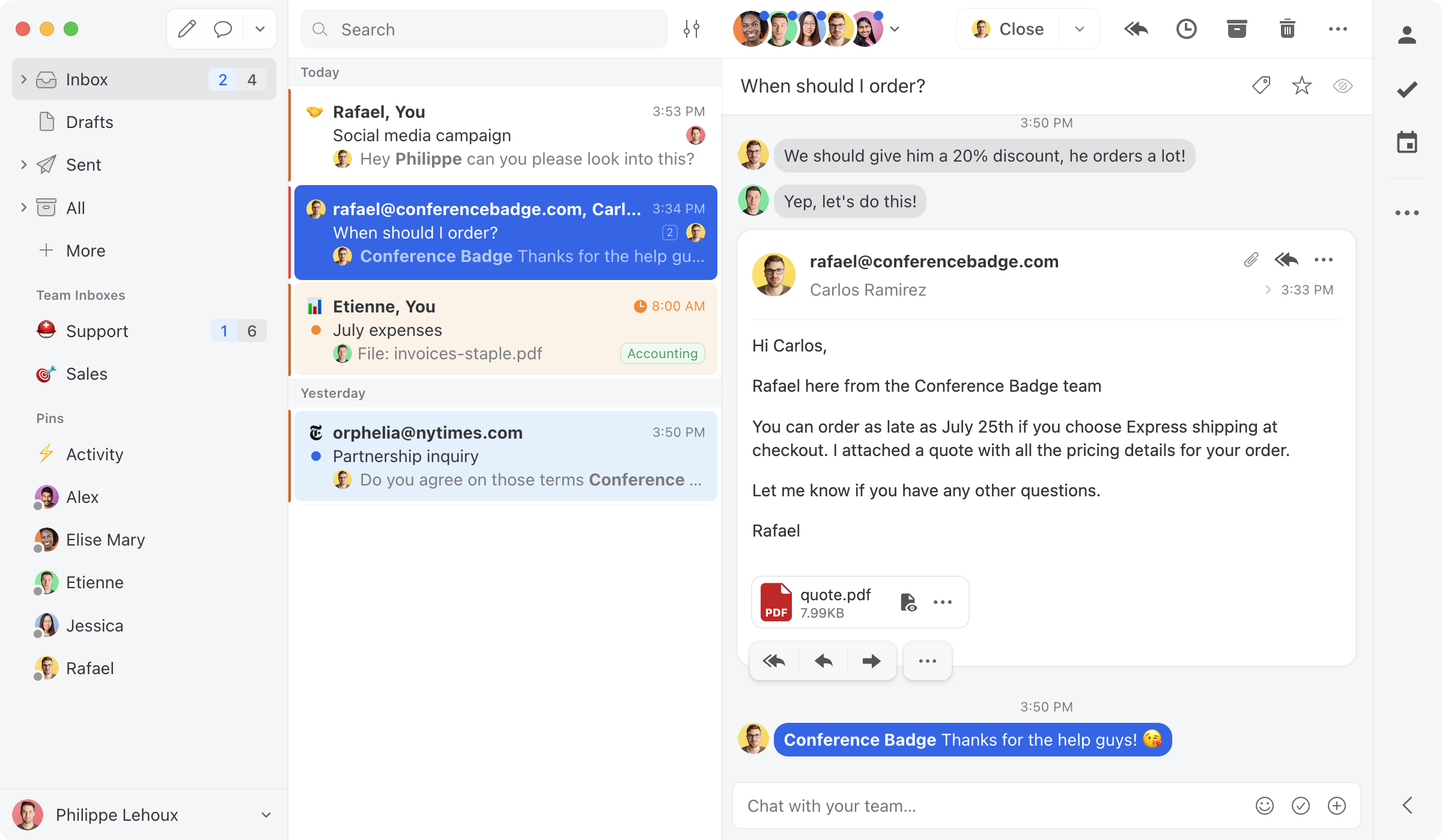
Best for: teams that want real collaboration on email and support more than one provider.
Missive is a collaborative inbox with in-thread team chat, shared drafts, and multi-assignee workflows across Gmail, Outlook, iCloud, and IMAP. A good pick for teams that find a help-desk ticket model heavier than they need.
- Pricing: Starter $14, Productive $24 and Business $36 per user per month billed yearly, as of July 2026.
- Watch-outs: Collaboration-first; lighter on knowledge base and formal help-desk reporting than Help Scout.
 Zendesk
Best for: teams whose support volume has outgrown an inbox entirely.
A well-known customer support platform that can be a Loop Email alternative, Zendesk is built around tickets, automation and reporting rather than around a shared mailbox. It is the heaviest tool on this list, which is the point when volume is the problem and the drawback when it is not.
- Pricing: about $19 per agent per month for the entry Support tier, which is the stripped ticketing plan rather than the Suite most teams end up comparing. Served in GBP from the UK at £15 per agent per month billed yearly, with Suite Team £45 and Suite Professional £89, as of July 2026.
- Watch-outs: the entry price is not the Suite, so the plan a Loop team actually wants sits several tiers above the headline figure.
 Help Scout
Best for: small support teams that want a help desk that still reads like email.
Help Scout is a help desk built around shared inboxes, saved replies and a knowledge base, without the ticket-number feel of a full service platform. It sits between a shared inbox and a ticketing system.
- Pricing: free for up to 5 users on 1 inbox; Standard $25 per user per month with 2 inboxes and additional inboxes at $10 a month; Plus $45; Pro $75. AI Answers is metered separately at $0.75 per resolution, as of July 2026.
- Watch-outs: inbox count is the real constraint rather than seats, and AI usage is billed on top of the seat price.
Drag · with Varley
The inbox your team and Varley work in together
Shared inbox and live chat for Gmail teams, with Varley, Drag’s AI, included from $18. Plus an MCP server your own AI tools can drive.
How this guide is verified
Every price on this page was read from the vendor's own pricing page in July 2026 and is dated, including Loop Email's own, because an alternatives page that never states the incumbent's cost is missing the comparison a reader came for. Tools removed from earlier versions are named here with the reason: SEDNA is alive but has repositioned as a data-driven communication platform for maritime, commodities, logistics and supply chain, so it is an industry-vertical enterprise product rather than a general shared-inbox alternative, and presenting it as one misled. Missive joins in its place as the closest analogue to what Loop actually does. Corrections are recorded rather than silently overwritten.
Two corrections from this update are worth stating plainly. This page listed Help Scout at "$15 per user/month" with "up to three mailboxes"; the vendor's own page shows Standard at $25 per user per month with 2 inboxes, so the price was understated by two thirds and the inbox count was wrong, and there is also a free plan for up to 5 users that we did not disclose. And Zendesk's entry figure was published without naming its tier, which made a stripped ticketing plan read like the Suite most teams compare. Both are fixed above.
Loop Email alternative FAQs
Is Loop Email still available?
Yes. Loop Email is alive and actively maintained at intheloop.io, with a current app, help center and status page. Its plans run from €15 to €18.75 per user per month on Starter up to €30 to €37.50 on Pro, with a 14-day trial and no free plan, and its seat minimums are 3 users on Starter, 10 on Pro and 30 on Enterprise as of July 2026.
What is the best Loop Email alternative for Gmail teams?
Full disclosure, this is our product: if your team already runs on Gmail, Drag adds the shared inbox and boards to the Gmail you have rather than moving everyone into a separate client, from $12 per user per month. If your team is on Outlook or spread across providers, Missive is the closer match to Loop's inbox-plus-chat shape.
Does Loop Email work on Android?
Yes, as of 2026, in beta: Loop ships an Android app on Google Play with its own install page and help section, retiring the old iOS-only complaint. The practical note is maturity, since the Android build is the newest part of the product, so Android-first teams should test it during the trial specifically.
How much does Loop Email cost?
Starter runs €15 to €18.75 per user per month depending on billing term with a 3-user minimum, Pro €30 to €37.50 with a 10-user minimum, and Enterprise is quoted custom at 30 seats and up, as of July 2026, with a 14-day trial and no free plan. The minimums matter more than the rates for small teams: three seats is the smallest purchase Loop sells.
Conclusion
For teams on Gmail, Drag is the alternative that skips the migration entirely, and the roster above covers the honest options for everyone else. If you want to know more, read a client success story.

Co-founder
Co-founder at Drag, writing about Google Workspace, shared inboxes, and how teams actually run email.
